Archive for May 2025
“In the last analysis, a pickle is a cucumber with experience”*…

The pickle is Gen Z’s avocado; it’s a passion and a personality. But maybe, Jaya Saxena suggests, that’s missing the point…
In the Top Chef episode “Pickle Me This,” which aired on April 17, host Kristen Kish, in power clashing greens, announces that two teams of chefs must go head to head in creating an all-pickle dinner. The five-course meal was to feature different kinds of pickles in every course — not kimchi or achar necessarily, but instead the cornichons and dill of the European influence. There were charred pickles with cured mackerel, cucumber and celeriac pickle gelee, chef Massimo Piedimonte’s winning fried pickle cannolo, and of course a bread and butter pickle curd with dill ice cream. Individually, each dish sounded great, and judge Tom Colicchio said two of the dishes, including the dessert, were some of the best he’s ever had on the show.
Top Chef contestants often have to create meals utilizing an ingredient that’s in the culinary zeitgeist. Some of those meals are more successful than others. But a successful five-course meal of all things pickles illustrates the strange place in culture the pickle holds now: both cheffy and with diverse-enough flavor profiles to inspire chefs in fierce competition, but obvious and basic enough to also be a little bit of a joke. It’s the food of the moment, both sincerely and ironically.
As Rebecca Jennings wrote in Vox, pickles are Gen Z’s avocado, a viral food that people genuinely enjoy: They “pair well with other contemporary food trends like dirty martinis and canned cocktails, and fit right in with aesthetically pleasing butter boards and “girl dinner” spreads.” But people are also consuming pickles for the meme of it all. There are pickle chips, pickle popcorn, Flamin’ Hot pickle Cheetos, and pickle seltzer. Popeyes recently introduced an entire pickle menu, including pickle lemonade. 21Seeds wants you to make a spicy pickle martini with its tequila, and people are putting pickles in their soda. Sweetgreen has pickle ketchup, and of course Molly Baz has dill pickle mayo. And like any “it” food nowadays, the pickle has moved into fashion and home decor.
Like with any trend, though, it’s kind of exhausting when it’s everywhere. Pickles have become subject to the flavor-ification of actual foods; half the time, pickle-flavored anything is an unsatisfying approximation of the flavor of Central European-style pickled cucumbers — typically a combination of salt, vinegar, and artificial dill which evokes none of the live-culture fizz that hums through the real thing. It’s that complexity we crave, herbs and lactic acid and often spices like coriander.
But for the pickle to be the centerpiece of an entire five-course meal, or for it to be one’s personality to the point that it flavors every snack in one’s house, slightly misses the point of the pickle. A Popeyes meal of fried pickles and pickle glazed wings washed down with a pickle lemonade serves no refreshing alternative to the onslaught of puckering pickle potency. A filthy martini and a bowl of pickle popcorn offers no relief. What makes pickles great on a sandwich or a charcuterie board is usually that the pungent brine and preserving salt make for a great contrast to any creamy, sweet or rich ingredients. Pickles are salt and acid bombs that are delicious on their own, but also enhance every other flavor. It’s why olives are often served with bread and cheese plates have all that cheese. The back and forth is what makes pickles truly shine.
Obviously no one is forcing anyone to only consume pickles, and if that is indeed what your taste buds crave, then congrats on being the moment! But put pickles everywhere and they cease to be a treat, the shining zinging bite to zap you into whatever else you’re eating. Maybe they should stay a sometimes food…
The flavor of the moment: “Is There Too Much Pickle?” from @jayasaxena.com in @eater.bsky.social.
Possibly apposite?: “Will Gen Z’s Pivot to the Republican Party Last?– It’s not only young men who lean conservative. The youngest female voters are also abandoning the Democratic Party.” (gift article)
###
As we test our tastebuds, we might recall that it was on this date in 2009 that 12 year old Catherine Ralston ( a member of Gen Z) was named Easy-Bake “Baker of the Year” for her “Queen of Hearts Strawberry Tart.” The Easy-Bake Oven is, of course, a working toy oven that Kenner introduced in 1963 (more than 16 million Easy-Bake Ovens (in 11 models) had been sold by 1997), and which Hasbro still manufactures.

“Firmness, utility, and beauty”*…
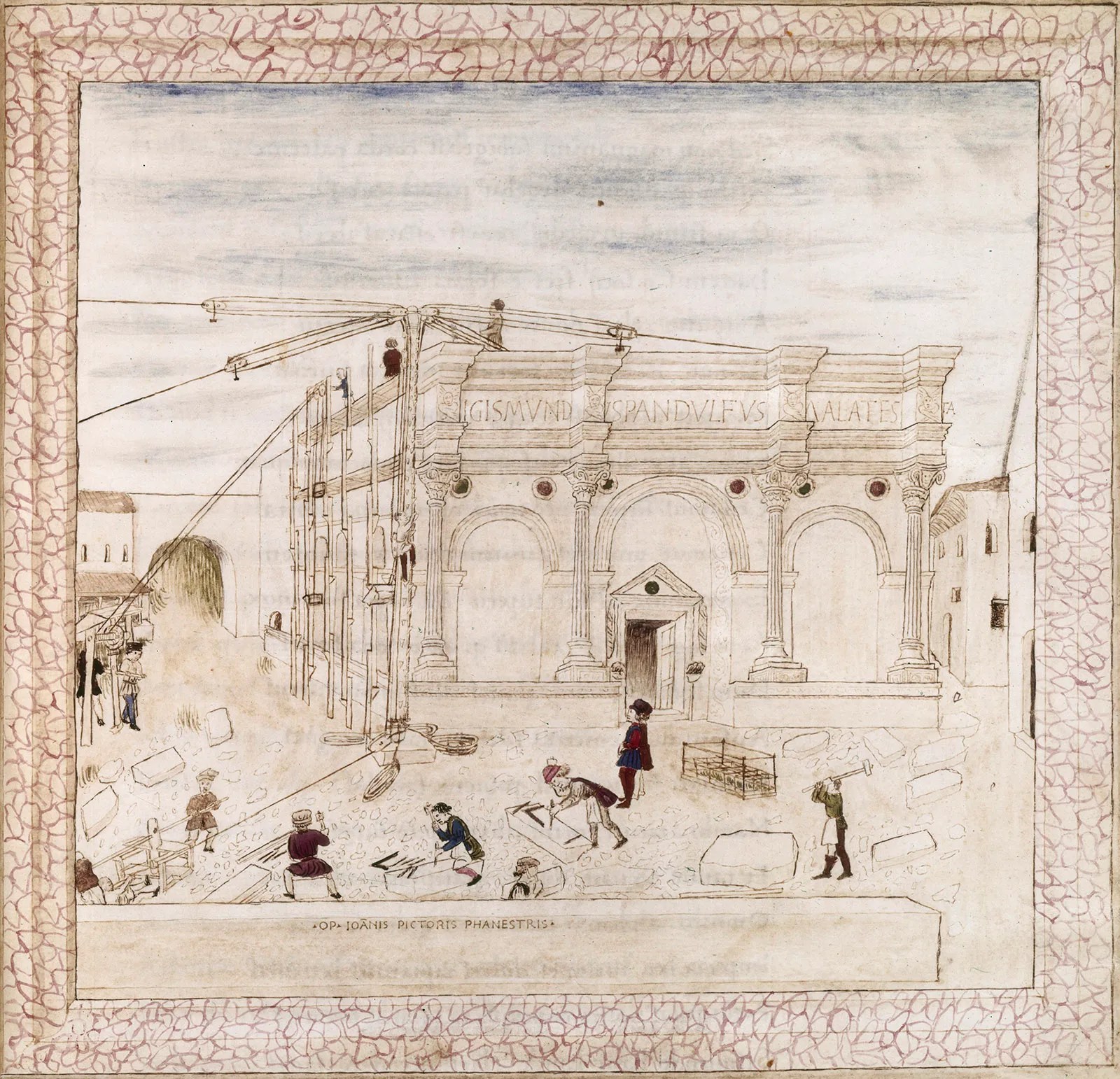
In a review of Indra Kagis McEwen‘s book All the King’s Horses- Vitruvius in an Age of Princes, Ingrid Rowland examines the ways in which Vitruvius’s Ten Books on Architecture [AKA De Architectura] was not only a manual of the building arts but a treatise on how to extend and consolidate the Roman Empire, and lent itself all too well to the autocratic ambitions of Renaissance princes…
As perennial best sellers go, the treatise known as Ten Books on Architecture by the Roman writer Vitruvius is not, perhaps, the most predictable. It includes some gripping stories, certainly, many of them military, like the the Carian queen Artemisia’s surprise naval attack on Rhodes aboard the Rhodians’ own ships or the thwarted siege of the same city by the Macedonian general Demetrius Poliorcetes, the proverbial “Sacker of Cities,” whose gigantic war machine, the “City-seizer” (Helepolis), churns to an ignominious halt in a pool of muck created overnight by the mass emptying of Rhodian chamber pots.
These vignettes, however, are little gems inserted to brighten long passages about what kind of wood to use for different parts of a building, the proportions of temples, and the marvels of waterproof concrete, as well as instructions on how to build, among many other wonders and amenities, sundials, aqueducts, water clocks, and catapults. Its storehouse of practical information helped to ensure that Vitruvius’s handbook, written around 25 BCE, was one of the few ancient Greek and Latin works to survive what the fifteenth-century pundit Leon Battista Alberti called the “shipwreck” of the Middle Ages, along with the poetry of Vergil and Ovid, the prose of Cicero, a Latin translation of Plato’s Timaeus, the Bible, and some other surprisingly durable texts. Ever since the papal printer Eucharius Silber brought out his edition in Rome in 1486, Ten Books on Architecture has never gone out of print.
One of the chief reasons for the enduring interest in On Architecture, aside from its treasury of practical instructions, is the ambitious educational program that Vitruvius puts forth in the first of his ten books (each of which originated as a single papyrus scroll, closer to the length of a modern chapter than an entire book, just as his chapters are approximately the size of a paragraph). Architects, he argues, can only complete their work properly (in his words, “perfect” it) if they are well informed about every one of the subjects that the art of building brings into play—if not as well informed as a specialist, then at least well enough to make the right decisions. A competent practitioner, therefore, must not only master drawing but also have a good grasp of literature, music, mathematics, and law…
… It seems likely that the connection between education, architecture, and empire inspired the creation of the earliest known manuscript of Vitruvius, copied on parchment in the ninth century, perhaps for Charlemagne, perhaps by the hand of his learned adviser Alcuin of York, almost certainly as part of the Frankish king’s project of resurrecting the glories of ancient Rome in a Christian spirit. It is through this same clever wedge, education, that Vitruvius has driven himself and his treatise into the very heart of the way the contemporary world still thinks about any number of things, from human scale to beauty to liberal education to the best methods of town planning. Whether you have read Vitruvius or not, his influence is still palpable in the fabric of modern urban life, and that is why he has been translated as recently as 2017 into Chinese…
… In All the King’s Horses: Vitruvius in an Age of Princes, Indra Kagis McEwen, a Canadian architect and historian, brings out a more chilling aspect of Vitruvius and his millennial tradition: his fatal attractiveness to despots. The “princes” of her title are the princes of whom Machiavelli wrote: strongmen who seized and maintained one-man rule over medieval and early modern Italian city-states by force of arms and charisma. Augustus served these princes as an inspiring model because his trajectory so closely resembled their own—except, of course, for its colossal scale. Like the Italian lords who revered him, the future Imperator rose to his august heights by doing whatever would ensure his own survival, eventually completing a process that Machiavelli attributes to Augustus’s adoptive father, Julius Caesar: supplanting the ancient Roman Republic with one-man rule…
Fascinating… and too timely: “Vitruvius & the Warlords” from @nybooks.com.
* “Firmitas, utilitas, venustas”– the three principles of good architecture, as described by Vitruvius in De Architectura
###
As we analyze the architecture of authoritarianism, we might recall that it was on thsi date in 1527, during the War of the League of Cognac (a dispute between the Holy Roman Empire and the Papacy), that Rome was captured and sacked by the mutinous troops of Charles V, Holy Roman Emperor. Charles V had intended only to threaten military action to make Pope Clement VII come to his terms. But most of Charles’ Imperial army (14,000 Germans, including Lutherans, 6,000 Spaniards, and some Italians) were unpaid, and took matters into their own hands. Despite being ordered not to storm Rome, they broke into the scarcely defended city and began looting, killing, and holding citizens for ransom. Clement VII took refuge in Castel Sant’Angelo after the Swiss Guard were annihilated in a delaying rear guard action; he remained there until a ransom was paid to the pillagers. Benvenuto Cellini witnessed the Sack and described the it in his works.
The Sack of Rome impacted the histories of Europe, Italy, and Christianity, creating lasting ripple effects throughout European culture and politics. Before the sack, Rome had been a center of Italian High Renaissance culture and patronage, and the main destination for any European artist eager for fame and wealth, thanks to the prestigious commissions of the papal court. In the sack, Rome suffered depopulation and economic collapse, sending artists and writers elsewhere.
The Sack of Rome also permanently shifted the balance of power between Church and State. Before the sack, Pope Clement VII opposed the ambitions of Emperor Charles V. Afterward, he no longer had the military or financial resources to do so. To avert more warfare, Clement adopted a conciliatory policy toward Charles. The power shift – away from the Pope, toward the Emperor – also produced lasting consequences for Catholicism.
And the Sack of Rome also contributed to making permanent the split between Catholics and Protestants. (After the sack, Clement acceded to Charles’ wishes, agreeing to call a Church Council to decide how to address the Protestant Reformation and naming the city of Trent, Italy as its site. In 1545, eleven years after Clement’s death, his successor Pope Paul III convened the Council of Trent. As Charles predicted, it reformed the corruption present in certain orders of the Catholic Church. But by 1545, the moment for reconciliation between Catholics and Protestants – arguably a possibility during the 1520s, given cooperation between the Pope and Emperor – had passed.)
The Sack of Rome is widely identified by historians as the the end of the Italian High Renaissance.

“Dada was a bomb… can you imagine anyone, around half a century after a bomb explodes, wanting to collect the pieces, sticking it together and displaying it?”*…

Marcel Duchamp was hugely influential in the revolutionary developments in the arts in the early 20th century. After helping establish Cubism, he turned to what he called “Readymades,” “found objects” which he selected and presented as art. By far the most famous of these was the piece he entitled “Fountain.” Damon Young and Graham Priest recount the stir that ensued… and unpack the work’s philosophical comment, making a case for why it resonates to this day…
In 1917 a pivotal event occurred for art and philosophy: Marcel Duchamp unveiled his artwork Fountain in Alfred Stieglitz’s New York studio. This was simply a porcelain urinal, signed ‘R. Mutt’.
Fountain was notorious, even for avant-garde artists. It has become one of the most discussed works of art of the 20th century. The Society of Independent Artists rejected it, though every artist who paid the exhibition fee was supposed to have their work shown. For almost a century, it has remained a difficult artwork. The philosopher John Passmore summed up Fountain as: ‘a piece of mischief at the expense of the art world’, though many have taken it very seriously.
No doubt there was some tomfoolery involved – Duchamp did not choose a urinal randomly. Yet there is more to Fountain than nose-thumbing. What makes this artwork so striking is its philosophical contribution.
Commentators often highlight the influence of Fountain on conceptual art, and this most ‘aggressive’ readymade, as Robert Hughes put it, has certainly had an enduring legacy. In 2004, it was voted the most important 20th-century work by hundreds of art experts. From Andy Warhol to Joseph Beuys to Tracey Emin, this urinal inspired artists to reconsider the traditional artwork. Instead of paintings and sculptures, art was suddenly Brillo boxes, an unmade bed, or a light-bulb plugged into a lemon: ordinary objects, some readymade, removed from their original contexts and placed on display in art galleries. The art critic Roberta Smith sums it up this way: ‘[Duchamp] reduced the creative act to a stunningly rudimentary level: to the single, intellectual, largely random decision to name this or that object or activity “art”.’ As we will see, Duchamp’s choice was not random at all, but Smith’s description points to the broader shock that Duchamp’s work prompted: if this can be art, then anything can.
Since then, scholars have discussed Fountain to demonstrate a shift away from aesthetics to thought. As the philosopher Noël Carroll notes, it’s possible to enjoy thinking about Duchamp’s work without actually looking at it, which cannot be said for Henri Matisse’s vivid paintings or Barbara Hepworth’s dignified stone sculptures.
These traditional ideas, as we will see, are all important to Fountain. But they do not go far enough. They treat Fountain as art, but of a mocking sort: a kind of intellectual heckling that nudged artists to taunt and scoff more academically at their own field. Our explanation of the artwork’s power is much more controversial: we believe that Fountain is art only insofar as it is not art. It is what it is not – and this is why it is what it is. In other words, the artwork delivers a true contradiction, what’s called a dialetheia. Fountain did not simply usher in conceptual art – it afforded us an unusual and intriguing concept to consider: a work of art that isn’t really a work of art, an everyday object that is not just an everyday object…
Marcel Duchamp’s ‘Fountain’ is not just a radical kind of art; it’s a philosophical dialetheia: a contradiction that is true: “It is and it isn’t,” from @damonyoung.com.au and Graham Priest @aeon.co. Eminently worth reading in full.
We might note that it’s not altogether clear that the dialetheia which the authors celebrate was what Duchamp had in mind. In any case (in line with the quote at the top) Duchamp, a father of Dada, was not entirely pleased with the influence that his work had:
This Neo-Dada, which they call New Realism, Pop Art, Assemblage etc. [Duchamp is referring to Andy Warhol and Roy Lichtenstein], is an easy way out and lives on what Dada did. When I discovered readymades I thought to discourage aesthetics. In Neo-Dada they have taken my readymades and found aesthetic beauty in them. I threw the bottle-rack [here] and the urinal in their faces as a challenge and now they admire them for their aesthetic beauty…
– Duchamp in a 1962 letter to Hans Richter
And as this is the centenniel of Dada’s “child,” Surrealism, we might peruse “The Small Magazines That Birthed Surrealism.”
###
As we ponder paradox, we might raise a glass in celebration of National Cartoonists Day, observed on this day each year. The date was chosen to recognize the first appearance (in color) of the mischievous cartoon character “The Yellow Kid” in the New York World newspaper (on May 5, 1895).

“‘When I use a word,’ Humpty Dumpty said in rather a scornful tone, ‘it means just what I choose it to mean — neither more nor less.'”*…
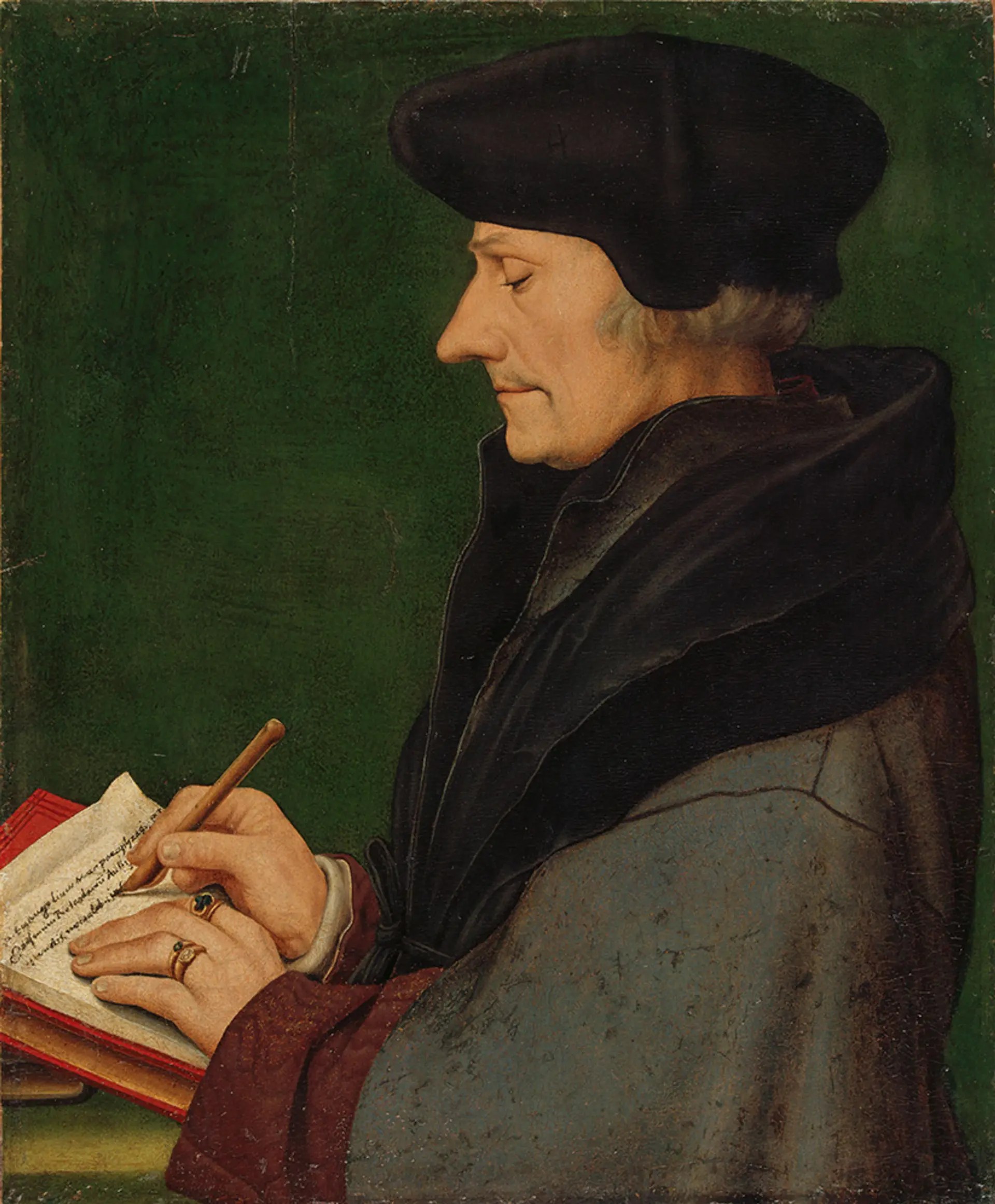
Like today’s large language models, some 16th-century humanists (like Erasmus) had techniques to automate writing. But as Hannah Katznelson explains, others (like Rabelais) called foul…
The Renaissance scholar and educator Erasmus of Rotterdam opens his polemical treatise The Ciceronian (1528) by describing the utterly dysfunctional writing process of a character named Nosoponus. The Ciceronianis structured as a dialogue, withtwo mature writers, Bulephorus and Hypologus, trying to talk Nosoponus out of his paralysing obsession with stylistic perfection. Nosoponus explains that it would take him weeks of fruitless writing and rewriting to produce a casual letter in which he asks a friend to return some borrowed books. He says that writing requires such intense concentration that he can do it only at night, when no one else is awake to distract him, and even then his perfectionism is so intense that a single sentence becomes a full night’s work. Nosoponus goes over what he’s written again and again, but remains so dissatisfied with the quality of his language that eventually he just gives up.
Nosoponus’s problem might resonate. Who has not spent too long going over the wording of a simple email, at some point or another? Today there is an easy fix: we have large language models (LLMs) to write our letters for us, helpfully proffering suggestions as to what we might say, and how we might phrase it. When I input Nosoponus’s intended request into GPT-4, it generated the following almost instantly:
Hey [Friend’s Name],
Hope you’re doing well! I just realised I never got those books back that I lent you a while ago. No rush, but whenever you get a chance, I’d love to get them back. Let me know what works for you! Thanks!
Nosoponus
But there was a solution in the 16th century, too. A humanist education on the Erasmian model could train its students to produce letters of any length, on any topic – quickly, easily and eloquently. The French humanist François Rabelais, a contemporary of Erasmus, appears to have understood these compositional techniques as automating the creating of text in a way that, retrospectively, looks a lot like how LLMs function. If we want to understand LLMs, and what they are and aren’t capable of, we can look at earlier versions of the same technology – like Erasmian humanism. We can also read authors like Rabelais, who is already thinking about automatic text-generation along these lines, as someone who appreciates the effectiveness of Erasmian generative technology, but at the same time sees it as vitiating the social force of language and, ultimately, ruining language as a tool for moral and political life…
[Katznelson recounts Erasmus’s efforts, Rabelais’s response, and unpacks the important differences between our own authentic speech language created to speak for us and their practical and moral implications…]
What lessons from the 16th century can tell us about AI and LLMs: “Methodical banality,” from @aeon.co.
* Lewis Carroll, Through the Looking Glass
###
As we honor authenticity, we might recall that it was on this date in 1886 that three U.S. patents were issued to Alexander Graham Bell’s Volta Labs for “recording and reproducing speech and other sounds.” The Graphophone, was an improved (and the first practical) version of the Edison phonograph (from 1877), and became the foundation on which the speech recording (e.g., dictaphone) and recorded music (and spoken word) industries began to grow.

“An educated citizenry is a vital requisite for our survival as a free people”*…

As the long campaign to dismantle public education picks up speed (see also), Anna Berkes reminds us that the Founders– to whom the destroyers so often allude– wouldn’t have approved…
As part of his work in revising the laws of Virginia during the late 1770s and early 1780s, Thomas Jefferson put forth a bill that has become one of his most enduring works on the subject of education: Bill 79, “A Bill for the More General Diffusion of Knowledge.” Its oft-quoted preamble reads as follows:
Whereas it appeareth that however certain forms of government are better calculated than others to protect individuals in the free exercise of their natural rights, and are at the same time themselves better guarded against degeneracy, yet experience hath shewn, that even under the best forms, those entrusted with power have, in time, and by slow operations, perverted it into tyranny; and it is believed that the most effectual means of preventing this would be, to illuminate, as far as practicable, the minds of the people at large, and more especially to give them knowledge of those facts, which history exhibiteth, that, possessed thereby of the experience of other ages and countries, they may be enabled to know ambition under all its shapes, and prompt to exert their natural powers to defeat its purposes; And whereas it is generally true that that people will be happiest whose laws are best, and are best administered, and that laws will be wisely formed, and honestly administered, in proportion as those who form and administer them are wise and honest; whence it becomes expedient for promoting the publick happiness that those persons, whom nature hath endowed with genius and virtue, should be rendered by liberal education worthy to receive, and able to guard the sacred deposit of the rights and liberties of their fellow citizens, and that they should be called to that charge without regard to wealth, birth or other accidental condition or circumstance; but the indigence of the greater number disabling them from so educating, at their own expence, those of their children whom nature hath fitly formed and disposed to become useful instruments for the public, it is better that such should be sought for and educated at the common expence of all, than that the happiness of all should be confided to the weak or wicked: …
The Bill was presented in the House of Delegates in 1778 and 1780, but was not passed; James Madison presented the bill several more times to the state legislature while Jefferson was serving in Paris as Minister to France. A much-revised version was finally passed into law in 1796 as an “Act to Establish Public Schools.”
Thomas Jefferson on the importance of public education: “A Bill for the More General Diffusion of Knowledge.”
* Thomas Jefferson
###
As we prioritize pedagogy, we might send enlightened birthday greetings to a women whose work exemplified Jefferson’s dictum: Septima Poinsette Clark; she was born on this date in 1898. educator and civil rights activist. Clark developed the literacy and citizenship workshops that played an important role in the drive for voting rights and civil rights for African Americans in the Civil Rights Movement. While her work was commonly under-appreciated by Southern male activists, she became known as the “Queen Mother” or “Grandmother” of the Civil Rights Movement in the United States. Martin Luther King Jr. commonly referred to Clark as “The Mother of the Movement.”
Clark’s explained her position in the Civil Rights Movement as one that claimed “knowledge could empower marginalized groups in ways that formal legal equality couldn’t.”

You must be logged in to post a comment.