Posts Tagged ‘civil rights movement’
“It’s not the voters picking their representatives; it’s the representatives picking their voters!”*…
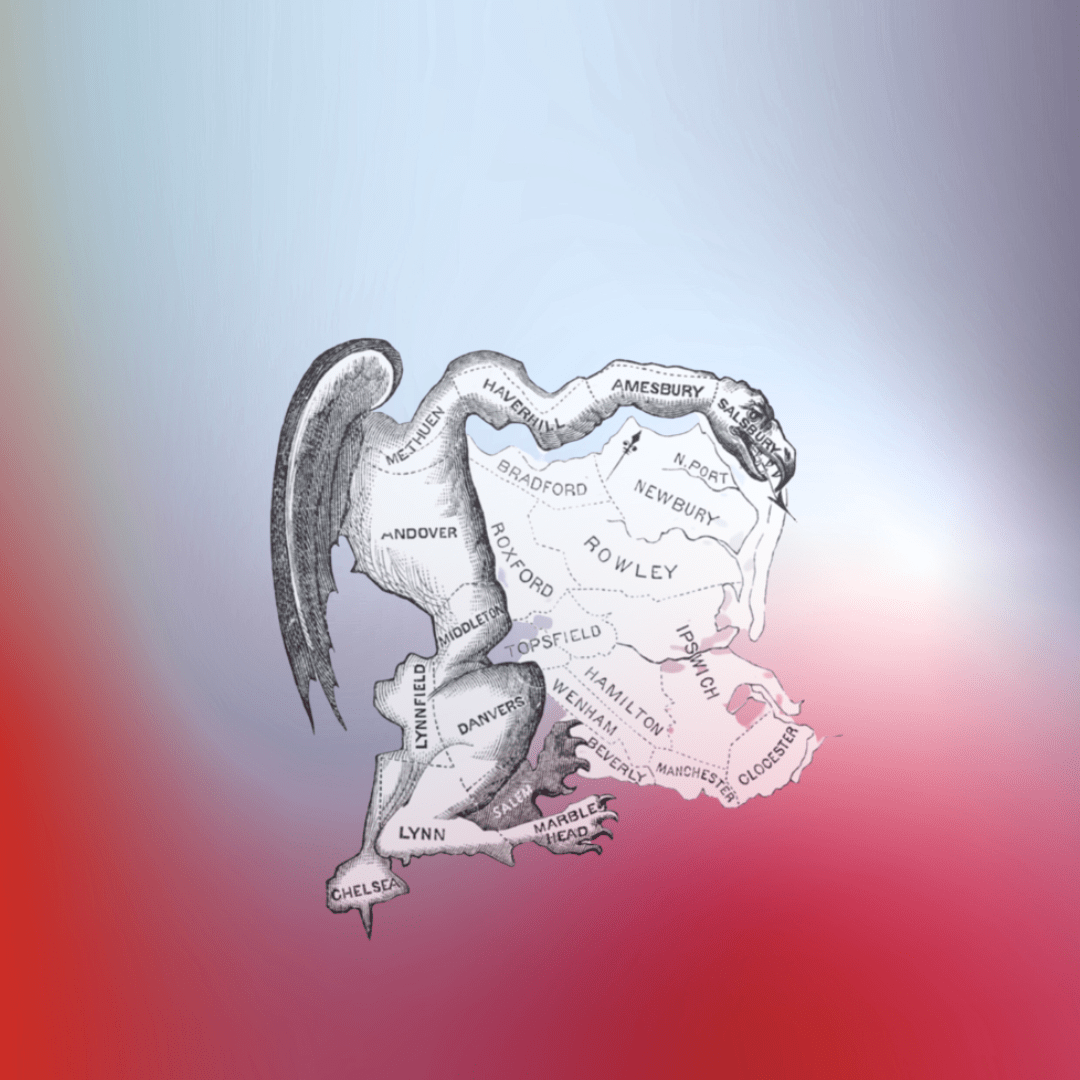
Gerrymandering has been a word since 1812 (when Elbridge Gerry signed a bill that created a partisan district in the Boston area [pictured above] that was compared to the shape of a mythological salamander); but the phenomenon has been an issue pretty much from our nation’s birth– first states, then congressional districts, drawn to favor the party doing the drawing. And, as researchers have shown, the result has been an increase in safe seats, occupied by representatives less responsive to constituents at large, and more atuned to the most vociferously-partisan elements in the disticts.
Redistricting every ten years, to reflect population changes detected in the census taken every decade, is mandated by the Constitution. But managing voting– and the drawing of district boundaries– are a state right and responsibility, usually exercised by a state’s legislature (though a few states have delegated the task to separate commissions). And while most states address the issue every ten years, following the census, the Supreme Court ruled in 2006 (in LULAC v Perry) that states could redistrict at other times and for other reasons as well.
Over three-quarters of Americans believe that gerrymandering is unfair and should be illegal; and so redistricting has typically been swathed in rhetoric that attempts to communicate fairness and obscures any partisan designs… at least until 2019, when the Supreme Court effectively gave states the right to redistrict for explicitly partisan reasons.
And now, with Texas’ newly-drawn maps enacted and other states both red and blue being pressured by the parties to “counter-plot,” gerrymandering is very much a “thing.” California is, of course, considering a response-in-kind. Republicans in Indiana, Missouri, and Florida have openly discussed the possibility of reworking their maps ahead of the 2026 midterms, while Democratic governors in Illinois, New York, and Maryland have also floated doing the same. Given that Texas’ move– creating five more “safe” Republican seats and making two of the remaining Democractic seats more competitive– looks to make the Democrats’ prospects of regaining control of now almost evenly-divided House much more difficult, California Democrats (even those opposed to gerrymandering) are, however reluctantly, lining up behind an attempt to off-set the impact of Texas’ rejiggering… which is increasing the pressure on Indiana, Missouri, and Florida to act… and on Illinois, New York, and Maryland to react (especially since, some believe, the Democrats might “win”)…
This is, one reckons, what happens when control matter more than governing. Put another way (and channeling the great James Carse, this is what happens when the winner of one round in an infinite game decides to change the rules in order to create a finite game in which they are the victor.
Of course, that rarely works in the long run. Historian Kevin Vrevich has some thoughts on what the onslaught that Texas has unleashed that might mean…
… The history of gerrymandering suggests that the current arms race of redistricting for short-term partisan gains is quite in line with the actions of those in the early republic, indicating a period of political instability akin to the Jacksonian period may be on the way…
[Vrevich unpacks the constitutional and political history of redistricting, culminating in 1812 event, outlined above, that gave the partisan practice its name…]
… The redistricting plans of the current political parties, especially their rapid response nature, feel very similar to the partisan machinations of the early republic and antebellum period. The usage of sophisticated tracking polls and predictive computer models does not change the fact that the goals of today are identical to those of the Massachusetts Republicans in 1812. That suggests that times of rapid party turnover, legitimate third parties, and increased political violence are all on the horizon…
“The Original Gerrymanders,” from @kevinvrevich.bsky.social in The Panorama (the online presence of the Journal of the Early Republic)
More background on (the more recent) history of partisan redistricting: “The Worst 10 Gerrymanders Ever.”
* Widely- (and accurately-)used critique of gerrymandering
###
As we regret regression to the mean (pun intended), we might recall that it was on this date in 1963 that an estimated 250,000 people attended the March on Washington for Jobs and Freedom in Washington D.C., which advocated for the civil and economic rights of African Americans. In addition to Martin Luther King Jr.’s “I Have a Dream” speech at the Lincoln Memorial calling for an end to racism, musicians Odetta, Mahalia Jackson, and Marian Anderson, Peter, Paul & Mary, Joan Baez, and Bob Dylan, performed.

“An educated citizenry is a vital requisite for our survival as a free people”*…

As the long campaign to dismantle public education picks up speed (see also), Anna Berkes reminds us that the Founders– to whom the destroyers so often allude– wouldn’t have approved…
As part of his work in revising the laws of Virginia during the late 1770s and early 1780s, Thomas Jefferson put forth a bill that has become one of his most enduring works on the subject of education: Bill 79, “A Bill for the More General Diffusion of Knowledge.” Its oft-quoted preamble reads as follows:
Whereas it appeareth that however certain forms of government are better calculated than others to protect individuals in the free exercise of their natural rights, and are at the same time themselves better guarded against degeneracy, yet experience hath shewn, that even under the best forms, those entrusted with power have, in time, and by slow operations, perverted it into tyranny; and it is believed that the most effectual means of preventing this would be, to illuminate, as far as practicable, the minds of the people at large, and more especially to give them knowledge of those facts, which history exhibiteth, that, possessed thereby of the experience of other ages and countries, they may be enabled to know ambition under all its shapes, and prompt to exert their natural powers to defeat its purposes; And whereas it is generally true that that people will be happiest whose laws are best, and are best administered, and that laws will be wisely formed, and honestly administered, in proportion as those who form and administer them are wise and honest; whence it becomes expedient for promoting the publick happiness that those persons, whom nature hath endowed with genius and virtue, should be rendered by liberal education worthy to receive, and able to guard the sacred deposit of the rights and liberties of their fellow citizens, and that they should be called to that charge without regard to wealth, birth or other accidental condition or circumstance; but the indigence of the greater number disabling them from so educating, at their own expence, those of their children whom nature hath fitly formed and disposed to become useful instruments for the public, it is better that such should be sought for and educated at the common expence of all, than that the happiness of all should be confided to the weak or wicked: …
The Bill was presented in the House of Delegates in 1778 and 1780, but was not passed; James Madison presented the bill several more times to the state legislature while Jefferson was serving in Paris as Minister to France. A much-revised version was finally passed into law in 1796 as an “Act to Establish Public Schools.”
Thomas Jefferson on the importance of public education: “A Bill for the More General Diffusion of Knowledge.”
* Thomas Jefferson
###
As we prioritize pedagogy, we might send enlightened birthday greetings to a women whose work exemplified Jefferson’s dictum: Septima Poinsette Clark; she was born on this date in 1898. educator and civil rights activist. Clark developed the literacy and citizenship workshops that played an important role in the drive for voting rights and civil rights for African Americans in the Civil Rights Movement. While her work was commonly under-appreciated by Southern male activists, she became known as the “Queen Mother” or “Grandmother” of the Civil Rights Movement in the United States. Martin Luther King Jr. commonly referred to Clark as “The Mother of the Movement.”
Clark’s explained her position in the Civil Rights Movement as one that claimed “knowledge could empower marginalized groups in ways that formal legal equality couldn’t.”

“The only thing that will redeem mankind is cooperation”*…

… and happily that prospect may be more likely than we’d been led to believe in works like Robert Putnam’s Bowling Alone…
Despite widespread worries that the social fabric is disintegrating, data from the American Psychological Association shows that since the 1950s, cooperation between strangers has steadily increased in the United States.
“We were surprised by our findings that Americans became more cooperative over the last six decades because many people believe U.S. society is becoming less socially connected, less trusting, and less committed to the common good,” said lead researcher Yu Kou, Ph.D., a professor of social psychology at Beijing Normal University. “Greater cooperation within and between societies may help us tackle global challenges, such as responses to pandemics, climate change, and immigrant crises.”
Over 63,000 people participated in 511 studies that were carried out in the US between 1956 and 2017 that were analyzed by the researchers. These studies included lab tests that evaluated strangers’ cooperation. The study was recently published in the journal Psychological Bulletin.
The study discovered a slight, gradual rise in collaboration over the period of 61 years…
“Good News: Cooperation Among Strangers Has Increased for the Past 60 Years.” The full study is here.
* Bertrand Russell
###
As we bowl together, we might recall that any improvement on cooperation is on a base that’s not too high: it was on this date in 1957 that nine Black students, having been denied entrance to Little Rock, Arkansas’ Central High School (in defiance of a 1954 Supreme Court ruling), were escorted to school by soldiers of the Airborne Battle Group of the U.S. Army’s 101st Airborne Division. Two days earlier the Black students had faced an angry mob of over 1,000 Whites in front of Central High School who were protesting the integration project; as the students were escorted inside by the Little Rock police (supporting national Guard troops), violence escalated, and they were removed from the school. President Eisenhower responded by calling in the regular Army.

You must be logged in to post a comment.