Posts Tagged ‘civil rights’
“It’s not the voters picking their representatives; it’s the representatives picking their voters!”*…
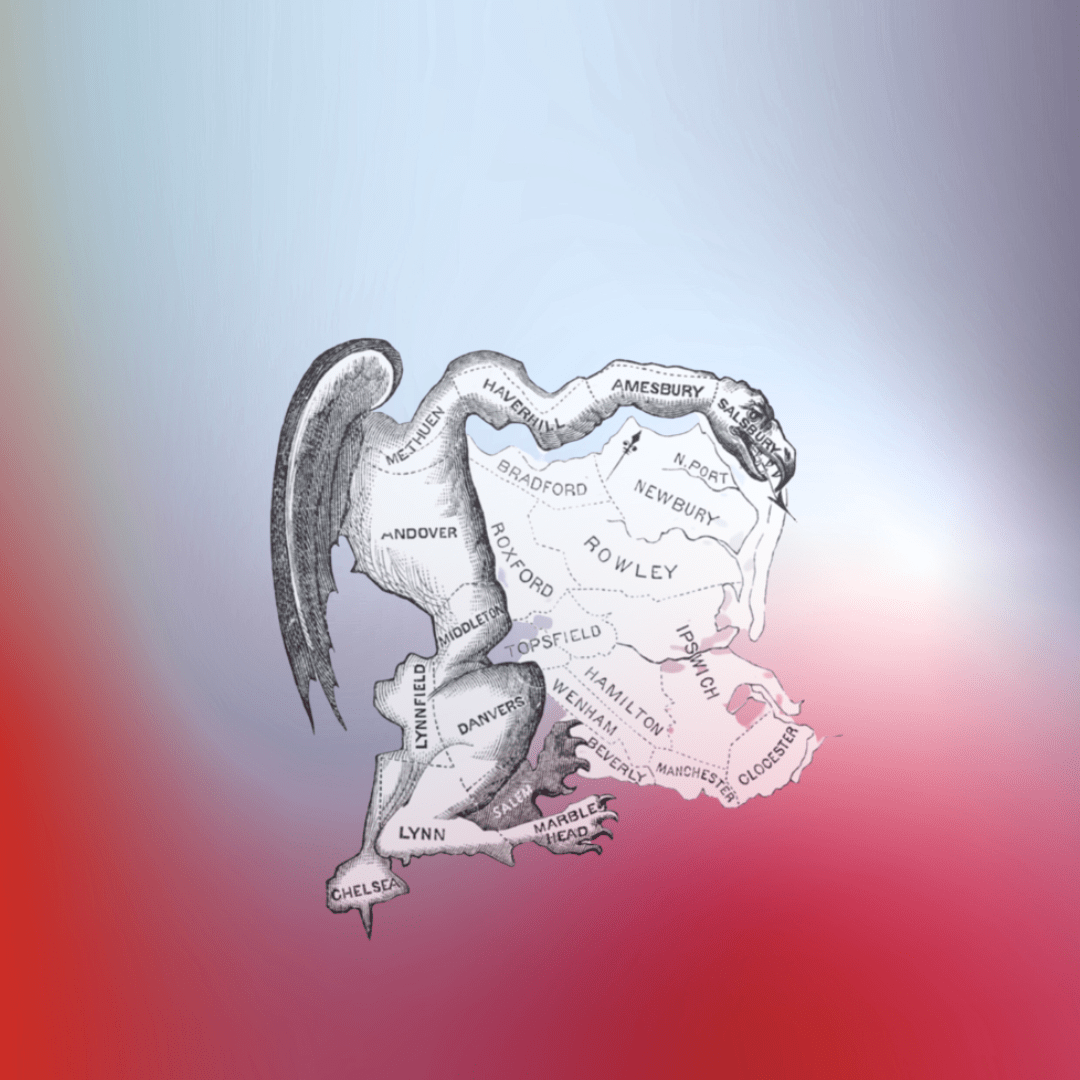
Gerrymandering has been a word since 1812 (when Elbridge Gerry signed a bill that created a partisan district in the Boston area [pictured above] that was compared to the shape of a mythological salamander); but the phenomenon has been an issue pretty much from our nation’s birth– first states, then congressional districts, drawn to favor the party doing the drawing. And, as researchers have shown, the result has been an increase in safe seats, occupied by representatives less responsive to constituents at large, and more atuned to the most vociferously-partisan elements in the disticts.
Redistricting every ten years, to reflect population changes detected in the census taken every decade, is mandated by the Constitution. But managing voting– and the drawing of district boundaries– are a state right and responsibility, usually exercised by a state’s legislature (though a few states have delegated the task to separate commissions). And while most states address the issue every ten years, following the census, the Supreme Court ruled in 2006 (in LULAC v Perry) that states could redistrict at other times and for other reasons as well.
Over three-quarters of Americans believe that gerrymandering is unfair and should be illegal; and so redistricting has typically been swathed in rhetoric that attempts to communicate fairness and obscures any partisan designs… at least until 2019, when the Supreme Court effectively gave states the right to redistrict for explicitly partisan reasons.
And now, with Texas’ newly-drawn maps enacted and other states both red and blue being pressured by the parties to “counter-plot,” gerrymandering is very much a “thing.” California is, of course, considering a response-in-kind. Republicans in Indiana, Missouri, and Florida have openly discussed the possibility of reworking their maps ahead of the 2026 midterms, while Democratic governors in Illinois, New York, and Maryland have also floated doing the same. Given that Texas’ move– creating five more “safe” Republican seats and making two of the remaining Democractic seats more competitive– looks to make the Democrats’ prospects of regaining control of now almost evenly-divided House much more difficult, California Democrats (even those opposed to gerrymandering) are, however reluctantly, lining up behind an attempt to off-set the impact of Texas’ rejiggering… which is increasing the pressure on Indiana, Missouri, and Florida to act… and on Illinois, New York, and Maryland to react (especially since, some believe, the Democrats might “win”)…
This is, one reckons, what happens when control matter more than governing. Put another way (and channeling the great James Carse, this is what happens when the winner of one round in an infinite game decides to change the rules in order to create a finite game in which they are the victor.
Of course, that rarely works in the long run. Historian Kevin Vrevich has some thoughts on what the onslaught that Texas has unleashed that might mean…
… The history of gerrymandering suggests that the current arms race of redistricting for short-term partisan gains is quite in line with the actions of those in the early republic, indicating a period of political instability akin to the Jacksonian period may be on the way…
[Vrevich unpacks the constitutional and political history of redistricting, culminating in 1812 event, outlined above, that gave the partisan practice its name…]
… The redistricting plans of the current political parties, especially their rapid response nature, feel very similar to the partisan machinations of the early republic and antebellum period. The usage of sophisticated tracking polls and predictive computer models does not change the fact that the goals of today are identical to those of the Massachusetts Republicans in 1812. That suggests that times of rapid party turnover, legitimate third parties, and increased political violence are all on the horizon…
“The Original Gerrymanders,” from @kevinvrevich.bsky.social in The Panorama (the online presence of the Journal of the Early Republic)
More background on (the more recent) history of partisan redistricting: “The Worst 10 Gerrymanders Ever.”
* Widely- (and accurately-)used critique of gerrymandering
###
As we regret regression to the mean (pun intended), we might recall that it was on this date in 1963 that an estimated 250,000 people attended the March on Washington for Jobs and Freedom in Washington D.C., which advocated for the civil and economic rights of African Americans. In addition to Martin Luther King Jr.’s “I Have a Dream” speech at the Lincoln Memorial calling for an end to racism, musicians Odetta, Mahalia Jackson, and Marian Anderson, Peter, Paul & Mary, Joan Baez, and Bob Dylan, performed.

“I am a camera with its shutter open, quite passive, recording, not thinking… Some day, all this will have to be developed, carefully printed, fixed.”*

How do we make sense of the world? How do we make our ways through it? Venkatesh Rao cautions against both of the currently-dominant narratives that shape our perceptions and actions: the “helpless witness,” as evinced in the quote above, and the other dominant lens, the “blind builder”…
It is hard to make sense of events these days because we feel constantly forced into a false choice between blind builder narratives and helpless witness narratives. Stories told by people so enthralled by new agencies they don’t notice their insensibility to current realities, or the poverty of their future visions driving their excited building. Or stories told by people so lacking in agency of any sort that their visions, while richer, are uniformly bleak and framed by their own sense of utter helplessness and doom.
The fundamental inadequacies of these frames, much more than the right/left political leanings usually associated with them, is perhaps the real reason for my refusal to ally with any of the narratives on offer. I don’t want to be either blind or helpless, or move along a tradeoff curve between them.
An interesting pattern that’s popped for me as a way out of this bind, and a possible stance from which to narrate and inhabit more powerful sorts of stories, is working with media that are simultaneously about seeing and doing...
Eminently worth reading in full: “Not Just a Camera, Not Just an Engine,” from @vgr.bsky.social.
* Christopher Isherwood, “Goodbye to Berlin” (in The Berlin Stories)
###
As we reframe, we might recall that, on this date in 1872, Susan B. Anthony was fined $100 for voting.
In 1863, she and Elizabeth Cady Stanton had founded the Women’s Loyal National League. In 1866, the pair initiated the American Equal Rights Association which campaigned for equal rights for both African Americans and all women. In 1869, they created the National Woman Suffrage Association and on this day in 1872, Anthony attempted to vote in her hometown of Rochester, New York– and was fined $100 for doing so. She refused to pay the fine and the authorities declined to take further action against her. In 1878, Anthony and Stanton presented Congress with an amendment giving women the right to vote. It became the 19th Amendment to the U.S. Constitution in 1920. In 1979, the United States honored Anthony by placing her image on the one-dollar U.S. coin.

“An educated citizenry is a vital requisite for our survival as a free people”*…

As the long campaign to dismantle public education picks up speed (see also), Anna Berkes reminds us that the Founders– to whom the destroyers so often allude– wouldn’t have approved…
As part of his work in revising the laws of Virginia during the late 1770s and early 1780s, Thomas Jefferson put forth a bill that has become one of his most enduring works on the subject of education: Bill 79, “A Bill for the More General Diffusion of Knowledge.” Its oft-quoted preamble reads as follows:
Whereas it appeareth that however certain forms of government are better calculated than others to protect individuals in the free exercise of their natural rights, and are at the same time themselves better guarded against degeneracy, yet experience hath shewn, that even under the best forms, those entrusted with power have, in time, and by slow operations, perverted it into tyranny; and it is believed that the most effectual means of preventing this would be, to illuminate, as far as practicable, the minds of the people at large, and more especially to give them knowledge of those facts, which history exhibiteth, that, possessed thereby of the experience of other ages and countries, they may be enabled to know ambition under all its shapes, and prompt to exert their natural powers to defeat its purposes; And whereas it is generally true that that people will be happiest whose laws are best, and are best administered, and that laws will be wisely formed, and honestly administered, in proportion as those who form and administer them are wise and honest; whence it becomes expedient for promoting the publick happiness that those persons, whom nature hath endowed with genius and virtue, should be rendered by liberal education worthy to receive, and able to guard the sacred deposit of the rights and liberties of their fellow citizens, and that they should be called to that charge without regard to wealth, birth or other accidental condition or circumstance; but the indigence of the greater number disabling them from so educating, at their own expence, those of their children whom nature hath fitly formed and disposed to become useful instruments for the public, it is better that such should be sought for and educated at the common expence of all, than that the happiness of all should be confided to the weak or wicked: …
The Bill was presented in the House of Delegates in 1778 and 1780, but was not passed; James Madison presented the bill several more times to the state legislature while Jefferson was serving in Paris as Minister to France. A much-revised version was finally passed into law in 1796 as an “Act to Establish Public Schools.”
Thomas Jefferson on the importance of public education: “A Bill for the More General Diffusion of Knowledge.”
* Thomas Jefferson
###
As we prioritize pedagogy, we might send enlightened birthday greetings to a women whose work exemplified Jefferson’s dictum: Septima Poinsette Clark; she was born on this date in 1898. educator and civil rights activist. Clark developed the literacy and citizenship workshops that played an important role in the drive for voting rights and civil rights for African Americans in the Civil Rights Movement. While her work was commonly under-appreciated by Southern male activists, she became known as the “Queen Mother” or “Grandmother” of the Civil Rights Movement in the United States. Martin Luther King Jr. commonly referred to Clark as “The Mother of the Movement.”
Clark’s explained her position in the Civil Rights Movement as one that claimed “knowledge could empower marginalized groups in ways that formal legal equality couldn’t.”

“A republic, if you can keep it.”*

Just over a decade ago, Nils Gilman wrote an essay, The Twin Insurgency,” in which he warned of an emerging confluence of strategies between the rising global plutocratic class, on the one hand, and transnational criminal organizations, on the other. For all our sins, as you’ll see in his piece, he nailed the fundamental disposition of the tech-libertarian broligarch class. And…
One other thing I think I correctly intuited a decade ago was that a key politico-spatial implication of the Twin Insurgency was that the space of the national was fragmenting into “kaleidoscopic microsovereignties,” an argument that my friend Quinn Slobodian has recently developed at monographic length in his marvelous book Crack-Up Capitalism.
Quinn’s thesis is that the ultimate goal of what I called the plutocratic insurgents (and their intellectual and high-end service-economy henchmen) is to end the constraints that democratic nation-states impose on the privileges of the rich. These are rich men (and it is almost entirely men) who believe that their wealth should be untouchable, and that the privileges that this wealth buys should be unlimited. With Elon Musk’s DOGE, the mask is off: they are hell-bent on destroying any institutions of social care or risk-sharing that might touch their money or their privileges.
I cannot recommend Crack-Up Capitalism enough. Methodologically, is an intellectual history of the most notorious radical libertarians — from well-known assholes** like Milton Friedman and Peter Thiel to a congeries of even more colorful crackpots and kakistocrats — and their quest to craft for the perfect space for unfettered capitalism by shattering the map of allegedly sovereign territories into a variety of “exceptional” legal spaces: free ports, tax havens, special economic zones, etc. It is also an historical travelogue, taking the reader (as its cover blurb says) “from Hong Kong in the 1970s to South Africa in the late days of apartheid, from the neo-Confederate South to the former frontier of the American West, from the medieval City of London to the gold vaults of right-wing billionaires, and finally into the world’s oceans and war zones, charting the relentless quest for a blank slate where market competition is unfettered by democracy.” Best of all, Crack-Up Capitalism is wonderfully written: erudite and droll in equal measure (as the punning title itself suggests).
** I use the term “assholes” in the technical sense elaborated by Aaron James, chair of the UC Irvine philosophy department, in his 2012 book Assholes: A Theory, namely someone who “allows himself to enjoy special advantages in social relations out of an entrenched sense of entitlement that immunizes him against the complaints of other people.” I was reading the book when I wrote “The Twin Insurgency” and, even though I didn’t cite it (the anxiety of influence?), I realize now looking back how much it informed my understanding of phenomenon of the plutocratic insurgency. Conversely, I suspect the empirical fact of the rising plutocratic insurgency may well have been part of what inspired James to write his own book.
– Nils’ thoughts in full: “Revisiting the Plutocratic Insurgency.”
So, what can we expect? Steven Levitsky and Lucan A. Way paint a pretty grim picture…
… Democracy survived Trump’s first term because he had no experience, plan, or team. He did not control the Republican Party when he took office in 2017, and most Republican leaders were still committed to democratic rules of the game. Trump governed with establishment Republicans and technocrats, and they largely constrained him. None of those things are true anymore. This time, Trump has made it clear that he intends to govern with loyalists. He now dominates the Republican Party, which, purged of its anti-Trump forces, now acquiesces to his authoritarian behavior.
U.S. democracy will likely break down during the second Trump administration, in the sense that it will cease to meet standard criteria for liberal democracy: full adult suffrage, free and fair elections, and broad protection of civil liberties.
The breakdown of democracy in the United States will not give rise to a classic dictatorship in which elections are a sham and the opposition is locked up, exiled, or killed. Even in a worst-case scenario, Trump will not be able to rewrite the Constitution or overturn the constitutional order. He will be constrained by independent judges, federalism, the country’s professionalized military, and high barriers to constitutional reform. There will be elections in 2028, and Republicans could lose them.
But authoritarianism does not require the destruction of the constitutional order. What lies ahead is not fascist or single-party dictatorship but competitive authoritarianism—a system in which parties compete in elections but the incumbent’s abuse of power tilts the playing field against the opposition. Most autocracies that have emerged since the end of the Cold War fall into this category, including Alberto Fujimori’s Peru, Hugo Chávez’s Venezuela, and contemporary El Salvador, Hungary, India, Tunisia, and Turkey. Under competitive authoritarianism, the formal architecture of democracy, including multiparty elections, remains intact. Opposition forces are legal and aboveground, and they contest seriously for power. Elections are often fiercely contested battles in which incumbents have to sweat it out. And once in a while, incumbents lose, as they did in Malaysia in 2018 and in Poland in 2023. But the system is not democratic, because incumbents rig the game by deploying the machinery of government to attack opponents and co-opt critics. Competition is real but unfair.
Competitive authoritarianism will transform political life in the United States. As Trump’s early flurry of dubiously constitutional executive orders made clear, the cost of public opposition will rise considerably: Democratic Party donors may be targeted by the IRS; businesses that fund civil rights groups may face heightened tax and legal scrutiny or find their ventures stymied by regulators. Critical media outlets will likely confront costly defamation suits or other legal actions as well as retaliatory policies against their parent companies. Americans will still be able to oppose the government, but opposition will be harder and riskier, leading many elites and citizens to decide that the fight is not worth it. A failure to resist, however, could pave the way for authoritarian entrenchment—with grave and enduring consequences for global democracy.
The second Trump administration may violate basic civil liberties in ways that unambiguously subvert democracy. The president, for example, could order the army to shoot protesters, as he reportedly wanted to do during his first term. He could also fulfill his campaign promise to launch the “largest deportation operation in American history,” targeting millions of people in an abuse-ridden process that would inevitably lead to the mistaken detention of thousands of U.S. citizens.
But much of the coming authoritarianism will take a less visible form: the politicization and weaponization of government bureaucracy. Modern states are powerful entities. The U.S. federal government employs over two million people and has an annual budget of nearly $7 trillion. Government officials serve as important arbiters of political, economic, and social life. They help determine who gets prosecuted for crimes, whose taxes are audited, when and how rules and regulations are enforced, which organizations receive tax-exempt status, which private agencies get contracts to accredit universities, and which companies obtain critical licenses, concessions, contracts, subsidies, tariff waivers, and bailouts. Even in countries such as the United States that have relatively small, laissez-faire governments, this authority creates a plethora of opportunities for leaders to reward allies and punish opponents. No democracy is entirely free of such politicization. But when governments weaponize the state by using its power to systematically disadvantage and weaken the opposition, they undermine liberal democracy. Politics becomes like a soccer match in which the referees, the groundskeepers, and the scorekeepers work for one team to sabotage its rival…
[The authors explore the ways in which the government bureaucracy could be politicized: the threat of targeted prosecution, the weaponization of the IRS, and the mobilization of other executive departments to further the adminsistration’s agenda– which can, among them, punish identified opponents, reward loyalists, and operate like a “protection racket” on everyone else. For alll of that, they see a limit to the damage…]
… The Trump administration may derail democracy, but it is unlikely to consolidate authoritarian rule. The United States possesses several potential sources of resilience. For one, American institutions are stronger than those in Hungary, Turkey, and other countries with competitive authoritarian regimes. An independent judiciary, federalism, bicameralism, and midterm elections—all absent in Hungary, for instance—will likely limit the scope of Trump’s authoritarianism.
Trump is also weaker politically than many successful elected autocrats. Authoritarian leaders do the most damage when they enjoy broad public support: Bukele, Chávez, Fujimori, and Russia’s Vladimir Putin all boasted approval ratings above 80 percent when they launched authoritarian power grabs. Such overwhelming public support helps leaders secure the legislative supermajorities or landslide plebiscite victories needed to impose reforms that entrench autocratic rule. It also helps deter challenges from intraparty rivals, judges, and even much of the opposition.
Less popular leaders, by contrast, face greater resistance from legislatures, courts, civil society, and even their own allies. Their power grabs are thus more likely to fail. Peruvian President Pedro Castillo and South Korean President Yoon Suk-yeol each had approval ratings below 30 percent when they attempted to seize extraconstitutional power, and both failed. Brazilian President Jair Bolsonaro’s approval rating was well below 50 percent when he tried to orchestrate a coup to overturn his country’s 2022 presidential election. He, too, was defeated and forced out of office.
Trump’s approval rating never surpassed 50 percent during his first term, and a combination of incompetence, overreach, unpopular policies, and partisan polarization will likely limit his support during his second. An elected autocrat with a 45 percent approval rating is dangerous, but less dangerous than one with 80 percent support.
Civil society is another potential source of democratic resilience. One major reason that rich democracies are more stable is that capitalist development disperses human, financial, and organizational resources away from the state, generating countervailing power in society. Wealth cannot wholly inoculate the private sector from the pressures imposed by a weaponized state. But the larger and richer a private sector is, the harder it is to fully capture or bully into submission. In addition, wealthier citizens have more time, skills, and resources to join or create civic or opposition organizations, and because they depend less on the state for their livelihoods than poor citizens do, they are in a better position to protest or vote against the government. Compared with those in other competitive authoritarian regimes, opposition forces in the United States are well-organized, well-financed, and electorally viable, which makes them harder to co-opt, repress, and defeat at the polls. American opposition will therefore be harder to sideline than it was in countries such as El Salvador, Hungary, and Turkey.
Civil society is another potential source of democratic resilience. One major reason that rich democracies are more stable is that capitalist development disperses human, financial, and organizational resources away from the state, generating countervailing power in society. Wealth cannot wholly inoculate the private sector from the pressures imposed by a weaponized state. But the larger and richer a private sector is, the harder it is to fully capture or bully into submission. In addition, wealthier citizens have more time, skills, and resources to join or create civic or opposition organizations, and because they depend less on the state for their livelihoods than poor citizens do, they are in a better position to protest or vote against the government. Compared with those in other competitive authoritarian regimes, opposition forces in the United States are well-organized, well-financed, and electorally viable, which makes them harder to co-opt, repress, and defeat at the polls. American opposition will therefore be harder to sideline than it was in countries such as El Salvador, Hungary, and Turkey.
Weaponized states create a difficult collective action problem for establishment elites who, in theory, would prefer democracy to competitive authoritarianism. The politicians, CEOs, media owners, and university presidents who modify their behavior in the face of authoritarian threats are acting rationally, doing what they deem best for their organizations by protecting shareholders or avoiding debilitating lawsuits, tariffs, or taxes. But such acts of self-preservation have a collective cost. As individual actors retreat to the sidelines or censor themselves, societal opposition weakens. The media environment grows less critical. And pressure on the authoritarian government diminishes.
The depletion of societal opposition may be worse than it appears. We can observe when key players sideline themselves—when politicians retire, university presidents resign, or media outlets change their programming and personnel. But it is harder to see the opposition that might have materialized in a less threatening environment but never did—the young lawyers who decide not to run for office; the aspiring young writers who decide not to become journalists; the potential whistleblowers who decide not to speak out; the countless citizens who decide not to join a protest or volunteer for a campaign.
America is on the cusp of competitive authoritarianism. The Trump administration has already begun to weaponize state institutions and deploy them against opponents. The Constitution alone cannot save U.S. democracy. Even the best-designed constitutions have ambiguities and gaps that can be exploited for antidemocratic ends. After all, the same constitutional order that undergirds America’s contemporary liberal democracy permitted nearly a century of authoritarianism in the Jim Crow South, the mass internment of Japanese Americans, and McCarthyism. In 2025, the United States is governed nationally by a party with greater will and power to exploit constitutional and legal ambiguities for authoritarian ends than at any time in the past two centuries.
Trump will be vulnerable. The administration’s limited public support and inevitable mistakes will create opportunities for democratic forces—in Congress, in courtrooms, and at the ballot box.
But the opposition can win only if it stays in the game. Opposition under competitive authoritarianism can be grueling. Worn down by harassment and threats, many of Trump’s critics will be tempted to retreat to the sidelines. Such a retreat would be perilous. When fear, exhaustion, or resignation crowds out citizens’ commitment to democracy, emergent authoritarianism begins to take root…
See also: “There’s a Term for What Trump and Musk Are Doing- How regime change happens in America,” from Anne Applebaum in The Atlantic (gift article), “Trump As Sovereign Decisionist,” from Nathan Gardels and Noema, and this elaboration on Applebaum’s piece by Gilman, “What Comes after the Cleansing Fire of MAGA?“
Happily, there are some signs of the opposition for which Levitsky and Way call, among them: state’s Attorneys General, some major priviate law firms, even some red-state universities. Let us fervently hope that this is just the beginning. (Indeed, here, from the estimable Henry Farrell, a suggestion as of a step each of us can take: “Trump is weaponizing financial payments: here’s what you can do.”)
* Benjamin Franklin, in response to Elizabeth Willing Powel’s question: “Well, Doctor, what have we got, a republic or a monarchy?“
###
As we deliberate on democracy, we might recall that it was on this date in 1945 that the first anti-discrimination law in the United States, the Alaska Equal Rights Act of 1945, was signed and went into effect. The product of the Alaska Native fight against segregation and other forms of discrimination, it abolished Jim Crow laws in Alaska, then a territory (not yet a state). One wonders if such an Act will be legal in our future…

“Do not remove a fence until you know why it was put up in the first place”*…

The last U. S. election was fueled, in some large measure, by dissatisfaction with government bureaucracies. Indeed, public trust in government has been low– among Democrats and Republicans alike– for decades; there is a wide-spread constituency for reform.
The pending answer at the federal level is an Elon Musk and Vivek Ramaswamy-led effort, DOGE, which their comments suggest will be an accelerationist application of “business principles” and slash-and-burn reduction.
But as Kevin Hawickhorst reminds us, there is another way, one that the U.S. has successfully pursued before– one that doesn’t throw the baby out with the bath water…
For the federal bureaucracy, the 1940s through the 1960s are a nostalgic time. The era saw one spectacular achievement after another: from winning World War II, to building the interstate highway system, to landing on the moon. At its high point, trust in the federal government reached almost 80% in the 1950’s, as opposed to only 20% today.
Trust in the federal government has plummeted alongside the federal government’s ability to accomplish anything – which is no coincidence. Although government competence has changed for many reasons, there is one forgotten reason: after the second World War, the government was competent because it taught its managers to be competent.
During World War II, the poor management in the federal government was keenly felt. Although federal management had never been especially good, it reached a boiling point when it began noticeably impeding the war effort. The Bureau of the Budget (now OMB) responded by creating a new management unit tasked with training federal managers.
They termed their newly-developed management approach work simplification, which held that implementation and policy went hand-in-hand, and therefore managers had to be trained to streamline procedure in order to achieve policy goals. Moreover, the Bureau of the Budget felt that this viewpoint could be systematically taught to federal managers of average competence, and developed a training program to do so.
During the war, the civilian agencies were incredibly short staffed due to the draft, so any procedural red tape or poor distribution of work created instant bottlenecks. Many of these bottlenecks directly impacted the war effort, as (for example) with slow approvals for important construction projects. The Bureau of the Budget therefore began an initiative to improve management around 1942.
They conducted user research with several agencies and eventually felt they had a management system that could scale, which they termed Work Simplification. They taught managers Work Simplification at training seminars, and also created guides and pamphlets to distribute across the government. I quote from one of their guides1 that sets out the problem, the audience, and their goal:
Thinking of this sort has been going on in the United States Bureau of the Budget for some time. It has culminated in the decision to make a concerted drive to capture the best available means for exposing and disposing of common management problems, set it forth in clear, simple language, and put it in the hands of those who can use it to best advantage. And who are they? They are the operating managers of government: middle management people and first line supervisors. […]
From the standpoint of the Bureau of the Budget, Work Simplification is a method of attacking the procedural problems of large organizations by equipping first line supervisors with the skill to analyze and improve procedures. It provides a way of tapping the great reservoir of unused practical knowledge represented by this group.
… Their management agenda developed a training program for the managers closest to the ground, rather than (as is common today) focusing on top leadership…
… Although Work Simplification was developed during World War II, it was still the common approach for training federal managers into the 1960s. These were the stodgy managers of the Eisenhower era who oversaw the building of the interstate highway system, or the administration of the GI bill.
This is not how the federal government approaches management today. It would be, obviously, unreasonable to claim that earlier success was entirely due to training managers differently. But it clearly contributed – their methods explicitly aimed to solve issues that today’s processes aggravate.
In particular, the Bureau of the Budget’s work almost remarkably anticipated current conversations on government efficiency. Reformers note that the bureaucracy piles up layers of procedure without ever rethinking them – process charting taught managers to reduce procedural burden. Reformers note that government IT piles up layers of software from different eras, with nobody understanding how it fits together – process charting taught managers the start-to-finish viewpoint. Reformers note that bureaucrats rarely consider what it’s like to actually apply for benefits – once again, a failure that process charting aimed to correct.
Process charting is clearly not a perfect solution to any of these issues. But it is proof that the government can train bureaucrats to tackle these issues head-on!
The overall lessons of Work Simplification are even more important. Work Simplification’s success did not last forever, but it did last for several decades. And it achieved its success because the Bureau of the Budget created free training for low-level managers, while nobody else particularly cared.
So would-be bureaucratic streamliners today – proponents of product management thinking, agile IT development, or what have you – might imitate Eisenhower’s bureaucrats. Above all, they should prove that their proposals are a rational method that can be systematically taught to low-level managers, in order to put their “great reservoir of unused practical knowledge” to use…
How the federal government taught its managers to cut red tape: “Eisenhower’s Bureaucrats,” from @KHawickhorst.
Via Jennifer Pahlka, whose own Recoding America (and her continuing work) are powerful contributions to this critically-important dialogue.
By way of context, a piece from Venkatesh Rao explicitly about “self-help” but very useful in this broader/more systemic context: “How to Fall Off of the Wagon.” (Per the diagram below, from that post, the approach suggested above is “clockwise”; the Musk/Ramaswamy m.o., “counterclockwise”… which will make clarifying sense after you’ve read the short essay. While I can’t attribute the significance that I draw from it [for the issue of reengineering the government bureaucracies that are not serving Americans as they should] to Rao, I’d note that the clockwise direction is green; the counterclockwise, red.)

* G. K. Chesterton, The Thing
###
As we fix it instead of throwing it away, we might recall that it was on this date in 1957 that President Dwight D. Eisenhower gave his sixth State of the Union Address to the joint houses of Congress. Eisenhower focused on three themes: a vigilant regard for human liberty, a wise concern for human welfare, and a ceaseless effort for human progress. His speech addressed the threats posed by the Soviet Union (and communism more generally around the world); urged efficient, effective government (as the government’s duty to citizens); and raised the issue of civil rights, calling for the enactment of what later became the Civil Rights Act of 1957.
Senate Majority Leader Lyndon B. Johnson called Eisenhower’s speech “a comprehensive and thoughtful analysis of the problems which confront our people.”

You must be logged in to post a comment.