Archive for May 2025
“Everywhere and always, when human beings either cannot or dare not take their anger out on the thing that has caused it, they unconsciously search for substitutes, and more often than not they find them.”*…

Rene Girard has been called the “Darwin of the Human Sciences.” A historian, literary critic, and philosopher of social science, he made contributions to literary criticism, critical theory, anthropology, theology, mythology, sociology, economics, cultural studies, and philosophy– most prominently, his psychology of desire: mimetic theory. But relatedly, he also developed a powerful interpretation of human culture and its use of what he called the “scapegoat mechanism.”
His thought has impacted scholarship, and also more worldly endeavors like marketing and sales, even online influencing.
But perhaps most saliently in our moment, it has informed and animated the thought and efforts of the techno-right. Here, a fascinating “intellectual history”– and critique– of the appropriation of Girard by Peter Thiel, J. D. Vance, and their fellow travelers…
This past summer, I was surprised to encounter a face I knew in two most unexpected places. The first was in a photo montage accompanying an article written by Josh Kovensky of Talking Points Memo in the wake of J.D. Vance becoming the Vice Presidential nominee, entitled “A Journey Through the Authoritarian Right.” Arranged in the collage among images of a ripped man with lasers shooting from his eyes, of anti-democracy blogger Curtis Yarvin, and of Peter Thiel rubbing Benjamins between his thumb and forefinger, was my former professor and friend from Stanford University, René Girard. I was in France at the time; mere hours after reading Kovensky’s piece, I saw through the window of a taxi René’s face again—this time in the form of a larger-than-life decal on a light rail car in Avignon, where as it happens he is one of a dozen local heroes permanently celebrated on the new transit system. What do the medieval, culturally-rich, Provençal city of Avignon and the American authoritarian right have in common? Both claim a bond with this influential philosopher and member of L’Académie Française, who died in 2015. Only one of the claims is legitimate. The misappropriation of Girard’s ideas by the American right is not just a matter of academic concern; it has significant implications for our political discourse and society.
As it turns out, I know exactly where this illegitimate claim to Girard’s legacy started. For several years in the 1990s, I was part of a small reading group that met bi-weekly on the Stanford campus in a trailer left over from the 1989 Loma Prieta earthquake. The group—a kaleidoscope of visiting scholars, a few former students [the author had been a Stegner Fellow at Stanford] and some of Girard’s campus friends—was led by Girard himself, and though he was already an influential thinker at the time, and though his theories and ideas pervaded our discussions and were the reason we gathered, one member of that intimate group of ten or so has gone on to eclipse Girard in terms of visibility and political influence: Peter Thiel.
That Thiel participated in this study group has been noted in a small subset of the countless articles that reference his connection to Girard. Journalists, podcasters, and young entrepreneurs alike have hoped to find in Thiel’s acknowledged devotion to Girard’s work a master key that, properly handled, could unlock the mystery of Thiel and explain everything from his success as a venture capitalist to his 2016 endorsement of Donald Trump. That some wannabe billionaires have ordered Violence and the Sacred or Deceit, Desire and the Novel from Amazon and scanned its chapters in search of an “open sesame” to affluence is as surreal a proposition as it is doubtless something that actually occurs—the aspiring mogul’s equivalent of clicking on one of those “one weird trick” links that promise a hack to making money and improving your health.
A mirror image of this shortcut-thinking is visible in those who scan Girard’s books with the opposite goal: to demystify and discredit Thiel. “Girardianism has become a secret doctrine of a strange new frontier in reactionary thought,” exclaimed Sam Kriss in Harper’s, in an essay referenced in a ninety-minute discussion between the co-hosts of the “Know Your Enemy” podcast and essayist John Ganz, entitled “René Girard and the New Right.” This podcast discussion stands out as an informed, thoughtful, and wide-ranging presentation of Girard’s work. Nevertheless—like Sam Kriss in Harper’s—the trio are unconvincing when they suggest a causal link between Girard and Peter Thiel’s right-wing politics. Indeed, all the critical discussions I have seen regarding Thiel’s reverence for Girard share a single pattern; they seek an opportunity for a negative judgment of Girard—believing this will help them cut Peter Thiel down to size and further their efforts to obliterate the reactionary right. Just like Thiel’s followers, these critics have followed Thiel to Girard. Only the one weird trick they hoped to pull off was not getting rich, but getting reassurance—confirmation that an assumed pillar of Thiel’s worldview was as shaky as they assumed it must be.
However, the real concern isn’t about misreadings from afar but about how Girard’s ideas are actively distorted by Thiel and other influential figures within powerful right-wing circles. This manipulation carries real-world consequences. Thiel’s profound engagement with Girard’s work has been instrumental in shaping his worldview, yet he selectively twists Girardian concepts in ways that distort their original meaning. This extends beyond Thiel to figures like his political protégé, J.D. Vance. Examining how both Thiel and Vance misconstrue Girard’s themes shows how their misreadings shape the way power is understood and exercised, affecting not just academic debates but the actual conduct of political life…
Eminently worth reading in full: “From Philosophy to Power:The Misuse of René Girard by Peter Thiel, J.D. Vance and the American Right,” from Salmagundi.
(Image above: source)
* Rene Girard… who also said: “Instead of blaming victimization on the victims, the Gospels blame it on the victimizers. What the myths systematically hide, the Bible reveals” and “Why is our own participation in scapegoating so difficult to perceive and the participation of others so easy? To us, our fears and prejudices never appear as such because they determine our vision of people we despise, we fear, and against whom we discriminate.”
###
As we practice what we preach, we might contemplate the ultimate consequences of these kinds of “misunderstandings”; one grim example (on the more benign end of the scale): on this day in 2013, Dominique Venner took his own life. A journalist, essayist, and historian, Venner was instrumental in founding founding the neo-fascist and white nationalist Europe-Action, before withdrawing from politics to focus on a career as a historian. Outraged by the recent legalization of same-sex marriage in France, which he believed would result in a white genocide, he killed himself inside the cathedral of Notre Dame de Paris. In a suicide note, he said his death was an act in “defence of the traditional family” and in the “fight against illegal immigration.”

“What’s for breakfast?”*…
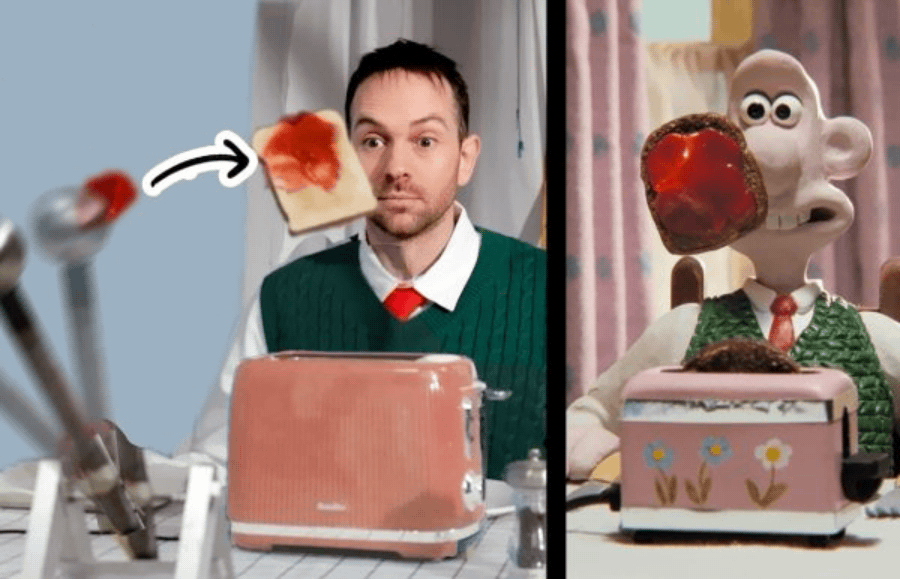
… and, we moderns tend to ask, how can we make it faster and easier?… a tendency lampooned, a la Rube Goldberg, in Aardman‘s Classic Wallace and Gromit outing The Wrong Trousers:
Joseph Herscher, proprietor of the wonderful Joseph’s Machines, put the concept to test: he built it…
I’m sure it comes as no surprise that Wallace & Gromit: The Wrong Trousers was a favourite of mine growing up, so this machine has been extra special to create! This video not only contains TWO different versions of the final result, but I also take you through my process of figuring out dangerous stunts, solving sticky jam complications and treating dog stage fright. Fun fact: The trousers at the very end were lent to me by Aardman Studios!
Modernizing the most important meal of the day: “Joseph’s Machines recreates Wallace & Gromit’s automated breakfast machine,” via the terrific The Kids Should See This.
* “When you wake up in the morning, Pooh,” said Piglet at last, “what’s the first thing you say to yourself?”
“What’s for breakfast?” said Pooh. “What do you say, Piglet?”
“I say, I wonder what’s going to happen exciting today?” said Piglet.
Pooh nodded thoughtfully. “It’s the same thing,” he said.”
– A. A. Milne
###
As we ponder progress, we might recall that today is National Quiche Lorraine Day.

“We can only sense that in the deep and turbulent recesses of the sea are hidden mysteries far greater than any we have solved.”*…

A new study finds that the vast majority of the deep sea floor remains undocumented. Nell Greenfieldboyce report…
Bizarre creatures like vampire squid and blobfish make their home in the dark, cold, depths of the deep sea, but most of this watery realm remains a complete mystery.
That’s because humans have seen less than 0.001% of the globe’s deep seafloor, according to a new study.
In fact, the area of the deep seafloor that’s been directly visualized is roughly equivalent to the state of Rhode Island, researchers report in the journal Science Advances.
Maps created with tools like sonar can show the shape of the seafloor, but it’s much harder to send cameras down beyond 200 meters, or more than 656 feet, where sunlight begins to fade rapidly and the waters turn cold and dark. This is the region of the ocean that’s considered “deep.”
“The fact of the matter is, when you’re down there with a remotely operated vehicle or other sort of deep-submergence vehicle, you can only see a very tiny bit of the deep sea floor at any one time,” says Katy Croff Bell of the nonprofit Ocean Discovery League, who led this new research…
… To try to get a better accounting of the total area of the deep seafloor that’s been observed so far, she and her colleagues created a database of all known efforts. They found records of more than 43,000 trips down, starting in 1958, with everything from robotic vehicles to human-driven subs to simple landers that didn’t move around.
It turns out that most of the exploratory expeditions occurred within 200 nautical miles of the United States, Japan, and New Zealand. Those three countries, along with France and Germany, led nearly all of the efforts.
As a result, scientists really haven’t seen a very representative sample of what’s going on around the globe…
… Bell says we don’t know what habitats might yet be discovered — and that even though the deep ocean might be out of sight and out of mind for most people, the currents down there bring oxygen and key nutrients up towards the surface.
“All of these things are connected, and impact us in so many different ways,” she says.
What little has been explored beneath the deep ocean suggests that it can have dramatically different ecosystems that support very different kinds of living things. Already, in the ocean, explorers have seen hot hydrothermal vents, alkaline vents, and cold seeps.
“But given how little we’ve seen and how biased it is, we can’t really give you a global map of all the habitats of the deep sea, because we just haven’t been to all of them,” she says.
Past explorations to the deep have revealed completely unexpected forms of life. For example, in the 1970’s, researchers discovered microbes at hydrothermal vents that did not depend at all on the sun and photosynthesis, and instead got their energy from chemical reactions.
“That was completely revolutionary and completely rewrote all the science books,” she says.
Geologist and deep sea expert Jeffrey Karson of Syracuse University, who wasn’t part of this research team, says this is the first time he’s ever seen a well-documented number that really encapsulates what’s been seen of the deep ocean floor so far.
He would have assumed the area seen by humanity was less than 1% of the total, he says, but was still surprised the faction would be “such a tiny number.”
“We’re spending a lot of money to try to understand other planets, maybe planets outside of our solar system. And yet right here on our own planet, we know so little of what’s going on in this area that covers about two-thirds of our planet,” says Karson. “Almost every time we go there, we learn something new and exciting, and many of our discoveries on the seafloor have been serendipitous. So, you know, we’re feeling our way in the dark, literally, there.”..
We’re asleep to the deep: “Humans still haven’t seen 99.999% of the deep seafloor,” from @ngreenfieldboyce.bsky.social and @npr.org.
* Rachel Carson, The Sea Around Us (1951)
###
As we dive deep, we might spare a thought for Robert S. Dietz; he died on this date in 1995. A marine geologist, geophysicist, and oceanographer with the United States Coast and Geodetic Survey, he developed (in 1961) a theory of seafloor spreading (a term he coined), in which new crustal material continually upwells from the Earth’s depths along the mid-ocean ridges and spreads outward at a rate of several inches per year.

“…When fascism comes to the United States it will be wrapped in the American flag and will claim the name of 100-percent Americanism”*…
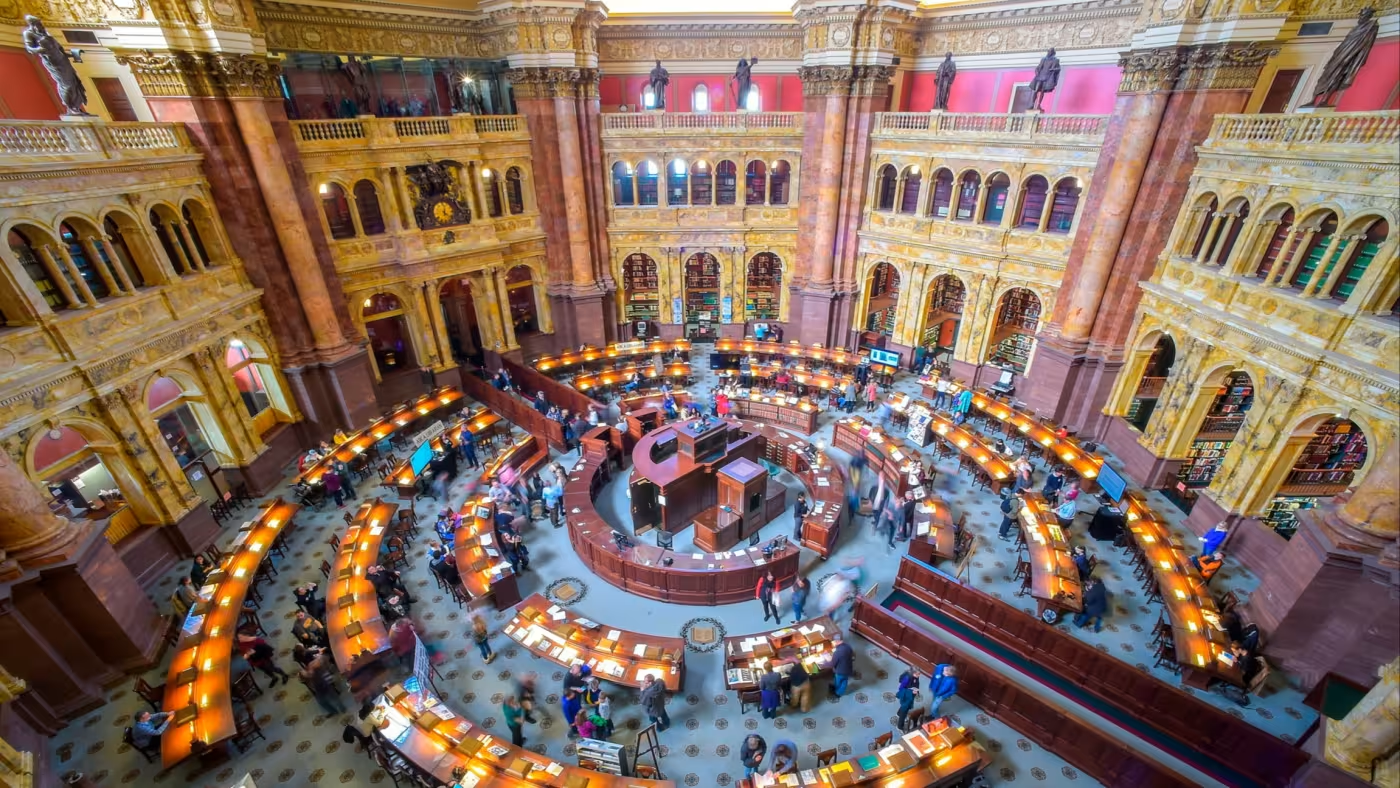
Sinclair Lewis sent up a warning flare in 1935. 90 years later, Richard Ovenden (Oxford’s librarian and author of the important– and terrific— Burning the Books: A History of Knowledge Under Attack) smells smoke…
In the space of three short months, the Archivist of the United States, Colleen Shogan, and the Librarian of Congress, Carla Hayden, have both been fired by the Trump administration. Both of these institutions have suffered setbacks before, and have come back stronger. One of the most severe attacks came at the hands of the British. In 1814 a British expeditionary force besieged Washington and set fire to the Capitol building. Officials had already recognised the threat and commandeered every cart they could find to move the National Archives outside the city.
The Capitol building also housed the Library of Congress, and its 3,000 volumes of highly combustible material could not be moved so quickly. The volumes were ignited by British troops. The whole building, and much of the city, was consumed by flames.
News of the destruction of the library reached Thomas Jefferson, whose presidency had ended five years before. In a letter published in a Washington newspaper, he expressed his outrage at the “barbarism” of the British, and offered to make good the losses from his own private library. Congress purchased 7,000 volumes from the former president; with Jefferson’s books, the Library was reborn.
The Library of Congress serves two functions simultaneously. It is both the national library and the library of the legislature. It is as if the British Library was the same organisation as the libraries of the House of Commons and the House of Lords. The irony of course is that unlike its predecessor in 1814, the 119th US Congress has done nothing to protect its own library.
Trump’s press secretary, Karoline Leavitt, stated in a press briefing that Hayden had been dismissed because the Library had been providing “inappropriate books for children”. It was another senior Trump aide, Kellyanne Conway, who in 2017 introduced the world to the notion that there could be “alternative facts”. This reason for firing Hayden — who has, since 2016, greatly strengthened the institution she inherited — is another “alternative fact”.
The Library of Congress is a reference-only research library and has no lending library for children or adults, its collections being built through legal deposit legislation, passed by Congress in 1909 and updated as recently as 2016.
Shogan was dismissed as Archivist of the United States and replaced by Marco Rubio — who clearly has so much free time alongside his dual role as Secretary of State and national security adviser that he can also run the world’s largest National Archives.
One role that archives play is to preserve documents for legal and evidential reasons. After his last presidency, Trump’s illegal removal of classified documents, stored in a guest bathroom at Mar-a-Lago, resulted in their eventual retrieval by the National Archives under the provisions of the Presidential Records Act.
The removal of Hayden and Shogan demonstrates the exercise of arbitrary power, asserting control over knowledge. Both are the first women to lead their respective institutions, and both committed to reaching all parts of the nation they were appointed to serve. If the ideologically motivated censorship of collections and the recent mass deletion of government websites is anything to go by, the Trump administration is intent on removing swaths of knowledge from public circulation.
In a famous letter of 1813, Thomas Jefferson compared the spread of ideas to the way one candle is lit from another: “He who receives an idea from me”, he wrote, “receives instruction without lessening mine; as he who lights his taper at mine, receives light without darkening me”. Instead of Trump lighting the candles of knowledge in the US today, they are being systematically snuffed out…
An institution that survived British torching in 1814 is now facing a new onslaught: “The US Library of Congress is under attack,” from @richove.bsky.social in @financialtimes.com.
For more on why the attack on the LoC (and the Archive): “Trump Is Trying to Take Control of Congress Through Its Library“- “admin is trying to take over the Library of Congress, ‘a major component of the legislative branch” that confidentially advises lawmakers’.”
And related: “Chaos At The Copyright Office: Trump’s Firing Of Register Shira Perlmutter Came After AI Report’s Release, Leaving Industry Wondering What’s Next“- “speculation about the role that a long-awaited report on [on the use of copyrighted materials to train generative AI models] may have played in his action.”
Apposite, Human Smoke by Nicholson Baker: as Hamilton Nolan explains:
… a history of the years leading up to World War 2. The entire book takes the form of short, stylized, factual items of a few paragraphs or less, presented in chronological order, which taken together tell the story of societies sliding—often unwittingly—into very dark places.
While reading the book, I found over and over again that certain entries would vividly remind me of things happening today. The experience was so vivid that I decided to present a few of them to you here—first, Baker’s entry in his book, and then the modern thing that it made me think of. I make no sweeping claims that one thing is just like the other, or that this time is equivalent to that time. I’m only a curious reader, not a professional historian. I make no sweeping claims at all. It’s just interesting. “History doesn’t repeat itself,” Mark Twain said, “but it often rhymes.”…
And per William Faulkner (“”The past is never dead. It’s not even past”)…

* Sinclair Lewis
###
As we listen carfully for echoes, we might celebrate International Museum Day.

“The test of our progress is not whether we add more to the abundance of those who have much it is whether we provide enough for those who have little.”*…

Your correspondent is headed onto the road again; so, with apologies, regular service will be suspended until on or about May 17…
… In the meantime, the remarkable Henry Farrell offers sage advice…
Last Thursday, Combinations (a publication of the RadicalxChange foundation), published a review essay that I wrote on Ezra Klein and Derek Thompson’s Abundance. I’m not going to repeat here what I say there; it’s available for free, so if you want to read it, just click on the link! [and one should read it]. Instead, I want to make the implicit argument explicit.
One of the big problems of American politics – and of politics in plenty of places elsewhere – is that we lack usable and attractive futures. The result is the current battle between the defenders of the present, and an incoherent counter-alliance that brings the cultists of an imaginary past and the evangelists of an impossible future into common cause.
Because I am weird, I think that the most immediately useful aspect of Klein and Thompson’s book is not its specific argument about how to get to the future. It is that the book has the promise to reorient the presentists around the prospect of an attractive future, and the different paths you might take to get there. On the one hand, as Dan Davies says (riffing on post-punk philosophizing), if you don’t have a dream then how’re ya gonna have a dream come true? On the other, no single dream is capable of foretelling the One True Path To Abundance (or, for that matter, any other desirable goal) so you want to have useful arguments between people with different dreams, and different plausible paths…
[Farrell discusses the book and its reception– the myriad reactions it has occasioned– puts the debate into an intellectualy historical context, then pivots to his advice…]
… One terrifying prospect for the U.S. is that the Trump faction wins again in 2028. Another is that the Democrats regain power – but that like Keir Starmer’s government, they trap themselves in a vicious cycle where universal expectations of less generate factionalism and political stasis, which further deepen those universal expectations.
That is why I think that abundance is important as a goal. We need to aim towards some version of abundance to escape the trap we’re in. That too, is why I think that disagreement about how to reach that goal over the next couple of years is valuable in two ways.
First, no faction on the left or right has any monopoly on the wisdom about how to get there. It is only through argument – and experimentation in those bits of the federal system and local politics where experimentation is possible – that we can figure out what to do when we can do it. Second, if we can get to a place where the major argument is about how to get towards abundance, not just between center left and centrists, but across the political spectrum, we – for a very broad value of we – will be halfway towards winning the fight we need to win. Far more is politically possible when we are disagreeing over how to get to an attractive future, than when we are struggling to ensure that we are as close to the top of the pile as possible in a horrible one.
We need usable futures that can orient current politics in fruitful ways. Abundance – in the broadest sense of that term – is the closest thing to a common denominator across such futures that I know of…
Abundance not as an agenda but a goal: “We need usable futures,” from @himself.bsky.social.
For contrast, pair with: “Trump’s futurism: Elon’s rockets and fewer dolls for ‘baby girl’” (and Part 2) from @adamtooze.bsky.social.
* Franklin D. Roosevelt
###
As we opt for optimism, we might send cautious birthday greetings to an example of what less-inclusive abundance can yield: John Warne “Bet-a-Million” Gates; he was born on this date in 1855. A Gilded Age industrialist and gambler, Gates was among the first salesmen of barbed wire. He parlayed his success into the manufacture of of the fencing; and success at that, into the manufacture fo steel. (He was instrumental in changing the steel industry’s production methods from the Bessemer process to the open hearth process.) He was the president of Republic Steel and later, of the Texas Company (an oil concern later known as Texaco) and of the Kansas City, Pittsburgh and Gulf Railroad.
Gates developed a taste– and a talent– for gambling at a young age. In his prime, he was known to host raucous, days-long poker games in his permanent suite at the Waldorf-Astoria. His nickname derived from a 1900 horserace in England on which he wagered $70,000 and was widely-reported to have won $1,000,000 (though it seems likely he won “only” $600,000).

You must be logged in to post a comment.