Posts Tagged ‘Rube Goldberg Machine’
“What’s for breakfast?”*…
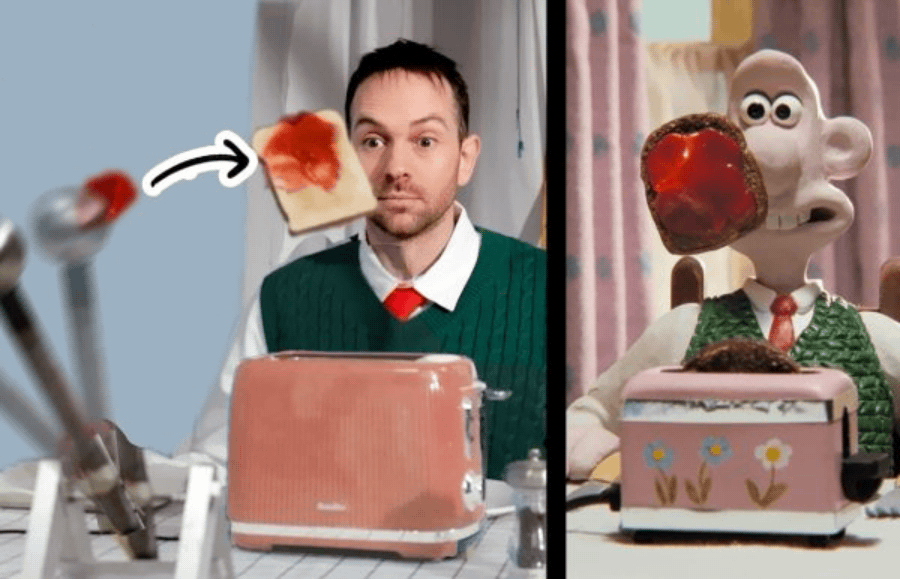
… and, we moderns tend to ask, how can we make it faster and easier?… a tendency lampooned, a la Rube Goldberg, in Aardman‘s Classic Wallace and Gromit outing The Wrong Trousers:
Joseph Herscher, proprietor of the wonderful Joseph’s Machines, put the concept to test: he built it…
I’m sure it comes as no surprise that Wallace & Gromit: The Wrong Trousers was a favourite of mine growing up, so this machine has been extra special to create! This video not only contains TWO different versions of the final result, but I also take you through my process of figuring out dangerous stunts, solving sticky jam complications and treating dog stage fright. Fun fact: The trousers at the very end were lent to me by Aardman Studios!
Modernizing the most important meal of the day: “Joseph’s Machines recreates Wallace & Gromit’s automated breakfast machine,” via the terrific The Kids Should See This.
* “When you wake up in the morning, Pooh,” said Piglet at last, “what’s the first thing you say to yourself?”
“What’s for breakfast?” said Pooh. “What do you say, Piglet?”
“I say, I wonder what’s going to happen exciting today?” said Piglet.
Pooh nodded thoughtfully. “It’s the same thing,” he said.”
– A. A. Milne
###
As we ponder progress, we might recall that today is National Quiche Lorraine Day.

I’ll take the low road…
 source: Argonne National Laboratory
Cartoonist Rube Goldberg sketched ironic paeans to parsimony– cartoons depicting the simplest of things being done in the most elaborate and complicated of ways. His whimsy inspired Purdue University to hold an annual Rube Goldberg Contest, in which teams of college students from around the country compete “to design a machine that uses the most complex process to complete a simple task – put a stamp on an envelope, screw in a light bulb, make a cup of coffee – in 20 or more steps.”
New Scientist reports on this year’s meet:
Who ever said a machine should be efficient? The device in this video was deliberately over-engineered to water a plant in 244 steps, while illustrating a brief history of life and the universe in the meantime. Created by students at Purdue University in West Lafayette, Indiana, it sets a new world record for the most complex Rube Goldberg machine – a contraption designed to complete a simple task through a series of chain reactions.
The machine was unveiled in March at the National Rube Goldberg Machine Championships held at Purdue University. The competition, first held in 1949, challenges competitors to accomplish a simple task in under 2 minutes, using at least 20 steps.
Although this machine used the greatest number of steps, it encountered some problems during the contest so was disqualified. But the team tried it again afterwards and it worked – too late to compete in the championships but still valid as a world record entry. They should find out this week if Guinness World Records accepts their record-breaking feat.
For more Rube Goldberg machines, check out our previous coverage of the championships, watch this cool music video by OK Go or see how an elaborate Japanese device could fix you a noodle dinner.
As we savor the sheer silliness of it all, we might recall that The American Academy of Arts and Sciences, which was founded during the Revolutionary War, was chartered on this date in 1780.
Established by by John Adams, James Bowdoin, John Hancock, and other leaders who contributed prominently to the establishment of the new nation, its government, and its Constitution, the Academy’s purpose was (in the words of the Charter) “to cultivate every art and science which may tend to advance the interest, honour, dignity, and happiness of a free, independent, and virtuous people.”
Over the years, just about everyone a reader may have encountered in a U.S. History text has been a member: The original incorporators were later joined by Benjamin Franklin, George Washington, Thomas Jefferson, Charles Bulfinch, Alexander Hamilton, John Quincy Adams, and others. During the 19th century, the elected membership included Daniel Webster, Henry Wadsworth Longfellow, John J. Audubon, Louis Agassiz, Asa Gray, Ralph Waldo Emerson, and Alexander Graham Bell. In the early decades of the twentieth century, membership in the Academy continued to grow as other noted scholars, scientists, and statesmen were elected– including A. A. Michelson, Percival Lowell, Alexander Agassiz and, later, Charles Steinmetz, Charles Evans Hughes, Samuel Eliot Morison, Albert Einstein, Henry Lee Higginson, Woodrow Wilson, William Howard Taft, and Henry Cabot Lodge. (Current members are listed here.)
Today the Academy is (in its self-explanation) “an international learned society with a dual function: to elect to membership men and women of exceptional achievement, drawn from science, scholarship, business, public affairs, and the arts, and to conduct a varied program of projects and studies responsive to the needs and problems of society.”
 The Minerva Seal (source)
You must be logged in to post a comment.