Posts Tagged ‘Edison’
“‘When I use a word,’ Humpty Dumpty said in rather a scornful tone, ‘it means just what I choose it to mean — neither more nor less.'”*…
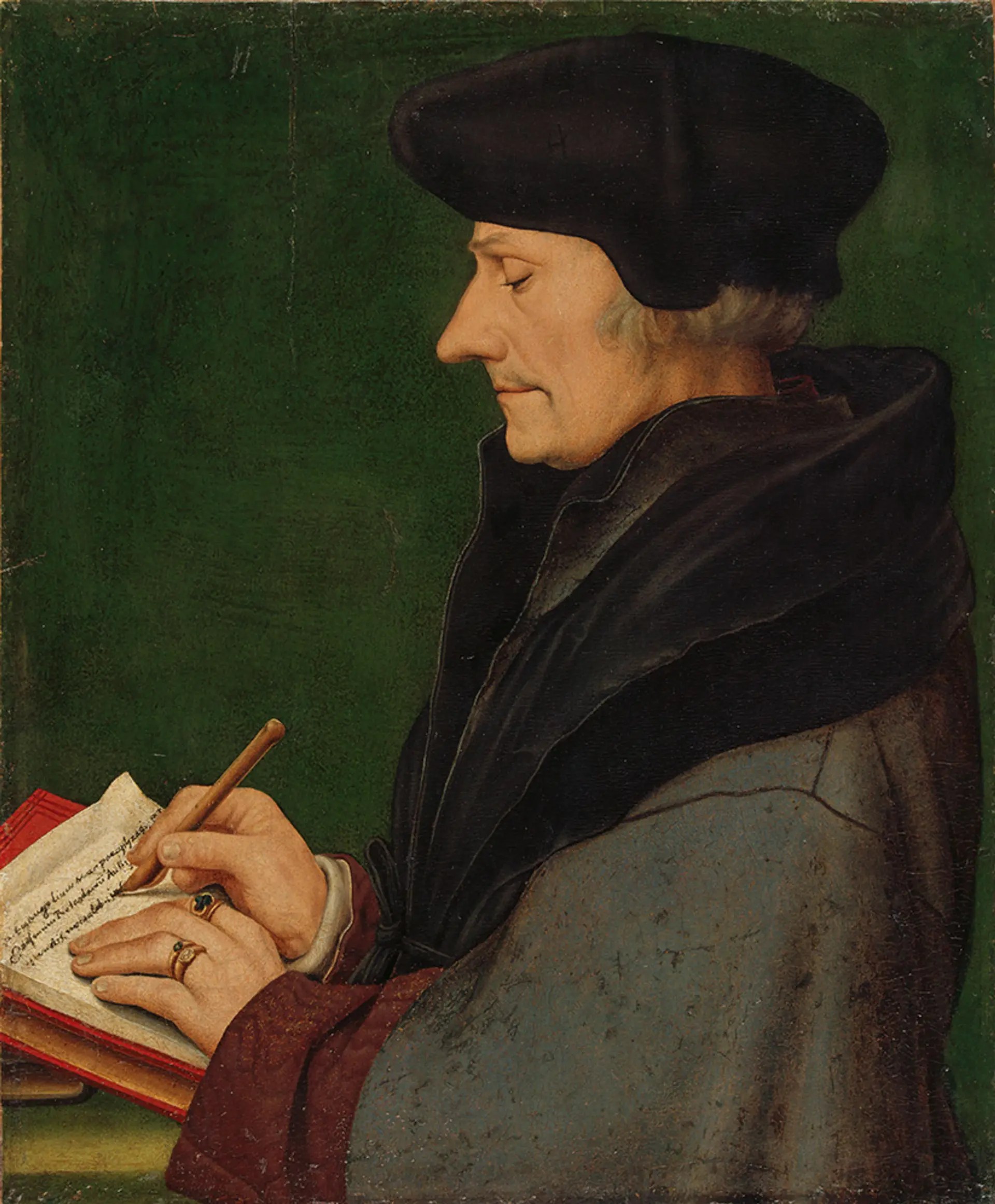
Like today’s large language models, some 16th-century humanists (like Erasmus) had techniques to automate writing. But as Hannah Katznelson explains, others (like Rabelais) called foul…
The Renaissance scholar and educator Erasmus of Rotterdam opens his polemical treatise The Ciceronian (1528) by describing the utterly dysfunctional writing process of a character named Nosoponus. The Ciceronianis structured as a dialogue, withtwo mature writers, Bulephorus and Hypologus, trying to talk Nosoponus out of his paralysing obsession with stylistic perfection. Nosoponus explains that it would take him weeks of fruitless writing and rewriting to produce a casual letter in which he asks a friend to return some borrowed books. He says that writing requires such intense concentration that he can do it only at night, when no one else is awake to distract him, and even then his perfectionism is so intense that a single sentence becomes a full night’s work. Nosoponus goes over what he’s written again and again, but remains so dissatisfied with the quality of his language that eventually he just gives up.
Nosoponus’s problem might resonate. Who has not spent too long going over the wording of a simple email, at some point or another? Today there is an easy fix: we have large language models (LLMs) to write our letters for us, helpfully proffering suggestions as to what we might say, and how we might phrase it. When I input Nosoponus’s intended request into GPT-4, it generated the following almost instantly:
Hey [Friend’s Name],
Hope you’re doing well! I just realised I never got those books back that I lent you a while ago. No rush, but whenever you get a chance, I’d love to get them back. Let me know what works for you! Thanks!
Nosoponus
But there was a solution in the 16th century, too. A humanist education on the Erasmian model could train its students to produce letters of any length, on any topic – quickly, easily and eloquently. The French humanist François Rabelais, a contemporary of Erasmus, appears to have understood these compositional techniques as automating the creating of text in a way that, retrospectively, looks a lot like how LLMs function. If we want to understand LLMs, and what they are and aren’t capable of, we can look at earlier versions of the same technology – like Erasmian humanism. We can also read authors like Rabelais, who is already thinking about automatic text-generation along these lines, as someone who appreciates the effectiveness of Erasmian generative technology, but at the same time sees it as vitiating the social force of language and, ultimately, ruining language as a tool for moral and political life…
[Katznelson recounts Erasmus’s efforts, Rabelais’s response, and unpacks the important differences between our own authentic speech language created to speak for us and their practical and moral implications…]
What lessons from the 16th century can tell us about AI and LLMs: “Methodical banality,” from @aeon.co.
* Lewis Carroll, Through the Looking Glass
###
As we honor authenticity, we might recall that it was on this date in 1886 that three U.S. patents were issued to Alexander Graham Bell’s Volta Labs for “recording and reproducing speech and other sounds.” The Graphophone, was an improved (and the first practical) version of the Edison phonograph (from 1877), and became the foundation on which the speech recording (e.g., dictaphone) and recorded music (and spoken word) industries began to grow.

“You are the music while the music lasts”*…

Composer (and Stanford professor) Jonathan Berger explains how music works its magic on our brains…
One evening, some 40 years ago, I got lost in time. I was at a performance of Schubert’s String Quintet in C major. During the second movement I had the unnerving feeling that time was literally grinding to a halt. The sensation was powerful, visceral, overwhelming. It was a life-changing moment, or, as it felt at the time, a life-changing eon.
It has been my goal ever since to compose music that usurps the perceived flow of time and commandeers the sense of how time passes. Although I’ve learned to manipulate subjective time, I still stand in awe of Schubert’s unparalleled power. Nearly two centuries ago, the composer anticipated the neurological underpinnings of time perception that science has underscored in the past few decades.
The human brain, we have learned, adjusts and recalibrates temporal perception. Our ability to encode and decode sequential information, to integrate and segregate simultaneous signals, is fundamental to human survival. It allows us to find our place in, and navigate, our physical world. But music also demonstrates that time perception is inherently subjective—and an integral part of our lives. “For the time element in music is single,” wrote Thomas Mann in his novel, The Magic Mountain. “Into a section of mortal time music pours itself, thereby inexpressibly enhancing and ennobling what it fills.”
We conceive of time as a continuum, but we perceive it in discretized units—or, rather, as discretized units. It has long been held that, just as objective time is dictated by clocks, subjective time (barring external influences) aligns to physiological metronomes. Music creates discrete temporal units but ones that do not typically align with the discrete temporal units in which we measure time. Rather, music embodies (or, rather, is embodied within) a separate, quasi-independent concept of time, able to distort or negate “clock-time.” This other time creates a parallel temporal world in which we are prone to lose ourselves, or at least to lose all semblance of objective time.
In recent years, numerous studies have shown how music hijacks our relationship with everyday time…
The fascinating story of “How Music Hijacks Our Perception of Time,” in @NautilusMag.
* T. S. Eliot
###
As we tangle with tempo, we might spare a thought for Charles Sumner Tainter; he died on this date in 1940. A scientific instrument maker, engineer, and inventor, he is best known for his collaborations with Alexander Graham Bell, and for his significant improvements to Thomas Edison’s phonograph, resulting in the Graphophone— which, beyond bringing music to living rooms around the world by making Edison’s idea commercially feasible, also spawned the Dictaphone.

“In the landscape of extinction, precision is next to godliness”*…

There is a portion of the sky where no spacefarer wants to go. It causes Astronauts to see shooting stars in front of their eyes, sets off emergency sensors and renders satellites useless. This Bermuda Triangle of space isn’t just a cause for concern for our future of space exploration, it could be the sign of something far more deadly. This may herald an event that last happened 42,000 years ago, which wiped out our closest relative, the Neanderthals. Welcome to the terrifying world of the South Atlantic Anomaly.
In the 80s engineers noticed that most satellite errors happened over South America and the South Atlantic. These errors ranged from minor glitches, wiped data to full-blown crashed satellites. But they couldn’t quite pinpoint what was causing these troubling errors, they named this mysterious area the South Atlantic Anomaly (SAA).
We didn’t understand the dangers of this region for a long time. When the Hubble Space Telescope first turned on in 1990 they found that the computers kept crashing and data was corrupted almost every time it flew over the South Atlantic. Not wanting their billion-dollar telescope to crash to Earth, the engineers had no choice but to switch it off every time it passed over this deadly patch of sky, and still do today. Not ideal, but it saves the telescope from this mysteriously dangerous part of space.
So what makes the South Atlantic Anomaly so dangerous? It turns out it is all down to the Sun and a crack in Earths armour caused some very bizarre geophysics.
…
So what does struggling satellites means for us here on Earth? Well, quite a lot really. It could be a sign of something much more deadly, a geomagnetic reversal.
When we picture the Earth’s magnetic field we often think of it as unchanging. It is our eternal armour from deadly solar radiation as well as the guide for our sailors. Even some birds have evolved iron-rich cells in their eyes, enabling them to ‘see’ the magnetic field and navigate the globe. But the magnetic north pole hasn’t always been in the north.
The magnetic poles have flipped repeatedly over the millennia. The field weakens, disappears and then reappears in the opposite direction. We know this because iron-rich lava aligns to the magnetic field and then sets, so we can look at ancient rocks and see what direction magnetic north was when it formed.
We don’t have a complete understanding of how the magnetic field is generated and why it flips. We know that convection currents of iron-rich mantle create the field, but the interactions between these immense systems are complex and hidden from us. What’s more, there are no patterns to the past flipping events, so it is very hard to predict when one will happen.

But, models and simulations show that when the field gets weaker at the beginning of a magnetic flip, it seems to happen in a random area and then grows from there. The poles also start to drift quite dramatically and chaotically. This is worrying because not only does the South Atlantic Anomaly look like the weakening in a simulation, it is also growing, and the North pole is drifting further each year.
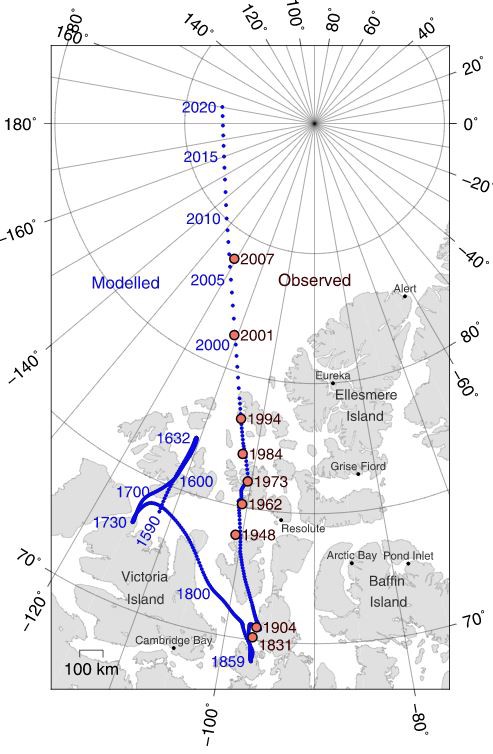
… So, it seems at least plausible that the South Atlantic Anomaly is the start of the next geomagnetic flip. If so, it could have enormous consequences for us!
The last time a flip happened was 42,000 years ago, but it was only a temporary event, and the poles returned to their previous locations, this is known as the Laschamps Excursion, and it lasted for about a thousand years. That meant Earth was without its essential protective shield for an awfully long time.
Now, 42,000 years ago is a significant time. This was when Neanderthals died out. We (Homo Sapiens) also started using caves, red ochre body paint, and the global craze of cave painting started. It was also when a lot of ice-age megafauna died out. All of which has been linked to the flipping of the poles during this period. This extinction event and Sapien revolution has been called the Adams Event (after Douglas Adams and the infamous 42).
This theory suggests that when the poles flipped, the Earth had a thousand years without its protective layer, so the planet was bombarded with radiation. This depleted ozone, increased radiation on the surface, messed with weather patterns and caused abrupt climate change.
Scientist even suggests that this is why we suddenly took to living in caves and using red ochre. We had to hide from the deadly rays of the Sun, and if we ventured out, we needed a powerful suncream, like powdered red ochre. This is why red ochre hand paintings became so widespread around this time.
But these immense changes hit one species particularly hard. Neanderthals were likely red-headed, light-skinned and mostly dwelt in steppes (grassy plains) and woodlands. They probably got sunburnt a lot. Unlike Homo Sapiens, it seems as though Neanderthals didn’t use red ochre much at all! All of this means that cancers would have been a deadly problem for them.
To make all this even worse, the radiation increased the strength of electrical storms, changed the weather patterns and screwed up many ecosystems. So the food that the Neanderthals hunted my have been driven away or gone extinct. It seems Neanderthals died out because they starved to death while being baked by the Sun. Meanwhile, we Homo Sapiens hid from the Sun, used weird sunscreen and adapted to new foods…
These flipping events take hundreds or thousands of years to pass due to the amount of heavy magma that needs to shift to cause a flip (however it is hypothesised it could take as little as a month in extreme circumstances). So we aren’t in any danger of waking up to a new direction for North. But, over the next few decades or hundreds of years, we will see the South Atlantic Anomaly grow and potentially be joined by many other areas of weak magnetism. We may even see some local flips in a few hundred years.
So, it seems at least plausible that the South Atlantic Anomaly is the start of the next geomagnetic flip. If so, it could have enormous consequences for us!
The South Atlantic Anomaly: Earth’s deadly weakness: “Do Failing Satellites Foretell An Imminent Extinction?” From Will Lockett (@welockett).
* Samuel Beckett
###
As we search for true north, we might send charged birthday greetings to a man whose life work could be at risk if there’s a flip (or an intense solar storm), Elihu Thomson; he was born on this date in 1853. An engineer and inventor, he was instrumental in developing the practical applications of electricity, especially alternating current. He invented electric welding and other important advances in electric lighting and power (among his lifetime total of about 700 patents). Thomson was also a cofounder of the General Electric Company (in 1892, in a merger of his Thomson-Houston Electric Company with the Edison Company.

“There is in souls a sympathy with sounds”*…

A Marconi-Stille recording machine, which the BBC helped to develop. It used thin steel for tape, a single spool of which weighed more than 20lb. (Photo taken in 1936)
In the worlds of television. audio, and film production, The BBC Sound Archive is legendary. Founded in 1936, its holdings date back to the late 19th century and include many rare items, including contemporary speeches by public and political figures, folk music, British dialects and sound effects– along with most BBC Radio programs. The pace of collection has flagged a bit under recent budget pressures; still, the archive is 350,000 hours of material in total duration.
The public has had some access to the archive through the British Library. But now there is a more direct channel: the BBC has made 16,000 sound effects available (for personal, educational or research use) for download directly on its web site. From “Drilling and reaming machine operating, with occasional pauses” to “Tropical Forest, West Africa at dawn.” there’s (literally) a world there to hear.
* William Cowper
###
As we lend an ear, we might recall that it was on this date in 1888, that Nikola Tesla was issued several patents relating to the induction magnetic motor, alternating current (AC) sychronous motor, AC transmission, and electricity distribution (Nos. 381,968-70; 382,279-82).
In his extraordinary career, Tesla patented over 110 innovations, ranging from these (which he deployed at Niagara Falls among other spots; in the long run, Tesla was right and Edison– proponent of direct current/DC, and vicious opponent of Tesla– wrong: AC became the standard) to the first wireless remote control. Tesla designed and began planning a “worldwide wireless communications system” that was backed by JP Morgan… until Morgan lost confidence and pulled out. “Cyberspace,” as described by the likes of Bill Gibson and Neal Stephenson, was largely prefigured in Tesla’s plan. Often mis-remembered (as a fringe figure, almost a looney), if at all, Tesla was a remarkable genius, whose talent ran far, far ahead of his luck. He died penniless in 1943.

“With recording, everything changed”*…

To the question “When were recordings invented?,” we might be tempted to answer “1877” — the year when Thomas A. Edison was first able to record and playback sound with a phonograph. But what if we think of recordings not as mere carriers of sound, but as commodities that can be bought and sold, as artifacts capable of capturing and embodying values and emotions; of defining a generation, a country or a social class? The story then becomes one that unfolds over three decades and is full of many layers and ramifications. Without Edison’s technological innovations, recordings would have certainly never existed — but hammering out the concept of recording were also a myriad of other inventors, musicians, producers and entrepreneurs from all over the world. Most of them were enthusiastic about being part of a global revolution, but they worked in close connection with their milieu too, shaping recording technologies and their uses to relate to the needs, dreams, and desires of the audiences they knew…
The full(er) story: “Inventing the Recording.”
* “With recording, everything changed. The prospect of music being detachable from time and place meant that one could start to think of music as a part of one’s furniture. It’s an idea that many composers have felt reluctant about because it seemed to them to diminish the importance of music.” – Brian Eno
###
As we drop the needle, we might recall that it was on this date in 1900 that “His Master’s Voice,” the logo of the Victor Talking Machine Company (later RCA Victor), was registered with the US Patent Office. The logo famously featured the dog “Nipper” looking into the horn of a gramophone.

You must be logged in to post a comment.