Posts Tagged ‘audio’
“The blues are the roots and the other musics are the fruits”*…

We recently lost an audio pioneer: Ben Manilla, an award-winning radio and podcast producer, audio entrepreneur, pioneering disc jockey, and broadcast journalism educator, passed away at the end of last month. In his long and storied career, he won awards (the Peabody, Columbia University’s Edward Howard Armstrong Award, RTNDA Edward R. Murrow Award, and the Scripps Howard Award among others) for everything from Philosophy Talk (from Stanford University) to The Loose Leaf Book Company (with Tom Bodett).
But Ben had a long suit in programming about the Blues. His work with Martin Scorcese and the Experience Music Project helped lead the year-long, nation-wide multimedia event, “The Blues.” It included Ben’s thirteen-hour radio documentary, The Blues with Keb’ Mo’, the most widely distributed special in the history of Public Radio International (PRI). His long running Elwood’s BluesMobile with Dan Aykroyd (nee, House of Blues) was recently inducted into the Library of Congress.

Here in tribute both to Ben and to the Blues, the series’ induction ceremony at the Library of Congress:
(Image at the top: source)
* “The blues are the roots and the other musics are the fruits. It’s better keeping the roots alive, because it means better fruits from now on. The blues are the roots of all American music. As long as American music survives, so will the blues.” – Willie Dixon
###
As we feel it, we might recall that it was on this date in 1997 that Bo Diddley, Keb’ Mo’, Buddy Guy, and a host of others performed at a tribute at the Kennedy Center to the “father of Chicago Blues,” Muddy Waters.
“How television stages the world becomes the model for how the world is properly to be staged”*…
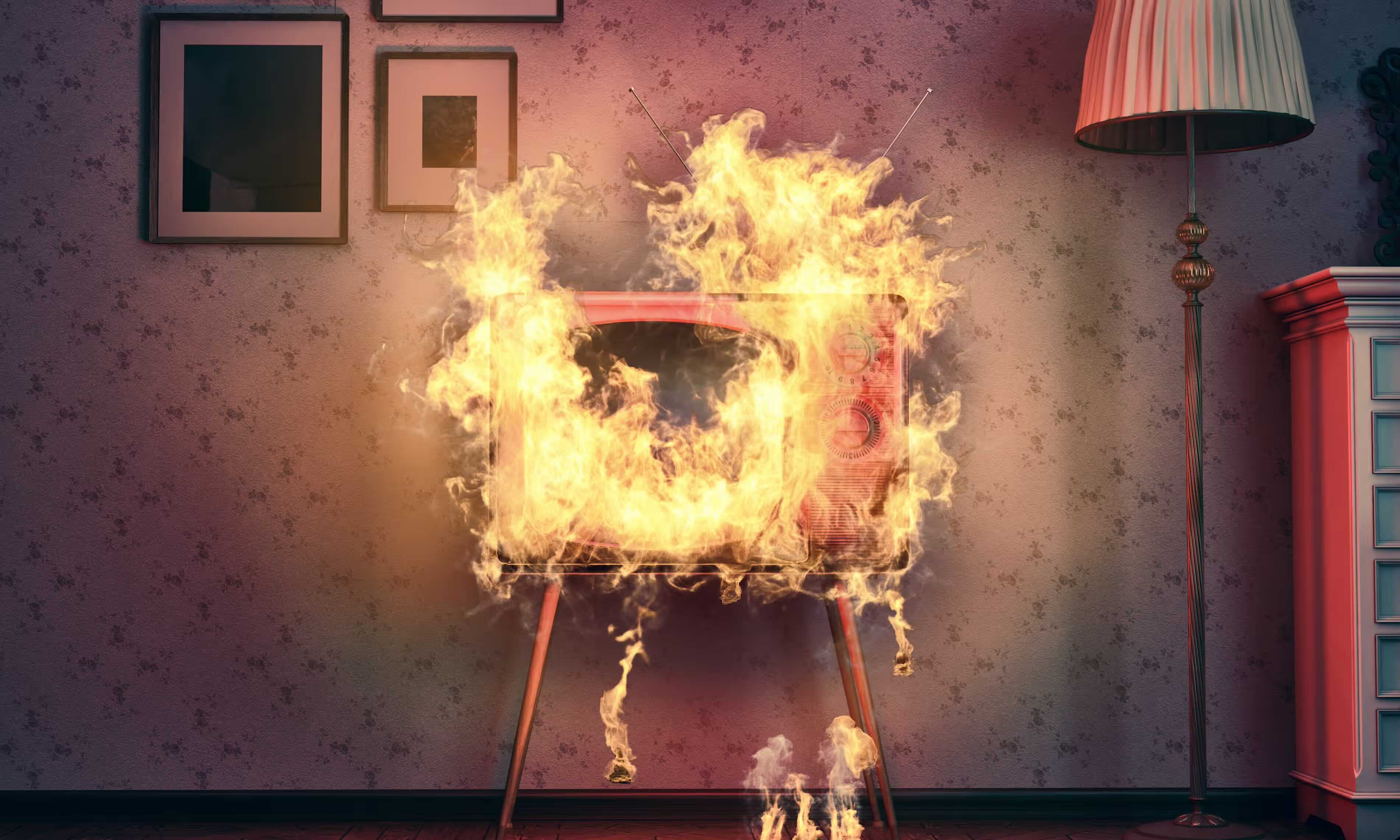
… and, as Mark Sweney reports, that staging is undergoing a fundamental transition. Case in point: Warner Bros Discovery’s recent massive write-down of traditional broadcast assets as it struggles to play catch-up with streaming and video services…
Warner Bros Discovery’s announcement… of a $9bn (£7bn) writedown in the value of its TV networks is a stark acknowledgment of the damage the streaming wars are inflicting on traditional broadcasting models.
The astonishing figure, which pushed the US entertainment group to a quarterly net loss of $10bn (£7.9bn) and sent shares sliding 12% in early trading on Thursday, lays bare how channels such as CNN, TLC and the Food Network can no longer rely on a captive cable subscriber base.
The rapid consumer shift away from high-priced TV packages, coupled with the inexorable decline in advertising, has forced traditional TV companies to invest billions in low-cost streaming services to catch up with first movers such as Netflix.
The question is now whether companies such as WBD – home to TV and film content including Furiosa: A Mad Max Saga, Godzilla x Kong: The New Empire, The Big Bang Theory, Succession, Friends and all Olympics events – can build the scale and make significant profits from their streaming operations before the death of linear television delivered by cable, satellite or aerial…
…
… Disney has more than 200 million global streaming subscribers, and WBD exceeds 100 million globally, with Discovery+ now the fastest-growing service in the UK thanks to winning the rights to show every Olympic discipline. But the battle is not just to continue to drive scale.
Boosting revenue and profits per subscriber has become critical through strategies including rapid rounds of price increases – Disney has just announced a set of price rises for later this year – as well as driving slightly cheaper ad-funded tiers to pull in cost-conscious consumers.
While traditional TV companies struggle with managing the decline in their legacy businesses, with drastic rounds of cost-cutting after a decade of profligate spending on content in the first decade of the streaming wars, Netflix points to a viable future.
The streaming giant, which once struggled with mounting losses running into tens of billions of dollars, has seen its market value surge by more than 50% over the past year after turning the profitability corner while continuing to see significant growth in subscribers.
WBD’s chief executive, David Zaslav, who has considered breaking up the company but concluded that is not currently the best option, said the market was being hit by a “generational disruption” that requires traditional TV companies to take “bold, necessary steps”.
Richard Broughton, director at Ampere Analysis, said: “Legacy TV businesses are in decline but the shift is not so rapid that it can’t be managed. There are still a lot of broadcast TV viewers, they have the time to pivot to profitability in the streaming world.”…
Dealing with disruption: “‘Traditional TV is dying’: can networks pivot and survive?” from @marksweney in @guardian.
Corollary damage: “two venerable TV trade publications, Broadcasting & Cable and Multichannel News, will shut down“
See also: “The music industry is suffering from a streaming hangover” (gift link) and on a more upbeat note, “Radio shows surprising resilience even in a rapidly changing media world.”
For (just one example of) the kind of speculation that tectonic shifts of this sort can elicit: “Why Apple should buy Warner Bros. Discovery. No, seriously.“
And for one take on why all of this is underway: “The Addiction Economy.”
* Neil Postman, Amusing Ourselves to Death
###
As we muse on media, we might spare a thought for Dominick George “Don” Pardo Jr.; he died on this date in 2014. A member of the Television Hall of Fame, Pardo had a 70-year tenure with NBC, working as the announcer for early incarnations of such notable shows as The Price Is Right, Jackpot, Jeopardy!, Three on a Match, Winning Streak, and NBC Nightly News. His longest, and best-known, announcing job was for NBC’s Saturday Night Live, a job he held for 38 seasons, from the show’s debut in 1975 until his death.

“Presenting honest stories of working people as told by rich Hollywood stars”*…
A self-contained four-man comedy troupe of writers/actors whose medium was the audio record, they created brilliant, multi-layered surrealist satire out of science-fiction, TV, old movies, avant-garde drama and literature, outrageous punning, the political turmoil of the Sixties, the great shows of the Golden Age of Radio, the detritus of high and low culture (James Joyce meets the found poetry of used-car pitch men) and their own intuitive understanding of the technological possibilities of multi-track recording. Their thirteen albums for CBS, recorded in various group permutations between 1967 and 1975, reveal them to have been at once the Beatles of comedy, the counter-cultural Lewis Carroll, and the slightly cracked step-children of Kafka, Bob and Ray, Jorge Luis Borges, Philip K. Dick, Stan Freberg, Samuel Beckett and the Goon Show.
Stereo Review

Firesign Theatre started to assemble during 1966 at KPFK, a freeform stereo FM radio station in Los Angeles, which was then a very new thing, during Peter Bergman’s “Radio Free Oz” show. Phil Austin and David Ossman worked at the station and would appear on RFO, while Philip Proctor, an actor friend the “Wizard of Oz” (Bergman) knew from Yale, was invited to join a bit later. The name refers to the fact that all four were born under fire signs in the zodiac, and to Orson Welles’ Mercury Theatre. The late night Radio Free Oz show was so popular—and they were regularly gigging in Hollywood’s folk and rock clubs—that they were quickly offered a record contract.
There are four undisputed “classics” in the vast Firesign canon, all recorded between 1967 and 1971, titled (in order) Waiting for the Electrician or Someone Like Him, How Can You Be in Two Places at Once When You’re Not Anywhere at All (which includes their most famous creation, “The Adventures of Nick Danger, Third Eye”), Don’t Crush That Dwarf, Hand Me the Pliers, and I Think We’re All Bozos on This Bus. Their first album was recorded in the same CBS radio studio where The Jack Benny Show was taped using vintage microphones and sound effects. By the time of their second record they were using 16-track tape machines in the studio, constructing tightly assembled radio plays with extremely creative sound effects and spatial cues that suggested time travel, watching something at a domed planetarium, being on a people mover, getting into a car where the inside is bigger than the outside and so on. These four records are the ultimate presentation of their unusual artform—literature as much as performed comedy that’s been carefully sculpted in a recording studio—but there are at least 20 other albums, dozens upon dozens of hours of live performances recorded onstage and during their radio shows, and TV and film work. Dear Friends, a 1972 released two record compilation of the best of their syndicated radio show of the same name is also considered to be a classic Firesign album, but being culled from live radio, it’s less elaborately constructed, and more spontaneous and improvisational.
These five albums represent the cream of the crop and they are all masterworks of surrealist “theater of the mind” sci-fi counterculture comedy. There was nothing else like them, and the sole thing I can think of to compare them to would be the Monty Python albums. Firesign Theatre were often called “the American Monty Python,” but this comparison would stop at the Python albums, as Firesign were a strictly audio proposition for the most part, and certainly during their late 60s/early 70s golden years. [They are actually much more akin to lysergic Goon Show, of which all four of the Firesign Theatre were fanatical fans. In fact, Peter Bergman wrote some TV comedy sketches in London with Spike Milligan in the early 1960s.]…
These days, everybody is always listening to their favorite podcasts, at the gym, in the car, cooking, whatever, they’ve all got a podcast going on in the background. Why not think of the Firesign oeuvre as the greatest comedy podcast ever made?
Well, you’re in luck as all of the major (and much of the minor) works of Firesign Theatre are streaming from the exact same sources as that weekly true crime thing you always listen to. Spotify, TIDAL, YouTube, Amazon Music, Apple Music, all of them are pumping Firesign Theatre directly into your home. The four (or five) classic albums are super easy for you to listen to. Just a few clicks away from where you are reading this…
An appreciation of past masters: “Firesign Theatre’s ‘Dope Humor of the Seventies’” from @DangerMindsBlog.
* Firesign Theatre
###
As we slip on the headphones, we might recall that it was on this date in 1987 that ABC premiered Max Headroom (which had originated on the UK’s Channel 4 in 1985). Painfully prophetic, the series followed the near-future exploits on the digital avatar of Edison Carter, a news host/reporter who hosts the most popular show on Channel 23.
As SyFy Wire explains, this future is a:
…dystopia in which several television networks essentially rule the world. That’s no exaggeration — the government knows all about it too, and plays along, while the networks do what they want without anyone to curtail their schemes. There are no “off” switches on TVs, so you can’t escape the watchful eye of the networks, who’ve even gone so far as to watch citizens through their TVs.
Each episode revolved around the various evil plans the television conglomerates planned to enact on the unsuspecting public. Network 23 is one of the major stations with the highest-rated “new” program, which Edison Carter himself hosts. Real-time ratings are more important than ever in this world, as they translate to money put toward advertisements. In fact, ads have taken over stocks in this world, making whoever performs the best on-air essentially the most powerful entity on the planet.
Every installment of the series is about the inner workings of the crooked conglomerates, up to and including advertisements known as “Blipverts,” which are completely capable of killing people just by airing on television. They’re meant to condense longer ads into a few seconds so the station can run more, but they’re much deadlier than that…
Catch an episode here.

“With recording, everything changed”*…

To the question “When were recordings invented?,” we might be tempted to answer “1877” — the year when Thomas A. Edison was first able to record and playback sound with a phonograph. But what if we think of recordings not as mere carriers of sound, but as commodities that can be bought and sold, as artifacts capable of capturing and embodying values and emotions; of defining a generation, a country or a social class? The story then becomes one that unfolds over three decades and is full of many layers and ramifications. Without Edison’s technological innovations, recordings would have certainly never existed — but hammering out the concept of recording were also a myriad of other inventors, musicians, producers and entrepreneurs from all over the world. Most of them were enthusiastic about being part of a global revolution, but they worked in close connection with their milieu too, shaping recording technologies and their uses to relate to the needs, dreams, and desires of the audiences they knew…
The full(er) story: “Inventing the Recording.”
* “With recording, everything changed. The prospect of music being detachable from time and place meant that one could start to think of music as a part of one’s furniture. It’s an idea that many composers have felt reluctant about because it seemed to them to diminish the importance of music.” – Brian Eno
###
As we drop the needle, we might recall that it was on this date in 1900 that “His Master’s Voice,” the logo of the Victor Talking Machine Company (later RCA Victor), was registered with the US Patent Office. The logo famously featured the dog “Nipper” looking into the horn of a gramophone.

“If you talk to the animals they will talk with you”*…

The Macaulay Library is the world’s largest and oldest scientific archive of biodiversity audio and video recordings. Our mission is to collect and preserve recordings of each species’ behavior and natural history, to facilitate the ability of others to collect and preserve such recordings, and to actively promote the use of these recordings for diverse purposes spanning scientific research, education, conservation, and the arts.
Scientists worldwide use our audio and video recordings to better understand and preserve our planet. Teachers use our sounds and videos to illustrate the natural world and create exciting interactive learning opportunities. We help others depict nature accurately and bring the wonders of animal behavior to the widest possible audience. It is an invaluable resource at your fingertips.
This archive grows through the efforts of dedicated recordists who share their recordings with the community. We encourage recordists around the world to contribute their recordings and data to what has become an irreplaceable resource…
Browse the collection and learn more about its work at Cornell’s Macaulay Library.
And explore more “sounds that never die” at “The Eternal Auditorium.”
* Chief Dan George
###
As we peel our ears, we might spare a thought for John W. “Jack” Ryan; he died on this date in 1991. A Yale-trained engineer, Ryan left Raytheon (where he worked on the Navy’s Sparrow III and Hawk guided missiles) to join Mattel. He oversaw the conversion of the Mattel-licensed “Bild Lili” doll into Barbie (contributing, among other things, the joints that allowed “her” to bend at the waist and the knee) and created the Hot Wheels line. But he is perhaps best remembered as the inventor of the pull-string, talking voice box that gave Chatty Cathy her voice.

Ryan with his wife, Zsa Zsa Gabor. She was his first only spouse; he, her sixth.
You must be logged in to post a comment.