Posts Tagged ‘streaming’
“Badger hates Society, and invitations, and dinner, and all that sort of thing”*…

Americans are now spending more time alone– mostly at home– than ever. It’s changing our personalities, our politics, and even our relationship to reality. While the pandemic certainly enforced some of that isolation; the post-COVID world remains extraordinarily atomized.
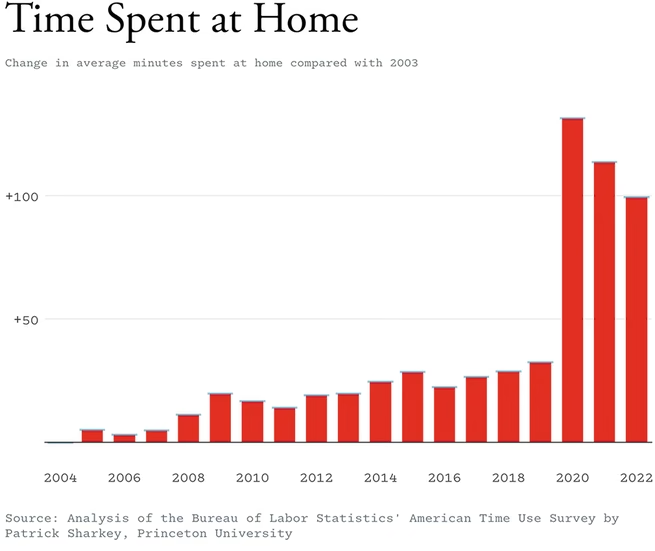

In a bracing essay, Derek Thompson, explores the emergence of this wide-spread isolation, unpacking its drivers, enumerating its considerable (personal and civic) costs, musing on the possible impact of AI, and pondering what might lead to a return to sociability…
… “I have a view that is uncommon among social scientists, which is that moral revolutions are real and they change our culture,” Robert Putnam [author of Bowling Alone] told me. In the early 20th century, a group of liberal Christians, including the pastor Walter Rauschenbusch, urged other Christians to expand their faith from a narrow concern for personal salvation to a public concern for justice. Their movement, which became known as the Social Gospel, was instrumental in passing major political reforms, such as the abolition of child labor. It also encouraged a more communitarian approach to American life, which manifested in an array of entirely secular congregations that met in union halls and community centers and dining rooms. All of this came out of a particular alchemy of writing and thinking and organizing. No one can say precisely how to change a nation’s moral-emotional atmosphere, but what’s certain is that atmospheres do change. Our smallest actions create norms. Our norms create values. Our values drive behavior. And our behaviors cascade.
The anti-social century is the result of one such cascade, of chosen solitude, accelerated by digital-world progress and physical-world regress. But if one cascade brought us into an anti-social century, another can bring about a social century. New norms are possible; they’re being created all the time. Independent bookstores are booming—the American Booksellers Association has reported more than 50 percent growth since 2009—and in cities such as New York City and Washington, D.C., many of them have become miniature theaters, with regular standing-room-only crowds gathered for author readings. More districts and states are banning smartphones in schools, a national experiment that could, optimistically, improve children’s focus and their physical-world relationships. In the past few years, board-game cafés have flowered across the country, and their business is expected to nearly double by 2030. These cafés buck an 80-year trend. Instead of turning a previously social form of entertainment into a private one, they turn a living-room pastime into a destination activity. As sweeping as the social revolution I’ve described might seem, it’s built from the ground up by institutions and decisions that are profoundly within our control: as humble as a café, as small as a new phone locker at school…
On how we spend our time and what that yields: “The Anti-Social Century,” from @dkthomp.bsky.social in @theatlantic.com (gift article).
See also: “You’re Being Alienated From Your Own Attention,” from @chrislhayes.bsky.social (also in @theatlantic.com, also a gift article)
* Kenneth Grahame, The Wind in the Willows
###
As we call a friend, we might recall that it was on this date in 1915 that Alexander Graham Bell placed the first transcontinental phone call, from New York to San Francisco, where the Panama–Pacific International Exposition celebrations were underway and his assistant, his assistant Thomas Augustus Watson stood by. Bell repeated his famous first telephonic words, “Mr. Watson, come here. I want you,” to which Watson this time replied “It will take me five days to get there now!” Bell’s call officially initiated AT&T’s transcontinental service.

And, on ths date 45 years later, in 1959, The first non-stop transcontinental commercial jet trip was made by an American Airlines Boeing 707, from Los Angeles to New York. The sleek silver plane made the flight in airline official time of 4 hours and 3 minutes, half the usual scheduled time for the prop-driven DC- 7Cs then in regular use on that route.

“How television stages the world becomes the model for how the world is properly to be staged”*…
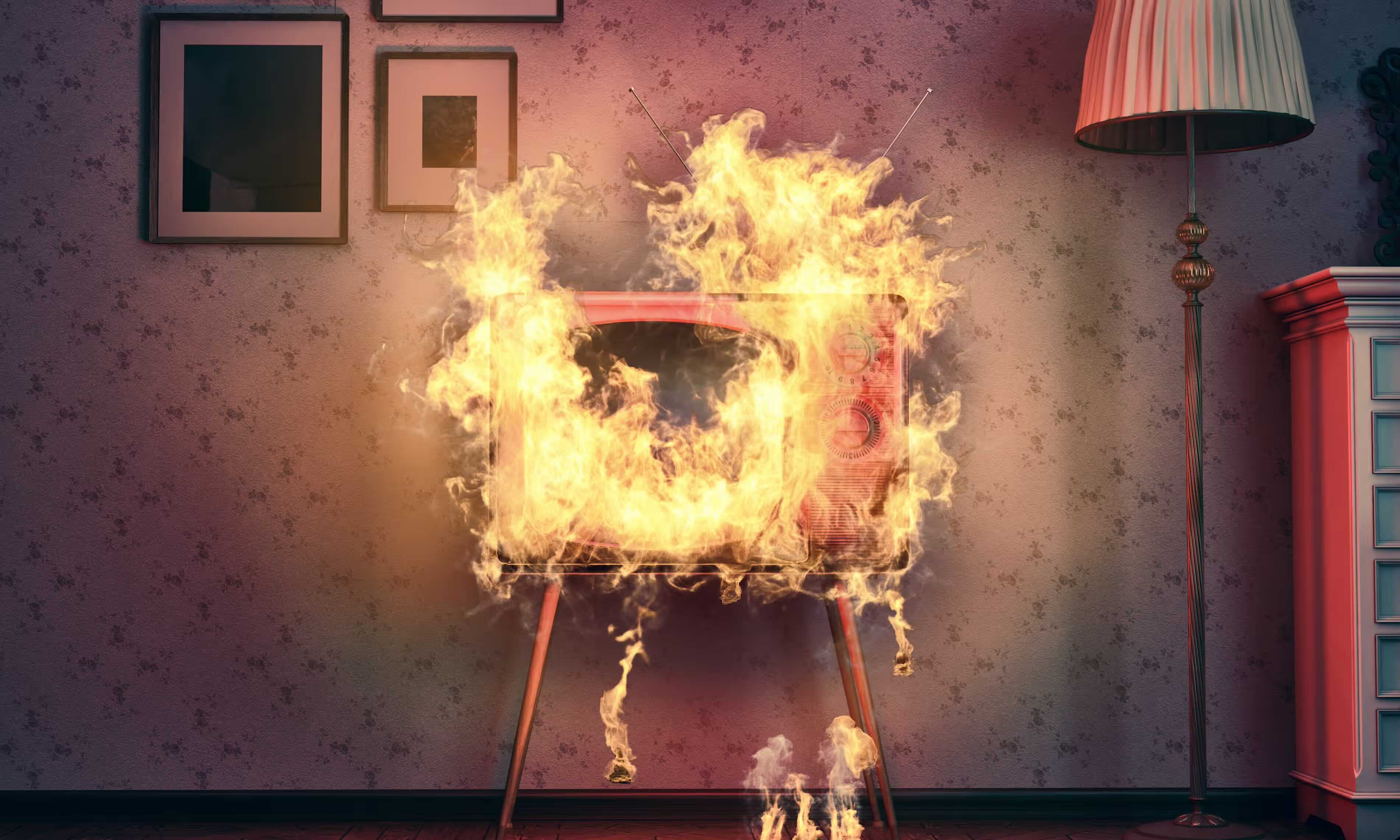
… and, as Mark Sweney reports, that staging is undergoing a fundamental transition. Case in point: Warner Bros Discovery’s recent massive write-down of traditional broadcast assets as it struggles to play catch-up with streaming and video services…
Warner Bros Discovery’s announcement… of a $9bn (£7bn) writedown in the value of its TV networks is a stark acknowledgment of the damage the streaming wars are inflicting on traditional broadcasting models.
The astonishing figure, which pushed the US entertainment group to a quarterly net loss of $10bn (£7.9bn) and sent shares sliding 12% in early trading on Thursday, lays bare how channels such as CNN, TLC and the Food Network can no longer rely on a captive cable subscriber base.
The rapid consumer shift away from high-priced TV packages, coupled with the inexorable decline in advertising, has forced traditional TV companies to invest billions in low-cost streaming services to catch up with first movers such as Netflix.
The question is now whether companies such as WBD – home to TV and film content including Furiosa: A Mad Max Saga, Godzilla x Kong: The New Empire, The Big Bang Theory, Succession, Friends and all Olympics events – can build the scale and make significant profits from their streaming operations before the death of linear television delivered by cable, satellite or aerial…
…
… Disney has more than 200 million global streaming subscribers, and WBD exceeds 100 million globally, with Discovery+ now the fastest-growing service in the UK thanks to winning the rights to show every Olympic discipline. But the battle is not just to continue to drive scale.
Boosting revenue and profits per subscriber has become critical through strategies including rapid rounds of price increases – Disney has just announced a set of price rises for later this year – as well as driving slightly cheaper ad-funded tiers to pull in cost-conscious consumers.
While traditional TV companies struggle with managing the decline in their legacy businesses, with drastic rounds of cost-cutting after a decade of profligate spending on content in the first decade of the streaming wars, Netflix points to a viable future.
The streaming giant, which once struggled with mounting losses running into tens of billions of dollars, has seen its market value surge by more than 50% over the past year after turning the profitability corner while continuing to see significant growth in subscribers.
WBD’s chief executive, David Zaslav, who has considered breaking up the company but concluded that is not currently the best option, said the market was being hit by a “generational disruption” that requires traditional TV companies to take “bold, necessary steps”.
Richard Broughton, director at Ampere Analysis, said: “Legacy TV businesses are in decline but the shift is not so rapid that it can’t be managed. There are still a lot of broadcast TV viewers, they have the time to pivot to profitability in the streaming world.”…
Dealing with disruption: “‘Traditional TV is dying’: can networks pivot and survive?” from @marksweney in @guardian.
Corollary damage: “two venerable TV trade publications, Broadcasting & Cable and Multichannel News, will shut down“
See also: “The music industry is suffering from a streaming hangover” (gift link) and on a more upbeat note, “Radio shows surprising resilience even in a rapidly changing media world.”
For (just one example of) the kind of speculation that tectonic shifts of this sort can elicit: “Why Apple should buy Warner Bros. Discovery. No, seriously.“
And for one take on why all of this is underway: “The Addiction Economy.”
* Neil Postman, Amusing Ourselves to Death
###
As we muse on media, we might spare a thought for Dominick George “Don” Pardo Jr.; he died on this date in 2014. A member of the Television Hall of Fame, Pardo had a 70-year tenure with NBC, working as the announcer for early incarnations of such notable shows as The Price Is Right, Jackpot, Jeopardy!, Three on a Match, Winning Streak, and NBC Nightly News. His longest, and best-known, announcing job was for NBC’s Saturday Night Live, a job he held for 38 seasons, from the show’s debut in 1975 until his death.

“Hollywood will rot on the windmills of Eternity”*…

… or possibly, Daniel Bessner argues, sooner…
… Thanks to decades of deregulation and a gush of speculative cash that first hit the industry in the late Aughts, while prestige TV was climbing the rungs of the culture, massive entertainment and media corporations had been swallowing what few smaller companies remained, and financial firms had been infiltrating the business, moving to reduce risk and maximize efficiency at all costs, exhausting writers in evermore unstable conditions.
“The industry is in a deep and existential crisis,” the head of a midsize studio told me in early August. We were in the lounge of the Soho House in West Hollywood. “It is probably the deepest and most existential crisis it’s ever been in. The writers are losing out. The middle layer of craftsmen are losing out. The top end of the talent are making more money than they ever have, but the nuts-and-bolts people who make the industry go round are losing out dramatically.”
Hollywood had become a winner-takes-all economy. As of 2021, CEOs at the majority of the largest companies and conglomerates in the industry drew salaries between two hundred and three thousand times greater than those of median employees. And while writer-producer royalty such as Shonda Rhimes and Ryan Murphy had in recent years signed deals reportedly worth hundreds of millions of dollars, and a slightly larger group of A-list writers, such as Smith, had carved out comfortable or middle-class lives, many more were working in bare-bones, short-term writers’ rooms, often between stints in the service industry, without much hope for more steady work. As of early 2023, among those lucky enough to be employed, the median TV writer-producer was making 23 percent less a week, in real dollars, than their peers a decade before. Total earnings for feature-film writers had dropped nearly 20 percent between 2019 and 2021.
Writers had been squeezed by the studios many times in the past, but never this far. And when the WGA went on strike last spring, they were historically unified: more guild members than ever before turned out for the vote to authorize, and 97.9 percent voted in favor. After five months, the writers were said to have won: they gained a new residuals model for streaming, new minimum lengths of employment for TV, and more guaranteed paid work on feature-film screenplays, among other protections.
But the business of Hollywood had undergone a foundational change. The new effective bosses of the industry—colossal conglomerates, asset-management companies, and private-equity firms—had not been simply pushing workers too hard and grabbing more than their fair share of the profits. They had been stripping value from the production system like copper pipes from a house—threatening the sustainability of the studios themselves. Today’s business side does not have a necessary vested interest in “the business”—in the health of what we think of as Hollywood, a place and system in which creativity is exchanged for capital. The union wins did not begin to address this fundamental problem.
Currently, the machine is sputtering, running on fumes. According to research by Bloomberg, in 2013 the largest companies in film and television were more than $20 billion in the black; by 2022, that number had fallen by roughly half. From 2021 to 2022, revenue growth for the industry dropped by almost 50 percent. At U.S. box offices, by the end of last year, revenue was down 22 percent from 2019. Experts estimate that cable-television revenue has fallen 40 percent since 2015. Streaming has rarely been profitable at all. Until very recently, Netflix was the sole platform to make money; among the other companies with streaming services, only Warner Bros. Discovery’s platforms may have eked out a profit last year. And now the streaming gold rush—the era that made Dickinson—is over. In the spring of 2022, the Federal Reserve began raising interest rates after years of nearly free credit, and at roughly the same time, Wall Street began calling in the streamers’ bets. The stock prices of nearly all the major companies with streaming platforms took precipitous falls, and none have rebounded to their prior valuation.
The industry as a whole is now facing a broad contraction. Between August 2022 and the end of last year, employment fell by 26 percent—more than one job gone in every four. Layoffs hit Warner Bros. Discovery, Netflix, Paramount Global, Roku, and others in 2022. In 2023, firings swept through the representation giants United Talent Agency and Creative Artists Agency; Netflix, Paramount Global, and Roku again; plus Hulu, NBCUniversal, and Lionsgate. In early 2024, it was announced that Amazon was cutting hundreds of jobs from its Prime Video and Amazon MGM Studios divisions. In February, Paramount Global laid off roughly eight hundred people. It’s unclear which streamers will survive. As James Dolan, the interim executive chair of AMC Networks, told employees in late 2022 as he delivered news of massive layoffs—roughly 1,700 people (20 percent of U.S. staff) would lose their jobs—“the mechanisms for the monetization of content are in disarray.”
Profit will of course find a way; there will always be shit to watch. But without radical intervention, whether by the government or the workers, the industry will become unrecognizable. And the writing trade—the kind where one actually earns a living—will be obliterated…
Film and television writers face an existential threat; viewers, a drab future: “The Life and Death of Hollywood,” from @dbessner in @Harpers. A bracing piece, eminently worth reading in full.
* Allen Ginsberg
###
As we study streaming, we might recall that it was on this date in 1964 that AT&T connected the first Picturephone call (between Disneyland in California and the World’s Fair in New York). The device consisted of a telephone handset and a small, matching TV, which allowed telephone users to see each other in fuzzy video images as they carried on a conversation. It was commercially-released shortly thereafter (prices ranged from $16 to $27 for a three-minute call between special booths AT&T set up in New York, Washington, and Chicago), but didn’t catch on… though, of course, it augured the “future” in which now we live.

“Television is now so desperately hungry for material that they’re scraping the top of the barrel”*…

The television industry, in its new streaming-led form, is in turmoil. The companies that control it are slashing their available libraries and “reorganizing” their operations, leading to layoffs throughout the industry, and writers are on strike. To some extent, these are consequences of the years of deficit-funded efforts to grab subscribers coming home to roost. But as Max Read argues, there is a deeper problem: the people making our entertainment don’t like it…
… [David] Zaslav is this cycle’s big Hollywood villain, most famous for burying completed but unreleased movies for tax write-offs and removing shows from their streaming platforms to save money. When “Max,” the new streaming service that combined all of WBD’s streaming apps into a single offering, was released in May, its interface credited directors and producers together under the hilariously dismissive heading “Creators,” which was both a blatant violation of bargaining agreements around credits and an on-the-nose suggestion that the WBD people simply couldn’t be bothered to care what a “director” is or what one does.
But he is hardly the only person in Hollywood who seems to have more contempt than love for what the industry does. This excellent Vulture piece about the state of streaming by Lane Brown and Joseph Adalian has been rattling around in my head all week, specifically this quote:
One high-level agent says that studios regard the WGA’s demands — for higher minimum pay and staffing requirements, among other things — as simply incompatible with the way TV is now made: “The Writers Guild, delusionally, is harkening back to a day when there were 25 episodes of Nash Bridges a year and repeats and residuals. Back-end payments existed because Europeans were willing to watch our garbage, and Americans were willing to watch repeats of that garbage on cable at 11 at night. The real issue is that the medium changed. Instead of getting a job as a staff writer on CSI: Miami for 46 weeks a year, now it’s a 25-week job working on Wednesday, which is a better show. That’s just progress.”
This begins as a relatively lucid description of why back-end payments existed and then becomes a bizarre fantasy in which, for some strange reason, writers are now obligated to trade stable and remunerative employment for a vague sense of creative fulfillment and prestige, and this trade is called “progress.”…
I don’t meant to make one agent’s offhand quotes to Vulture emblematic of an entire industry, and I know there are many people in Hollywood who would disagree. But the contempt on display for (1) the product being produced, (2) the people who make that product, and (3) the people who consume that product is, I think, widely shared–look at Zaslav, HBO, and TCM. That contempt is nothing new in the entertainment industry, of course. But as it grows and develops it has increasingly made the people in charge unable to distinguish between good product and bad product.
The agent here is committing the same mistake as a lot of bad critics and even more bad development executives, which is to think of “prestige” as a desirable marker of quality, instead of as a kind of genre, or, more cynically, a set of narrative and aesthetic tropes (antiheroes, serialized narratives, film-like cinematography) designed to appeal to a particular marketing demographic–one that happens to be a target demographic for subscription streaming services. As the Vulture piece goes on to point out, just because something is eight episodes long and “actually about trauma” doesn’t automatically make it good, let alone popular…
The agent describes the old residuals system like this: “Back-end payments existed because Europeans were willing to watch our garbage, and Americans were willing to watch repeats of that garbage on cable at 11 at night.” The idea is that people are no longer willing to watch “garbage,” presumably because so many more options are available to them. But this is only a satisfying answer if you assume that “garbage” is automatically bad. What if the problem is that we’re not really making much good garbage anymore?…
You don’t even have to watch the garbage to appreciate its role in the creative ecosystem. The Shield creator Shawn Ryan, who’s quoted in the story above, was a Nash Bridges writer; so too was Watchmen and The Leftovers creator Damon Lindelof. I’m not the first person to make this point, but the entire first generation of “prestige TV” in the 2000s–which is to say, 90 percent of the actually good prestige TV–was written by people who’d spent a lot of time learning to write quickly to a tight structure for a big audience, a set of skills no longer as widespread among writers, to dire consequences for audiences, who have essentially traded consistent, engaging entertainment for the convenience of on-demand streaming.
Networks used to create several Honda Civic shows a year (and, yes, a lot of lemons); these days, if I can stretch this metaphor past the breaking point, streaming platforms seem to mostly create Tesla Model 3s, which is to say expensive, technologically interesting products that gesture at luxury and quality but tend to fall apart quickly and rely almost entirely on hype and conspicuous consumption (not to mention labor exploitation!) to make themselves profitable–and then only after years of burning cash in pursuit of a business model…
Is the problem really that streamers (or writers) are too focused on “prestige” at the expense of “populist” “garbage”? Netflix, the biggest streamer of all, produces mind-boggling amounts of middlebrow and trash TV; every time I open the app there’s a new reality competition between friendship bracelet makers or whatever.
There are many, many cultural and technological reasons for the various (and often overstated) malaises of the streaming era, and there’s no one weird trick for the industry to fix itself. But it’s hard not to notice that, from a labor perspective, the big difference between the era of West Wing and Ally McBeal and now is not so much that writers and directors and actors are too pretentious for lady-lawyer shows but that back then seasons lasted for 20+ episodes, paid more people, promised more consistency (to audiences and to workers above and below the line), and underwent more development. Streamers seem happy to make middlebrow TV; but they also seem unable or unwilling to consistently make good middlebrow TV–by paying enough people, building enough institutional knowledge, committing enough resources, and marketing the product.
You hear sometimes a call from writers or directors or other creatives for studios and streamers to take more risks and get more creative. But I don’t really think the problem of bad TV in the streaming era is an issue of “creativity” (versus conservatism) or “risk” (versus safety) so much as it is an issue of professionalism (versus saying “yes” to 1,000 shows at once, under-developing them, and then killing them en masse for no clear reason). Maybe the reason writers and directors and other creatives are treating TV “like art” instead of like “a job” is because none of the people who hire them are treating it like a job either!
If you do not like movies and TV you cannot make good movies and TV: “Why do entertainment executives hate entertainment?” from @readmaxread in his ever-illuminating newsletter, Read Max. Eminently worth reading in full.
* Gore Vidal
###
As we change the channel, we might recall that it was on this date in 1977 that Elvis performed his last concert at Indianapolis’ Market Square Arena.

“All we can do is stare at the pond, holding our breath”*…

Your correspondent is headed eight time zones away, so (Roughly) Daily will be on hiatus for a bit; regular service should resume on or about May 7.
In the meantime, enjoy Michael Turvey‘s (@tichaelmurvey) interactive “Koi Pond.”
* Haruki Murakami
###
As we contemplate, we might recall that it was on this date in 2003 that Apple launched iTunes. Downloading music had been already popularized by Napster, torrents, and others, but they operated largely outside the law, “sharing”; the sale of music was still confined largely to brick-and-mortar stores (and in a nascent way, to e-tailers like Amazon).
Steve Jobs approached Warner Music, Universal Music Group, and Sony Music to offer their music for 99 cents a song (and ten dollars for a full album). Their sales wounded by illegal file-sharing, the music labels were eager to staunch the bleeding; they struck the deal with Jobs.
iTunes was an instant success, selling over one million songs in its first week; it became the biggest music vendor in the U.S. five years later and remained a force for another decade or so… when it was overtaken by streaming.

You must be logged in to post a comment.