Posts Tagged ‘Saturday Night Live’
“How television stages the world becomes the model for how the world is properly to be staged”*…
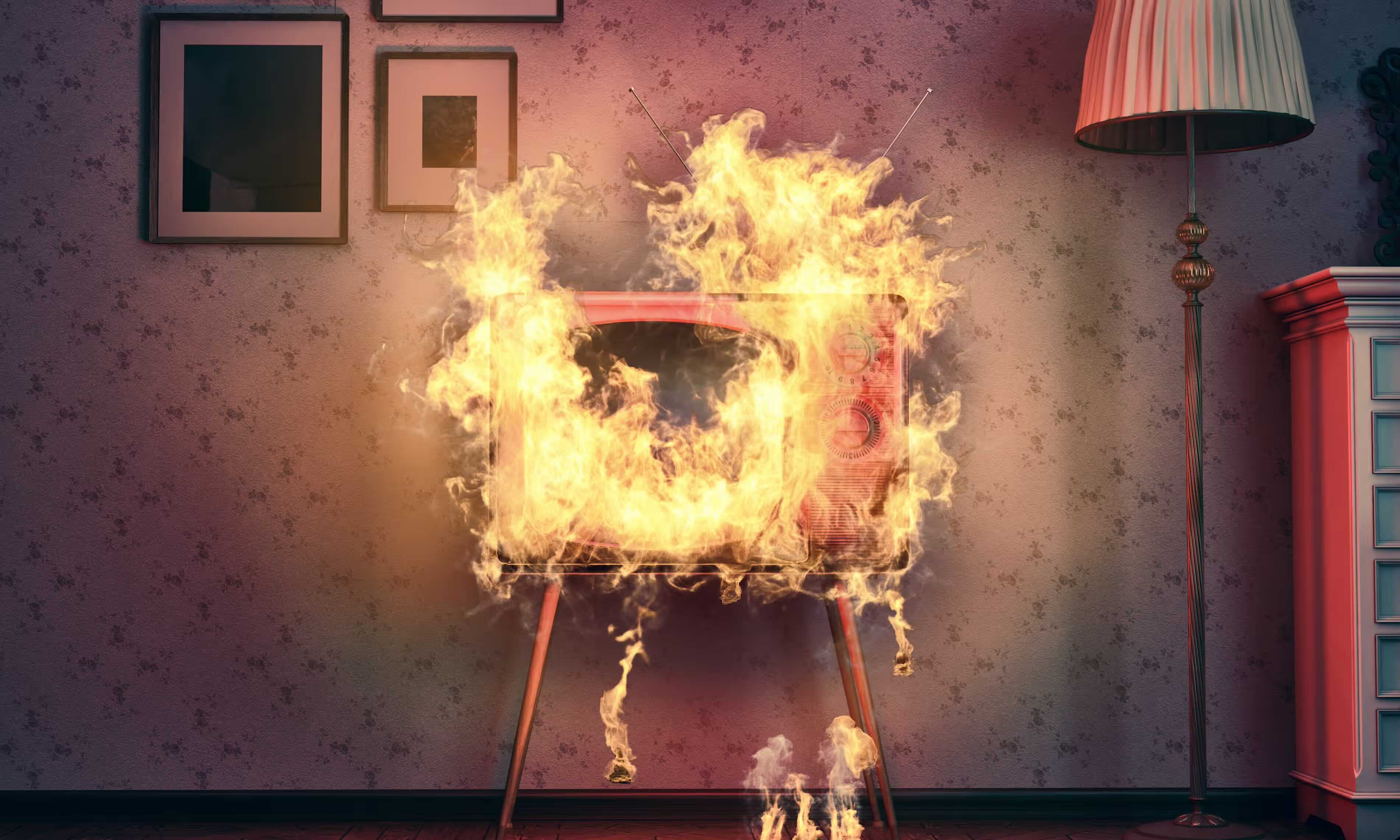
… and, as Mark Sweney reports, that staging is undergoing a fundamental transition. Case in point: Warner Bros Discovery’s recent massive write-down of traditional broadcast assets as it struggles to play catch-up with streaming and video services…
Warner Bros Discovery’s announcement… of a $9bn (£7bn) writedown in the value of its TV networks is a stark acknowledgment of the damage the streaming wars are inflicting on traditional broadcasting models.
The astonishing figure, which pushed the US entertainment group to a quarterly net loss of $10bn (£7.9bn) and sent shares sliding 12% in early trading on Thursday, lays bare how channels such as CNN, TLC and the Food Network can no longer rely on a captive cable subscriber base.
The rapid consumer shift away from high-priced TV packages, coupled with the inexorable decline in advertising, has forced traditional TV companies to invest billions in low-cost streaming services to catch up with first movers such as Netflix.
The question is now whether companies such as WBD – home to TV and film content including Furiosa: A Mad Max Saga, Godzilla x Kong: The New Empire, The Big Bang Theory, Succession, Friends and all Olympics events – can build the scale and make significant profits from their streaming operations before the death of linear television delivered by cable, satellite or aerial…
…
… Disney has more than 200 million global streaming subscribers, and WBD exceeds 100 million globally, with Discovery+ now the fastest-growing service in the UK thanks to winning the rights to show every Olympic discipline. But the battle is not just to continue to drive scale.
Boosting revenue and profits per subscriber has become critical through strategies including rapid rounds of price increases – Disney has just announced a set of price rises for later this year – as well as driving slightly cheaper ad-funded tiers to pull in cost-conscious consumers.
While traditional TV companies struggle with managing the decline in their legacy businesses, with drastic rounds of cost-cutting after a decade of profligate spending on content in the first decade of the streaming wars, Netflix points to a viable future.
The streaming giant, which once struggled with mounting losses running into tens of billions of dollars, has seen its market value surge by more than 50% over the past year after turning the profitability corner while continuing to see significant growth in subscribers.
WBD’s chief executive, David Zaslav, who has considered breaking up the company but concluded that is not currently the best option, said the market was being hit by a “generational disruption” that requires traditional TV companies to take “bold, necessary steps”.
Richard Broughton, director at Ampere Analysis, said: “Legacy TV businesses are in decline but the shift is not so rapid that it can’t be managed. There are still a lot of broadcast TV viewers, they have the time to pivot to profitability in the streaming world.”…
Dealing with disruption: “‘Traditional TV is dying’: can networks pivot and survive?” from @marksweney in @guardian.
Corollary damage: “two venerable TV trade publications, Broadcasting & Cable and Multichannel News, will shut down“
See also: “The music industry is suffering from a streaming hangover” (gift link) and on a more upbeat note, “Radio shows surprising resilience even in a rapidly changing media world.”
For (just one example of) the kind of speculation that tectonic shifts of this sort can elicit: “Why Apple should buy Warner Bros. Discovery. No, seriously.“
And for one take on why all of this is underway: “The Addiction Economy.”
* Neil Postman, Amusing Ourselves to Death
###
As we muse on media, we might spare a thought for Dominick George “Don” Pardo Jr.; he died on this date in 2014. A member of the Television Hall of Fame, Pardo had a 70-year tenure with NBC, working as the announcer for early incarnations of such notable shows as The Price Is Right, Jackpot, Jeopardy!, Three on a Match, Winning Streak, and NBC Nightly News. His longest, and best-known, announcing job was for NBC’s Saturday Night Live, a job he held for 38 seasons, from the show’s debut in 1975 until his death.

“Barbecue may not be the road to world peace, but it’s a start”*…

As we noted in an earlier post, Robert C. Baker– “the George Washington Carver of chicken,” a member of the American Poultry Hall of Fame– is best-remembered for his invention of the chicken nugget. But on his home turf, he’s remembered for something else entirely…
In 1950, Robert C. Baker, a professor at Cornell University, published Cornell Cooperative Extension Information Bulletin 862, which changed summer in upstate New York forever. Entitled “Barbecued Chicken and Other Meats,” the bulletin describes a simple vinegar-based sauce that can be used to turn broilers—chickens raised for their meat rather than their eggs—into juicy, delicious barbecue heaven.
At the time, this was an innovation. When Americans ate meat, they preferred beef and pork, and the poultry industry was just beginning to increase production. As an agricultural extension specialist, part of Baker’s job was to convince Americans to eat chicken. Before he passed away in 2006, he invented chicken bologna, chicken hot dogs, chicken salami, and, most famously, a prototype chicken nugget.
Cornell Chicken Barbecue Sauce, though, was his first great triumph, and what he is best known for in upstate New York. All summer, every summer, Cornell Barbecue Chicken features at backyard parties and family get-togethers. Younger generations of Finger Lake residents don’t even recognize this as a regional specialty so much as the default way to cook chicken outdoors. “Every fund-raising event, every fire department cookout, every little league barbecue, must serve this recipe or nobody would come,” writes barbecue expert Meathead Goldwyn…
The way Baker told the story, he first came up with the idea of the chicken barbecue when he worked at Penn State and the governor came to visit. When he went to Cornell a short while later, he started putting on barbecues regularly, enlisting his family and the young men who worked with him at Cornell as basters and turners.
“My father was quite a promoter,” says Dale Baker, the eldest of Baker’s six children. “He would have me and others go out in high school and cook for groups.” Roy Curtiss, who worked with Baker as a Cornell undergraduate, remembers killing and butchering chickens in the basement of Rice Hall, on campus, freezing them, and using them all summer long to create barbecues for 50 to 100 people.
“We’d charge them a buck and half, for a roll, an ear of corn, and half a chicken,” Curtiss says. All summer, they set up for church groups and farm bureaus, toting collapsible grates in the back of a pickup truck, all around the Ithaca area. “It was very popular,” he says. “People would hear about this, and think it was a great alternative to hamburgers and hot dogs.”…
Perhaps the most ambitious use of the sauce, though, has been at Baker’s Chicken Coop, the barbecue stand Baker started in the 1950s at the New York State Fair. (His daughter still operates it today.) “We would cook, when I was younger, 22, 23,000 half-chickens in 10 or 11 days. It was a pretty big thing,” says Dale Baker. When he finished college, he and his dad estimated how many half-chickens they had cooked up until that point in time. It was more than a million…

The true legacy of the Cornell professor who invented the chicken nugget: “Why All of Upstate New York Grew Up Eating the Same Barbecue Chicken.”
* Anthony Bourdain
###
As we baste, we might recall that on this date in 1982 Saturday Night Live viewers decided the fate of Larry the Lobster. In an early example of interactive television, Eddie Murphy held Larry, a live lobster, aloft and declared that the show’s audience would determine whether he lived or died. He read two “900” phone numbers, one for those who wanted to spare Larry, and another for those who wanted to see him cooked. Calls cost $0.50 each. (Murphy tended to read the number to save Larry very quickly, as opposed to his giving the number to cook Larry very slowly and clearly.)
Updates on the voting were given by other cast members over the course of the episode, and in the span of 30 minutes, viewers made nearly 500,000 calls, sending phone traffic soaring– indeed, the heavy phone use stood as a record or near-record for many years.
Larry was spared by about 12,000 votes; 239,096 callers voted to save him and 227,452 voted for him to be boiled. (Though on the following week’s show, a lobster– reputedly Larry– was eaten on-air.)
To this day the sketch is cited in discussions of classic comedy routines, cruelty to animals, and in rosters of famous animals.

“Wherever you are right now, you’re just taking a break”*…

All seven members of boy band BTS have become multimillionaires after their label, Big Hit Entertainment, pulled off South Korea’s biggest stock market listing in three years. The K-pop label is issuing its shares at 135,000 won ($115) each, Big Hit said in a filing on Monday, raising 962.55 million won ($822 million) and valuing the company at 4.8 trillion won ($4.1 billion). That makes the deal South Korea’s largest stock offering since July 2017, according to data compiled by Dealogic…
CNN
K-Pop is huge, generating huge sales and cultural impact around the world. But what, readers of a certain age might ask, is K-Pop? And why are the groups so large? Our friends at The Pudding ride to the rescue:
Try typing “Why are K-pop groups…” into Google search and autocomplete offers several suggestions: “…so large,” “…so big” and “…so popular.” The rapid global growth of Korean music over the past decade has puzzled non-fans (and even experts), and it seems that the size of K-pop groups might be a mystery, too.
Traditionally, rock bands have as many members as there are instruments: a lead singer, two guitarists, and a drummer. Popular Western boy groups—like The Jackson Five, New Kids on the Block, Boyz II Men, Backstreet Boys, N*Sync, The Jonas Brothers, One Direction—and girl groups—like The Supremes, Destiny’s Child, TLC, The Spice Girls, and Little Mix—have ranged in size from 3-5 members. Compared to those numbers, K-pop groups with 7 or 9, or even 23 members (yes, a group that big exists) might seem alien, or downright excessive. And yet the average size of the top 10 selling K-pop groups of the last decade (like girl group TWICE, pictured above) is 9 members.
So, how did groups get that large? What about large groups is so appealing? And, what do the sizes of K-pop groups tell us about why K-pop is so popular?
To answer those questions, we tracked trends in group sizes and member roles over modern K-pop’s 30-year history, breaking the numbers down across the industry’s three generations of artists…
Elegant infographics explain: “Why are K-pop groups so big?“
* BTS
###
As we ponder popularity, we might recall that it was on this date in 1976, during Saturday Night Live‘s second season, that musical guest Joe Cocker performed his hit version of Traffic‘s “Feelin’ Alright.” In the event, the audience got not one Cocker, but two, as an identically-dressed John Belushi (already noted for his Cocker impression) came out with Joe for the full live performance. The two traded lines and successfully mirrored each other –a testament to both Cocker’s trademark stage presence and Belushi’s remarkable impersonation abilities. New York’s own jazz-funk heroes Stuff (hence the shirts in the video) backed them up.
Just let me hear some of that Rock And Roll Music…

Metallica + The Smiths = Iron Maiden
Weezer – Air Supply = Grateful Dead
(Europe + Asia) x Foreigner = Outkast
Rage Against the Machine + Florence + The Machine = System of a Down
The Cars + Flo Rida + Boston + Chicago + Kansas = Journey
More Band Math at McSweeney’s.
As we tap our toes, we might recall that it was on this date in 1977 that then-emerging musician Elvis Costello bit the hand that feeds him. Dangerous Minds reports:
Elvis Costello and The Attractions appeared on Saturday Night Live on December 17, 1977 as a last minute replacement for The Sex Pistols, who had run into problems getting into the USA because of some prior legal hassles in the UK. Costello’s performance on SNL would become the stuff of rock and roll legend.
Costello’s record label, Columbia, wanted him to perform “Less Than Zero”, the first single from his as yet unreleased (in the U.S.) debut album My Aim Is True. Elvis wanted to perform “Radio Radio,” his attack on corporate control of the airwaves – a punk move that would have been in the spirit of The Pistols. Columbia disapproved of the idea and SNL producer Lorne Michaels allegedly told Costello, on orders from his employer NBC, to not perform “Radio Radio.”
Come show time, the band started playing “Less Than Zero” and then abruptly stopped and shifted into “Radio Radio.” At the end of the tune, they defiantly walked off the set.
Michaels was furious. According to first hand accounts, he was flipping Costello the bird through the entire performance. Michaels ended up banning Costello from ever performing again on SNL. The ban lasted 12 years, which in TV years is an eternity. SNL was an essential promotional venue for jacking up a band’s record sales. Costello bit the hand that was supposed to feed him even before he even got a nibble of commercial success. In the long run, it didn’t stop him from becoming one of rock’s enduring forces.

… so you don’t have to…

Every week, I scour Netflix for a movie rated at one star and put it in my queue, suffering through it for your entertainment so that you don’t have to. In the past, I’ve taken on anime cancer demons, softcore Iraq War porn and racist ventriloquism, and this week, it’s the most unnecessary sequel since Caddyshack IV: Oblivion.
ACE VENTURA : PET DETECTIVE JR. (2009)
Starring: Existential dread.
If you’re anywhere near my age, then you probably remember when Ace Ventura: Pet Detective hit theaters, and how it led to 7th graders across the nation upgrading their playground Fire Marshall Bill impressions into full-fledged Ace Ventura riffs that were only slightly less funny than the end of Old Yeller by fall. Looking back, I can pinpoint the class (third period Social Studies) where I came to the conclusion that if I never heard another pre-teen drop an “alllllllll righty then,” it’d be too soon.
And then someone had to go and spend more money than I’ve ever seen to make that very thing happen.
Read the entire review here, then check out the Worst of Netflix Archive. It’s the handiwork of Chris Sims, one of whose other endeavors, Chris’ Invincible Super Blog is a treasure of sufficient worth to have become an “easter egg” in Glen David Gold’s Sunnyside.
As we cull our queues, we might bid a profane farewell to wise and witty George Carlin, the Grammy-winning comedian who is probably best remembered for his routine (originated on his third album) “Seven Words You Can Never Say on Television.” When it was first broadcast on New York radio, a complaint led the Federal Communications Commission (FCC) to ban the broadcast as “indecent,” an order that was upheld by the Supreme Court and remains in effect today. Not coincidentally, Carlin was selected to host the first Saturday Night Live.

You must be logged in to post a comment.