Posts Tagged ‘Elvis Costello’
“‘Scenius’ stands for the intelligence and the intuition of a whole cultural scene. It is the communal form of the concept of the genius.”*…

Zachary Hastings Hooper on Mark Wilkerson‘s Pub Rock, an appreciation of a now largely forgotten legacy…
The history of popular music is one of continual evolution, with one generation inspired by and then replaced by the next. Think the Beatles and Rolling Stones usurping their idols Buddy Holly and Muddy Waters. In the U.K., conventional wisdom holds that the pretension and precision of early 1970s prog rock acts like Yes and Genesis were smashed by the intentional amateurism and outrage of later-decade punk rockers such as the Sex Pistols and the Clash. This is perhaps best represented by the image of Johnny Rotten’s “I Hate Pink Floyd” t-shirt.
Pub Rock (Bloomsbury), a new book by Mark Wilkerson, biographer of Pete Townshend and Thunderclap Newman, shines some light on the overlooked genre of pub rock that catalyzed the shift from prog to punk. Wilkerson traces the genre’s birth in London pubs in the early seventies and its gestation of the world-shattering punk and New Wave scenes that followed.
I’m the audience for this book. As a teenager honing his musical tastes in the late eighties, I was introduced, by MTV and college radio, to the sounds of angry young men like Elvis Costello, Nick Lowe, and Graham Parker. Digging into their back catalogs, I discovered that Lowe especially was deeply intertwined with something called pub rock; his old band, Brinsley Schwarz, had been a major player in that scene. At the same time, I realized that Stiff Records—home to Lowe, Costello, and Parker, as well as the Damned and Madness—was run by two pub rock managers [see here]. In a sense, I’ve been waiting for this book for decades. And now that it’s here, I’m happy to dust off some old records while cueing up some new (to me) selections.
Wilkerson characterizes pub rock as “simply music that was played in pubs. A diverse mix was represented there: Roots rock, country, R&B, soul and rock’n’roll—both the good-time variety and the harder-edged stuff.” Unlike the sounds dominating airwaves and filling stadiums, pub rock was unadorned and earnest. It was neither glam nor grandiose.
While sonically similar to more mainstream rock and roll, pub rock had a slyly subversive allure. These seemingly square guys (yes, they are all guys) were about to birth punk. Every budding music snob tries to earn their bona fides with obscure knowledge. So learning that the dude behind “Cruel to Be Kind” had a previous professional life and that “(What’s So Funny ’Bout) Peace Love and Understanding” was a cover gave me an undeserved sense of superiority.
Pub Rock is part of the 33 ⅓ Genre series of primers on musical subgenres. It hews to the imprint’s mission, offering a quick, accessible entry point to a genre with little or no knowledge required, just curiosity. Like any good synopsis of a genre or musical scene, it sends the reader off to their favorite streamer or record store in search of a new listen or three.
In the age of the algorithm, we’re accustomed to being told, “If you like X, you’ll like Y.” However, snapshots like Wilkerson’s go beyond the “what” to tell you why you should add Dr. Feelgood or Brinsley Schwarz to your playlist.
As the book’s title indicates, the scene grew around a series of pubs in London. Groups like the Rolling Stones, the Yardbirds, and the Band strongly influenced the nascent pub rock bands, but as Wilkerson notes, pub rock arose as big-name British acts were increasingly focused on selling out stadiums in America, and economic pressures were closing the venues that sustained the sixties scenes. Pubs, which had historically featured jazz acts, gave new bands opportunities to hone their skills and build followings. Wilkerson posits that intimate venues forced bands to up their game: proximity to Carlsberg-swilling audiences meant that you had to play your instruments and entertain the crowd without hiding behind light shows and heavy amplification.
The pub rock movement yielded a couple of minor hits, notably Ace’s “How Long,” now a staple of yacht rock radio. But many of its key figures became leaders in the punk and New Wave era. Ian Dury from Kilburn and the High Roads became the iconic leader of the Blockheads, while John Mellor from the 101ers became the even more iconic Joe Strummer of the Clash. Ace’s Paul Carrack had chart-topping success with both Squeeze and Mike + the Mechanics. The aforementioned Lowe went on to chart success as a solo artist, producer, and songwriter. Parker and Dave Edmunds enjoyed long careers. And pub rock’s DIY ethos—finding new places to play, hauling your own gear, building audiences from scratch—directly inspired the punk and New Wave scenes that followed.
It’s been said the Velvet Underground and the Ramones only sold a few copies of their debut albums but everyone who bought them started a band. It could be suggested that, similarly, everyone who encountered Eggs Over Easy or Brinsley Schwarz at the Tally Ho did the same. Artists as diverse as the Sex Pistols, Costello, Madness, and the Stranglers trace their roots to pub rock shows…
“Punk’s Pub Crawl,” from @ctrrelpol-washu.bsky.social.
For more, and videos of exemplary pub rock performances, see “Raising the bar: the chaotic story of pub rock.”
And for more listening suggestions, see “A beginner’s guide to pub rock in five essential albums.”
###
As we give credit where credit is due, we might recall that it was on this date in 1976 the one of the core pub rock bands, Dr. Feelgood, scored their only No.1 UK album when their live LP Stupidity went to the top of the charts– the first ever live album to go to No.1 in the UK chart in its first week of release.
Hear it here.

“Merely fact-minded sciences make merely fact-minded people”*…

As we float awash in the debate over who/what is conscious (only humans? animals? plants? AI? everything?), we might take a moment to ponder the role of consciousness. For example, in science.
Harald A. Wiltsche argues that physicists, and scientists in general, attempt to paint an objective picture of reality. Consciousness, experience, and subjectivity are forcibly pushed out of the picture. Indeed, even where science is empirical, this empiricism rarely involves a consideration of human consciousness, but rather the readings of some mechanical measuring device, or some hypothetical abstracted sum of all perspectives – a God’s eye view or view from nowhere.
A phenomenologist of science, Wiltsche paints a different picture. Physics, even in the form of quantum mechanics, has its origins in the phenomenology of human consciousness. No matter how hard scientists try, it can never escape those origins, and to truly move forward, it must understand and embrace them…
Physics and phenomenology are usually taken to inhabit different worlds. Physics aims at a description of objective reality in mathematical terms. Phenomenology—the philosophical movement inaugurated by Edmund Husserl—is an a priori investigation into consciousness and into the ways things appear in experience. Physics deals with equations, invariants, and symmetries, aiming to represent reality minus observers; phenomenology seems to concern precisely what physics leaves out: subjectivity, consciousness, meaning. If the two meet at all, it is only in polite, but ultimately inconsequential, interdisciplinary dialogue.
My claim is that this picture is mistaken. Physics does not stand outside phenomenology. It presupposes the very structures phenomenology seeks to analyse—above all, the structured correlation between subject and object through which objectivity first becomes intelligible. The task, therefore, is not to unite two distant domains, but to recognize a relation that has been there from the beginning…
[Wiltsche makes his point first with reference to spacetime physics, then to quantum mechanics. He concludes…]
… The question, then, is no longer whether physics and phenomenology should be united. As physics confronts its own conceptual foundations, the challenge is to bring into view the structures phenomenology has analyzed since its inception—and to explore how they can illuminate the meaning of objectivity in modern theory.
Eminently worth reading in full.
Physics cannot escape its roots in phenomenology: “Consciousness is the hidden architecture behind fundamental and quantum physics” (or archived version here) from @haraldwiltsche.bsky.social in @iai.tv.
Bonus question: if Wiltsche is right that consciousness is essential to advancing our understanding of reality, and consciousness is something that other things, living and “inanimate,” (do or can) possess, what does that mean for our quest to understand realit(ies)?… Or does a question like this simply (albeit implicitly) affirm anthropocentrism? How will we know?
See also: “A physicist is just an atom’s way of looking at itself“
* Edmund Husserl
###
As we contemplate consciousness, we might note that it was on this date in 1977, at the High Wyncombe Town Hall in England, that the Bunch of Stiffs tour kicked off. It featured Nick Lowe’s Last Chicken in the Shop, Elvis Costello and The Attractions, Ian Dury and the Blockheads, Wreckless Eric and The New Rockets, and Larry Wallis’ Psychedelic Rowdies– acts managed by Dave Robinson and Jake Riviera before they formed the Stiff Records label, which released a live album of the festivities in February of 1978.
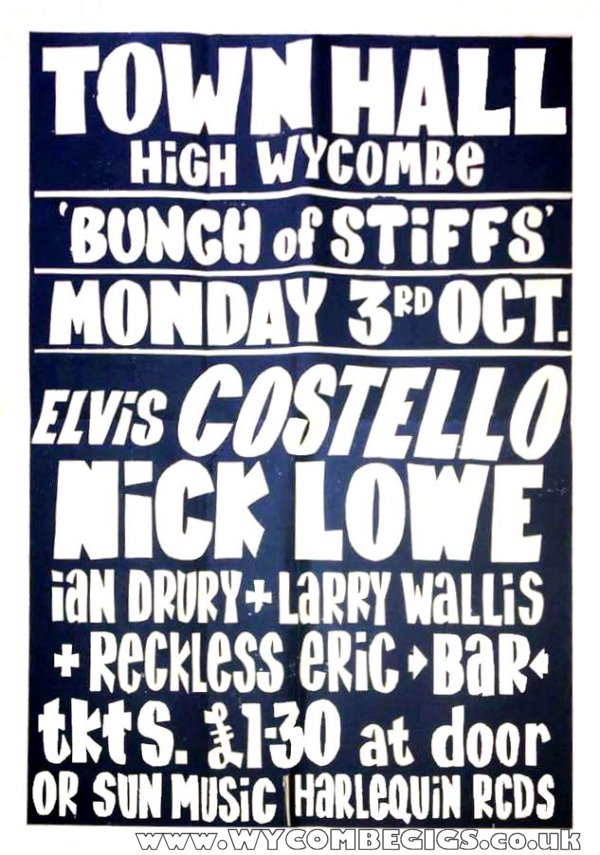
Just let me hear some of that Rock And Roll Music…

Metallica + The Smiths = Iron Maiden
Weezer – Air Supply = Grateful Dead
(Europe + Asia) x Foreigner = Outkast
Rage Against the Machine + Florence + The Machine = System of a Down
The Cars + Flo Rida + Boston + Chicago + Kansas = Journey
More Band Math at McSweeney’s.
As we tap our toes, we might recall that it was on this date in 1977 that then-emerging musician Elvis Costello bit the hand that feeds him. Dangerous Minds reports:
Elvis Costello and The Attractions appeared on Saturday Night Live on December 17, 1977 as a last minute replacement for The Sex Pistols, who had run into problems getting into the USA because of some prior legal hassles in the UK. Costello’s performance on SNL would become the stuff of rock and roll legend.
Costello’s record label, Columbia, wanted him to perform “Less Than Zero”, the first single from his as yet unreleased (in the U.S.) debut album My Aim Is True. Elvis wanted to perform “Radio Radio,” his attack on corporate control of the airwaves – a punk move that would have been in the spirit of The Pistols. Columbia disapproved of the idea and SNL producer Lorne Michaels allegedly told Costello, on orders from his employer NBC, to not perform “Radio Radio.”
Come show time, the band started playing “Less Than Zero” and then abruptly stopped and shifted into “Radio Radio.” At the end of the tune, they defiantly walked off the set.
Michaels was furious. According to first hand accounts, he was flipping Costello the bird through the entire performance. Michaels ended up banning Costello from ever performing again on SNL. The ban lasted 12 years, which in TV years is an eternity. SNL was an essential promotional venue for jacking up a band’s record sales. Costello bit the hand that was supposed to feed him even before he even got a nibble of commercial success. In the long run, it didn’t stop him from becoming one of rock’s enduring forces.

So it went…

In the late 70s, Tony Wilson— who would go on to co-found Factory Records (the seminal independent label that embodied “The Manchester Sound”) and The Hacienda (the warehouse-based club that was the birthplace of the rave)– hosted a tea-time television show called So It Goes.
A weekly arts/culture/music series, the program’s passion was emerging new pop music… which in those days meant Punk and New Wave.
The Way We Were is a Channel 4 (UK) retrospective first broadcast circa 1984.– a compilation of performances by bands performing on So It Goes– many of them making their TV debuts: Sex Pistols, Clash, Buzzcocks, Iggy Pop, The Fall, Elvis Costello, Blondie, Penetration, Wreckless Eric, Ian Dury, Tom Robinson, Magazine, John Cooper Clarke, XTC and Joy Division…
[TotH to Richard Metzger and his essential Dangerous Minds for the lead to TWWW]
As we slam dance down memory lane, we might recall that it was on this date in 1976– as we in the U.S. were beginning our Bi-Centennial Day celebrations– that the Clash gave their first public performance: they opened for the Sex Pistols at The Black Swan in Sheffield, England. As U2 guitarist The Edge later wrote, “This wasn’t just entertainment. It was a life-and-death thing….It was the call to wake up, get wise, get angry, get political and get noisy about it.”
 The Clash, 1976 (source)
The Hall of Unsung Singers…

Bill Kirchen is one of those guys… a musician’s musician, talented enough to perform regularly with the likes of Elvis Costello, Emmylou Harris, and Nick Lowe, at the same time that he’s at low-to-no risk of being accosted by the celebrity-obsessed masses…
With thanks to the terrific folks at TMM and KUT in Austin, a little something for a Saturday morning (do listen far enough in to get to Kirchen’s roster of other folks who “pull over”)…
As we tap our toes, we might recall that it was on this date in 1966 that the Beatles said “thank you, and goodnight” for the last time– at the end of their last public concert, at Candlestick Park in San Francisco.
 source: RareBeatles.com
![Reblog this post [with Zemanta]](https://i0.wp.com/img.zemanta.com/reblog_e.png?w=700)
You must be logged in to post a comment.