Posts Tagged ‘Wreckless Eric’
“Merely fact-minded sciences make merely fact-minded people”*…

As we float awash in the debate over who/what is conscious (only humans? animals? plants? AI? everything?), we might take a moment to ponder the role of consciousness. For example, in science.
Harald A. Wiltsche argues that physicists, and scientists in general, attempt to paint an objective picture of reality. Consciousness, experience, and subjectivity are forcibly pushed out of the picture. Indeed, even where science is empirical, this empiricism rarely involves a consideration of human consciousness, but rather the readings of some mechanical measuring device, or some hypothetical abstracted sum of all perspectives – a God’s eye view or view from nowhere.
A phenomenologist of science, Wiltsche paints a different picture. Physics, even in the form of quantum mechanics, has its origins in the phenomenology of human consciousness. No matter how hard scientists try, it can never escape those origins, and to truly move forward, it must understand and embrace them…
Physics and phenomenology are usually taken to inhabit different worlds. Physics aims at a description of objective reality in mathematical terms. Phenomenology—the philosophical movement inaugurated by Edmund Husserl—is an a priori investigation into consciousness and into the ways things appear in experience. Physics deals with equations, invariants, and symmetries, aiming to represent reality minus observers; phenomenology seems to concern precisely what physics leaves out: subjectivity, consciousness, meaning. If the two meet at all, it is only in polite, but ultimately inconsequential, interdisciplinary dialogue.
My claim is that this picture is mistaken. Physics does not stand outside phenomenology. It presupposes the very structures phenomenology seeks to analyse—above all, the structured correlation between subject and object through which objectivity first becomes intelligible. The task, therefore, is not to unite two distant domains, but to recognize a relation that has been there from the beginning…
[Wiltsche makes his point first with reference to spacetime physics, then to quantum mechanics. He concludes…]
… The question, then, is no longer whether physics and phenomenology should be united. As physics confronts its own conceptual foundations, the challenge is to bring into view the structures phenomenology has analyzed since its inception—and to explore how they can illuminate the meaning of objectivity in modern theory.
Eminently worth reading in full.
Physics cannot escape its roots in phenomenology: “Consciousness is the hidden architecture behind fundamental and quantum physics” (or archived version here) from @haraldwiltsche.bsky.social in @iai.tv.
Bonus question: if Wiltsche is right that consciousness is essential to advancing our understanding of reality, and consciousness is something that other things, living and “inanimate,” (do or can) possess, what does that mean for our quest to understand realit(ies)?… Or does a question like this simply (albeit implicitly) affirm anthropocentrism? How will we know?
See also: “A physicist is just an atom’s way of looking at itself“
* Edmund Husserl
###
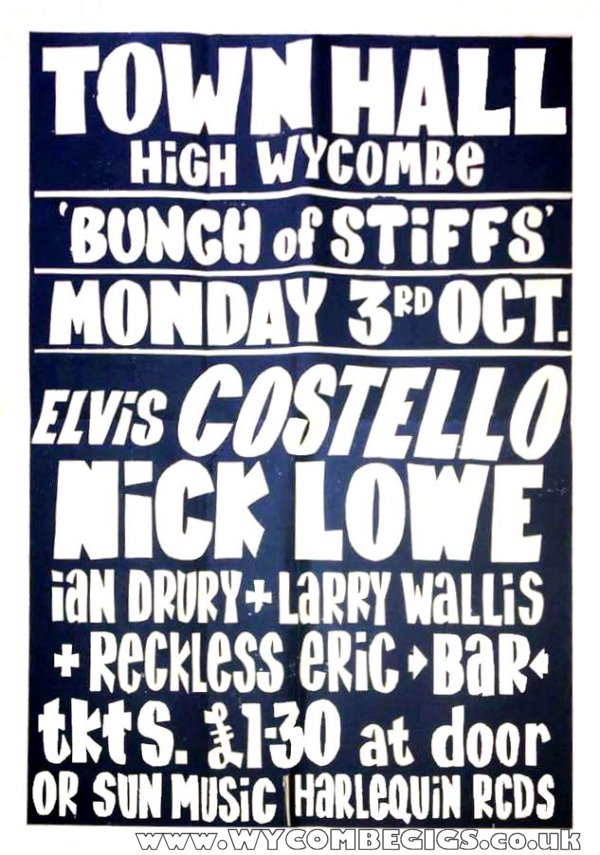
As we contemplate consciousness, we might note that it was on this date in 1977, at the High Wyncombe Town Hall in England, that the Bunch of Stiffs tour kicked off. It featured Nick Lowe’s Last Chicken in the Shop, Elvis Costello and The Attractions, Ian Dury and the Blockheads, Wreckless Eric and The New Rockets, and Larry Wallis’ Psychedelic Rowdies– acts managed by Dave Robinson and Jake Riviera before they formed the Stiff Records label, which released a live album of the festivities in February of 1978.
So it went…

In the late 70s, Tony Wilson— who would go on to co-found Factory Records (the seminal independent label that embodied “The Manchester Sound”) and The Hacienda (the warehouse-based club that was the birthplace of the rave)– hosted a tea-time television show called So It Goes.
A weekly arts/culture/music series, the program’s passion was emerging new pop music… which in those days meant Punk and New Wave.
The Way We Were is a Channel 4 (UK) retrospective first broadcast circa 1984.– a compilation of performances by bands performing on So It Goes– many of them making their TV debuts: Sex Pistols, Clash, Buzzcocks, Iggy Pop, The Fall, Elvis Costello, Blondie, Penetration, Wreckless Eric, Ian Dury, Tom Robinson, Magazine, John Cooper Clarke, XTC and Joy Division…
[TotH to Richard Metzger and his essential Dangerous Minds for the lead to TWWW]
As we slam dance down memory lane, we might recall that it was on this date in 1976– as we in the U.S. were beginning our Bi-Centennial Day celebrations– that the Clash gave their first public performance: they opened for the Sex Pistols at The Black Swan in Sheffield, England. As U2 guitarist The Edge later wrote, “This wasn’t just entertainment. It was a life-and-death thing….It was the call to wake up, get wise, get angry, get political and get noisy about it.”
 The Clash, 1976 (source)
You must be logged in to post a comment.