Posts Tagged ‘NBC’
“How television stages the world becomes the model for how the world is properly to be staged”*…
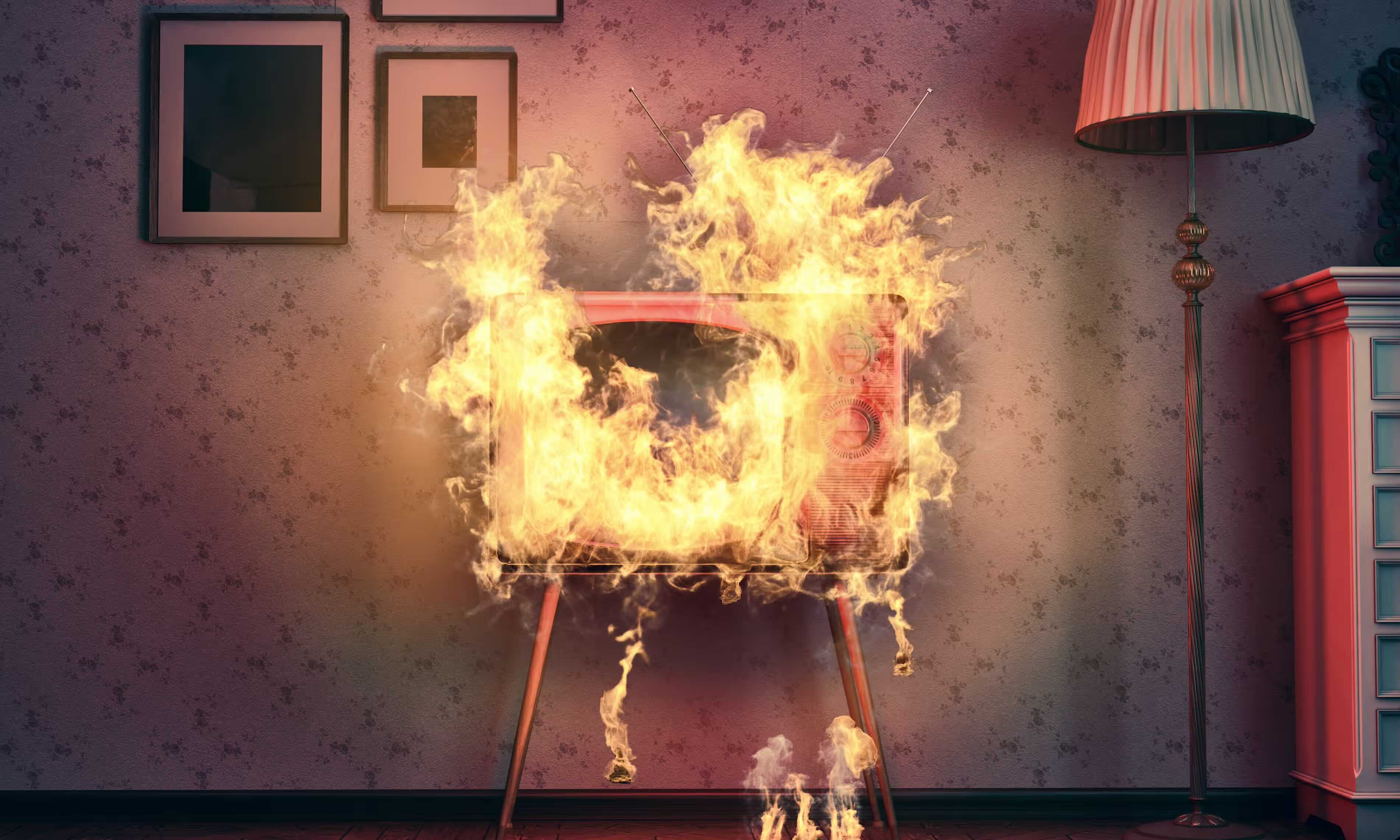
… and, as Mark Sweney reports, that staging is undergoing a fundamental transition. Case in point: Warner Bros Discovery’s recent massive write-down of traditional broadcast assets as it struggles to play catch-up with streaming and video services…
Warner Bros Discovery’s announcement… of a $9bn (£7bn) writedown in the value of its TV networks is a stark acknowledgment of the damage the streaming wars are inflicting on traditional broadcasting models.
The astonishing figure, which pushed the US entertainment group to a quarterly net loss of $10bn (£7.9bn) and sent shares sliding 12% in early trading on Thursday, lays bare how channels such as CNN, TLC and the Food Network can no longer rely on a captive cable subscriber base.
The rapid consumer shift away from high-priced TV packages, coupled with the inexorable decline in advertising, has forced traditional TV companies to invest billions in low-cost streaming services to catch up with first movers such as Netflix.
The question is now whether companies such as WBD – home to TV and film content including Furiosa: A Mad Max Saga, Godzilla x Kong: The New Empire, The Big Bang Theory, Succession, Friends and all Olympics events – can build the scale and make significant profits from their streaming operations before the death of linear television delivered by cable, satellite or aerial…
…
… Disney has more than 200 million global streaming subscribers, and WBD exceeds 100 million globally, with Discovery+ now the fastest-growing service in the UK thanks to winning the rights to show every Olympic discipline. But the battle is not just to continue to drive scale.
Boosting revenue and profits per subscriber has become critical through strategies including rapid rounds of price increases – Disney has just announced a set of price rises for later this year – as well as driving slightly cheaper ad-funded tiers to pull in cost-conscious consumers.
While traditional TV companies struggle with managing the decline in their legacy businesses, with drastic rounds of cost-cutting after a decade of profligate spending on content in the first decade of the streaming wars, Netflix points to a viable future.
The streaming giant, which once struggled with mounting losses running into tens of billions of dollars, has seen its market value surge by more than 50% over the past year after turning the profitability corner while continuing to see significant growth in subscribers.
WBD’s chief executive, David Zaslav, who has considered breaking up the company but concluded that is not currently the best option, said the market was being hit by a “generational disruption” that requires traditional TV companies to take “bold, necessary steps”.
Richard Broughton, director at Ampere Analysis, said: “Legacy TV businesses are in decline but the shift is not so rapid that it can’t be managed. There are still a lot of broadcast TV viewers, they have the time to pivot to profitability in the streaming world.”…
Dealing with disruption: “‘Traditional TV is dying’: can networks pivot and survive?” from @marksweney in @guardian.
Corollary damage: “two venerable TV trade publications, Broadcasting & Cable and Multichannel News, will shut down“
See also: “The music industry is suffering from a streaming hangover” (gift link) and on a more upbeat note, “Radio shows surprising resilience even in a rapidly changing media world.”
For (just one example of) the kind of speculation that tectonic shifts of this sort can elicit: “Why Apple should buy Warner Bros. Discovery. No, seriously.“
And for one take on why all of this is underway: “The Addiction Economy.”
* Neil Postman, Amusing Ourselves to Death
###
As we muse on media, we might spare a thought for Dominick George “Don” Pardo Jr.; he died on this date in 2014. A member of the Television Hall of Fame, Pardo had a 70-year tenure with NBC, working as the announcer for early incarnations of such notable shows as The Price Is Right, Jackpot, Jeopardy!, Three on a Match, Winning Streak, and NBC Nightly News. His longest, and best-known, announcing job was for NBC’s Saturday Night Live, a job he held for 38 seasons, from the show’s debut in 1975 until his death.

“[Hannah] Arendt wrote about the subjugation of public space – in effect the disappearance of public space, which, by depriving a person of boundaries and agency, rendered him profoundly lonely”*…

… and Alexandra Lange writes about an (imperfect) modern “work-around”: the way in which shopping malls won over a wide range of admirers, from teens to seniors, by providing something they couldn’t find in their dwindling public parks or on their crowded sidewalks…
… The mall, in its quiet early hours, provides affordances most cities and suburbs cannot: even, open walkways, consistent weather, bathrooms and benches. The mall is also “safe,” as Genevieve Bogdan told The New York Times in 1985; the Connecticut school nurse was “apprehensive about walking alone outdoors early in the morning before work.”
For the more vulnerable among us, malls’ privately owned and privately managed amenities offer an on- or off-ramp from the real world, sometimes literally. Skateboarders and wheelchair users both appreciate the fact that most malls were built to include ramps, escalators and elevators, or have been retrofitted to do so. At Grossmont Center, a mall in La Mesa, California, the parking lot features signs giving the step counts from your parking spot to Target, Macy’s and the movie theater. Few cities can say the same.
It isn’t only the ease of exercise that has made mall walking programs durable. On Twitter, city planner Amina Yasin praised malls as spaces that accommodate many racialized and even unhoused senior citizens, offering free and low-cost-of-entry access to air-conditioning, bathrooms and exercise, while throwing up her hands that “white urbanism decided malls are evil.” Gabrielle Peters, a writer and former member of the city of Vancouver’s Active Transportation and Policy Council, responded with her own thread on some ways malls offer better access for people with physical disabilities than city streets: dedicated transit stops, wide automatic doors, wide level passages, multiple types of seating, elevators prominently placed rather than hidden, ramps paired with stairs, public bathrooms and so on.
…
The food court at the Gallery offered a relatively low-cost way to hang out after the transit trip or mall walk. While public libraries and senior centers offer free public seating, they have neither the proximity to shopping, nor the proximity to the action that a mall offers. Like teens hanging out in the atrium, the seniors in the food court can observe without penalty and be a part of community life that can be overwhelming in truly public spaces. After police officers removed elderly Korean Americans from a McDonald’s in Flushing, Queens — managers claimed the group overstayed their welcome, buying only coffee and french fries — sociologist Stacy Torres wrote in The New York Times, “Centers offer vital services, but McDonald’s offers an alternative that doesn’t segregate people from intergenerational contact. ‘I hate old people,’ one 89-year-old man told me.”
…
As malls closed in the spring of 2020 because of Covid-19, mall walkers across the country were forced back outside, battling weather and uneven sidewalks in their neighborhoods, missing the groups that easily formed on the neutral ground of the mall. One New Jersey couple took to walking the parking lot of the mall they once traversed inside, drawn to its spaciousness and their sense of routine. As malls reopened in the summer and fall with social-distancing and mask-wearing policies, some malls suspended their programs until the pandemic’s end, while others curtailed the hours…
“Lessons From the Golden Age of the Mall Walkers,” from @LangeAlexandra in @CityLab.
* Masha Gessen
###
As we ponder perambulation, we might recall that it was on this date in 1949 that Hopalong Cassidy (starring William Boyd, who’d created and developed the role in 66 films, starting in 1935) premiered on the fledgling NBC TV network and became the first Western television series.

“The study of man is the study of his extensions”*…

The magic lantern was invented in the 1600’s, probably by Christiaan Huygens, a Dutch scientist. It was the earliest form of slide projector and has a long and fascinating history. The first magic lanterns were illuminated by candles, but as technology evolved they were lit by increasingly powerful means.
The name “magic lantern” comes from the experience of the early audiences who saw devils and angels mysteriously appear on the wall, as if by magic. Even in the earliest period, performances contained images that moved—created with moving pieces of glass.
By the 18th century the lantern was a common form of entertainment and education in Europe. The earliest known “lanthorn show” in the U. S. was in Salem, Massachusetts, on December 3, 1743, “for the Entertainment of the Curious.” But the source of light for lanterns in this period—usually oil lamps—was still weak, and as a consequence the audiences were small.
In the mid 19th century, two new forms of illumination were developed which led to an explosion of lantern use. “Limelight” was created by heating a piece of limestone in burning gas until it became incandescent. It was dangerous, but produced a light that was strong enough to project an image before thousands of people, leading to large shows by professional showmen…
All about the entertainment sensation of its time at the web site of The Magic Lantern Society. [TotH to friend and colleague RW]
And for a peek at the transition from the static images of the magic lantern to film-as-we-know-it, see “Putting Magic in the Magic Lantern.”
[image above: source]
* Edward T. Hall, Beyond Culture
###
We we watch with wonder, we might recall that it was on this date in 1926 that The NBC Radio Network, the first network in the U.S., was launched. Carl Schlegel of the Metropolitan Opera opened the four-hour inaugural broadcast, which also featured Will Rogers and Mary Garden; it included a remote link from KYW in Chicago and was carried by twenty-two eastern and midwestern stations, located as far west as WDAF in Kansas City, Missouri.
NBC has been formed from assets already held by its parent, Radio Corporation of America (RCA) and other assets acquired from AT&T (which had been, up to that point, a pioneer in radio technology). Crucially, as part of the reassignment permissions granted by the government, NBC was allowed to sell advertising.
NBC’s network grew quickly; two months later, on January 1, 1927, it was split into the Red and Blue networks. And it quickly attracted competition: the Columbia Broadcasting System (CBS) in 1927 and the Mutual Broadcasting System in 1934. In 1942 the government required NBC to divest one of its networks; it sold off NBC Blue, which became The American Broadcasting Company (ABC).

Special Academy Awards Prep Edition: Inside “Social Network”…

Aaron Sorkin
Aaron Sorkin, the odds-on favorite for this year’s Best Adapted Screenplay Oscar, set out to be an actor. But as Pete Hammond reports in Deadline Hollywood, his career took a different turn…
…those early plans were trumped when he began writing for the stage. In 1989, at the age of 28, he was named Outstanding American Playwright by the Outer Critics Circle for A Few Good Men. Just three years later, he wrote the screenplay for the film version which was nominated for the Best Picture Oscar. His subsequent success in film has included scripts for Malice (1993), The American President (1995), Charlie Wilson’s War (2007) and the upcoming Moneyball. As an Emmy-winning television writer and producer, he was behind critically acclaimed [and your correspondent’s all-time fave] Sports Night, long-running The West Wing, and the short-lived Studio 60 On The Sunset Strip. But he has never been nominated for an Academy Award.
Discover how Sorkin (who worked from the book proposal, not the book, which wasn’t written when he started) did his research, how he shaped his characters, and how he approaches a “non-fiction film”…
I would tell anyone that if you are seeing a movie that begins with “The following is a true story…,” you need to look at that movie the way you would a painting and not a photograph. This is my take on what happened. You can put a bowl of fruit on a table and have 10 people take a picture of it and those 10 photographs would look pretty much like each other. If you ask 10 painters to paint it, you’re going to get a lot of different versions of the thing. And so I was telling a true story, but very quickly the people became characters to me and not historical figures. And people, and properties of people, and properties of characters, actually have very little to do with each other. I know people don’t speak in dialogue, and life doesn’t play itself out in a series of connected scenes that form a narrative. But that’s what a writer does.
… and more in his interview with Hammond. As a special bonus, use the link there (or here) to download a pdf of Sorkin’s full script.
And lest one fret that Sorkin’s dreams of greasepaint came to naught, watch for him in his cameo as the advertising executive in Social Network.
As we recheck our privacy settings on Facebook, we might recall that it was on this date in 1981 that Hill Street Blues premiered on NBC. The first show from Sorkin’s spiritual forefather Stephen Bochco, the gritty HSB resurrected the then-moribund “cop show” genre and introduced the ensemble cast as a structural feature of series. By the time the show signed off in May 1987, it had set the records for most Emmy nominations and most Emmys won in a single season. In its first season alone, it received eight Emmy awards– a debut season record surpassed only by Sorkin’s ensemble political drama The West Wing.

Fun with Advertising!…
With the perspective of passing time often comes the desire to re-write the past. Now, as the “Twisted Adverts” Flickr pool demonstrates, one can.
Bobster855 has created and collected dozens of goodies like this re-purposed lawn mower advertisement:

Or this Aunt Jemima spread:

See them all here.
Then, readers who are disposed to do a little revisionist mashing themselves should turn to the hundreds of specimens at The Vintage Ad Browser. Consider, for example, what one could do with:
 Procter & Gamble Co.’s Drene Shampoo (1937)
As we take steps to “control the dialogue,” we might recall that it was on this date in 1952 that NBC TV format pioneer Sylvester L. “Pat” Weaver premiered The Today Show— and introduced the U.S. (and the world, as it turned out) to morning “news.” Hosts over the years have included John Chancellor, Hugh Downs, Florence Henderson, Barbara Walters, Tom Brokaw, Bryant Gumbel, Jane Pauley, Matt Lauer, and Katie Couric. In 1953, the show also featured a chimpanzee named J. Fred Muggs, who co-hosted with Dave Garroway. (Weaver also pioneered other important formats– including The Tonight Show– but is probably better known these days as the father of Signorey Weaver.)

You must be logged in to post a comment.