Posts Tagged ‘telephone’
“Whatever the world is, today, good and bad together, that is what Gutenberg’s invention has made it”*…

Before he became the renowned author we know, Samuel Clemens– Mark Twain– worked (among other things) as a printer. He knew both the painstaking (and sometimes painful) labor of hand-setting type and the extraordinary cultural power of the mass-printed (by Twain’s time, on steam-powered presses) products that it enabled.
As Jeff Jarvis explains in an excerpt from Hot Type- The Magnificent Machine that Gave Birth to Mass Media and Drove Mark Twain Mad, Twain lived through the transition from hand setting to the Linotype, and through the intertwined transition of the society of which the transition was a part…
In the history of the invention of the typesetting machine and the consequent birth of mass media, Mark Twain is the Zelig of our tale, returning frequently as a typesetter in his brother’s ratty newspaper; as a tramp printer witnessing an explosion of progress in printing technology; as the bankrupted investor in the failed Paige Compositor, a competitor to the successful Linotype; as an early best-selling author and cultural celebrity; and as a publisher trying to invent a business model for books as an industry.
Now that their machinery could produce volume, publishers needed ways to sell at scale, to build the modern phenomenon of the best-seller. The problem: In 1859, only 1,090 bookstores dotted America. By 1914, there were still only 3,501. So if readers couldn’t find books, books had to find their readers. For certain authors and publishers, including Twain, that was accomplished through subscription publishing, with door-to-door canvassers taking orders for books before they were printed. Until the end of the nineteenth century, three quarters of books in the U.S. were sold this way.
In 1874, the New York Tribune estimated that 50,000 agents were employed by subscription publishers. What a wonderful fictional character it would be to imagine the itinerant peddler pitching not pots or patent medicines but literature and literacy, foot in door after door, blurbing Twain with a few dozen sample pages and illustrations to whet curiosity and demand.
Subscription publishing brought advantages. By collecting orders for books before printing, publishers knew how many copies to produce. Publishers could use customers’ capital to finance production—not unlike a content producer today raising money via Kickstarter or Patreon. Subscription publishing’s cross to bear was snobbery. William Dean Howells dismissed subscription books, carving out a caveat only for his friend Twain: “No book of literary quality was made to go by subscription except Mr. Clemens’s books, and I think these went because the subscription public never knew what good literature they were.”
The regular trade carped that subscription publishers “flood the country with worthless books, poorly written, poorly printed and bound, containing a small amount of matter in large type and with wide margins to the page, for a large price.” Elisha Bliss, Twain’s publisher, defended the trade to the Tribune: “Instead of injuring the regular book business I think we create a thirst for knowledge and thus increase the sale of all kinds of books. In the little town where there are no bookstores the book agent induces people to buy.”
Twain valued these readers as they valued him. They freed him from the expectations of high culture and its critics. And he was certain they’d make him rich. “Harper publishes very high-class books,” he wrote to a friend, “and they go to people who are accustomed to read. That class are surfeited. But there is a vast class that isn’t—the factory hands and the farmers. They never go to a bookstore; they have to be hunted down by the canvasser.”
Twain knew that a new, mass audience had to be corralled, one door knocked after another. As he wrote to London critic Andrew Lang: “The thin top crust of humanity—the cultivated—are worth pacifying, worth pleasing, worth coddling, worth nourishing and preserving with dainties and delicacies, it is true; but to cater to that little faction is of no very dignified or valuable occupation, it seems to me; it is merely feeding the over-fed, and there must be small satisfaction in that.” He sought instead to entertain “the mighty mass of the uncultivated who are underneath….I have never tried in even one single instance, to help cultivate the cultivated classes. I was not equipped for that, either by native gifts or training. And I never had any ambition in that direction, but always hunted for bigger game—the masses.”
In 1866, Twain nabbed the assignment of a dream: sailing to the Sandwich Islands (now Hawaii) to send back reports to the Sacramento Union. Upon his return to San Francisco, he launched a side gig as a lecturer, amusing ever-larger audiences with his travel tales and humor. “He wouldn’t be a cloistered writer so much as a showman, a public personality, a professional crowd-pleaser. In short, a celebrity,” wrote Ron Chernow. Next, Twain reported for the Alta California about a journey Back East. Then he issued his first book, The Celebrated Jumping Frog of Calaveras County and Other Sketches, which debuted to good reviews and established Twain’s reputation as a wry humorist. The book was published by Twain’s friend Charles Henry Webb, whom he soon dumped, complaining—as would become his habit—about sales.
Next came another enviable gig and a reputation-setting assignment from Alta California, to report from a five-month cruise to the Holy Land on the Quaker City. His letters ran in the paper and were picked up in others across the country. He returned home to a letter from Elisha Bliss of Hartford’s American Publishing Company, soliciting a book on the adventure, which became The Innocents Abroad.
Twain received negotiating advice from famed minister Henry Ward Beecher, who had inspired the Holy Land trip but didn’t go along. In Twain’s telling, Beecher offered a prophetic warning: “Now here—you are one of the talented men of the age—nobody is going to deny that—but in matters of business, I don’t suppose you know more than enough to come in when it rains.” Twain reported to his family, “I listened well, and then came up here and made a splendid contract for a Quaker City book of 5 or 600 large pages, with illustrations….But I had my mind made up to one thing—I wasn’t going to touch a book unless there was money in it, and a good deal of it.” He soon complained this was a bad deal.
Subscription books were fancy and rich in illustration, not so much elegant as tarted up. Buyers had the choice of various bindings as upgrades. The average price of Innocents was $4 (almost $100 today). Readers bought them to display their erudition to visitors: every book a coffee-table book. The Innocents Abroad was received well, favorably reviewed in The Atlantic Monthly by Howells, who noted its length—“in compliance with one of the main conditions of a subscription book’s success, bigness namely”; praised its drollery five times, its irony three times, and its impudence twice; applauded the “amount of pure human nature in the book, that rarely gets into literature”; and counted Twain among America’s humorists, “quite worthy of the company of the best.” Twain’s head swelled sufficiently to accept the praise: “It was quite generally conceded that I was a valuable asset to the American nation and to the great ranks of literature.”
In a year and a half, Innocents sold 82,524 copies, nowhere near Uncle Tom’s Cabin’s 300,000 in its first year, but a success nonetheless. Twain had negotiated well, for he rejected a $10,000 flat payment from Bliss in favor of the 5-percent royalty, which added up to $16,504—about $400,000 today. During his lifetime, no book of Twain’s sold as well as quickly, fueling his chronic grievances with publishers.
Twain wrote a next book for Bliss, about his life Out West, this time demanding half of the profits after manufacturing costs, equaling a royalty of 7.5 percent. Twain told Bliss, “We shall sell 90,000 copies in the first 12 months. I haven’t even a shadow of doubt of that.” Published in 1872, it sold 65,000 in the first year—again, respectable.
Twain and Warren joined to write The Gilded Age, published by Bliss for a 10-percent royalty. The book sold 50,000 copies in its first year. Twain thought he would be a better publisher. He would soon try.
He released The Adventures of Tom Sawyer in 1876, selling only 23,600 copies in its first year. He blamed Bliss for mistiming its release. He next published A Tramp Abroad in 1880. Walter A. Friedman provided an accounting: American Publishing sold 62,000 copies in the first year at $3.50 each for a total of $218,000. Just over half of that went to sales agents, who paid their canvassers. The company kept $106,000, out of which it spent $41,540 on printing, leaving a profit of $64,460, of which Twain received $32,000—nearly $1 million today.
As Twain was writing The Prince and the Pauper, Bliss died. He shifted publication of The Prince to his friend James Osgood. This time, Twain funded the book’s publication—complaining that he was out $65,000 before the first copy was printed. Instead of receiving a royalty, he paid Osgood 7.5 percent of sales. Neither was experienced in subscription sales, and of a first printing of 25,000, 5,000 remained in their warehouses after two years. He repeated the mistake with the publication of Life on the Mississippi, which lured only 30,000 orders, far from the 100,000 Twain hoped for. Osgood’s company ended in bankruptcy in 1885. This might have discouraged a sensible man from deciding to become a publisher. Not Twain.
Twain established his own publishing house, giving it the name of his general manager and dogsbody, Charles L. Webster & Co. The aim was to publish only Twain’s books. The first was his masterpiece, Huckleberry Finn, in 1885. Infamously, an engraver subverted the publication by endowing Uncle Silas Phelps with an erect penis, necessitating the scissoring of the offending image from thousands of copies and delaying publication past prime Christmas season. Nonetheless, the Webster Company’s agents sold 60,000 copies, rewarding the author with a check for $54,000. “Once more I experienced a new birth,” Twain wrote. “I have been born more times than anybody except Krishna, I suppose.”
Huck’s success emboldened Twain and Webster to expand as a full-fledged publishing house. Twain worked diligently to solicit the memoirs of Ulysses S. Grant. Twain offered Grant an astounding 70 percent of profits. He told Webster to hire veterans as canvassers, have them wear their Grand Army regalia, and deliver his script: “I presume it is simply a question with you of your choice of bindings, as no American will want to have it said that he has not read General Grant’s book, a work that will descend to your children and will increase in value with every generation.” The memoirs were a stupendous best-seller, 10,000 door-to-door canvassers selling 325,000 two-volume sets in 1886, earning the general’s widow and children as much as $15 million in today’s dollars.
It was downhill from there for Twain and Webster, their record studded with poor choices of books by a half-dozen Civil War generals or their widows, the king of Hawaii, and Pope Leo XIII (“’Twas kind of a fizzle,” recalled Twain’s maid Katy Leary). Twain signed Henry Ward Beecher to write his memoirs, but the minister died before setting pen to paper. Twain was inspired to publish the ambitious Library of American Literature with 1,700 selections by 500 authors in eleven volumes, but failed to grasp the perilous economics of selling such a gargantuan series by subscription. Readers paid a three-dollar down-payment, but Webster & Co. would not collect the rest of its thirty-three-dollar price until after paying the printers thirteen dollars, on top of twelve dollars to sales agents, with Twain carrying that debt in the meantime. The company needed capital to tide itself over, but where was Twain’s—and his wife’s—money? Sunk into the Paige Compositor. [see here] The business analysis was not complicated. His maid understood it: “Mr. Clemens was all deep in the typesetting machine, and he was putting all his money in that so he didn’t have much left to help out the publishing company. That was the beginning of the end of that venture.”
Even without their bad business decisions, Twain’s venture was likely doomed, along with the subscription publishing industry, for books were getting radically cheaper, with ever-more competition. The number of titles published in the U.S. more than doubled, from 4,559 in 1890 to 12,010 in 1914. In 1895, The Bookman began publishing the first lists of most-popular books according to store sales. The term “best-seller” came into general use around 1910, according to historian of publishing Frank Luther Mott, who set the bar for “best-seller” at “one percent of the total population of continental United States for the decade in which the book was published.” To meet Mott’s benchmark, books today would need to sell 3.4 million copies. For comparison, Kristen McLean, a lead industry analyst at NPD BookScan, reported that in 2022, of 45,571 titles released by just the top ten publishers, only 163 books or 0.36 percent sold more than 100,000 copies in a year.
In our age of mass media, we have developed a skewed definition of big—a presumption that many means most. To sell 100,000 books—and congratulations if you do!—is to speak to 0.03 percent of the nation, hardly a resounding expression of the cultural zeitgeist. The blockbuster economics of media—in film, television, music, and books—depends on a few best-sellers to make up for the vast number of lesser bets. But that eternal quest for blockbusters gives the impression that anything called a best-seller is widely influential, while all else is dismissed. Whether selling entertainment to an audience or an audience to advertisers, the mechanization and industrialization of media—begun with the steam-powered press and culminating with the Linotype—spawned a business and cultural obsession with scale…
The rise and fall of subscription book publishing and the birth of mass media: “Mark Twain, America’s First Celebrity Author and Publisher” from @jeffjarvis.bsky.social via @literaryhub.bsky.social.
* Mark Twain, in an April, 1900 letter contributed to the celebration of the opening of the Gutenberg Museum in Mainz
###
As we roll the presses, we might send illuminating birthday greetings to Lee de Forrest; he was born on this date in 1873. An electrical engineer and inventor, he ultimately held 300 patents on a variety of inventions crucial to electronic communications, and co-founded the forerunner organization to the IEEE, De Forest is probably best remembered as the inventor of the Audion vacuum tube, which made possible live radio broadcasting (which he also pioneered) and became the key component of all radio, telephone, radar, television, and computer systems before the invention of the transistor in 1947.
Unwittingly then had I discovered an Invisible Empire of the Air, intangible, yet solid as granite, whose structure shall persist while man inhabits the planet.
– Father of Radio: The Autobiography of Lee De Forest (1950), p. 4

Coincidentally, today is also the anniversary of the award in 1930 of Philo Farnsworth‘s first patent: a television system (U.S. 1,773,980), with a description of his image dissector tube, which was his most important contribution to the development of television.

“A commodity appears at first sight an extremely obvious, trivial thing. But its analysis brings out that it is a very strange thing”*…

Prices are on everyone’s minds these days. Brian Potter looks underneath the costs of the finished products and services that we typically track to examine the costs of the commodities that go into them…
This American Enterprise Institute chart [above], which breaks down price changes for different types of goods and services in the consumer price index, has by now become very widely known. A high-level takeaway from this chart is that labor-intensive services (education, healthcare) get more expensive in inflation-adjusted terms over time, while manufactured goods (TVs, toys, clothing) get less expensive over time.
But there are many types of goods that aren’t shown on this chart. One example is commodities: raw (or near-raw) materials mined or harvested from the earth. Commodities have many similarities with manufactured goods: they’re physical things that are produced (or extracted) using some sort of production technology (mining equipment, oil drilling equipment), and many of them will go through factory-like processing steps (oil refineries, blast furnaces). But commodities also seem distinct from manufactured goods. For one, because they’re often extracted from the earth, commodities can be subject to depletion dynamics: you run out of them at one location, and have to go find more somewhere else. In my book I talk about how iron ore used to be mined from places like Minnesota, but as the best deposits were mined out steel companies increasingly had to source their ore from overseas. And the idea of “Peak Oil” is based on the idea that society will use up the easily accessible oil, and be forced to obtain it from increasingly marginal, expensive-to-access locations.
(Some commodities, particularly agricultural commodities that can be repeatedly grown on a plot of land, don’t have the same sort of depletion dynamics, though bad farming practices can degrade a plot of land over time. Other commodities get naturally replenished over time, but can still get used up if the rate of extraction exceeds the rate of replenishment; non-farmed timber harvesting and non-farmed commercial fishing come to mind as examples.)
Going into this topic, I didn’t have a great sense of what price trends look like for commodities in general. Julian Simon famously won a 1980 bet with Paul Ehrlich that several raw materials — copper, chromium, nickel, tin, and tungsten — would be cheaper (in inflation-adjusted terms) after 10 years, not more expensive. But folks have pointed out that if the bet had been over a different 10-year window, Ehrlich would have won the bet.
To better understand how price tends to change for different commodities and raw materials, I looked at historical prices for over a hundred different commodities. Broadly, agricultural commodities tend to get cheaper over time, while fossil fuels have a slight tendency to get more expensive. Minerals (chemicals, metals, etc.) have a slight tendency towards getting cheaper, with a lot of variation — 15 minerals more than doubled in price over their respective time series. But this has shifted over the last few decades, and recently there’s been a greater tendency for commodities to rise in price…
[Potter offers a thorough– and fascinating– analysis, concluding…]
… historically commodities have generally fallen in price over time, but recently this trend has increasingly shifted towards rising prices. Natural gas and oil got cheaper until the 1950s and the 1970s, respectively, and since then have gotten more expensive. Beef and pork both got cheaper from 1970 until the 1990s, and since then have risen in price. Agricultural products were almost uniformly falling in price until around 2000, and have almost uniformly risen in price since then.
My general sense looking at historical commodity price data is that the more that production of some commodity looks like manufacturing — produced by a repetitive process that can be steadily improved and automated, from a supply that can be scaled up in a relatively straightforward fashion, without being subject to severe depletion dynamics — the more you’ll tend to see prices fall over time. The biggest decline in price of any commodity I looked at is industrial diamonds, which fell in price by 99.9% between 1900 and 2021d ue to advances in lab-grown diamonds production. This effectively replaced mined diamonds with manufactured ones for industrial uses; roughly 99% of industrial diamonds today are synthetic. Many other commodities had major price declines that were the result of production process improvements — aluminum got cheaper thanks to the invention (and subsequent improvements) of the Hall-Heroult smelting process, titanium’s price declined following the introduction of the Kroll process, and so on. (Steel also got much cheaper following the introduction of the Bessemer process, but that predates USGS price data.) And of course agriculture, which has evolved from crops being harvested manually to being harvested with highly automated, continuous process machinery, closely mirrors the sorts of process improvements we see in manufacturing.
Of course, this trend alone can’t explain changes in commodity prices over time, and there are plenty of commodities — steel, cement, silicon — that are produced in a manufacturing-type operation but which haven’t seen substantially declining prices over their history. And even commodities which resemble manufactured goods have risen in price recently. More generally, there are plenty of things that can shift supply and demand curves to the right or left: cartels, national policies, a spike or collapse in demand, and so on. But the question of “how much, over time, does the production of this commodity resemble a manufacturing process?” seems like a useful lens on understanding the dynamics of commodity prices…
“Do Commodities Get Cheaper Over Time?” from @constructionphysics.skystack.xyz.
* Karl Marx
###
As we brush up on the basics, we might recall that this date in the anniversary of two events that spurred commodity consumption.
Alexander Graham Bell spurred a boom on copper consumption when, on this date in 1915, he placed the first transcontinental phone call, from New York to San Francisco, where the Panama–Pacific International Exposition celebrations were underway and his assistant, his assistant Thomas Augustus Watson stood by. Bell repeated his famous first telephonic words, “Mr. Watson, come here. I want you,” to which Watson this time replied “It will take me five days to get there now!” Bell’s call officially initiated AT&T’s transcontinental service.

And, on this date 45 years later, in 1959, the aluminum market got a boost when the first non-stop transcontinental commercial jet trip was made by an American Airlines Boeing 707, from Los Angeles to New York. The sleek silver plane made the flight in airline official time of 4 hours and 3 minutes, half the usual scheduled time for the prop-driven DC- 7Cs then in regular use on that route.

“Badger hates Society, and invitations, and dinner, and all that sort of thing”*…

Americans are now spending more time alone– mostly at home– than ever. It’s changing our personalities, our politics, and even our relationship to reality. While the pandemic certainly enforced some of that isolation; the post-COVID world remains extraordinarily atomized.
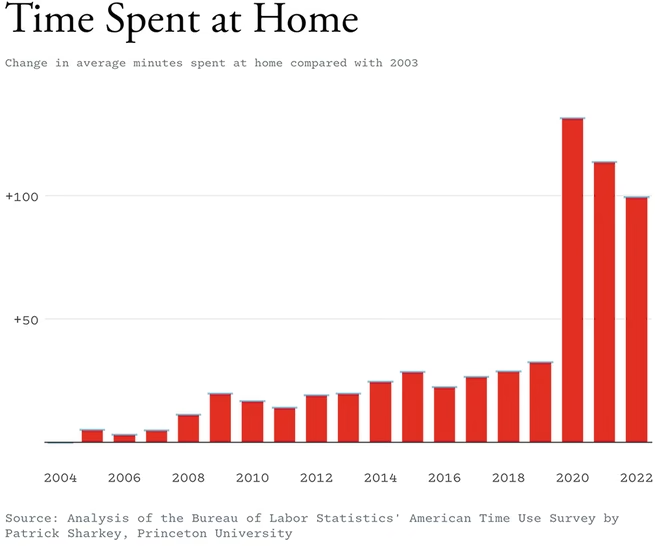

In a bracing essay, Derek Thompson, explores the emergence of this wide-spread isolation, unpacking its drivers, enumerating its considerable (personal and civic) costs, musing on the possible impact of AI, and pondering what might lead to a return to sociability…
… “I have a view that is uncommon among social scientists, which is that moral revolutions are real and they change our culture,” Robert Putnam [author of Bowling Alone] told me. In the early 20th century, a group of liberal Christians, including the pastor Walter Rauschenbusch, urged other Christians to expand their faith from a narrow concern for personal salvation to a public concern for justice. Their movement, which became known as the Social Gospel, was instrumental in passing major political reforms, such as the abolition of child labor. It also encouraged a more communitarian approach to American life, which manifested in an array of entirely secular congregations that met in union halls and community centers and dining rooms. All of this came out of a particular alchemy of writing and thinking and organizing. No one can say precisely how to change a nation’s moral-emotional atmosphere, but what’s certain is that atmospheres do change. Our smallest actions create norms. Our norms create values. Our values drive behavior. And our behaviors cascade.
The anti-social century is the result of one such cascade, of chosen solitude, accelerated by digital-world progress and physical-world regress. But if one cascade brought us into an anti-social century, another can bring about a social century. New norms are possible; they’re being created all the time. Independent bookstores are booming—the American Booksellers Association has reported more than 50 percent growth since 2009—and in cities such as New York City and Washington, D.C., many of them have become miniature theaters, with regular standing-room-only crowds gathered for author readings. More districts and states are banning smartphones in schools, a national experiment that could, optimistically, improve children’s focus and their physical-world relationships. In the past few years, board-game cafés have flowered across the country, and their business is expected to nearly double by 2030. These cafés buck an 80-year trend. Instead of turning a previously social form of entertainment into a private one, they turn a living-room pastime into a destination activity. As sweeping as the social revolution I’ve described might seem, it’s built from the ground up by institutions and decisions that are profoundly within our control: as humble as a café, as small as a new phone locker at school…
On how we spend our time and what that yields: “The Anti-Social Century,” from @dkthomp.bsky.social in @theatlantic.com (gift article).
See also: “You’re Being Alienated From Your Own Attention,” from @chrislhayes.bsky.social (also in @theatlantic.com, also a gift article)
* Kenneth Grahame, The Wind in the Willows
###
As we call a friend, we might recall that it was on this date in 1915 that Alexander Graham Bell placed the first transcontinental phone call, from New York to San Francisco, where the Panama–Pacific International Exposition celebrations were underway and his assistant, his assistant Thomas Augustus Watson stood by. Bell repeated his famous first telephonic words, “Mr. Watson, come here. I want you,” to which Watson this time replied “It will take me five days to get there now!” Bell’s call officially initiated AT&T’s transcontinental service.
And, on ths date 45 years later, in 1959, The first non-stop transcontinental commercial jet trip was made by an American Airlines Boeing 707, from Los Angeles to New York. The sleek silver plane made the flight in airline official time of 4 hours and 3 minutes, half the usual scheduled time for the prop-driven DC- 7Cs then in regular use on that route.
“Insofar as we have power over the world and over one another, we must learn to do what the leaf and the whale and the wind do of their own nature.”*…

James Bridle’s remarkable new book, Ways of Being-Animals, Plants, Machines: The Search for a Planetary Intelligence, explores the many types of intelligences that exist in the more-than-human world around us. In a fascinating interview with Emmanuel Vaughan-Lee, Bridle elaborates…
I knew, setting out to do this, that I would have to at some point, as a writer about intelligence, define what I meant by intelligence. But I was very frustrated by the lack of what seemed to me to be clear, good definitions of what it is we’re all talking about. You can get all these lists of what people mean when they talk about intelligence, and it’s a kind of grab bag of different qualities that changes all the time: things like planning, counterfactual imagining or coming up with scenarios, theories of mind, tool use, all these different qualities. People pick from them according to whatever their particular field is, but they all come from a human perspective. That seemed to me to be what actually united almost all our common discussions about intelligence: that it was just whatever humans did. And so all our discussions about other potential forms of intelligence, other intelligences that we encountered in the world, or intelligences that we imagined, were all framed in terms of how we understood ourselves and our own thinking. It really struck me that this became an incredibly limiting factor in how we were thinking about intelligence more broadly—and not just intelligence, really, but all relationships we have in the world that are so often mediated by our own intelligence. On the one hand this has restricted our ability to recognize the intelligences of other beings—and I think we’ll probably come to that—but it’s also deeply shaped our history of technology, and particularly AI…
So much more at: “An Ecological Technology– An Interview with James Bridle“; @jamesbridle in @emergence_zine.
* Ursula K. Le Guin, The Farthest Shore
###
As we investigate intelligence inclusively, we might recall that it was on this date in 1878 that the first telephone directory was issued. Consisting of a single piece of cardboard, it listed 50 individuals, businesses, and other offices in New Haven, Connecticut that had telephones. There were, as readers will note on the photo below, no numbers, as callers had to be connected by an operator.

“Progress means getting nearer to the place you want to be. And if you have taken a wrong turn, then to go forward does not get you any nearer.”*…

Earlier (Roughly) Daily posts have looked at “Progress Studies” and at its relationship to the Rationalism community. Garrison Lovely takes a deeper look at this growing and influential intellectual movement that aims to understand why human progress happens – and how to speed it up…
For most of history, the world improved at a sluggish pace, if at all. Civilisations rose and fell. Fortunes were amassed and squandered. Almost every person in the world lived in what we would now call extreme poverty. For thousands of years, global wealth – at least our best approximations of it – barely budged.
But beginning around 150-200 years ago, everything changed. The world economy suddenly began to grow exponentially. Global life expectancy climbed from less than 30 years to more than 70 years. Literacy, extreme poverty, infant mortality, and even height improved in a similarly dramatic fashion. The story may not be universally positive, nor have the benefits been equally distributed, but by many measures, economic growth and advances in science and technology have changed the way of life for billions of people.
What explains this sudden explosion in relative wealth and technological power? What happens if it slows down, or stagnates? And if so, can we do something about it? These are key questions of “progress studies”, a nascent self-styled academic field and intellectual movement, which aims to dissect the causes of human progress in order to better advance it.
Founded by an influential economist and a billionaire entrepreneur, this community tends to define progress in terms of scientific or technological advancement, and economic growth – and therefore their ideas and beliefs are not without their critics. So, what does the progress studies movement believe, and what do they want to see happen in the future?
Find out at: “Do we need a better understanding of ‘progress’?,” from @GarrisonLovely at @BBC_Future.
Then judge for yourself: was Adorno right? “It would be advisable to think of progress in the crudest, most basic terms: that no one should go hungry anymore, that there should be no more torture, no more Auschwitz. Only then will the idea of progress be free from lies.” Or can–should– we be more purposively, systemically ambitious?
* C. S. Lewis
###
As we get better at getting better, we might recall that it was on this date in 1922 that the United States paid tribute to a man instrumental in the progress that Progress Studies is anxious to sustain, Alexander Graham Bell…
There were more than 14 million telephones in the United States by the time Alexander Graham Bell died. For one minute on August 4, 1922, they were all silent.
The reason: Bell’s funeral. The American inventor was the first to patent telephone technology in the United States and who founded the Bell Telephone System in 1877. Though Bell wasn’t the only person to invent “the transmission of speech by electrical wires,” writes Randy Alfred for Wired, achieving patent primacy in the United States allowed him to spend his life inventing. Even though the telephone changed the world, Bell didn’t stop there.
Bell died on August 2, 1922, just a few days after his 75th birthday. “As a mark of respect every telephone exchange in the United States and Canada closed for a minute when his funeral began around 6:30 p.m. Eastern Standard Time,” Alfred writes.
On the day of the funeral, The New York Times reported that Bell was also honored by advocates for deaf people. “Entirely apart from the monumental achievement of Professor Bell as the inventor of the telephone, his conspicuous work in [sic] behalf of the deaf of this country would alone entitle him to everlasting fame,” said Felix H. Levey, president of the Institution for the Improved Instruction of Deaf Mutes.
In fact, Bell spent much of his income from the telephone on helping deaf people. The same year he founded the Bell Telephone System, 1880, Bell founded the Volta Laboratory. The laboratory, originally called Volta Associates, capitalized on Bell’s work and the work of other sound pioneers. It made money by patenting new innovations for the gramophone and other recorded sound technologies. In 1887, Bell took his share of the money from the sale of gramophone patents and founded the Volta Bureau “as an instrument for the increase and diffusion of knowledge relating to the Deaf,’” writes the National Park Service. Bell and Volta continued to work for deaf rights throughout his life.
Volta Laboratory eventually became Bell Laboratories, which was home to many of the twentieth century’s communication innovations.
Smithsonian

You must be logged in to post a comment.