Posts Tagged ‘socializing’
“It is fun to have fun”*…

… but it’s getting tougher to manage. As Ben Steverman reports, with fewer places to relax and socialize, and steeper prices for entry, having fun is quantifiably harder than it used to be…
Over the course of the past two decades, the US has lost 2,000 golf courses and 7,000 bars and nightclubs, and Americans now own 1.3 million fewer boats. It’s prohibitively expensive to open a new summer camp and practically impossible to build a beachfront resort or marina. Venue shortages afflict musicians looking for performance spaces, children looking to play in local sports leagues and adults looking to go out dancing. The best time to book a rental for this summer was last summer, and the best time to book for next summer is … well, it may already be too late.
America appears to be suffering from a fun shortage. For the industries supplying recreational amenities, this deficit is a business opportunity. But for everyone not positioned to profit from the trend, it’s a source of stress and frustration that’s been building for a while. It also has broad ramifications for the future of the economy, society and politics. On… the country’s 250th birthday, it’s worth pondering whether the pursuit of happiness has become more difficult.
First, a quick definition: Experts on these matters generally agree that the kinds of fun we should be striving for are enjoyable experiences with others. A live show with friends, a vacation with family or even small talk with a stranger can all make us feel more connected and content.
By those measures, it’s clear that Americans are having less fun than they used to. Since its 2003 inception, the Bureau of Labor Statistics’ American Time Use Survey shows double-digit percentage drops in the hours spent each year on arts and entertainment activities, attending sports or recreational events, and attending or hosting social events. In a 2024 US Census Bureau survey, almost 80% of respondents said they saw friends or relatives fewer than three times a week.
The US, along with Australia, Canada and New Zealand, seems to have grown uniquely unhappy over the past 15 years, according to the annual World Happiness Report, which combines data on more than 140 countries. For good reason, we often blame smartphones and social media for making us feel worse. But most of the world uses these digital tools at least as much as Americans do, and the US still came in 23rd on the global happiness ranking in 2026, down from 13th a decade prior. America’s happiness decline must have another major cause, says report co-editor and University of British Columbia professor emeritus of economics John Helliwell. He points to the “often forgotten” factor of fun. “It’s not just connections” with other people, he says. “It’s how much you’re enjoying the connections.”…
… It keeps getting harder — and more expensive — to have fun. A combination of factors is delivering a summer of higher prices, fewer options, limited vacancies and longer lines.
No matter how enthusiastic Americans are for offline experiences, there’s a limit to how much they can afford, with prices rising at the fastest pace in three years. As the cost of commutes, housing, utilities and other necessities climbs more quickly than wages, people have little choice but to skimp on fun. Meanwhile, the prices of some key categories of fun have been rising even faster than inflation. The price of a ticket to one of the top 100 concert tours in North America averaged $134 last year, trade publication Pollstar estimates, a 42% increase from 2019. Vacation rentals in coastal destinations jumped 38% over the same period, to $413 per night, according to data analyst AirDNA LLC.
Fun isn’t just harder to afford. It’s harder to access. The US has lost a fifth of its movie theaters and almost a third of its bowling alleys since 2001, Bureau of Labor Statistics data show. Camp spots for children fill up quickly, with more than 80% of organizations reporting steady or increasing enrollment last summer, according to the American Camp Association. At US country clubs, the median initiation fee has doubled since 2019, to $51,500, at the same time that waiting lists have also doubled in length, according to data firm Club Benchmarking…
… Parks departments have added thousands of pickleball courts to meet demand, but the new facilities often come at the expense of basketball and tennis, which have also been getting more popular, while the rest of the park gets busier as well. Park space per person declined in 65 of the 100 largest cities from 2016 to 2023, according to the Trust for Public Land. Record crowds are also inundating the National Park Service’s most scenic spots and descending on America’s most popular beach towns. With tours, hotels and beach houses booking up early, planning a vacation has turned into a thankless task of gaming out the distant future. “Availability is becoming a bigger issue than price,” says Laura Mattia, a financial adviser at the firm Wealth Enhancement in Sarasota, Florida. “I see clients booking rentals six to nine months ahead, committing before they have fully thought through the trip, or saying yes to expensive options simply because they are available.”
Rising inequality is making the problem worse, as the superwealthy bid up the costs of fun, whether luxury hotels or the best seats at sporting events. A 2011 study showed lower levels of happiness in areas of Switzerland with more Ferraris and Porsches. “Inequality matters objectively to people, but when it’s thrown in their faces, they like it even less,” Helliwell says…
…
… This fun shortage may be shifting American politics in significant ways. Studies in the UK and continental Europe show voters are more likely to vote for right-wing candidates in the years after local social spaces such as pubs shut down. “When the last gathering place in a town goes, people experience it as a sign of being left behind, of a place emptying out,” says Subtil, the author of a new paper showing France’s far-right National Rally party has benefited from the closure of thousands of bars-tabacs, shops where customers can make a bet, get a coffee or pick up a newspaper.
Replenishing America’s inventory of fun won’t be easy at a time when digital tools are absorbing ever more attention and economic resources. It will take creativity and capital to generate real excitement in real spaces where real people interact. Encouragingly, there are signs of a shift: After New York City repealed century-old rules against dancing in bars in recent years, New York Governor Kathy Hochul announced a similar statewide policy in May. Massachusetts, meanwhile, has loosened rules that capped the number of liquor licenses, which Boston Mayor Michelle Wu argued were starving neighborhoods of local gathering places. The city may add 225 liquor licenses, the vast majority designated for areas far from the tourist sites downtown.
Local governments “really need to think about fun, leisure and entertainment for everyone,” including children and seniors, says Jess Reia, a professor of public policy and data science at the University of Virginia.
In the meantime, Americans are finding cheaper ways to fill their free time. Participation in outdoor activities and team sports has soared in the past five years, reaching record levels, according to a long-running survey by the Physical Activity Council, which estimates the number of “inactive” Americans has dropped by 13.6 million, or 18%, since 2020. Plus there are signs that young people are taking up old-school hobbies, such as crafts and birding, Reia says. “People are trying to find the fun where they can.”
“The Fun Shortage Is Real, and It’s Making America Miserable,” gift article from @bloomberg.com.
See also: “Do you believe that everybody should have fun or that only a few people should have fun?” from @garrettbucks.bsky.social.
* Dr. Seuss, The Cat in the Hat
###
As we recreate revelry, we might note that today is National Swimming Pool Day. While public baths and dedicated coastal swimming areas have a very long history, the first recorded swimming pool in the U.S. was a public pool built in 1887 in Brookline, Massachusetts, a place to socialize and beat the summer heat before the invention of air conditioning. One of the first residential pools was built on the Vanderbilt estate in Asheville, North Carolina in 1895.
As of 2024, there were 10.7 million pools in the U.S., of which 10.4 million are residential (about 8% of homes). While public pools took an early lead in the build-out, these days only 309,000 are public or commercial pools.

“Badger hates Society, and invitations, and dinner, and all that sort of thing”*…

Americans are now spending more time alone– mostly at home– than ever. It’s changing our personalities, our politics, and even our relationship to reality. While the pandemic certainly enforced some of that isolation; the post-COVID world remains extraordinarily atomized.
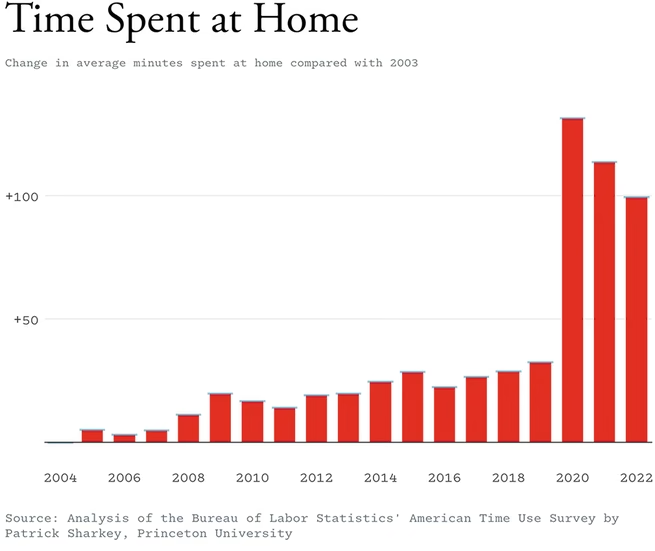

In a bracing essay, Derek Thompson, explores the emergence of this wide-spread isolation, unpacking its drivers, enumerating its considerable (personal and civic) costs, musing on the possible impact of AI, and pondering what might lead to a return to sociability…
… “I have a view that is uncommon among social scientists, which is that moral revolutions are real and they change our culture,” Robert Putnam [author of Bowling Alone] told me. In the early 20th century, a group of liberal Christians, including the pastor Walter Rauschenbusch, urged other Christians to expand their faith from a narrow concern for personal salvation to a public concern for justice. Their movement, which became known as the Social Gospel, was instrumental in passing major political reforms, such as the abolition of child labor. It also encouraged a more communitarian approach to American life, which manifested in an array of entirely secular congregations that met in union halls and community centers and dining rooms. All of this came out of a particular alchemy of writing and thinking and organizing. No one can say precisely how to change a nation’s moral-emotional atmosphere, but what’s certain is that atmospheres do change. Our smallest actions create norms. Our norms create values. Our values drive behavior. And our behaviors cascade.
The anti-social century is the result of one such cascade, of chosen solitude, accelerated by digital-world progress and physical-world regress. But if one cascade brought us into an anti-social century, another can bring about a social century. New norms are possible; they’re being created all the time. Independent bookstores are booming—the American Booksellers Association has reported more than 50 percent growth since 2009—and in cities such as New York City and Washington, D.C., many of them have become miniature theaters, with regular standing-room-only crowds gathered for author readings. More districts and states are banning smartphones in schools, a national experiment that could, optimistically, improve children’s focus and their physical-world relationships. In the past few years, board-game cafés have flowered across the country, and their business is expected to nearly double by 2030. These cafés buck an 80-year trend. Instead of turning a previously social form of entertainment into a private one, they turn a living-room pastime into a destination activity. As sweeping as the social revolution I’ve described might seem, it’s built from the ground up by institutions and decisions that are profoundly within our control: as humble as a café, as small as a new phone locker at school…
On how we spend our time and what that yields: “The Anti-Social Century,” from @dkthomp.bsky.social in @theatlantic.com (gift article).
See also: “You’re Being Alienated From Your Own Attention,” from @chrislhayes.bsky.social (also in @theatlantic.com, also a gift article)
* Kenneth Grahame, The Wind in the Willows
###
As we call a friend, we might recall that it was on this date in 1915 that Alexander Graham Bell placed the first transcontinental phone call, from New York to San Francisco, where the Panama–Pacific International Exposition celebrations were underway and his assistant, his assistant Thomas Augustus Watson stood by. Bell repeated his famous first telephonic words, “Mr. Watson, come here. I want you,” to which Watson this time replied “It will take me five days to get there now!” Bell’s call officially initiated AT&T’s transcontinental service.

And, on ths date 45 years later, in 1959, The first non-stop transcontinental commercial jet trip was made by an American Airlines Boeing 707, from Los Angeles to New York. The sleek silver plane made the flight in airline official time of 4 hours and 3 minutes, half the usual scheduled time for the prop-driven DC- 7Cs then in regular use on that route.

You must be logged in to post a comment.