Posts Tagged ‘Rabelais’
“‘When I use a word,’ Humpty Dumpty said in rather a scornful tone, ‘it means just what I choose it to mean — neither more nor less.'”*…
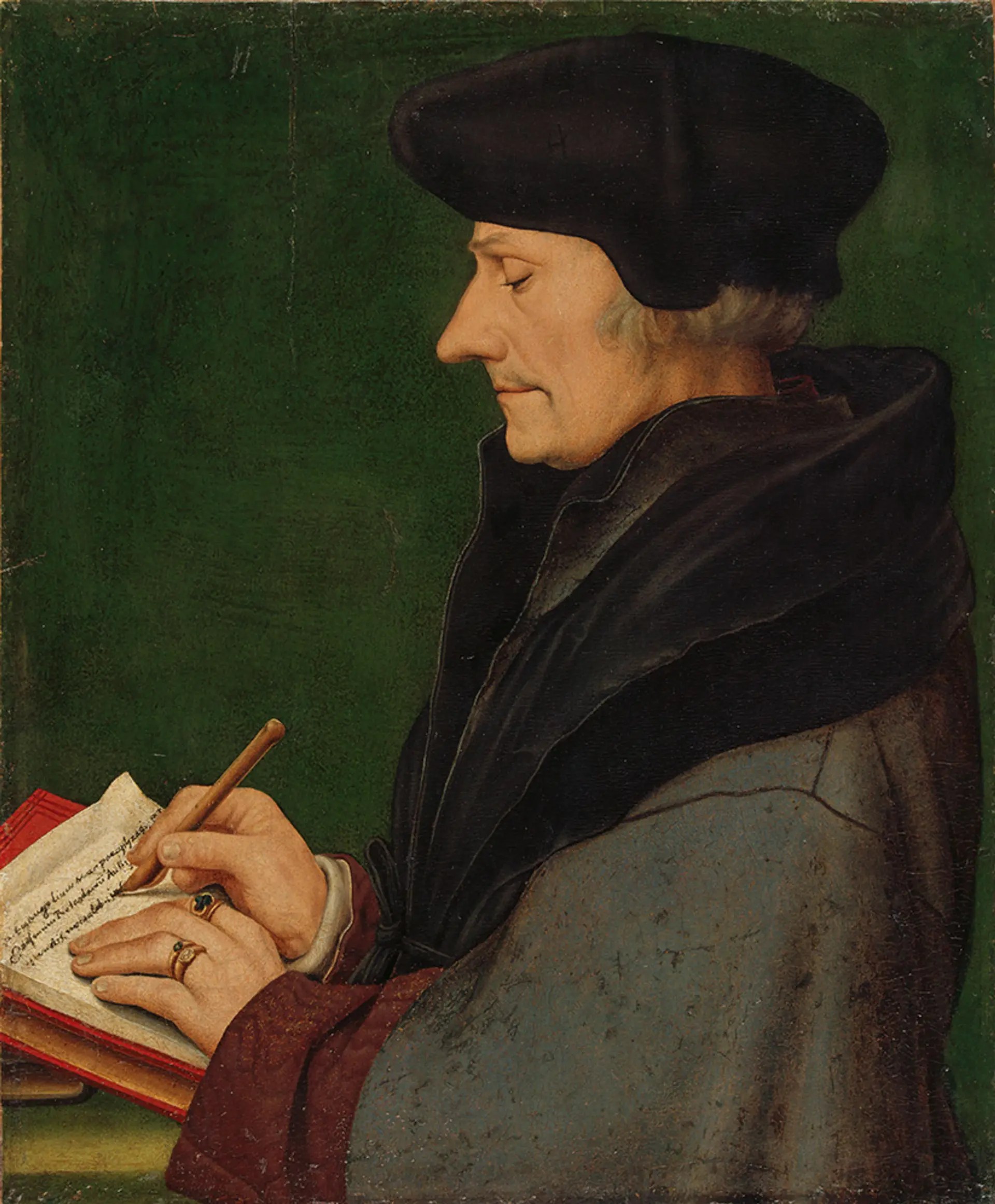
Like today’s large language models, some 16th-century humanists (like Erasmus) had techniques to automate writing. But as Hannah Katznelson explains, others (like Rabelais) called foul…
The Renaissance scholar and educator Erasmus of Rotterdam opens his polemical treatise The Ciceronian (1528) by describing the utterly dysfunctional writing process of a character named Nosoponus. The Ciceronianis structured as a dialogue, withtwo mature writers, Bulephorus and Hypologus, trying to talk Nosoponus out of his paralysing obsession with stylistic perfection. Nosoponus explains that it would take him weeks of fruitless writing and rewriting to produce a casual letter in which he asks a friend to return some borrowed books. He says that writing requires such intense concentration that he can do it only at night, when no one else is awake to distract him, and even then his perfectionism is so intense that a single sentence becomes a full night’s work. Nosoponus goes over what he’s written again and again, but remains so dissatisfied with the quality of his language that eventually he just gives up.
Nosoponus’s problem might resonate. Who has not spent too long going over the wording of a simple email, at some point or another? Today there is an easy fix: we have large language models (LLMs) to write our letters for us, helpfully proffering suggestions as to what we might say, and how we might phrase it. When I input Nosoponus’s intended request into GPT-4, it generated the following almost instantly:
Hey [Friend’s Name],
Hope you’re doing well! I just realised I never got those books back that I lent you a while ago. No rush, but whenever you get a chance, I’d love to get them back. Let me know what works for you! Thanks!
Nosoponus
But there was a solution in the 16th century, too. A humanist education on the Erasmian model could train its students to produce letters of any length, on any topic – quickly, easily and eloquently. The French humanist François Rabelais, a contemporary of Erasmus, appears to have understood these compositional techniques as automating the creating of text in a way that, retrospectively, looks a lot like how LLMs function. If we want to understand LLMs, and what they are and aren’t capable of, we can look at earlier versions of the same technology – like Erasmian humanism. We can also read authors like Rabelais, who is already thinking about automatic text-generation along these lines, as someone who appreciates the effectiveness of Erasmian generative technology, but at the same time sees it as vitiating the social force of language and, ultimately, ruining language as a tool for moral and political life…
[Katznelson recounts Erasmus’s efforts, Rabelais’s response, and unpacks the important differences between our own authentic speech language created to speak for us and their practical and moral implications…]
What lessons from the 16th century can tell us about AI and LLMs: “Methodical banality,” from @aeon.co.
* Lewis Carroll, Through the Looking Glass
###
As we honor authenticity, we might recall that it was on this date in 1886 that three U.S. patents were issued to Alexander Graham Bell’s Volta Labs for “recording and reproducing speech and other sounds.” The Graphophone, was an improved (and the first practical) version of the Edison phonograph (from 1877), and became the foundation on which the speech recording (e.g., dictaphone) and recorded music (and spoken word) industries began to grow.

“All that we see or seem is but a dream within a dream”*…

In 1565, twelve years after the death of François Rabelais (1494-1553) — the French Renaissance author best known for his satirical masterpiece The Life of Gargantua and of Pantagruel, the bawdy tale of two giants, Gargantua and his son Pantagruel [see here] — the Parisian bookseller and publisher Richard Breton brought out Les songes drolatiques de Pantagruel (The drolatic dreams of Pantagruel). The slim volume, save a short preface from Breton, is made up entirely of images [like the one above] — 120 woodcuts depicting a series of fantastically bizarre and grotesque figures, reminiscent of some of the more inventive and twisted creations of Brueghel or Bosch…
More of the backstory and more of the illustrations at “The Drolatic Dreams of Pantagruel.” See the original, in full, at The Internet Archive.
* Edgar Allan Poe
###
As we explore the extraordinary, we might send mysterious birthday greetings to a master of grotesque characters: Mary Flannery O’Connor; she was born on this date in 1925. The author of two novels and thirty-two short stories (as well as a number of reviews and commentaries), she was an exemplar of the Southern Gothic movement in American literature. Her posthumously compiled Complete Stories, which won the 1972 U.S. National Book Award for Fiction, has been the subject of enduring praise.

“I’m completely in favor of the separation of Church and State… These two institutions screw us up enough on their own, so both of them together is certain death”*…

The Redeemed Christian Church of God’s international headquarters in Ogun state has been transformed from a mere megachurch to an entire neighbourhood, with departments anticipating its members’ every practical as well as spiritual need.
A 25-megawatt power plant with gas piped in from the Nigerian capital serves the 5,000 private homes on site, 500 of them built by the church’s construction company. New housing estates are springing up every few months where thick palm forests grew just a few years ago. Education is provided, from creche to university level. The Redemption Camp health centre has an emergency unit and a maternity ward.
On Holiness Avenue, a branch of Tantaliser’s fast food chain does a brisk trade. There is an on-site post office, a supermarket, a dozen banks, furniture makers and mechanics’ workshops. An aerodrome and a polytechnic are in the works.
And in case the children get bored, there is a funfair with a ferris wheel…
In Nigeria, the line between church and city is rapidly vanishing: “Eat, pray, live: the Lagos megachurches building their very own cities.”
* George Carlin
###
As we re-read Max Weber, we might recall that it was on this date in 1545 that Renaissance writer, physician, humanist, monk, and Greek scholar François Rabelais received the permission of King François I to publish the Gargantua series– Gargantua and Pantagruel as we know it. In fact, Rabelais’ wild mix of fantasy, satire, the grotesque, bawdy jokes, and songs had been circulating pseudonymously for years. The censors of the Collège de la Sorbonne stigmatized it as obscene; and in a social climate of increasing religious oppression in a lead up to the French Wars of Religion, it had been treated with suspicion.
Rabelais wrote at a time of great ferment in the French language, and contributed mightily to it– both in coinage and in usage. But his influence was even broader (Tristram Shandy, e.g., is full of quotes from Rabelais) and continues to this day via writers including Milan Kundera, Robertson Davies, and Kenzaburō Ōe.

“Everything you can imagine is real”*…

Gregory Frank Harris, Tea in the Garden, c. 1953
A mash-up of fine art and current SMS messages…
From the sacred…

Diego Velazquez, Christ Crucified, 1632
…to the profane…

Jacques-Louis David, Male Nude Known as Hector, 1778
… readers will find oh so many more at If Paintings Could Text…

Rosa Bonheur, Portrait de Col. William F. Cody, 1889
[TotH to @mattiekahn]
* Pablo Picasso (whose paintings-with-texts are here)
###
As we just hit “send,” we might recall that it was on this date in 1545 that François Rabelais received the permission of King François I to publish the Gargantua series– Gargantua and Pantagruel as we know it. In fact, Rabelais’ wild mix of fantasy, satire, the grotesque, bawdy jokes, and songs had been circulating pseudonymously for years.
Rabelais wrote at a time of great ferment in the French language, and contributed mightily to it– both in coinage and in usage. But his influence was even broader (Tristram Shandy, e.g., is full of quotes from Rabelais) and continues to this day via writers including Milan Kundera, Robertson Davies, and Kenzaburō Ōe.
Forgotten words…

From Studio Jubilee, a collection of forgotten words: Lexican… e.g.,

More nostalgic nouns, verbs, and modifiers at Lexican.
###
As we appreciate history, we might recall that it was on this date in 1545 that François Rabelais received the permission of King François I to publish the Gargantua series– Gargantua and Pantagruel as we know it. In fact, Rabelais’ wild mix of fantasy, satire, the grotesque, bawdy jokes, and songs had been circulating pseudonymously for years.
Rabelais wrote at a time of great ferment in the French language, and contributed mightily to it– both in coinage and in usage. But his influence was even broader (Tristram Shandy, e.g., is full of quotes from Rabelais) and continues to this day via writers including Milan Kundera, Robertson Davies, and Kenzaburō Ōe.
You must be logged in to post a comment.