Posts Tagged ‘dictation’
“‘When I use a word,’ Humpty Dumpty said in rather a scornful tone, ‘it means just what I choose it to mean — neither more nor less.'”*…
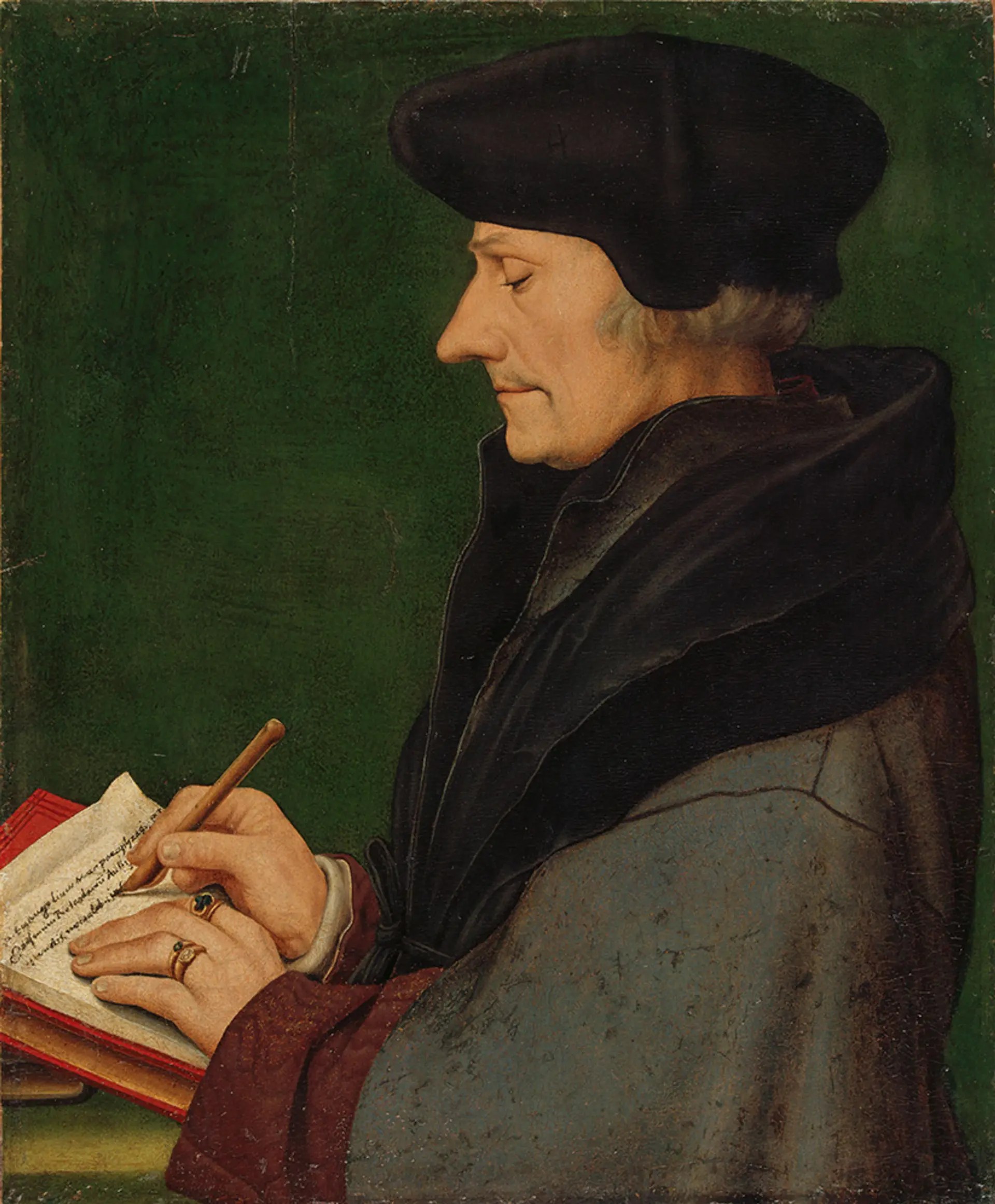
Like today’s large language models, some 16th-century humanists (like Erasmus) had techniques to automate writing. But as Hannah Katznelson explains, others (like Rabelais) called foul…
The Renaissance scholar and educator Erasmus of Rotterdam opens his polemical treatise The Ciceronian (1528) by describing the utterly dysfunctional writing process of a character named Nosoponus. The Ciceronianis structured as a dialogue, withtwo mature writers, Bulephorus and Hypologus, trying to talk Nosoponus out of his paralysing obsession with stylistic perfection. Nosoponus explains that it would take him weeks of fruitless writing and rewriting to produce a casual letter in which he asks a friend to return some borrowed books. He says that writing requires such intense concentration that he can do it only at night, when no one else is awake to distract him, and even then his perfectionism is so intense that a single sentence becomes a full night’s work. Nosoponus goes over what he’s written again and again, but remains so dissatisfied with the quality of his language that eventually he just gives up.
Nosoponus’s problem might resonate. Who has not spent too long going over the wording of a simple email, at some point or another? Today there is an easy fix: we have large language models (LLMs) to write our letters for us, helpfully proffering suggestions as to what we might say, and how we might phrase it. When I input Nosoponus’s intended request into GPT-4, it generated the following almost instantly:
Hey [Friend’s Name],
Hope you’re doing well! I just realised I never got those books back that I lent you a while ago. No rush, but whenever you get a chance, I’d love to get them back. Let me know what works for you! Thanks!
Nosoponus
But there was a solution in the 16th century, too. A humanist education on the Erasmian model could train its students to produce letters of any length, on any topic – quickly, easily and eloquently. The French humanist François Rabelais, a contemporary of Erasmus, appears to have understood these compositional techniques as automating the creating of text in a way that, retrospectively, looks a lot like how LLMs function. If we want to understand LLMs, and what they are and aren’t capable of, we can look at earlier versions of the same technology – like Erasmian humanism. We can also read authors like Rabelais, who is already thinking about automatic text-generation along these lines, as someone who appreciates the effectiveness of Erasmian generative technology, but at the same time sees it as vitiating the social force of language and, ultimately, ruining language as a tool for moral and political life…
[Katznelson recounts Erasmus’s efforts, Rabelais’s response, and unpacks the important differences between our own authentic speech language created to speak for us and their practical and moral implications…]
What lessons from the 16th century can tell us about AI and LLMs: “Methodical banality,” from @aeon.co.
* Lewis Carroll, Through the Looking Glass
###
As we honor authenticity, we might recall that it was on this date in 1886 that three U.S. patents were issued to Alexander Graham Bell’s Volta Labs for “recording and reproducing speech and other sounds.” The Graphophone, was an improved (and the first practical) version of the Edison phonograph (from 1877), and became the foundation on which the speech recording (e.g., dictaphone) and recorded music (and spoken word) industries began to grow.

You must be logged in to post a comment.