Posts Tagged ‘sociology’
“Status is welcome, agreeable, pleasant, & hard to obtain in the world”*…

We live in a time when a certain kind of status– expertise– is under attack. Dan Williams suggests that by celebrating “common sense” over expert authority, populism performs a dramatic status inversion. It gifts uneducated voters the power of knowledge and deflates those who look down on them…
… As Will Storr argues in The Status Game, humiliation is the “nuclear bomb of the emotions”. When ignited, it can fuel everything from genocide to suicide, mass atrocities to self-immolation. There are few parts of human nature more chaotic, dangerous, or self-destructive. And yet, there is often a rationale underlying these reactions rooted in the strange nature of human sociality.
If humans were solitary animals, we would have evolved to approximate the behaviour of Homo economicus, the idealised rational agent imagined in much of twentieth century economics. We would act in ways that are predictable, sensible, and consistent. The characters depicted in Dostoevsky’s novels would be unintelligible to such a creature, except as victims of mental illness.
But we are not. We are social creatures, and almost everything puzzling and paradoxical about our species is downstream of this fact.
For one thing, we rely on complex networks of cooperation to achieve almost all our goals. Given this, much of human behaviour is rooted not in ordinary material self-interest but in the need to gain access to such networks—to win approval, cultivate a good reputation, and attract partners, friends, and allies. Human decision-making occurs within the confines of this social scrutiny. We evaluate almost every action, habit, and preference not just by its immediate effects but by its reputational impact.
At the same time, much of human competition is driven by the desire for prestige. In well-functioning human societies, individuals advance their interests not by bullying and dominating others but by impressing them. These high-status individuals are admired, respected, and deferred to. They win esteem and all its benefits. Their lives feel meaningful and purposeful.
In contrast, those who fail at the status game—who stack up at the bottom of the prestige hierarchy—experience shame and humiliation. If their position feels unfair, they become resentful and angry. In extreme cases, they might take vengeance on those who look down on them. Or they might take their own life. In some cases, such as mass killings by young men who “lose face” and run “amok” (a Malay word, illustrating the behaviour’s cross-cultural nature), they do both…
…
… The name of this newsletter, “Conspicuous Cognition”, is inspired by Veblen’s ideas about economics. Just as he sought to correct a misguided tendency to treat economics through a narrowly economic lens, my work and writings seek to correct a similarly misguided tendency to treat cognition—how we think, form beliefs, generate ideas, evaluate evidence, communicate, and so on—through a narrowly cognitive lens.
Much cognition is competitive and conspicuous. People strive to show off their intelligence, knowledge, and wisdom. They compete to win attention and recognition for making novel discoveries or producing rationalisations of what others want to believe. They often reason not to figure out the truth but to persuade and manage their reputation. They often form beliefs not to acquire knowledge but to signal their impressive qualities and loyalties.
Placed in this context of social competition and impression management, what might be called “epistemic charity”—the free offer of knowledge and expertise—takes on a different appearance. Although this charity can be driven by disinterested altruism (think of parents educating their children), it can also result from status competition and a desire to show off.
In some cases, people are happy to receive such epistemic charity and heap praise and admiration on those who provide it. The wonders of modern science emerge from a status game that celebrates those who make discoveries. However, we sometimes recoil at the thought of admitting someone has discovered something new, or—even worse—that they know better than we do. When that happens, we are not sceptical of the truth of their ideas, although we might choose to frame things that way. Rather, their offer of knowledge carries a symbolic significance we want to reject. It hurts our pride. It feels humiliating.
On a small scale, this feeling is an everyday occurrence. Few people like to be corrected, to admit they are wrong, or to acknowledge another’s superior knowledge, wisdom, or intelligence. On a larger scale, it might be implicated in some of the most significant and dangerous trends in modern politics.
Many of our most profound political problems appear to be entangled with epistemic issues. Think of our alleged crises of “disinformation”, “misinformation”, “post-truth”, and conspiracy theories. Think of the spread of viral lies and falsehoods on social media. Think of intense ideological polarisation, vicious political debates, and heated culture wars, disagreements and conflicts that ultimately concern what is true.
A critical aspect of these problems is the so-called “crisis of expertise”, the widespread populist rejection of claims advanced in institutions like science, universities, public health organisations, and mainstream media. Famously, many populists have “had enough of experts.” As Trump once put it, “The experts are terrible.”
This rejection of expertise goes beyond mere scepticism. It is actively hostile. The Trump administration’s recent attacks on Harvard and other elite universities provide one illustration of this hostility, but there are many others. Most obviously, there is the proud willingness among many populists to spread and accept falsehoods, conspiracy theories, and quack science in the face of an exasperated barrage of “fact-checks” from establishment institutions. Why are these corrections so politically impotent? Why do so many voters refuse to “follow the science” or “trust the experts”?
Experts have produced many theories. Some point to ignorance and stupidity. Some point to disinformation and mass manipulation. Some point to partisan media, echo chambers, and algorithms. And some suggest that the crisis might be related to objective failures by experts themselves.
There is likely some truth in all these explanations. Nevertheless, they share a common assumption: that the “crisis of expertise” is best understood in epistemic terms. They assume that populist hostility to the expert class reflects scepticism that their expertise is genuine—that they really know what they claim to know.
Perhaps this assumption is mistaken. Perhaps at least in some cases, the crisis of expertise is less about doubting expert knowledge than about rejecting the social hierarchy that “trust the experts” implies… some populists might sooner accept ignorance than epistemic charity from those they refuse to acknowledge as superior…
…
… If this analysis is correct, the populist rejection of expertise is not merely an intellectual disagreement over truth or evidence, even if it is typically presented that way. It is, in part, a proud refusal to accept epistemic charity from those who present themselves as social superiors.
In the case of populist elites and conspiracy theorists, this refusal is often driven by objectionable feelings of grandiosity and narcissism. However, for many ordinary voters, it may serve as a more understandable dignity-defence mechanism, a refusal to accept the social meanings implied by one-way deference to elites with alien values. It is less “post-truth” than anti-humiliation.
This would help to explain several features of the populist rejection of expertise.
First, there is its emotional signature. In many cases, the populist refusal to defer to experts appears to be wrapped up in intense emotions of resentment, indignation, and defiant pride, rather than simple scepticism.
Second, the rejection of expert authority often has a performative character. Experts are not merely ignored. They are actively, angrily, and proudly rejected. Like Captain Snegiryov, the populist publicly tramples on the expert’s offer of knowledge.
Third, there is the destructive aspect of many populist sentiments. If the issue were merely scepticism of experts and establishment institutions, the solution would presumably involve targeted reforms designed to make them more reliable. As recent Republican attacks on elite universities make clear, many populists prefer to take a sledgehammer to these institutions. The explosive hostility towards public health experts during the pandemic provides another telling example.
Finally, there is the fact that populists often embrace anti-intellectualism as an identity marker, a badge of pride. The valorisation of gut instincts, the proposed “revolution of common sense”, and the embrace of slogans like “do your own research” affirm the status of those who prioritise intuition over experts. The demonisation of “ivory tower academics”, “blue-haired”, “woke” professors, and the “chattering classes” are crafted to have a similar effect. This all looks more like status-inverting propaganda than intellectual disagreements over truth and trustworthiness.
To understand is not to forgive. Just as we can empathise with Snegiryov’s refusal of much-needed money whilst condemning it as short-sighted and self-destructive, we can try to understand the populist rejection of expertise without endorsing or justifying it.
To be clear, there are profound problems with our expert class and elite institutions. They routinely make errors, sometimes catastrophic ones, and often wield their social authority in ways that advance their own interests over the public good. The Iraq war, the financial crisis, and the many failures of policy and communication throughout the pandemic provide powerful illustrations of these expert failures, but there are many others.
Moreover, the social and political uniformity of experts today creates legitimate concerns about their trustworthiness. When scientific journals, public health authorities, and fact-checking organisations are obviously shaped by the values, partisan allegiances, and sensibilities of highly educated, progressive professionals, it is reasonable for those with very different values and identities to become mistrustful of them.
Nevertheless, there is no alternative to credentialed experts in complex, modern societies. To address the political challenges we confront today, we need specialised training, rigorous standards of evidence, and coordinated activity within institutions carefully engineered to produce knowledge. Although these institutions must be reformed in countless ways, they are indispensable.
Given this, the populists’ rejection of expertise does not liberate them from bias and error. It guarantees bias and error. Gut instincts, intuition, and “common sense” are fundamentally unreliable ways of producing knowledge. As we see with the MAGA media ecosystem today, the valorisation of such methods means returning to a pre-scientific, medieval worldview dominated by baseless conspiracy theories, snake oil medicine, economic illiteracy, and know-nothing punditry.
And yet, the dangers associated with this style of politics underscore the importance of understanding its causes. If the crisis of expertise is partly rooted in feelings of status threat, resentment, and humiliation, this has significant implications for how we should think about—and address—this crisis.
Most obviously, it suggests that purely epistemic solutions will have limited efficacy. You cannot fact-check your way out of status competition. And as long as the acceptance of expert guidance is experienced as an admission of social inferiority, there will be a lucrative market for demagogues and bullshitters who produce more status-affirming narratives.
Moreover, it suggests that rebuilding trust in experts means more than improving their reliability, as crucial as that is. Institutions dominated by a single social class and political tribe will inevitably face resistance and backlash in broader society, regardless of their technical competence.
We do not just need better ways of producing knowledge. We need to rethink how knowledge is offered: in ways that respect people’s pride and minimise the humiliations of one-sided epistemic charity…
Eminently worth reading in full: “Status, class, and the crisis of expertise,” from @danwphilosophy.bsky.social.
(Image above: source)
* Buddha (Ittha Sutta, AN 5.43)
###
As we dig dignity, we might send classy birthday greetings to George Bryan “Beau” Brummell; he was born on this date in 1778. An important figure in Regency England (a close pal of the Prince Regent, the future King George IV), he became the the arbiter of men’s fashion in London and in the territories under its cultural sway.
Brummell was remembered afterwards as the preeminent example of the dandy; a whole literature was founded on his manner and witty sayings, e.g. “Fashions come and go; bad taste is timeless.”

“I know not all that may be coming, but be it what it will, I’ll go to it laughing”*…
Antropologist Kristin Bell explores laughter as a far more complex phenomenon than simple delight, reflecting on its surprising power to disturb and disrupt…
… As an anthropologist specializing in health and medicine, laughter isn’t really in my professional wheelhouse—unless you subscribe to the view that laughter is the best medicine. My interest in the topic is more personal, not just because of my history as a former Giggling Gertie, but because it’s a behavior that is much less straightforward than it seems.
Ideally, laughter is something we share. According to anthropologist Munro Edmonson, laughter is sociable; it ideally invites a similar response. Indeed, it has contagious qualities: When we hear someone laugh, we often laugh, or at least smile, ourselves—an effect consistently shown through psychological research. This is how we ended up with canned laughter on sitcoms. Studios realized that the sound of laughter made their shows seem funnier to their audiences, while also giving them a degree of control over when people laughed…
… According to the anthropologist Munro Edmonson, the central feature of laughter is aspiration: We release a forceful puff of air as we laugh.
But laughter is also characterized by repetition. In fact, given the extraordinary variability in the sounds people make when they laugh, repetition is what makes laughter universally recognizable. This is why writers conventionalize laughter as “he-he-he,” “ha-ha-ha,” and “ho-ho-ho” (well, at least if you’re Santa Claus). Notably, this feature isn’t exclusive to English representations. Edmonson observed that laughter is represented in Russian as xe, xe, xe; in Tzotzil—a Mayan language spoken in Mexico—it’s ‘eh ‘eh ‘eh.
We don’t fully understand why humans make this sound when we laugh. When 19th-century biologist Charles Darwin set out to explore the biology of feelings in The Expression of the Emotions in Man and Animals, he wrote, “why the sounds which man utters when he is pleased have the peculiar reiterated character of laughter we do not know.” However, the response seems to occur well before culture is embedded in our behaviors: Recognizable laughter is evident in babies from 4 months old.
Nor is laughter unique to humans. Great apes respond to being tickled in much the same way that humans do. Of course, because chimps, bonobos, et cetera have a different vocal apparatus than humans, it sounds more like a dog panting or a person having an asthma attack or energetic sex. However, these primate sounds have the same “peculiar, reiterated character” that Darwin highlighted in humans. This is why laughter is characterized by scientists as a cross-species phenomenon.
Yet, while laughter is evident in the play of other primates, it’s unclear whether they have a sense of humor. Recent research provides evidence of a capacity for teasing through nonverbal behavior. But, as the evolutionary psychologist Robert Provine noted, “there is no evidence that they respond to apparently humorous behavior, their own or that of others, with laughter.”
Giving meaning to laughter seems to be distinctively human.
While some laughter is deliberate, much of it is outside conscious control—an attribute that goes a long way toward explaining the widespread Euro-American ambivalence toward the act. According to the literary scholar Sebastian Coxon, a growing anxiety about mirth is evident in the European historical record from the late Middle Ages. For example, the 16th-century Dutch philosopher Desiderius Erasmus, better known for advising children to “replace farts with coughs,” also warned against “loud laughter and immoderate mirth.”
Notably, Erasmus singled out the “neighing sound that some people make when they laugh” for particular opprobrium—an impulse evident in the contemporary tendency to compare unrestrained laughter with the cries of animals: “howling” with laughter, “hooting” in delight, “snorting” with amusement, and so on. Indeed, while the term “guffaw” might not be borrowed from animal noises, it certainly sounds like it could be.
These characterizations reveal an attempt to draw laughter into the realm of taste and civility—categories that are strongly tied to gender and class strictures. For instance, in an 1860 etiquette guide titled The Ladies’ Book of Etiquette and Manual of Politeness: A Complete Hand Book for the Use of the Lady in Polite Society, readers are counseled to moderate their laughter during a dinner party so that it’s neither too loud nor too soft: “To laugh in a suppressed way, has the appearance of laughing at those around you, and a loud, boisterous laugh is always unlady-like.”
Social judgments abound not just in relation to how we laugh but what we laugh at—as an early 19th-century artwork attests. “Laughter,” etched by British artist and social commentator Thomas Rowlandson, depicts a man laughing at his cat adorned in a bonnet and cloak.

The caption reads: ‘Laughter is one of the most pleasing of the Passions and is with difficulty accounted for, as risibility is frequently excited from the most simple causes—as is the case with the Countryman and his Cat.’ The implication is that “unsophisticated” countrymen lack “class” and are therefore easily amused. (For the record, I am equally unsophisticated, because I will never not find cats pictured with human props funny.)
Still, despite the association between humor and taste, it’s often physical comedy that gets the most laughs. It’s not a coincidence that the first truly global hit comedy was The Gods Must Be Crazy, whose sublime “Tati-like slapstick routines” drew audiences from New York and Caracas to Tokyo and Lagos, despite being widely condemned by film reviewers as apartheid propaganda.
Indeed, screenwriters have long predicted that physical humor will become increasingly prominent in Hollywood comedies because it “transcends dialogue and even most cultural differences,” and movies must increasingly appeal to a global market to produce reliable returns. (As far as I can tell, the future of Hollywood films is basically Marvel movies and slapstick comedies.)…
… As McDonald observes, laughter disrupts the notion of a stable, coherent self—reflected in terms like “cracking up” and “bursting.” Moreover, unrestrained laughter doesn’t just signify a lack of personal control; it can be politically dangerous as well. The literary historian Joseph Butwin writes of “seditious laughter” as a weapon of the oppressed that can serve to destabilize hierarchies and power relations.
In the end, it’s clear that laughter is a deeply curious thing. It’s simultaneously the most social of human expressions and the one most disruptive of social edifices and rules. Shared, sanctioned laughter might bring us together, but unsanctioned laughter shows the cracks, revealing that we’re not quite who we think…
“The Strange Power of Laughter“
* Herman Melville, Moby-Dick
###
As we muse on mirth (and lest we forget that sometimes laughter is simply a function of simple delight), we might recall that it was on this date in 1929 that Rube Goldberg‘s “The Inventions of Professor Lucifer Gorgonzola Butts, A.K.,” cartoon series first published in Colliers Weekly.

“Badger hates Society, and invitations, and dinner, and all that sort of thing”*…

Americans are now spending more time alone– mostly at home– than ever. It’s changing our personalities, our politics, and even our relationship to reality. While the pandemic certainly enforced some of that isolation; the post-COVID world remains extraordinarily atomized.
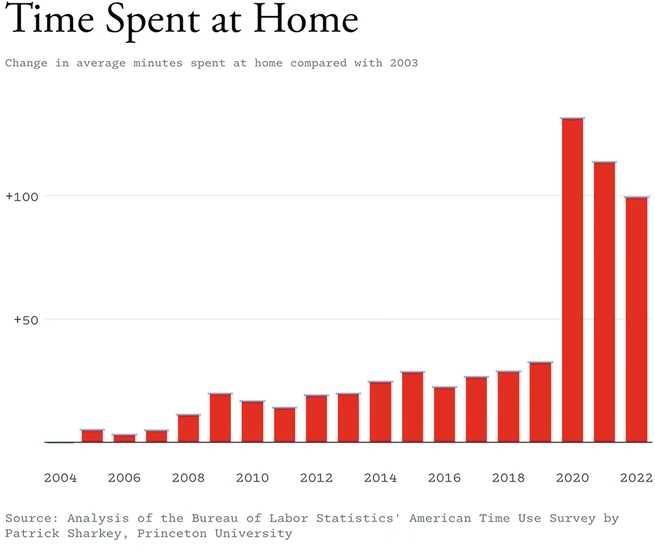

In a bracing essay, Derek Thompson, explores the emergence of this wide-spread isolation, unpacking its drivers, enumerating its considerable (personal and civic) costs, musing on the possible impact of AI, and pondering what might lead to a return to sociability…
… “I have a view that is uncommon among social scientists, which is that moral revolutions are real and they change our culture,” Robert Putnam [author of Bowling Alone] told me. In the early 20th century, a group of liberal Christians, including the pastor Walter Rauschenbusch, urged other Christians to expand their faith from a narrow concern for personal salvation to a public concern for justice. Their movement, which became known as the Social Gospel, was instrumental in passing major political reforms, such as the abolition of child labor. It also encouraged a more communitarian approach to American life, which manifested in an array of entirely secular congregations that met in union halls and community centers and dining rooms. All of this came out of a particular alchemy of writing and thinking and organizing. No one can say precisely how to change a nation’s moral-emotional atmosphere, but what’s certain is that atmospheres do change. Our smallest actions create norms. Our norms create values. Our values drive behavior. And our behaviors cascade.
The anti-social century is the result of one such cascade, of chosen solitude, accelerated by digital-world progress and physical-world regress. But if one cascade brought us into an anti-social century, another can bring about a social century. New norms are possible; they’re being created all the time. Independent bookstores are booming—the American Booksellers Association has reported more than 50 percent growth since 2009—and in cities such as New York City and Washington, D.C., many of them have become miniature theaters, with regular standing-room-only crowds gathered for author readings. More districts and states are banning smartphones in schools, a national experiment that could, optimistically, improve children’s focus and their physical-world relationships. In the past few years, board-game cafés have flowered across the country, and their business is expected to nearly double by 2030. These cafés buck an 80-year trend. Instead of turning a previously social form of entertainment into a private one, they turn a living-room pastime into a destination activity. As sweeping as the social revolution I’ve described might seem, it’s built from the ground up by institutions and decisions that are profoundly within our control: as humble as a café, as small as a new phone locker at school…
On how we spend our time and what that yields: “The Anti-Social Century,” from @dkthomp.bsky.social in @theatlantic.com (gift article).
See also: “You’re Being Alienated From Your Own Attention,” from @chrislhayes.bsky.social (also in @theatlantic.com, also a gift article)
* Kenneth Grahame, The Wind in the Willows
###
As we call a friend, we might recall that it was on this date in 1915 that Alexander Graham Bell placed the first transcontinental phone call, from New York to San Francisco, where the Panama–Pacific International Exposition celebrations were underway and his assistant, his assistant Thomas Augustus Watson stood by. Bell repeated his famous first telephonic words, “Mr. Watson, come here. I want you,” to which Watson this time replied “It will take me five days to get there now!” Bell’s call officially initiated AT&T’s transcontinental service.

And, on ths date 45 years later, in 1959, The first non-stop transcontinental commercial jet trip was made by an American Airlines Boeing 707, from Los Angeles to New York. The sleek silver plane made the flight in airline official time of 4 hours and 3 minutes, half the usual scheduled time for the prop-driven DC- 7Cs then in regular use on that route.

“This is a cardboard universe”*…

As we rid ourselves of the detritus of the Holiday season, let us pause to consider its signature component: at the turn of the 21st century, corrugated cardboard accounted for just fifteen percent of the United States recycling stream; today, it’s nearly half. Shannon Mattern on the cardboard box…
… As historian Maria Rentetzi writes (“Cardboard Box: The Politics of Materiality,” in Boxes: A Field Guide), “the cardboard box — the waste of our commercial world — is recycled in such a way as to make visible the disorder in our societies, the faults of capitalism.” It is an abject object that touches all parts of the city, from the granite kitchen island to the sewer grate. And for many of us, the cardboard box is our closest touchpoint to globalized trade, structuring our relations with people in distant places. It brings the logistics chain to our doorstep. The magnificently ripped metal freight container may get the Economist cover shot, but the plain brown box delivers messages to our homes. Its very existence in our homes, Marshall McLuhan would say, is the message. In the immortal words of Walter Paepcke, founder of the Container Corporation of America, “packages are not just commodities; they are communications.”
Let’s unpack that, shall we? Boxes are media in multiple senses of the word. They’re lithographed surfaces designed to be read, and they’re dimensional containers that mediate between outside and inside worlds. They’re “media of transport and information, shapers of public opinion and consumer desire, and means of targeting attention.” And they’re “logistical media” that “arrange people and property into time and space,” that “coordinate and control the movement of labor, people, and things situated along and within global supply chains.” The cardboard box is a minimalist form with maximalist ambitions, an arboreal apparatus made from one of the world’s most abundant renewable resources, then filled with plastic and moved around by copious quantities of oil. It doesn’t just coordinate and control landscapes; it transforms them.
Cardboard’s ubiquity rests on simple claims: I can hold that, and I can go there. The Container Corporation of America was founded in 1926, and upon those claims it built an empire with surprising reach. The CCA made collapsible shipping boxes, and it transformed packaging into a science and an art. It advanced market research, shaped mid-century taste, and altered the chromatic universe through color standards. It employed some of the best graphic designers of the period, and as national borders shifted after the Second World War, it commissioned Herbert Bayer, author of the Universal typeface, to revise the World Geo-Graphic Atlas. Even then, the CCA was remaking that new world to meet its logistical needs, rehabbing mining towns and germinating forests, and orchestrating civic discourse about all of this.
How did a packaging company get into the publishing business — into the containment and distribution of information? How were geographic imaginations changed in the process? Soon we’ll dive into the Paepcke archive, to find answers to those questions. But first I want to show you how a cardboard box is made…
In turn, inspiring and horrifying– the social history of the cardboard carton: “World in a Box,” @shannonmattern.bsky.social in @placesjournal.bsky.social.
For an earlier (R)D focused on Mattern’s work: “To clarify, ADD data.”
* Philip K. Dick, The Dark-Haired Girl
###
As we tape it tight, we might recall that it was on this date in 1910 that a federal official who might slowed the onset of the cardboard box was fired: Gifford Pinchot, the first chief of the United States Forest Service, was fired by President William Howard Taft. Pinchot had opposed Taft’s newly appointed Secretary of the Interior, Richard Ballinger, who favored commercial exploitation of federal reserve lands.
During President Theodore Roosevelt’s term, Pinchot had help enable policies for the conservation of natural resources. Roosevelt had designated millions of acres to protect as National Forests. That legacy was threatened, so Pinchot pressured Taft to remove Ballinger from office. In November of 1909, Collier’s Magazine had created a scandal when it accused Ballinger of shady dealings in coal lands in Alaska. When Pinchot criticized both Ballinger and Taft, the president reacted by firing him.

“If you could choose only one of the following two inventions, indoor plumbing or the Internet, which would you choose?”*…

For years, people have bemoaned the sorry state of innovation. Compared with the great inventions of the industrial era, the inventions of our own time seem pathetic. In a short essay reprised from 2012, the estimable Nicholas Carr offers a different take: We’re as innovative as ever, but the focus of innovation has shifted…
… The original inspiration for such grousing… came from Robert J. Gordon, a Northwestern University economist. His influential 2000 paper “Does the ‘New Economy’ Measure Up to the Great Inventions of the Past?” included a damning comparison of the flood of inventions of a century ago with the seeming trickle we see today. Consider the products invented in just the ten years between 1876 and 1886: the internal combustion engine, the electric lightbulb, the electric transformer, the steam turbine, the electric railroad, the automobile, the telephone, the movie camera, the phonograph, the linotype machine, the film roll for cameras, the dictaphone, the cash register, vaccines, reinforced concrete, the flush toilet. The typewriter had arrived a few years earlier, and the punch-card tabulator, the computer’s precursor, would appear a few years later. And then, in short order, came the airplane, the radio, air conditioning, the vacuum tube, jet aircraft, the television, the refrigerator, and a raft of other home appliances, as well as revolutionary advances in manufacturing processes. (And let’s not forget The Bomb.)
The conditions of life changed utterly between 1890 and 1950, observed Gordon. Between 1950 and today? Not so much.
So why is innovation less impressive today?… maybe it’s crappy education. Or a lack of corporate investment in research. Or short-sighted venture capitalists. Or monopolistic business practices. Or overaggressive lawyers. Or imagination-challenged entrepreneurs. Or maybe it’s a catastrophic loss of mojo. None of these explanations makes much sense. The aperture of science grows ever wider, after all, even as the commercial and reputational rewards for innovation grow ever larger and the ability to share ideas grows ever stronger. Any barrier to innovation should be swept away by such forces.
Let me float an alternative explanation: There has been no decline in innovation; there has just been a shift in its focus. We’re as creative as ever, but we’ve funneled our creativity into areas that produce smaller-scale, less far-reaching, less visible breakthroughs. And we’ve done that for entirely rational reasons. We’re getting precisely the kind of innovation we desire — and deserve.
My idea is that there’s a hierarchy of innovation that runs in parallel with Abraham Maslow’s famous hierarchy of needs. Maslow argued that human needs progress through five stages, with each new stage requiring the fulfillment of lower-level, or more basic, needs. So first we have to meet our most primitive Physiological needs, and that frees us to focus on our needs for Safety, and once our needs for Safety are met, we can attend to our needs for Belongingness, and then on to our needs for personal Esteem, and finally, at the peak of Maslow’s pyramid, to our needs for Self-Actualization.
If you look at Maslow’s hierarchy as an inflexible structure, with clear boundaries between its levels, it falls apart. Our needs are messy, and the boundaries between them are porous. A caveman probably pursued esteem and self-actualization, to some degree, just as we today spend time and effort fulfilling our physical needs. But if you look at the hierarchy as a map of human focus, then it makes sense — and seems to be borne out by history.
In short: The more comfortable you are, the more time you spend thinking about yourself.
If technological progress is shaped by human needs, as it surely is, then general shifts in needs would also bring shifts in the nature of innovation. The tools we invent would move through the hierarchy of needs, from tools that help safeguard our bodies or coordinate social groups on up to tools that allow us to modify our moods or express our individuality — from tools of survival to tools of the self. Here’s my crack at what the hierarchy of innovation looks like:

Innovation’s focus moves up through five stages, propelled by shifts in the needs we seek to fulfill. In the beginning come Technologies of Survival (think bow-and-arrow), then Technologies of Social Organization (think cathedral), then Technologies of Prosperity (think assembly line), then technologies of leisure (think TV), and finally Technologies of the Self (think Facebook, or Prozac).
As with Maslow’s hierarchy, you shouldn’t look at my hierarchy as a rigid one. Innovation today continues at all five levels. But the rewards, both monetary and reputational, are greatest at the top level (Technologies of the Self), which has the effect of shunting investment, attention, and activity in that direction. We’re already physically comfortable, so getting a little more physically comfortable doesn’t seem particularly pressing. We’ve become inward looking, and what we crave are more powerful tools for modifying our internal states or projecting those states outward to an audience. An entrepreneur today has a greater prospect of fame and riches if he or she creates a popular social-networking app than a faster, more efficient system for mass transit. Innovation, to put a dark spin on it, arcs toward decadence…
One might wonder why Carr doesn’t focus more (and more affirmatively) on information technologies– the emergence of personal computing in all of its form factors, the knitting together of the web and the advent of turbocharged connectivity, and on its back, the emergence of social media– all of which have been hugely impactful, perhaps especially in the 12 years since this essay was written: a “TikTok/YouTube/influencer election,” a social media fueled mental health concern, the proliferation of meme investing and online gambling, etc., etc… But then, one might conclude that they simply underline his point.
Why our innovations seem so small: “The Arc of Innovation Bends toward Decadence.”
Pair with Ted Gioia‘s painfully apposite “The State of the Culture, 2024.”
* Robert J. Gordon
###
As we ponder progress, we might recall that it was on this date that an acute observer of this phenomenon, The Simpsons, made its debut as a full-length show. Originally a part of The Tracey Ullman Show, The Simpsons got their own Christmas special, which aired on FOX on this day in 1989. “Simpsons Roasting on an Open Fire” (AKA “The Simpsons Christmas Special”– the first of an annual tradition) was created by Matt Groening and written by Mimi Pond (who only wrote the one episode). It was viewed by 13.4 million viewers, was nominated for two Emmy Awards, and hasn’t left the airwaves since.

You must be logged in to post a comment.