Posts Tagged ‘sociology’
“All the world is made of faith, and trust, and pixie dust”*…

The Gen Z gender divide, especially as it relates to ever-more conservative males and ever-more liberal females, is widely remarked. (E.g., see here [gift article].) Ruth Graham explores that divide in a different dimension– one that may be fueling the political divergence…
… For the first time in modern American history, young men are now more religious than their female peers. They attend services more often and are more likely to identify as religious.
“We’ve never seen it before,” Ryan Burge, an associate professor of political science at Eastern Illinois University, said of the flip.
Among Generation Z Christians, this dynamic is playing out in a stark way: The men are staying in church, while the women are leaving at a remarkable clip.
Church membership has been dropping in the United States for years. But within Gen Z, almost 40 percent of women now describe themselves as religiously unaffiliated, compared with 34 percent of men, according to a survey last year of more than 5,000 Americans by the Survey Center on American Life at the American Enterprise Institute.
In every other age group, men were more likely to be unaffiliated. That tracks with research that has shown that women have been consistently more religious than men, a finding so reliable that some scholars have characterized it as something like a universal human truth.
The men and women of Gen Z are also on divergent trajectories in almost every facet of their lives, including education, sexuality and spirituality.
Young women are still spiritual and seeking, according to surveys of religious life. But they came of age as the #MeToo movement opened a national conversation about sexual harassment and gender-based abuse, which inspired widespread exposures of abuse in church settings under the hashtag #ChurchToo. And the overturning of Roe v. Wade in 2022 compelled many of them to begin paying closer attention to reproductive rights.
Young men have different concerns. They are less educated than their female peers. In major cities, including New York and Washington, they earn less.
At the same time, they place a higher value on traditional family life. Childless young men are likelier than childless young women to say they want to become parents someday, by a margin of 12 percentage points, according to a survey last year by Pew…
… This growing gender divide has the potential to reshape the landscape of not just religion, but also of family life and politics. In a Times/Siena poll of six swing states in August, young men favored former President Donald J. Trump by 13 points, while young women favored Vice President Kamala Harris by 38 points — a 51-point gap far larger than in other generational cohorts.
It is too early to know if this new trend in churchgoing indicates a long-term realignment, said Russell Moore, the editor in chief of Christianity Today.
But he marveled at its strangeness in Christian history.
“I’m not sure what church life looks like with a decreasing presence of women,” he said, pointing out that they historically have been crucial forces in missionary work and volunteering. “We need both spiritual mothers and spiritual fathers.”…
Eminently worth reading in full: “In a First Among Christians, Young Men Are More Religious Than Young Women” (gift article) by @publicroad in @nytimes.
* J.M. Barrie, Peter Pan
###
As we ponder piety, we might spare a thought for Aimee Semple McPherson; she died on this date in 1944. A Pentecostal evangelist and media celebrity in the 1920s and 1930s, she is best known for founding the Los Angeles-based Foursquare Church and for pioneering the use of media to build her following. She broadcast on radio (spiced with popular entertainment and stage techniques) to draw in both audience and revenue for her weekly sermons at Foursquare’s Angelus Temple, an early megachurch. In her time, she was the most well-known (and publicized) Protestant evangelist, surpassing Billy Sunday and other predecessors.
While McPherson certainly undertook her own promotion, her fame was ignited in 1926, when (a la Agatha Christie) she disappeared– in McPherson’s case for five weeks. The evangelist insisted that she had been kidnapped and taken to Mexico; many believed that she had “retreated” into a tryst with a male colleague. Indeed, she was investigated and charged by L.A. authorities with fabricating a hoax. That charge was never proved, though many still believe that she was in fact the architect of her own disappearance. In any event, the turmoil was national news– and supercharged her rise.

“An imbalance between rich and poor is the oldest and most fatal ailment of all republics”*…

Plutarch’s warning is one to take seriously–as then, now. So, how is the American Dream doing?…
In late 20th-century music, the elusiveness of the American Dream is a recurring theme. From Stevie Wonder’s ode to a boy “born in hard time Mississippi” in 1973 to Bruce Springsteen’s anthems to the working class in factory-shuttered towns in the 1980s, frustration with people’s inability to outgrow their circumstances is rife. The timing of the peak of that genre is no coincidence: whereas nearly all American children born in 1940 could still expect to do better than their parents, only two in five could by 1984…
… A new study by Raj Chetty, of Harvard University, and colleagues provides fresh data on how America’s landscape of opportunity has shifted sharply over the past decades. Although at the national level there have been only small declines in mobility, the places and groups that have become more (or less) likely to enable children to rise up have changed a lot. The most striking finding is that, compared with the past, a child’s race is now less relevant for predicting their future and their socioeconomic class more so.
The greatest drops in mobility have been not in the places evoked in song, but on the coasts and the Great Plains, which historically provided pathways up (see maps). “Fifteen years ago, the American Dream was alive and well for white children born to low-income parents in much of the North-east and West Coast,” says Benjamin Goldman of Cornell University, one of the co-authors. “Now those areas have outcomes on par with Appalachia, the rustbelt and parts of the South-east.”
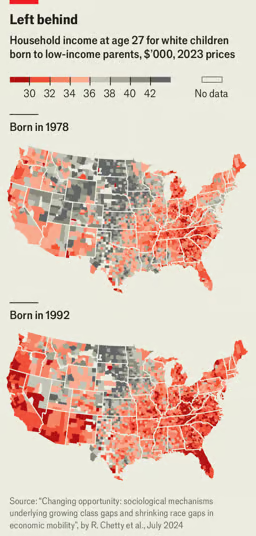
The fact that white children have become more likely to remain in poverty than before, whereas for black children the reverse is true, raises many questions. The finding comes from tracing the trajectories of 57m children born in America between 1978 and 1992 and looking at their outcomes by the age of 27. “This is really the first look with modern big data into how opportunity can change within a place over time,” says Mr Goldman. For children born into high-income families, household income increased for all races between birth cohorts. Yet among those from low-income families, earnings rose for black children and fell for white children.
A black child born to poor parents in 1992 earned $1,400 a year more than one born in 1978. A similar white child earned $2,000 less than one born in 1978. But on average, a poor white child still earned $9,500 more than a poor black child.
This pattern has played out in virtually every county, though with big regional differences. As a result, the earnings gap between rich and poor white children (the “class gap”) grew by 27%, whereas the earnings gap between poor white and poor black children (the “race gap”) fell by 28%…
… None of this means that race is no longer relevant for Americans’ chances in life. Although the reversal of the direction of travel is striking, a young black American born in 1992 to poor parents was still four percentage points more likely to remain in poverty than a poor white peer, down from a 15 percentage-point gap for those born in 1978. And while the near doubling in rates of mortality among young, lower-income white Americans is deeply alarming, mortality rates for their black counterparts have increased too, and they are still (a bit) more likely to die young…
… Convergence has not yet brought equality. Despite improvements across America for poor black children, there is still no county where their outcomes match those of poor white ones. Yet the decline of the white working class is steep, and bound to cause grief. Telling a young white man with lower life outcomes than previous generations that he is still doing better than the average black peer is about as useful as telling a young black man that he’s doing well “for a black man”.
Another possible misconception is that social mobility is a zero-sum game: that poor white children are doing worse because poor black children are doing better. The authors tackle this by showing how in places where black children have done well, white children’s outcomes have remained stable; and in places where white children have done particularly poorly, their black peers have also not thrived.
In his previous work Mr Chetty demonstrated [see here for a summary of his 2018 study] just how much a child’s chances of outperforming their parents depended on their race and where they grew up. One of the questions the authors were left with was how “sticky” these effects would be over time: could opportunities for the next cohorts of children change within these same places, or were they fixed? The new study’s most hopeful finding is that, far from being fixed, opportunities within a place can change significantly and rapidly. Neither history nor place is destiny…
… Americans love a rags-to-riches story. In his acceptance speech [at the Republican Convention], Mr Vance pledged to “make this country a place where every dream…will be possible once again”. In his bestselling book “Hillbilly Elegy” he writes that the assumption “that only a truly extraordinary person could have made it to where I am today…I think that theory is a load of bullshit.”
But the story of Mr. Vance, who grew up in a poor part of the rustbelt, rose to be a venture capitalist and now, at 39, is a potential American president, remains extraordinarily rare. While there has been a reshuffling of opportunities for Americans trying to escape the lowest rung, there has been no progress at all for routes into the upper class. For the vast majority of poor black children, who continue to have a 3% chance of rising from the bottom to the top quintile, and poor white children, whose chances have fallen from 14% to 12%, that door remains firmly shut…
“Class, race and the chances of outgrowing poverty in America,” a big-data analysis– a gift article from @TheEconomist.
* Plutarch
###
As we optimize opportunity, we might send mortgaged birthday greetings to Charles Darrow; he was born on this date in 1889. He designed (in 1933) and patented (in 1935) the board game Monopoly. He later sold his patent to Parker Brothers, which credits him as its creator.
In fact, the history of Monopoly is much longer. It can be traced back to 1903, when American anti-monopolist Lizzie Magie created a game called The Landlord’s Game that she hoped would explain the single-tax theory of Henry George. It was intended as an educational tool to illustrate the negative consequences of concentrating land in private monopolies.
After losing his job at a sales company following the Stock Market Crash of 1929, Darrow worked at various odd jobs. Seeing his neighbors and acquaintances play a board game in which the object was to buy and sell property, he decided to publish his own version of the game.
In fact, Darrow and his friends were just a few of many people in the American Midwest and East Coast who had been playing a game of buying and trading property– all based on Magie’s original… but most having morphed as warnings of that sort too often do) into the opposite of Magie’s intent– a celebration of accumulation. The game was used by college professors and their students, and another variant, called The Fascinating Game of Finance, was published in the Midwest in 1932. From there the game traveled back east, where it had remained popular in Pennsylvania, and became popular with a group of Quakers in Atlantic City. Darrow was taught to play the game by Charles Todd, who had played it in Atlantic City, where it had been customized with that city’s street and property names– to wit Monopoly‘s nomenclature.

“A public-opinion poll is no substitute for thought”*…

Opinion polls are a key accelerant in the inflamed civil discourse of our time. And, as Teresa Carr explain, that’s a problem…
Last December, a joint survey by the Economist and the polling organization YouGov claimed to reveal a striking antisemitic streak among America’s youth. One in five young Americans thinks the Holocaust is a myth, according to the poll. And 28 percent think Jews in America have too much power.
“Our new poll makes alarming reading,” declared the Economist. The results inflamed discourse over the Israel-Hamas war on social media and made international news.
There was one problem: The survey was almost certainly wrong. The Economist/YouGov poll was a so-called opt-in poll, in which pollsters often pay people they’ve recruited online to take surveys. According to a recent analysis from the nonprofit Pew Research Center, such polls are plagued by “bogus respondents” who answer questions disingenuously for fun, or to get through the survey as quickly as possible to earn their reward.
In the case of the antisemitism poll, Pew’s analysis suggested that the Economist/YouGov team’s methods had yielded wildly inflated numbers. In a more rigorous poll posing some of the same questions, Pew found that only 3 percent of young Americans agreed with the statement “the Holocaust is myth.”
These are strange times for survey science. Traditional polling, which relies on responses from a randomly selected group that represents the entire population, remains the gold standard for gauging public opinion, said Stanford political scientist Jon Krosnick. But as it’s become harder to reach people on the phone, response rates have plummeted, and those surveys have grown exponentially more expensive to run. Meanwhile, cheaper, less-accurate online polls have proliferated.
“Unfortunately, the world is seeing much more of the nonscientific methods that are put forth as if they’re scientific,” said Krosnick…
…
… headlines as outrageous as they are implausible continue to proliferate: 7 percent of American adults think chocolate milk comes from brown cows; 10 percent of college graduates think Judge Judy is on the Supreme Court; and 4 percent of American adults (about 10 million people) drank or gargled bleach to prevent Covid-19. And although YouGov is one of the more respected opt-in pollsters, some of its findings — one third of young millennials aren’t sure the Earth is round, for example — strain credulity.
Amidst a sea of surveys, it’s hard to distinguish solid findings from those that dissolve under scrutiny. And that confusion, some experts say, reflects deep-seated problems with new methods in the field — developed in response to a modern era in which a representative sample of the public no longer picks up the phone.
The fractious evolution in polling science is likely to receive fresh attention as the 2024 elections heat up, not least because the consequences of failed or misleading surveys can go well beyond social science. Such “survey clickbait” erodes society’s self-esteem, said Duke University political scientist Sunshine Hillygus: It “undermines people’s trust that the American public is capable of self-governance.”
Veteran pollster Gary Langer compares traditional randomized polling methods, known as probability polling, to dipping a ladle into a well-stirred pot of minestrone soup. “We can look in and see some cannellini beans, little escarole, chunks of tomato,” he said. “We get a good representation of what’s in the soup.”
It doesn’t matter if the pot is the size of Yankee Stadium, he said. If the contents are thoroughly mixed, one ladle is enough to determine what’s in it. That’s why probability surveys of 1,000 people can, in theory, represent what the entire country thinks.
The problem is that getting a truly representative sample is virtually impossible, said YouGov’s Douglas Rivers, who pointed out that these days a good response rate to a randomized poll is 2 percent…
…
… with the appropriate guardrails against fraud, YouGov chief scientist Rivers said, such methods offer a practical alternative to conventional probability sampling, where the costs are too high, and the response rates are too low. In some sense, he suggested, most polling is now nonprobability polling: When only 2 out of 100 people respond to a survey, it’s much harder to claim that those views are representative, said Rivers. “Sprinkling a little bit of randomness at the initial stage does not make it a probability sample.”
“Our approach has been: Let us assemble a sample systematically based on characteristics,” said Rivers. “It’s not comparable to what the census does in the current population survey, but it’s performed very well in election polling.” Rivers pointed to YouGov’s high ranking on the website FiveThirtyEight, which rates polling firms based on their track record in predicting election results and willingness to show their methods.
Gary Langer was not particularly impressed by high marks from FiveThirtyEight. (His own firm, Langer Research Associates, also gets a top grade for political polling they conduct on behalf of the partnership between ABC News and The Washington Post.) “Pre-election polls, while they get so much attention, are the flea on the elephant of the enterprise of public opinion research,” he said. The vast majority of surveys are concerned with other topics. They form the basis of federal data on jobs and housing, for example, and can reflect the public’s views on education, climate change, and other issues. “Survey data,” he said, “surrounds us, informs our lives, informs the choices we make.”
Given the stakes, Langer relies exclusively on probability polling. Research shows that opt-in polls just don’t produce the same kind of consistent, verifiable results, said Langer…
Research suggests that widely used nonprobability methods, in particular online opt-in polls such as the Economist/YouGov survey, have inherent vulnerabilities.
The prospect of cash or rewards can incentivize some people to complete surveys quickly and with as little effort as possible. “They’re giving you data and answers that just can’t possibly be true,” said Kennedy.
For example, in one test of opt-in polling, 12 percent of U.S. adults younger than 30 claimed that they were licensed to operate a nuclear submarine. The true figure, of course, is approximately 0 percent…
…
… Media consumers should be skeptical of implausible findings, said Krosnick. So should reporters, said Langer, who spent three decades as a journalist, and who said news outlets have a responsibility to vet the polls they report on: “Every newsroom in the country — in the world — should have someone on their team evaluate surveys and survey methodologies.”
In the end, people need to realize that survey research involves some degree of uncertainty, said Joshua Clinton, a political scientist at Vanderbilt University, who noted that polls leading up to the 2024 election are bound to get something wrong. “My concern is what that means about the larger inferences that people make about not only polling, but also science in general,” he said. People may just dismiss results as a predictable scientific failure: “‘Oh, the egghead screwed up again.’” Clinton said he wants people to recognize the difficulty of doing social science research, rather than to delegitimize the field outright.
Even Rivers, whose firm produced the Economist poll that made headlines, acknowledged that readers should be cautious with eye-catching headlines. “We’re in a challenging environment for conducting surveys,” he said. That means that people need to take survey results — especially those that are provocative — with a grain of salt.
“The tendency is to overreport polls,” said Rivers. “The polls that get reported are the ones that are outliers.”…
It’s very difficult to get anyone to answer a phone call—and that’s skewing data on everything from chocolate milk to antisemitism: “We’re in a New Era of Survey Science,” from @TeresaRCarr in @undark via @Slate. Eminently worth reading in full.
* Warren Buffett
###
As we take it with a grain of salt, we might recall that it was on this date in 1941 that Tom and Jerry first appeared on screen with those names in the MGM cartoon “The Midnight Snack,” though it was in fact their second screen appearance.
In 1940, MGM had produced “Puss Gets the Boot,” based on Hanna’s and Barbera’s pitch for a story rooted in two “equal characters who were always in conflict with each other.” It was the first collaboration between William Hanna and Joseph Barbera (founding a partnership that would last over 50 years and yield such treasures as The Flintstones, Huckleberry Hound, The Jetsons, Scooby-Doo, Top Cat, and Yogi Bear); at over nine minutes in length, it’s the longest T&J ever produced– and the first of three T&J essays (with “Puss n’ Toots” and “Puss ‘n’ Boats”) to pun it’s title on the fairy tale “Puss in Boots.” “Puss Gets the Boot” was nominated for an Academy Award– the first of Hanna and Barbera’s many Oscar nominations.
The cat in “Puss Gets the Boot” was actually named “Jasper”; the mouse, “Jinx.” But when the pilot got the go-ahead to become a series, animator John Carr won a studio-wide naming contest with his suggestion: “Tom and Jerry.” The cat’s owner, “Mammy Two-Shoes,” was voiced by June Foray— who later earned immortality as the voice of Rocky J. Squirrel.
“The purpose of a system is what it does”*…

Via Patrick Tanguay and his wonderful newsletter, Sentiers. Tanguay observes, “diagnosing what’s going on in society right now, how our multiple systems function and the issues that emerge from that, is not an easy task. It’s probably unfair then to also expect solutions from one article, but that’s what I was hoping for by the end of this one,” by Barath Raghavan and Bruce Schneier…
Technology was once simply a tool—and a small one at that—used to amplify human intent and capacity. That was the story of the industrial revolution: we could control nature and build large, complex human societies, and the more we employed and mastered technology, the better things got. We don’t live in that world anymore. Not only has technology become entangled with the structure of society, but we also can no longer see the world around us without it. The separation is gone, and the control we thought we once had has revealed itself as a mirage. We’re in a transitional period of history right now.
We tell ourselves stories about technology and society every day. Those stories shape how we use and develop new technologies as well as the new stories and uses that will come with it. They determine who’s in charge, who benefits, who’s to blame, and what it all means.
Some people are excited about the emerging technologies poised to remake society. Others are hoping for us to see this as folly and adopt simpler, less tech-centric ways of living. And many feel that they have little understanding of what is happening and even less say in the matter.
But we never had total control of technology in the first place, nor is there a pretechnological golden age to which we can return. The truth is that our data-centric way of seeing the world isn’t serving us well. We need to tease out a third option. To do so, we first need to understand how we got here.
When we describe something as being abstract, we mean it is removed from reality: conceptual and not material, distant and not close-up. What happens when we live in a world built entirely of the abstract? A world in which we no longer care for the messy, contingent, nebulous, raw, and ambiguous reality that has defined humanity for most of our species’ existence? We are about to find out, as we begin to see the world through the lens of data structures.
Two decades ago, in his book Seeing Like a State, anthropologist James C. Scott explored what happens when governments, or those with authority, attempt and fail to “improve the human condition.” Scott found that to understand societies and ecosystems, government functionaries and their private sector equivalents reduced messy reality to idealized, abstracted, and quantified simplifications that made the mess more “legible” to them. With this legibility came the ability to assess and then impose new social, economic, and ecological arrangements from the top down: communities of people became taxable citizens, a tangled and primeval forest became a monoculture timber operation, and a convoluted premodern town became a regimented industrial city.
This kind of abstraction was seemingly necessary to create the world around us today. It is difficult to manage a large organization, let alone an interconnected global society of eight billion people, without some sort of structure and means to abstract away details. Facility with abstraction, and abstract reasoning, has enabled all sorts of advancements in science, technology, engineering, and math—the very fields we are constantly being told are in highest demand.
The map is not the territory [quoth Alfred Korzybski], and no amount of intellectualization will make it so. Creating abstract representations by necessity leaves out important detail and context. Inevitably, as Scott cataloged, the use of large-scale abstractions fails, leaving leadership bewildered at the failure and ordinary people worse off.
But our desire to abstract never went away, and technology, as always, serves to amplify intent and capacity. Now, we manifest this abstraction with software. Computing supercharges the creative and practical use of abstraction. This is what life is like when we see the world the way a data structure sees the world. These are the same tricks Scott documented. What has changed is their speed and their ubiquity…
… Data structures dominate our world and are a byproduct of the rational, modern era, but they are ushering in an age of chaos. We need to embrace and tame, but not extinguish, this chaos for a better world…
…
As [Lewis] Mumford wrote in his classic history of technology, “The essential distinction between a machine and a tool lies in the degree of independence in the operation from the skill and motive power of the operator.” A tool is controlled by a human user, whereas a machine does what its designer wanted. As technologists, we can build tools, rather than machines, that flexibly allow people to make partial, contextual sense of the online and physical world around them. As citizens, we can create meaningful organizations that span our communities but without the permanence (and thus overhead) of old-school organizations.
Seeing like a data structure has been both a blessing and a curse. Increasingly, it feels like it is an avalanche, an out-of-control force that will reshape everything in its path. But it’s also a choice, and there is a different path we can take. The job of enabling a new society, one that accepts the complexity and messiness of our current world without being overwhelmed by it, is one all of us can take part it. There is a different future we can build, together…
A fascinating and important piece: “Seeing Like a Data Structure,” @schneierblog @BelferCenter. Eminently worth reading in full.
See also: “Empty Innovation“
###
As we reframe, we might send free birthday greetings to Matthias Ettrich; he was born on this date in 1972. A computer scientist interested in Linux and open source software, he Ettrich founded KDE in 1996 to create (as he put it on Usenet) “consistent, nice looking free desktop environment” for Unix-like systems using Qt as its widget toolkit– to which end, he has developed LyX. A German, operating in Berlin, Ettrich was awarded the Federal Cross of Merit for his contributions to free software.

“God has no religion”*…

For the last 15 years, the Public Religion Research Institute (PRRI) has done quantitative and qualitative research on religious values in the U.S. A recent study has generated a number of headlines, most focusing on a single issue– a good example: “People say they’re leaving religion due to anti-LGBTQ teachings and sexual abuse“… which is in fact a significant finding, but only one finding in a wide range of other interesting– and important– observations that emerge…
America encompasses a rich diversity of faith traditions, and “religious churning” is very common. In 2023, PRRI surveyed more than 5,600 adults across the United States about their experiences with religion. This report examines how well major faith traditions retain their members, the reasons people disaffiliate, and the reasons people attend religious services. Additionally, this report considers how atheists and agnostics differ from those who say they are “nothing in particular.” Finally, it analyzes the prevalence of charismatic elements as well as prophecy and prosperity theology in American churches and the role of charismatic Christianity in today’s Republican Party…
[Among the major areas explored…]
- “Unaffiliated” is the only major religious category experiencing growth…
- Catholic loss continues to be highest among major religious groups; white Evangelical retention rate has improved since 2016…
- While most disaffiliate because they stop believing, religious teachings on the LGBTQ community and clergy sexual abuse now play a more prominent role…
- The religiously unaffiliated are not a monolith…
- Most unaffiliated Americans are not looking for a religious or spiritual home…
- Church attendance among Americans is down and fewer Americans say religion is important; most Americans who attend religious services do so to feel closer to God…
- Exploring the prevalence of charismatic elements in American churches…
- Prophetic and Prosperity theological beliefs are more common among Republicans and African Americans…
- Religion and the MAGA Movement: The Role of Charismatic Christianity and Prophecy/Prophetic Beliefs in the Republican Party…
The state of faith in the U. S. and what it can tell us about our society: “Religious Change in America” from @PRRIpoll.
Apposite: “Ufologists, Unite!“– Nathaniel Rich‘s review of two books by D.W. Pasulka, a professor of religious studies at the University of North Carolina Wilmington who (to oversimplify only slightly) sees the growing devotion to UFOs/UAPs as a new religious movement… one not considered in the PRRI study.
* Gandhi
###
As we contemplate celestial conviction, we might recall that it was on this date in 1506 that the cornerstone of the current St. Peter’s Basilica was laid. (It was completed in 1626.) Located in Vatican City, an independent microstate enclaved within the city of Rome, it was initially planned in the 15th century by Pope Nicholas V and then Pope Julius II to replace the ageing Old St. Peter’s Basilica, which was built in the fourth century by Roman emperor Constantine the Great.
Designed principally by Donato Bramante, Michelangelo, and Carlo Maderno, with piazza and fittings by Gian Lorenzo Bernini, St. Peter’s is one of the most renowned works of the Italian High Renaissance. It is the largest church in the world (by interior measure). And while it is neither the mother church of the Catholic Church nor the cathedral of the Diocese of Rome (these equivalent titles being held by the Archbasilica of Saint John Lateran in Rome), St. Peter’s is regarded as one of the holiest Catholic shrines. The pope presides at a number of liturgies throughout the year both within the basilica or the adjoining St. Peter’s Square, liturgies that draw audiences numbering from 15,000 to over 80,000 people.

You must be logged in to post a comment.