Posts Tagged ‘forests’
“The clearest way into the Universe is through a forest”*…

Dillon Osleger explains that, while the future of Western forests depends on professional pinecone collectors, they’re slowly being starved out of existence…
High in the crown of a giant sequoia, the world becomes a cathedral of green and amber, hushed but for the creak of ancient wood and the sharp, rhythmic snap of cones being pulled from boughs. Dan Keeley, 31, moved around with a practiced, fluid economy, suspended by thin lines of high-tensile rope 200 feet above the ground on the western edge of California’s Sequoia National Park. To his left, the sequoia’s cinnamon-colored bark provided a steady presence as he leaned out over the negative space between branches.
“There is a lot of trust that goes into this work,” Keeley said, speaking over the wind. He eyed a cluster of green, egg-sized cones. “Trust in the trees, predominantly, but also trust in the system — that I’m being sent to the right trees, at the right time, and for the right reason, not all of which are always the case.”
Keeley, a lean, tanned former rock climber and arborist, is what some in the forestry industry call a pinecone cowboy, a freelance contractor hired to harvest the genetic future of Western forests. He climbs trees of important or threatened species to collect ripe cones for seeds intended to be used for reforestation.
Keeley is part of a specialized workforce that’s become the primary resistance against the rapid erasure of a Western landscape. As megafires — fueled by climate change and a century of heavy-handed forest management and fire suppression — incinerate millions of acres in the West, natural regeneration is failing. Cones from serotinous species, which open their scales and drop their seeds in response to low-intensity wildfires on the forest floor, are now incinerated in increasingly common crown fires — high-intensity blazes that leap into the canopy. Meanwhile, other species’ seeds, dropped into the soil by wind and animals like squirrels and birds, are choked underneath layers of ash or outcompeted by invasive shrubs. The future of a relationship between trees and wildfires that has existed for 350 million years now rests on the shoulders of rope-suspended climbers who collect the trees’ cones one 45-liter bag at a time…
[The work, which dates back to the 1930s, is both arduous and precise; the workers, dedicated. But, as Osleger explains, a number of forces– main among them, Federal budget cuts, have taken a huge toll on the effort…]
… The result is an annual reforestation shortfall that is compounding and transforming entire ecosystems. The Forest Service produces 30 million to 50 million seedlings a year, according to American Forests, a mere fraction of the 120-million annual seedling goal the REPLANT Act established. Roughly 80% of those seedlings will survive, while it takes about 220 trees to reforest each burned acre. Altogether, the agency meets just 6% of its post-wildfire planting needs annually, according to its 2022 Reforestation Strategy Report.
And that’s just on Forest Service land: Wildfires on both public and private lands have affected, on average, 7.8 million acres a year over the last decade, according to the National Interagency Fire Center. In California alone, current seedling production and planting rates mean that it would take 15 to 20 years to reforest what has already been lost, while each additional fire “puts us further behind,” said Kuldeep Singh, operations manager of seed production for CAL FIRE. While the Forest Service considers a tract reforested after seedlings survive their first five years, research says that a functioning ecosystem like the one the fire destroyed won’t return for several decades.
When a forest fails to regenerate, either because it wasn’t replanted or because new seedlings didn’t survive, it often becomes scrub-land, in a permanent ecological shift known as type conversion. The new brush-based ecosystem creates a more flammable fuel bed that resists the forest’s return, effectively locking the land into a cycle of fire and scrub. In areas like South Lake Tahoe, California, for example, fields of 8-foot-tall manzanita and buckbrush now dominate hundreds of acres where conifers once stood. In Oregon, Washington, Idaho, Wyoming and throughout the Southwest, Forest Service research says that high-severity burn areas — which are difficult to regenerate regardless of human intervention — are increasingly repopulated by invasive grasses or the flowering plants called Brassicaceae, which store less carbon and prevent conifers from taking root. This process is permanently altering the hydrology, fire cycle and carbon-sequestration capacity of the West…
More– and more photos– at: “The plight of the pinecone cowboy,” from @highcountrynews.org.
Pair with: “Make Your Own Micro Forest” (“The Miyawaki method of reforestation inserts small, densely packed wild acreage into urban environs. It’s proving wildly successful.”)
* John Muir
###
As we treasure trees, we might recall that it was on this date in 1910 that Glacier National Park in northwestern Montana was established. The park encompasses more than 1 million acres and includes parts of two mountain ranges (sub-ranges of the Rocky Mountains), more than 130 named lakes, more than 1,000 different species of trees and plants, and hundreds of species of animals. Its pristine ecosystem is the centerpiece of what has been referred to as the “Crown of the Continent Ecosystem,” a region of protected land encompassing 16,000 square miles.
The park’s predominantly coniferous forest is home to various species of trees such as the Engelmann spruce, Douglas fir, subalpine fir, limber pine and western larch, which is a deciduous conifer, producing cones but losing its needles each fall.

“The one who plants trees knowing that he or she will never sit in their shade, has at least started to understand the meaning of life”*…
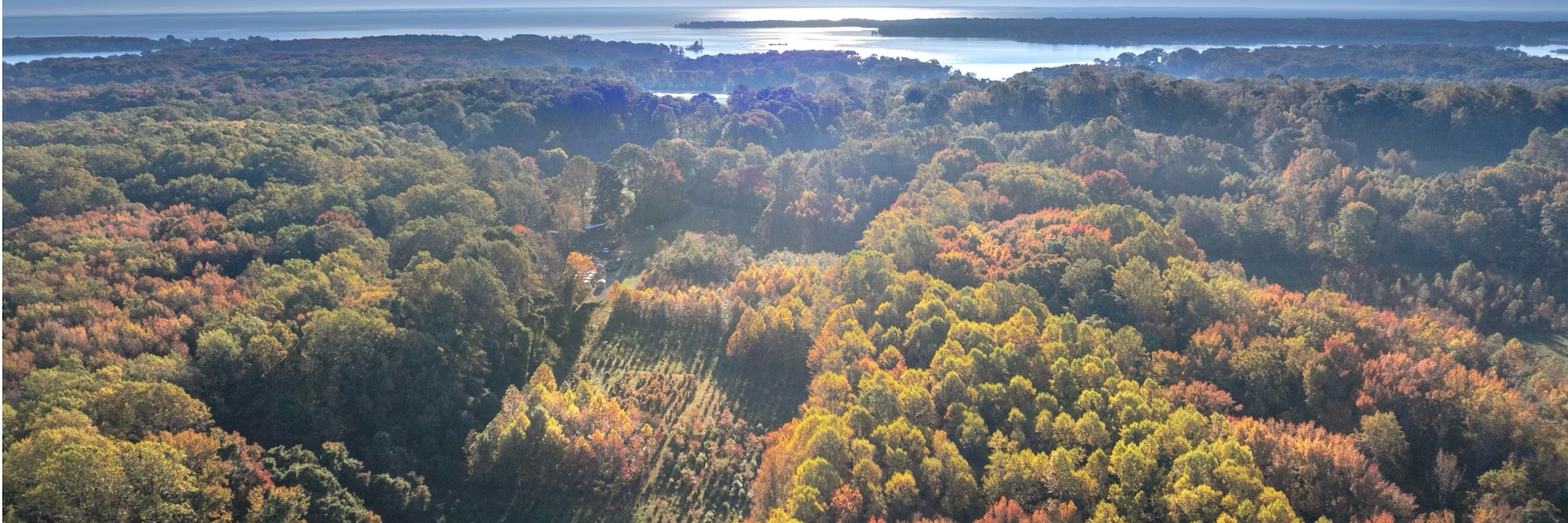
… Yes, and, as John Parker and Justin Nowakowski explain, it turns out that what and how we plant matters enormously…
Around the world, people plan to plant more than 1 trillion trees this decade in an ambitious effort to slow climate change and reduce biodiversity loss. But if the past is prologue, many of those planted trees won’t survive. And if they do, they could end up as biological deserts that lack the richness and resilience of healthy forests.
It doesn’t have to be this way.
The United Nations declared 2021-2030 the Decade on Ecosystem Restoration to encourage efforts to repair degraded ecosystems. Tree planting has become a centerpiece of that effort, championed by initiatives such as the Bonn Challenge and the Trillion Trees Campaign.
However, many tree-planting commitments have a critical flaw: They rely too heavily on monoculture plantations – vast areas planted with just a single tree species.
Monoculture plantations are generally one-way tickets to producing wood. But these high-yield plantations are high risk and can be surprisingly fragile. When drought, pests, or forest fires strike, entire monoculture plantations can fail at once. In one example, nearly 90% of 11 million saplings planted in Turkey died within three months due to drought and lack of maintenance.
Forests are more than just timber factories. They regulate water, store carbon, provide habitat for wildlife, cool the landscapes around them and even provide human health benefits.
Rather than gambling on a single species and hoping for the best, science now points to a smarter path that captures both ecological and economic benefits while minimizing risk: mixed-species plantings that mirror the biodiversity of a natural forest, ultimately creating forests that grow faster and are more resilient in the face of constant threats.
We are community and landscape ecologists at the Smithsonian Environmental Research Center. Since 2013, we and our colleagues have been rigorously testing this idea in a large, ecosystem-scale experiment called BiodiversiTREE. The verdict is striking: Trees in mixed forests don’t just survive – they outgrow their monoculture counterparts and support dramatically more biodiversity…
[Parker and Nowakowski outline their project, unpack it’s (impressive) results, and explore the challenges to sclaing their example. They conclude..]
… The stakes are high. Restoration has become a major global investment, with hundreds of billions of dollars already being spent annually. Getting it wrong means wasted resources and missed opportunities to address some of the most pressing environmental challenges of our time.
If the world is going to plant a trillion trees, we believe it needs to do more than just put seedlings in the ground. It needs to rethink what a forest should be.
The goal isn’t just to grow trees. It’s to grow forests that last.
Eminently worth reading in full: “Don’t just plant trees, plant forests to restore biodiversity for the future,” from @johndparker.bsky.social and Justin Nowakowski in @us.theconversation.com.
###
As we see the forest, we might send observant birthday greetings to a man who spent a good bit of time in and around forests, John James Audubon; he was born on this date in 1785. An ornithologist, naturalist, and artist, Audubon documented all types of American birds with detailed illustrations depicting the birds in their natural habitats. His The Birds of America (1827–1839), in which he identified 25 new species, is considered one of the most important– and finest– ornithological works ever completed.

“This is a cardboard universe”*…

As we rid ourselves of the detritus of the Holiday season, let us pause to consider its signature component: at the turn of the 21st century, corrugated cardboard accounted for just fifteen percent of the United States recycling stream; today, it’s nearly half. Shannon Mattern on the cardboard box…
… As historian Maria Rentetzi writes (“Cardboard Box: The Politics of Materiality,” in Boxes: A Field Guide), “the cardboard box — the waste of our commercial world — is recycled in such a way as to make visible the disorder in our societies, the faults of capitalism.” It is an abject object that touches all parts of the city, from the granite kitchen island to the sewer grate. And for many of us, the cardboard box is our closest touchpoint to globalized trade, structuring our relations with people in distant places. It brings the logistics chain to our doorstep. The magnificently ripped metal freight container may get the Economist cover shot, but the plain brown box delivers messages to our homes. Its very existence in our homes, Marshall McLuhan would say, is the message. In the immortal words of Walter Paepcke, founder of the Container Corporation of America, “packages are not just commodities; they are communications.”
Let’s unpack that, shall we? Boxes are media in multiple senses of the word. They’re lithographed surfaces designed to be read, and they’re dimensional containers that mediate between outside and inside worlds. They’re “media of transport and information, shapers of public opinion and consumer desire, and means of targeting attention.” And they’re “logistical media” that “arrange people and property into time and space,” that “coordinate and control the movement of labor, people, and things situated along and within global supply chains.” The cardboard box is a minimalist form with maximalist ambitions, an arboreal apparatus made from one of the world’s most abundant renewable resources, then filled with plastic and moved around by copious quantities of oil. It doesn’t just coordinate and control landscapes; it transforms them.
Cardboard’s ubiquity rests on simple claims: I can hold that, and I can go there. The Container Corporation of America was founded in 1926, and upon those claims it built an empire with surprising reach. The CCA made collapsible shipping boxes, and it transformed packaging into a science and an art. It advanced market research, shaped mid-century taste, and altered the chromatic universe through color standards. It employed some of the best graphic designers of the period, and as national borders shifted after the Second World War, it commissioned Herbert Bayer, author of the Universal typeface, to revise the World Geo-Graphic Atlas. Even then, the CCA was remaking that new world to meet its logistical needs, rehabbing mining towns and germinating forests, and orchestrating civic discourse about all of this.
How did a packaging company get into the publishing business — into the containment and distribution of information? How were geographic imaginations changed in the process? Soon we’ll dive into the Paepcke archive, to find answers to those questions. But first I want to show you how a cardboard box is made…
In turn, inspiring and horrifying– the social history of the cardboard carton: “World in a Box,” @shannonmattern.bsky.social in @placesjournal.bsky.social.
For an earlier (R)D focused on Mattern’s work: “To clarify, ADD data.”
* Philip K. Dick, The Dark-Haired Girl
###
As we tape it tight, we might recall that it was on this date in 1910 that a federal official who might slowed the onset of the cardboard box was fired: Gifford Pinchot, the first chief of the United States Forest Service, was fired by President William Howard Taft. Pinchot had opposed Taft’s newly appointed Secretary of the Interior, Richard Ballinger, who favored commercial exploitation of federal reserve lands.
During President Theodore Roosevelt’s term, Pinchot had help enable policies for the conservation of natural resources. Roosevelt had designated millions of acres to protect as National Forests. That legacy was threatened, so Pinchot pressured Taft to remove Ballinger from office. In November of 1909, Collier’s Magazine had created a scandal when it accused Ballinger of shady dealings in coal lands in Alaska. When Pinchot criticized both Ballinger and Taft, the president reacted by firing him.

“A nation that destroys its soils destroys itself”*…

The cliché, avidly promoted by Moscow, is that Russia, one of the world’s largest petro-states, will be a relative winner in climate change; but a new book argues that the country will find itself in deep trouble. Sophie Pinkham unpacks the lesson’s in Thane Gustafson’s Klimat: Russia in the Age of Climate Change…
Thane Gustafson, a longtime specialist on Russian energy, wrote Klimat: Russia in the Age of Climate Change before the [Ukraine] invasion, when the Covid pandemic seemed the great unexpected event complicating every prediction. Yet with its focus on the future of Russia’s energy, grain, and metals markets, all of which have been reconfigured by the war and the new sanctions, Klimat could hardly be more timely. Gustafson argues that Russia’s days of hydrocarbon-funded might are numbered. Unfortunately, the end of this era will not come soon enough for Ukrainians, or for the planet.
Russia is warming 2.5 times as fast as the world on average, and the Arctic is warming even faster. The cliché, avidly promoted by Moscow, is that the country will be a relative winner in climate change, benefiting from a melting and accessible Arctic shipping route, longer growing seasons, and the expansion of farmland into newly thawed areas. Gustafson counters, with a dry but persuasive marshaling of facts, that in the redistribution of wealth and power that will result from climate change, Russia is doomed. After reading Klimat, Russia’s attack on Ukraine begins to look like the convulsion of a dying state.
About two thirds of Russia is covered in permafrost, a mixture of sand and ice that, until recently, remained frozen year-round. As permafrost melts, walls built on it fracture, buildings sink, railways warp, roads buckle, and pipelines break. Anthrax from long-frozen reindeer corpses has thawed and infected modern herds. Sinkholes have opened in the melting ground, swallowing up whole buildings. Ice roads over frozen water, once the only way to travel in some remote regions, are available for ever-shorter periods. The Arctic coast is eroding rapidly, imperiling structures built close to the water…
Russia’s forests are the largest in the world, accounting for a fifth of Earth’s trees, but they are being grievously damaged by fire, drought, and disease, all of which are caused or exacerbated by climate change. Smoke has choked Siberian cities. During the 2019 fires that burned about 10,000 square miles of forest in Siberia, the Internet lit up with protest, and Russian singers and actors took part in a flash mob called “Siberia Is Burning.” President Putin sent in military units to help extinguish the fire, but he was soon rescued by rain. The problem was forgotten. As burning, dying, clear-cut forests become carbon producers rather than carbon sinks, they make the problem of climate change even worse. The same is true of melting permafrost, which releases methane, another potent greenhouse gas…
Imperialism originates in a struggle for resources; the ideology justifying the brutality of conquest and control is secondary. Oil has been one of the most coveted resources of the modern era, but the oldest and most essential resource is food. Ukraine’s famously fertile “black earth,” desired by many invaders and colonizers over the course of the country’s history, may also be among the motivations for Russia’s new aggression. According to recent reports, Russia has been commandeering or destroying Ukrainian grain stores and making off with Ukrainian agricultural equipment, smuggling the stolen grain to Syria for sale in the Middle East. Gustafson points out that as shortages become more frequent, food will become an increasingly significant tool of geopolitical influence…
Eminently worth reading in full: climate change is coming for Russia: “A Hotter Russia,” from @sophiepinkhmmm on @ThaneGustafson in @nybooks.
Lest American readers feel complacent: “The challenging politics of climate change,” from @BrookingsInst.
* Franklin D. Roosevelt
###
As we get serious, we might send imperial birthday greetings to the man Vladimir Putin seems to wish he was: Pyotr Alekséyevich, also known as Peter I, and best known as Peter the Great; he was born on this date in 1672. But even as Putin is trying to turn back the cultural clock, Peter was the Tsar who modernized Russia and grew it into an empire, capturing ports at Azov and the Baltic Sea, laying the groundwork for the Imperial Russian Navy, ending uncontested Swedish supremacy in the Baltic, and beginning the Tsardom’s expansion into a much larger empire that became a major European power.
Peter led a cultural revolution that replaced some of the traditionalist and medieval social and political systems with ones that were modern, scientific, Westernised, and based on the Enlightenment. His reforms had a lasting impact on Russia, and many institutions of the Russian government trace their origins to his reign. He adopted the title of Emperor in place of the old title of Tsar in 1721, and founded and developed the city of Saint Petersburg, which remained the capital of Russia until 1917.

“A tree is known by its fruit”*…

From the International Center for Tropical Agriculture (CIAT), “Origins and Primary Regions of Diversity of Agricultural Crops.”
* St. Basil
###
As we reap what we sow, we might recall that it was on this date in 1886 that Congress recognized and established by law (24 Stat. L.103), the Division of Forestry in the Department of Agriculture. Created in 1881 by fiat of the then-Commissioner of Agriculture, it’s initial remit was to assess the quality and conditions of forests in the United States. In 1891, its mandate was expanded to include authorization to withdraw land from the public domain as “forest reserves,” to be managed by the Department of the Interior– the precursor to America’s National Forest and National Park program.

_-_Portrait_de_Pierre_Ier_(mus%C3%A9e_de_l%E2%80%99Ermitage).jpg)
You must be logged in to post a comment.