Posts Tagged ‘John James Audubon’
“The one who plants trees knowing that he or she will never sit in their shade, has at least started to understand the meaning of life”*…
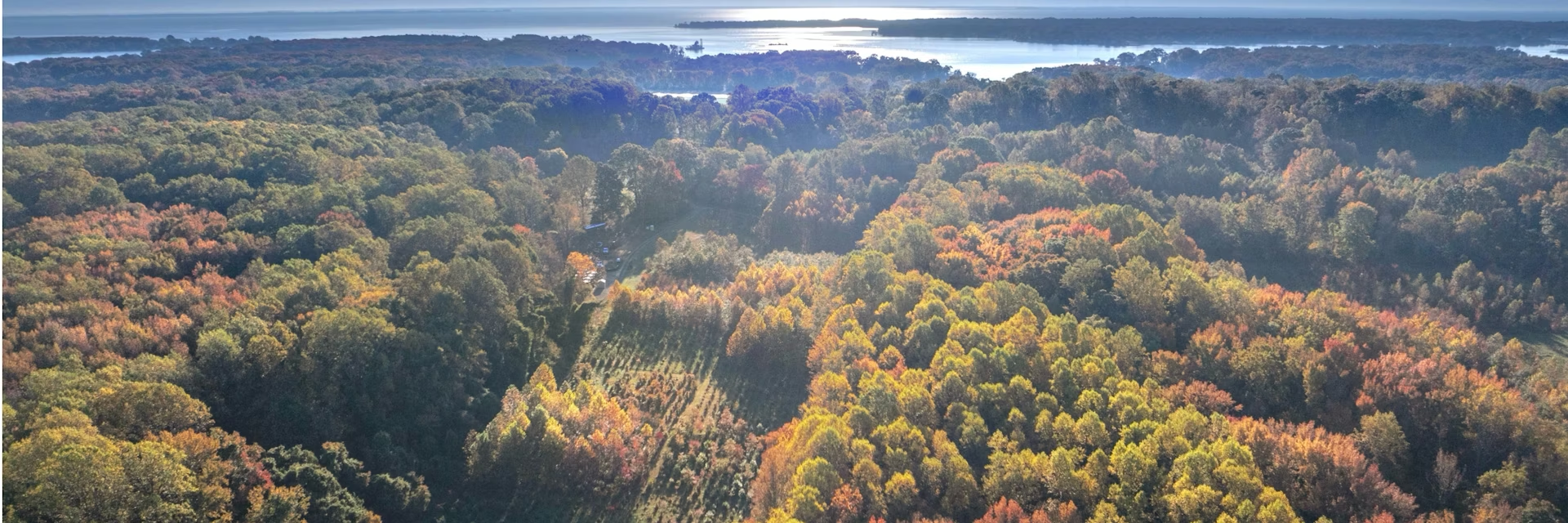
… Yes, and, as John Parker and Justin Nowakowski explain, it turns out that what and how we plant matters enormously…
Around the world, people plan to plant more than 1 trillion trees this decade in an ambitious effort to slow climate change and reduce biodiversity loss. But if the past is prologue, many of those planted trees won’t survive. And if they do, they could end up as biological deserts that lack the richness and resilience of healthy forests.
It doesn’t have to be this way.
The United Nations declared 2021-2030 the Decade on Ecosystem Restoration to encourage efforts to repair degraded ecosystems. Tree planting has become a centerpiece of that effort, championed by initiatives such as the Bonn Challenge and the Trillion Trees Campaign.
However, many tree-planting commitments have a critical flaw: They rely too heavily on monoculture plantations – vast areas planted with just a single tree species.
Monoculture plantations are generally one-way tickets to producing wood. But these high-yield plantations are high risk and can be surprisingly fragile. When drought, pests, or forest fires strike, entire monoculture plantations can fail at once. In one example, nearly 90% of 11 million saplings planted in Turkey died within three months due to drought and lack of maintenance.
Forests are more than just timber factories. They regulate water, store carbon, provide habitat for wildlife, cool the landscapes around them and even provide human health benefits.
Rather than gambling on a single species and hoping for the best, science now points to a smarter path that captures both ecological and economic benefits while minimizing risk: mixed-species plantings that mirror the biodiversity of a natural forest, ultimately creating forests that grow faster and are more resilient in the face of constant threats.
We are community and landscape ecologists at the Smithsonian Environmental Research Center. Since 2013, we and our colleagues have been rigorously testing this idea in a large, ecosystem-scale experiment called BiodiversiTREE. The verdict is striking: Trees in mixed forests don’t just survive – they outgrow their monoculture counterparts and support dramatically more biodiversity…
[Parker and Nowakowski outline their project, unpack it’s (impressive) results, and explore the challenges to sclaing their example. They conclude..]
… The stakes are high. Restoration has become a major global investment, with hundreds of billions of dollars already being spent annually. Getting it wrong means wasted resources and missed opportunities to address some of the most pressing environmental challenges of our time.
If the world is going to plant a trillion trees, we believe it needs to do more than just put seedlings in the ground. It needs to rethink what a forest should be.
The goal isn’t just to grow trees. It’s to grow forests that last.
Eminently worth reading in full: “Don’t just plant trees, plant forests to restore biodiversity for the future,” from @johndparker.bsky.social and Justin Nowakowski in @us.theconversation.com.
###
As we see the forest, we might send observant birthday greetings to a man who spent a good bit of time in and around forests, John James Audubon; he was born on this date in 1785. An ornithologist, naturalist, and artist, Audubon documented all types of American birds with detailed illustrations depicting the birds in their natural habitats. His The Birds of America (1827–1839), in which he identified 25 new species, is considered one of the most important– and finest– ornithological works ever completed.

“When words become unclear, I shall focus with photographs. When images become inadequate, I shall be content with silence.”*…

As Josh Begley elegantly demonstrates, silence may be nigh…
The New York Times published its first issue on September 18, 1851, but the first photos wouldn’t appear on the cover until the early 1900s over 60 years later. This visual timeline by self-described data artist Josh Begley captures the storied newspaper’s approach to layout and photography by incorporating every NY Times front page ever published into a single one-minute video. The timelapse captures decades text-only front pages before the newspaper began to incorporate illustrated maps and wood engravings. The liberal usage of black and white photography begins a century later and finally the first color photo appears in 1997. What a fascinating way to view history through image, over 60,000 front pages in all…
Showing instead of (simply) telling: “The Rise of the Image: Every NY Times Front Page Since 1852 in Under a Minute,” from @thisiscolossal.com (who found it via @kottke.org).
See the animated visualization here or here.
(TotH to EWW)
* Ansel Adams
###
As we ponder the prevalence of pictures, we might spare a thought for a man who made powerful– and beautiful– use of images, John James Audubon; he died on this date in 1851. An ornithologist, naturalist, and artist, Audubon documented all types of American birds with detailed illustrations depicting the birds in their natural habitats. His The Birds of America (1827–1839), in which he identified 25 new species, is considered one of the most important– and finest– ornithological works ever completed.

Happy Mozart’s Birthday!
“I don’t think academic writing ever was wonderful”*…

Academic writing is famously abstruse. But, Stefan Washietl, founder of Paperpile, reminds us, it isn’t always so. As Rob Beschizza observes…
Stefan Washietl collected the shortest scientific papers. Some are unvarnished mathematical proofs, some are humor to amusing or incisive ends, others are clever-dickery that shoves the conclusion into the abstract. All are wonderful!…

Accessible academia: treat yourself to “The Shortest Papers Ever Published,” from @washietl and @paperpile via @Beschizza in @BoingBoing.
* Stephen Jay Gould
###
As we go for the gist, we might send voluminous birthday greetings to Constantine Samuel Rafinesque; he was born on this date in 1783. An autodidact naturalist, traveler, and writer who, in spite of work of variable reliability, substantially expanded knowledge via his extensive travels, collecting, cataloging, and naming huge numbers of plants and some animals. Among these are many new species he is credited with being the first to describe.
Years ahead of Charles Darwin’s theory of evolution, Rafinesque conceived his own ideas. He thought that species had, even within the timeframe of a century, a continuing tendency for varieties to appear that would diverge in their characteristics to the point of forming new species. Accordingly, he was over-enthusiastic at distinguishing what he called new species.
Rafinesque wrote prolifically, and often self-published. His work varied from brilliant insightfulness to carelessness, and raised the eyebrows– and sometimes the ire– of his scientific contemporaries. Indeed, he so incensed John James Audubon with his belief that Audubon has included unnamed species in his sketches of birds, that Audubon pranked him, feeding him sketches of imaginary fish… which Rafinesque believed and included in his writings, where (for 50 years or so) they remained as part of the scientific record.

You must be logged in to post a comment.