Posts Tagged ‘The Birds of America’
“The one who plants trees knowing that he or she will never sit in their shade, has at least started to understand the meaning of life”*…
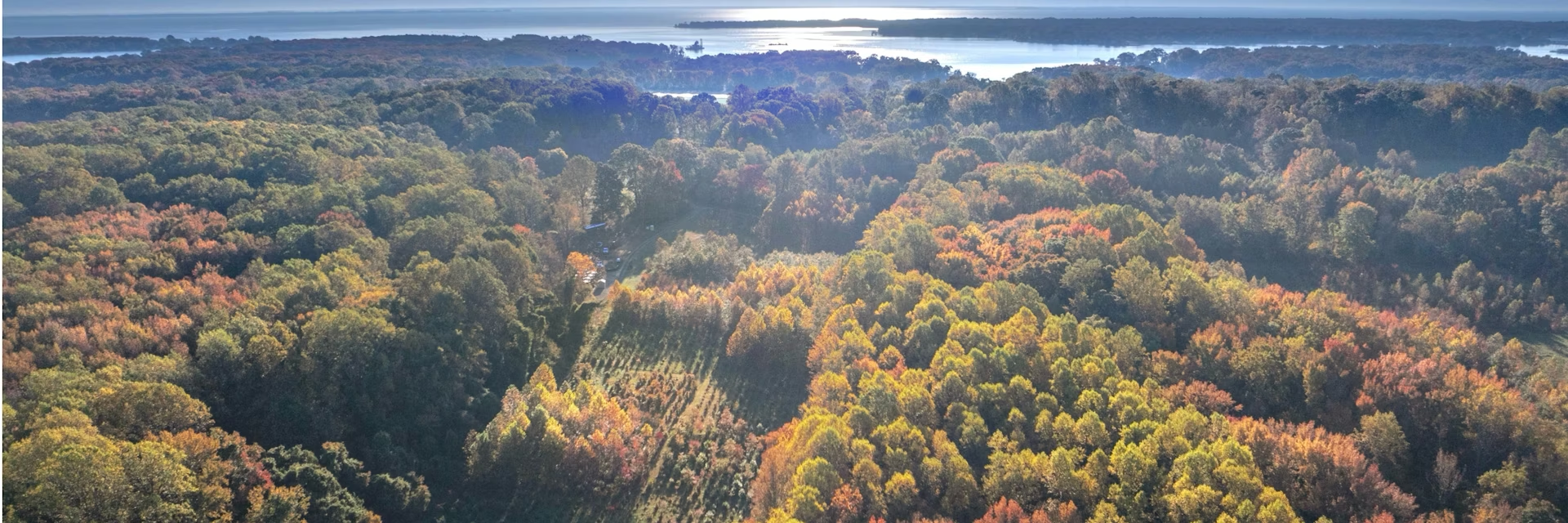
… Yes, and, as John Parker and Justin Nowakowski explain, it turns out that what and how we plant matters enormously…
Around the world, people plan to plant more than 1 trillion trees this decade in an ambitious effort to slow climate change and reduce biodiversity loss. But if the past is prologue, many of those planted trees won’t survive. And if they do, they could end up as biological deserts that lack the richness and resilience of healthy forests.
It doesn’t have to be this way.
The United Nations declared 2021-2030 the Decade on Ecosystem Restoration to encourage efforts to repair degraded ecosystems. Tree planting has become a centerpiece of that effort, championed by initiatives such as the Bonn Challenge and the Trillion Trees Campaign.
However, many tree-planting commitments have a critical flaw: They rely too heavily on monoculture plantations – vast areas planted with just a single tree species.
Monoculture plantations are generally one-way tickets to producing wood. But these high-yield plantations are high risk and can be surprisingly fragile. When drought, pests, or forest fires strike, entire monoculture plantations can fail at once. In one example, nearly 90% of 11 million saplings planted in Turkey died within three months due to drought and lack of maintenance.
Forests are more than just timber factories. They regulate water, store carbon, provide habitat for wildlife, cool the landscapes around them and even provide human health benefits.
Rather than gambling on a single species and hoping for the best, science now points to a smarter path that captures both ecological and economic benefits while minimizing risk: mixed-species plantings that mirror the biodiversity of a natural forest, ultimately creating forests that grow faster and are more resilient in the face of constant threats.
We are community and landscape ecologists at the Smithsonian Environmental Research Center. Since 2013, we and our colleagues have been rigorously testing this idea in a large, ecosystem-scale experiment called BiodiversiTREE. The verdict is striking: Trees in mixed forests don’t just survive – they outgrow their monoculture counterparts and support dramatically more biodiversity…
[Parker and Nowakowski outline their project, unpack it’s (impressive) results, and explore the challenges to sclaing their example. They conclude..]
… The stakes are high. Restoration has become a major global investment, with hundreds of billions of dollars already being spent annually. Getting it wrong means wasted resources and missed opportunities to address some of the most pressing environmental challenges of our time.
If the world is going to plant a trillion trees, we believe it needs to do more than just put seedlings in the ground. It needs to rethink what a forest should be.
The goal isn’t just to grow trees. It’s to grow forests that last.
Eminently worth reading in full: “Don’t just plant trees, plant forests to restore biodiversity for the future,” from @johndparker.bsky.social and Justin Nowakowski in @us.theconversation.com.
###
As we see the forest, we might send observant birthday greetings to a man who spent a good bit of time in and around forests, John James Audubon; he was born on this date in 1785. An ornithologist, naturalist, and artist, Audubon documented all types of American birds with detailed illustrations depicting the birds in their natural habitats. His The Birds of America (1827–1839), in which he identified 25 new species, is considered one of the most important– and finest– ornithological works ever completed.

“When words become unclear, I shall focus with photographs. When images become inadequate, I shall be content with silence.”*…

As Josh Begley elegantly demonstrates, silence may be nigh…
The New York Times published its first issue on September 18, 1851, but the first photos wouldn’t appear on the cover until the early 1900s over 60 years later. This visual timeline by self-described data artist Josh Begley captures the storied newspaper’s approach to layout and photography by incorporating every NY Times front page ever published into a single one-minute video. The timelapse captures decades text-only front pages before the newspaper began to incorporate illustrated maps and wood engravings. The liberal usage of black and white photography begins a century later and finally the first color photo appears in 1997. What a fascinating way to view history through image, over 60,000 front pages in all…
Showing instead of (simply) telling: “The Rise of the Image: Every NY Times Front Page Since 1852 in Under a Minute,” from @thisiscolossal.com (who found it via @kottke.org).
See the animated visualization here or here.
(TotH to EWW)
* Ansel Adams
###
As we ponder the prevalence of pictures, we might spare a thought for a man who made powerful– and beautiful– use of images, John James Audubon; he died on this date in 1851. An ornithologist, naturalist, and artist, Audubon documented all types of American birds with detailed illustrations depicting the birds in their natural habitats. His The Birds of America (1827–1839), in which he identified 25 new species, is considered one of the most important– and finest– ornithological works ever completed.

Happy Mozart’s Birthday!
“Enumeration shall be made within three Years after the first Meeting of the Congress of the United States, and within every subsequent Term of ten Years, in such Manner as they shall by Law direct.”*…

The census is an essential part of American democracy. The United States counts its population every ten years to determine how many seats each state should have in Congress. Census data have also been used to levy taxes and distribute funds, estimate the country’s military strength, assess needs for social programs, measure population density, conduct statistical analysis of longitudinal trends, and make business planning decisions.
We looked at every question on every census from 1790 to 2020. The questions—over 600 in total—tell us a lot about the country’s priorities, norms, and biases in each decade. They depict an evolving country: a modernizing economy, a diversifying population, an imperfect but expanding set of civil and human rights, and a growing list of armed conflicts in its memory…
From our friends at The Pudding (@puddingviz), a graphic history of the questions asked in the U.S. Census. What changes each decade, what stays the same, and what do the questions say about American culture and society? “The Evolution of the American Census.”
For a look at how the pandemic is impacting this year’s census, see “It’s the Official Start to the 2020 Census. But No One Counted On a Pandemic.” and “Coronavirus could exacerbate the US census’ undercount of people of color.”
* Article 1, Section 2, of the the Constitution of the United States of America, directing the creation and conducting of a regular census; Congress first met in 1789, and the first national census was held in 1790.
###
As we answer faithfully, we might send illustratively enumerating birthday greetings to John James Audubon; he was born on this date in 1785. An ornithologist, naturalist, and artist, Audubon documented all types of American birds with detailed illustrations depicting the birds in their natural habitats. His The Birds of America (1827–1839), in which he identified 25 new species, is considered one of the most important– and finest– ornithological works ever completed.

Book plate featuring Audubon’s print of the Greater Prairie Chicken
Chicken, out…

One week from today, millions will gather on couches across America (and the world) to watch the Harbaugh brothers’ teams duel in Superbowl XLVII. And on the coffee tables in front of many– if not most– of them will sit heaping mounds of (now traditional) chicken wings. But this year those mounds will be both fewer and smaller: in all, it’s estimated that Americans will consume 12.3 million fewer chicken wings as they watch the 49ers and the Ravens than they did watching the Giants and Patriots last year.
It’s not that our appetite for these zesty, protein-rich snacks [sic] has diminished. Quite the contrary, said Bill Roenigk, chief economist and market analyst at the National Chicken Council, a Washington, D.C.-based trade group.
“Chicken companies produced about 1 percent fewer birds last year, due in large part to record high corn and feed prices,” Roenigk said. “Corn makes up more than two-thirds of chicken feed and corn prices hit an all-time high in 2012, due to two reasons: last summer’s drought and pressure from a federal government requirement that mandates 40 percent of our corn crop be turned into fuel in the form of ethanol. Simply put, less corn equals higher feed costs, which means fewer birds produced…”
Consumption is estimated to be 1.23 billion wing segments during the 2013 Super Bowl– as noted above, 12.3 million fewer than last year. Still it’s a hefty number: laid end to end, 1.23 billion wings would stretch from Candlestick Park, the home of the 49ers, to the Raven’s M&T Bank Stadium 27 times over.
Wings have become the most expensive part of a chicken, having risen over 50% in price (to the highest on record at the U.S. Department of Agriculture), while the cost of a whole chicken is up only about 6%.

What’s a poor host to do? It appears that, increasingly, he/she will have to revert to the older meaning of “winging it.”
[For a more substantial look at “how food intersects with public health and the environment as it moves from field to plate,” browse this series of lectures from the Johns Hopkins School of Public Health.]
Sources of the images above: photo, chart
###
As we note that ranch dressing has surpassed the original bleu cheese as the dip of choice, we might spare an avian thought for John James Audubon; he died on this date in 1851. An ornithologist, naturalist, and artist, Audubon documented all types of American birds with detailed illustrations depicting the birds in their natural habitats. His The Birds of America (1827–1839), in which he identified 25 new species, is considered one of the most important– and finest– ornithological works ever completed.
Book plate featuring Audubon’s print of the Greater Prairie Chicken
Happy Mozart’s Birthday!
You must be logged in to post a comment.