Posts Tagged ‘St. Petersburg’
“Conceal me what I am, and be my aid for such disguise as haply shall become the form of my intent”*…
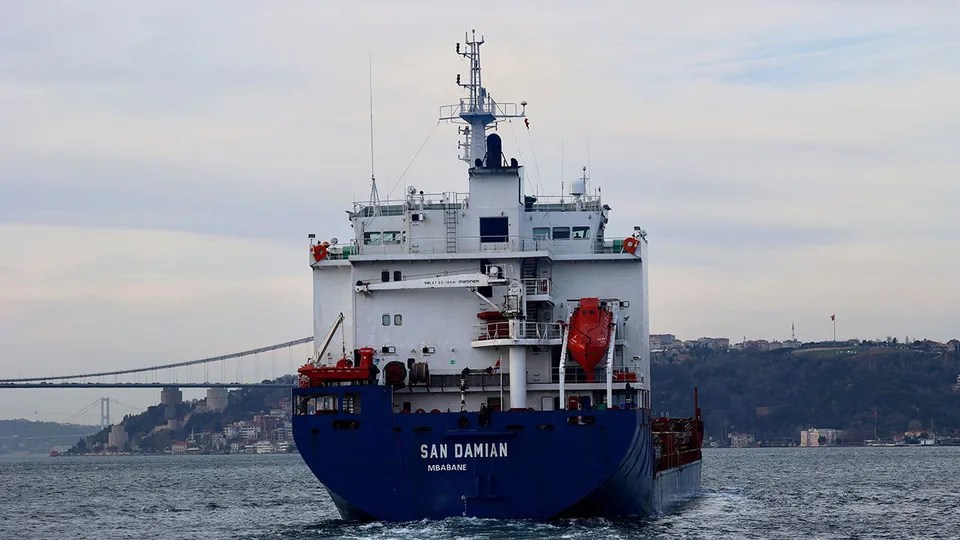
Jurisdictional triage…
The website for the shipping registry of Eswatini (formerly Swaziland), established in October 2023, appears much like those of more established seafaring nations. A picture of vast cruise ships sits alongside promises of the “highest quality ship maritime services and ship registrations”. Delve deeper though and Eswatini’s nautical credentials start to unravel. For one thing, the African country is landlocked, calling into doubt the assertion that the port of Mbabane, Eswatini’s capital, is situated on the coast of South Africa. It is a “dry port”, 150km from the sea and 30km from a rail link to Maputo on Mozambique’s Indian Ocean coast. Its stated ability to handle “containers, bulk carriers and tankers” seems questionable.
The country is following in the wake of other smaller nations that offer their flag to shipowners. Seagoing vessels are obliged by maritime law to fly a flag of a country of registration and stateless vessels are not protected by international law. Yet the days when the stern of a ship would fly a national flag connected to the ownership of the vessel are long past. Liberia, Panama and the Marshall Islands now account for nearly half of the global fleet, by tonnage. Countries with loose ties to seafaring have been dubbed “flags of convenience” for levying low or no taxes and offering an escape from burdensome labour laws and other regulatory requirements. Often administered by private companies based elsewhere, these registries are a handy source of additional revenue for small and poor countries.
Registering a merchant vessel with a jurisdiction that is a mere speck on the map is not necessarily a cause for concern. Many take seriously their responsibility to oversee adherence to the rules and regulations of the high seas. Liberia’s, based near Washington, dc, has a good record of maintaining global standards across its fleet. Other registries merely give a “façade of legal oversight” says Richard Meade, editor of Lloyd’s List Intelligence, a trade publication. A blacklist complied by Paris mou, an organisation that aims to “eliminate the operation of substandard ships”, puts the likes of Cameroon, Vanuatu and Comoros near the bottom…
…
Less diligent registries are helping to fuel the growth of a “dark fleet”—some 1,400 vessels, according to the Atlantic Council, a think-tank—that operates with little regulatory oversight. They are mostly oil tankers that engage in subterfuge to hide where they are and the origin of their cargo in order to evade sanctions on Russian crude oil. Ownership is often opaque. Mr Meade estimates that 12% of the global tanker fleet is now dark. He notes that Gabon’s registry, now comprising 140 vessels, is the fastest-growing in the world thanks largely to the reflagging of Russian tankers.
An expanding dark fleet poses a danger to itself and other vessels. Dark ships tend to be old and less well maintained, and some may be uninsured. Practices such as turning off or “spoofing” location devices are a danger to other ships. Swapping oil cargoes at sea to obscure their origins poses the danger of a spillage. Mr Meade foresees a worse calamity of a large “dark fleet” tanker sinking in an environmentally sensitive area, with no accountability…
Sea-going chicanery: “Why does landlocked Eswatini have a ship registry?” (gift article) from @TheEconomist.
* Shakespeare, Twelfth Night
###
As we deconstruct disguises, we might recall that it was on this date in 1617 that Sweden and the Tsardom of Russia signed the Treaty of Stolbovo, ending the Ingrian War and shutting Russia out of the Baltic Sea… until 1703, when Peter the Great won back access in battle with the Swedes– a victory he cemented by founding St. Petersburg.


“A nation that destroys its soils destroys itself”*…

The cliché, avidly promoted by Moscow, is that Russia, one of the world’s largest petro-states, will be a relative winner in climate change; but a new book argues that the country will find itself in deep trouble. Sophie Pinkham unpacks the lesson’s in Thane Gustafson’s Klimat: Russia in the Age of Climate Change…
Thane Gustafson, a longtime specialist on Russian energy, wrote Klimat: Russia in the Age of Climate Change before the [Ukraine] invasion, when the Covid pandemic seemed the great unexpected event complicating every prediction. Yet with its focus on the future of Russia’s energy, grain, and metals markets, all of which have been reconfigured by the war and the new sanctions, Klimat could hardly be more timely. Gustafson argues that Russia’s days of hydrocarbon-funded might are numbered. Unfortunately, the end of this era will not come soon enough for Ukrainians, or for the planet.
Russia is warming 2.5 times as fast as the world on average, and the Arctic is warming even faster. The cliché, avidly promoted by Moscow, is that the country will be a relative winner in climate change, benefiting from a melting and accessible Arctic shipping route, longer growing seasons, and the expansion of farmland into newly thawed areas. Gustafson counters, with a dry but persuasive marshaling of facts, that in the redistribution of wealth and power that will result from climate change, Russia is doomed. After reading Klimat, Russia’s attack on Ukraine begins to look like the convulsion of a dying state.
About two thirds of Russia is covered in permafrost, a mixture of sand and ice that, until recently, remained frozen year-round. As permafrost melts, walls built on it fracture, buildings sink, railways warp, roads buckle, and pipelines break. Anthrax from long-frozen reindeer corpses has thawed and infected modern herds. Sinkholes have opened in the melting ground, swallowing up whole buildings. Ice roads over frozen water, once the only way to travel in some remote regions, are available for ever-shorter periods. The Arctic coast is eroding rapidly, imperiling structures built close to the water…
Russia’s forests are the largest in the world, accounting for a fifth of Earth’s trees, but they are being grievously damaged by fire, drought, and disease, all of which are caused or exacerbated by climate change. Smoke has choked Siberian cities. During the 2019 fires that burned about 10,000 square miles of forest in Siberia, the Internet lit up with protest, and Russian singers and actors took part in a flash mob called “Siberia Is Burning.” President Putin sent in military units to help extinguish the fire, but he was soon rescued by rain. The problem was forgotten. As burning, dying, clear-cut forests become carbon producers rather than carbon sinks, they make the problem of climate change even worse. The same is true of melting permafrost, which releases methane, another potent greenhouse gas…
Imperialism originates in a struggle for resources; the ideology justifying the brutality of conquest and control is secondary. Oil has been one of the most coveted resources of the modern era, but the oldest and most essential resource is food. Ukraine’s famously fertile “black earth,” desired by many invaders and colonizers over the course of the country’s history, may also be among the motivations for Russia’s new aggression. According to recent reports, Russia has been commandeering or destroying Ukrainian grain stores and making off with Ukrainian agricultural equipment, smuggling the stolen grain to Syria for sale in the Middle East. Gustafson points out that as shortages become more frequent, food will become an increasingly significant tool of geopolitical influence…
Eminently worth reading in full: climate change is coming for Russia: “A Hotter Russia,” from @sophiepinkhmmm on @ThaneGustafson in @nybooks.
Lest American readers feel complacent: “The challenging politics of climate change,” from @BrookingsInst.
* Franklin D. Roosevelt
###
As we get serious, we might send imperial birthday greetings to the man Vladimir Putin seems to wish he was: Pyotr Alekséyevich, also known as Peter I, and best known as Peter the Great; he was born on this date in 1672. But even as Putin is trying to turn back the cultural clock, Peter was the Tsar who modernized Russia and grew it into an empire, capturing ports at Azov and the Baltic Sea, laying the groundwork for the Imperial Russian Navy, ending uncontested Swedish supremacy in the Baltic, and beginning the Tsardom’s expansion into a much larger empire that became a major European power.
Peter led a cultural revolution that replaced some of the traditionalist and medieval social and political systems with ones that were modern, scientific, Westernised, and based on the Enlightenment. His reforms had a lasting impact on Russia, and many institutions of the Russian government trace their origins to his reign. He adopted the title of Emperor in place of the old title of Tsar in 1721, and founded and developed the city of Saint Petersburg, which remained the capital of Russia until 1917.

_-_Portrait_de_Pierre_Ier_(mus%C3%A9e_de_l%E2%80%99Ermitage).jpg)
You must be logged in to post a comment.