Posts Tagged ‘smuggling’
“Conceal me what I am, and be my aid for such disguise as haply shall become the form of my intent”*…
Jurisdictional triage…
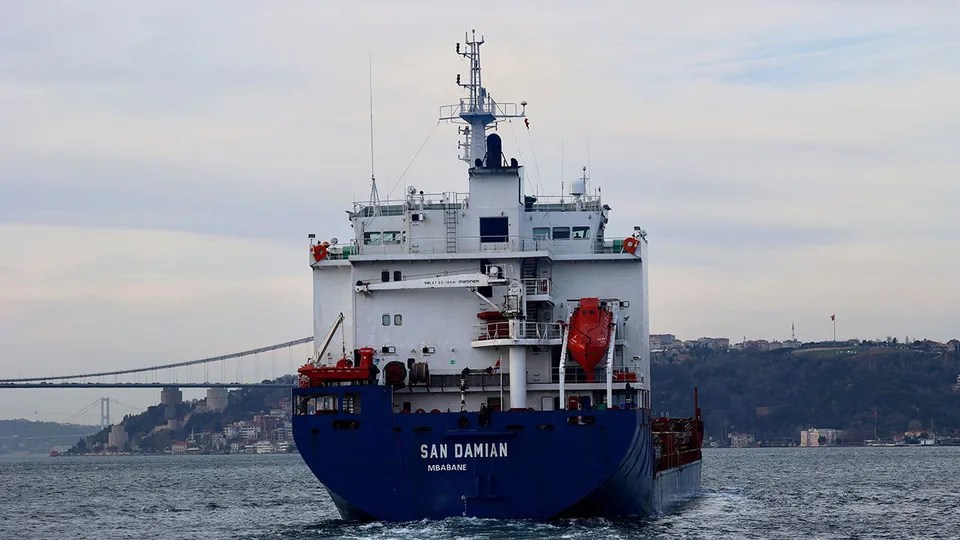
The website for the shipping registry of Eswatini (formerly Swaziland), established in October 2023, appears much like those of more established seafaring nations. A picture of vast cruise ships sits alongside promises of the “highest quality ship maritime services and ship registrations”. Delve deeper though and Eswatini’s nautical credentials start to unravel. For one thing, the African country is landlocked, calling into doubt the assertion that the port of Mbabane, Eswatini’s capital, is situated on the coast of South Africa. It is a “dry port”, 150km from the sea and 30km from a rail link to Maputo on Mozambique’s Indian Ocean coast. Its stated ability to handle “containers, bulk carriers and tankers” seems questionable.
The country is following in the wake of other smaller nations that offer their flag to shipowners. Seagoing vessels are obliged by maritime law to fly a flag of a country of registration and stateless vessels are not protected by international law. Yet the days when the stern of a ship would fly a national flag connected to the ownership of the vessel are long past. Liberia, Panama and the Marshall Islands now account for nearly half of the global fleet, by tonnage. Countries with loose ties to seafaring have been dubbed “flags of convenience” for levying low or no taxes and offering an escape from burdensome labour laws and other regulatory requirements. Often administered by private companies based elsewhere, these registries are a handy source of additional revenue for small and poor countries.
Registering a merchant vessel with a jurisdiction that is a mere speck on the map is not necessarily a cause for concern. Many take seriously their responsibility to oversee adherence to the rules and regulations of the high seas. Liberia’s, based near Washington, dc, has a good record of maintaining global standards across its fleet. Other registries merely give a “façade of legal oversight” says Richard Meade, editor of Lloyd’s List Intelligence, a trade publication. A blacklist complied by Paris mou, an organisation that aims to “eliminate the operation of substandard ships”, puts the likes of Cameroon, Vanuatu and Comoros near the bottom…
…
Less diligent registries are helping to fuel the growth of a “dark fleet”—some 1,400 vessels, according to the Atlantic Council, a think-tank—that operates with little regulatory oversight. They are mostly oil tankers that engage in subterfuge to hide where they are and the origin of their cargo in order to evade sanctions on Russian crude oil. Ownership is often opaque. Mr Meade estimates that 12% of the global tanker fleet is now dark. He notes that Gabon’s registry, now comprising 140 vessels, is the fastest-growing in the world thanks largely to the reflagging of Russian tankers.
An expanding dark fleet poses a danger to itself and other vessels. Dark ships tend to be old and less well maintained, and some may be uninsured. Practices such as turning off or “spoofing” location devices are a danger to other ships. Swapping oil cargoes at sea to obscure their origins poses the danger of a spillage. Mr Meade foresees a worse calamity of a large “dark fleet” tanker sinking in an environmentally sensitive area, with no accountability…
Sea-going chicanery: “Why does landlocked Eswatini have a ship registry?” (gift article) from @TheEconomist.
* Shakespeare, Twelfth Night
###
As we deconstruct disguises, we might recall that it was on this date in 1617 that Sweden and the Tsardom of Russia signed the Treaty of Stolbovo, ending the Ingrian War and shutting Russia out of the Baltic Sea… until 1703, when Peter the Great won back access in battle with the Swedes– a victory he cemented by founding St. Petersburg.


“No fiction romantic / Could ever’ve predicted / All the things that happen in my life”*…

John Maher was just sixteen when he was asked to play drums for a local band called the Buzzcocks in 1976. The Buzzcocks had been formed by Peter Shelley and Howard Devoto in Manchester in late 1975. Maher didn’t really think about it—he just said yes. His first gig playing drums with the band was supporting the Sex Pistols at their second (now legendary) appearance at the Lesser Free Trade Hall, Manchester, in July 1976.
When he was eighteen, Maher bought his first camera—an Olympus Trip—just prior to the Buzzcocks tour of America in 1978. Photography was something to do on the road—but for Maher it was soon became a passion.
After the Buzzcocks split in 1981, Maher played drums for Wah! and Flag of Convenience. But his interest in music waned. When the Buzzcocks reformed in 1989, Maher opted out—only ever making occasional guest appearances with the band.
Maher had an interest in drag racing which led to his launching an incredibly successful business making high performance engines—John Maher Racing. His engines and transmissions are described as the best built in the UK. The success of his company allowed Maher to retire. It was then that he returned to photography.
In 2002, Maher relocated from Manchester to the Isle of Harris in Scotland. The beautiful, bleak Hebridean landscape was in stark contrast to his busy post-industrial hometown of Manchester. The land inspired Maher and he became fascinated with the deserted crofts dotted across the island. Homes once filled with working families and children now lay abandoned in disrepair—belongings scattered across wooden floors, empty chairs faithfully waiting for a new owner, wallpaper and paint drifting from the walls, windows smashed, and gardens long untended…
More of Maher’s story– and more of his wonderful photos– at “What a Buzzcock Did Next: Drummer John Maher’s stunning photographs of abandoned homes.”
* from “Fiction Romance,” on Another Music in a Different Kitchen, the Buzzcocks’ first album
###
As we tap our toes, we might recall that it was on this date in 1965 that Johnny Cash was stopped by U.S. Customs officials at the Mexican border on suspicion of heroin smuggling and found to be holding over 1,000 doses of prescription narcotics and amphetamines. He received a suspended sentence.

“He was a secret agent, and still alive thanks to his exact attention to the detail of his profession”*…

The Descriptive Catalogue of Special Devices and Supplies, used by British spies sent to the Continent to track Nazi movements and aid resistance fighters during World War II, has been recently reprinted by the Imperial War Museum. These pages from the back of the two-volume catalogue, which was published in 1944 and 1945, show a few of the ways that the Special Operations Executive (the name for the secret British agency charged with training and deploying these agents) managed to sneak arms and ammunition to its operatives.
As historian-author Sinclair McKay writes in the introduction to the new volume, the Special Operations Executive trained many volunteers and recruits with no previous experience in the field. The recruits underwent crash courses, with SOE personnel bringing them quickly up to speed on the use of weapons and explosives, the maintenance of communications equipment, and the cultures of the places they were to infiltrate.
The two volumes of the manual are packed full of explanations of the many devices SOE operatives might encounter, or choose to use, in their operations…
More in the remarkable Rebecca Onion’s “Nifty Methods for Smuggling Contraband, From a Manual for WWII-Era British Spies.”
* Ian Fleming, Casino Royale
###
As we dawdle at the dead drop, we might recall that it was on this date in 1941, the day after the Japanese attack on Pearl Harbor, that Franklin D. Roosevelt delivered the “Infamy Speech”–the name deriving from the first line of the speech, in which Roosevelt describes the previous day as “a date which will live in infamy”– to a Joint Session of Congress.
Read Roosevelt’s original typescript here; and hear an except here.

You must be logged in to post a comment.