Posts Tagged ‘research’
“Having to read footnotes resembles having to go downstairs to answer the door while in the midst of making love”*…

Gertrude Himmelfarb begs to differ: “The footnote would seem to be the smallest detail in a work of history. Yet it carries a large burden of responsibility, testifying to the validity of the work, the integrity (and the humility) of the historian, and to the dignity of the discipline.”
Matthew Wills channels the estimable Anthony Grafton in defense of the oft-maligned marginalia…
“The history of the footnote may well seem an apocalyptically trivial topic,” writes historian Anthony Grafton. “Footnotes seem to rank among the most colorless and uninteresting features of historical practice.” And yet, Grafton—who has also written The Footnote: A Curious History (1999)—argues that they’re actually pretty important.
“Once the historian writes with footnotes, historical narrative becomes a distinctly modern” practice, Grafton explains. History is no longer a matter of rumor, unsubstantiated opinion, or whim.
“The text persuades, the note proves,” he avers. Footnotes do double duty, for they also “persuade as well as prove” and open up the work to a multitude of voices.
Leopold von Ranke (1795–1886), the founder of source-based history, is usually credited with the “invention” of the scholarly footnote in the European tradition. Grafton describes von Ranke’s theory as sharper than his practice: his footnoting was much too sloppy to be a model for scholars today. But various forms of footnotes were used long before von Ranke. Sources were of vital importance to both Roman lawyers and Christian theologians in late antiquity and the early Middle Ages, as they strove to back up their own arguments with the weight and gravitas of others…
The history– and importance– of annotation: “History’s Footnotes,” @scaliger via @JSTOR_Daily.
* Noel Coward
###
As we check our references, we might spare a thought for James MacGregor Burns; he died on this date in 2014. A historian and political scientist, he is best known for his biographies of American Presidents; his work on America’s 32nd president, Roosevelt: The Soldier of Freedom, won both the Pulitzer Prize and the National Book Award in History and Biography in 1971.
His work was influential in the field of leadership studies, shifting its focus from the traits and actions of “great men” to the interaction of leaders and their constituencies as collaborators working toward mutual benefit.

“Nature does not hurry, yet everything is accomplished”*…

Paul Constance on a chain of dedicated scientists who are building data sets on the natural world around us, and how– coupled with emerging new nature apps that enable citizen scientists– they are expanding our ecological attention span into the long now…
Every two weeks from March to November, Chris Halsch walks a ten-mile loop near the Donner Pass, high up in California’s Sierra Nevada, for the sole purpose of counting butterflies.
It is one of five sites at various altitudes that Halsch, a PhD candidate at the University of Nevada, Reno, has been visiting with metronomic regularity for the past five years. At each one he retraces his steps, pausing every so often to jot down species and numbers in a notebook.
Along the way, he sometimes meets recreational birders or hikers who take photographs and use nature apps to identify species for fun. But unlike those random snapshots, Halsch’s notes are a coveted resource for scientists. Once he types them into a spreadsheet, each of his data points adds a new segment to a chain of observations that has been growing without interruption for half a century, in one the world’s longest-lived efforts to monitor butterfly populations. Like a relay runner, Halsch is extending a marathon of sustained attention that began 20 years before he was born.
Multi-decadal time-series of field observations are among the rarest and most valuable artifacts in ecosystem science because they help to overcome a peculiar weakness in our ability to perceive and interpret the natural world. Humans have developed powerful methods for reconstructing events in the distant past, from the birth of a galaxy to mass extinctions in the Devonian. We have built instruments that can parse the present down to the zeptosecond. But when it comes to the modest timescale of our own lifespans, we are like near-sighted moles.
Weren’t there more birds in this meadow when we were kids?
Doesn’t it seem like spring is a lot rainier than it used to be?
Are you sure it’s safe to eat fish from this river?
Our answers to these types of questions are notoriously unreliable. Think of the tendency to describe a single weather event as evidence for (or against) climate change, or the panic caused by invasive zebra mussels that, 20 years later, turns out to have been misplaced. Perceptions are distorted by selective memories, cognitive biases, political agendas and shifting baseline syndrome—the propensity of each generation to gradually forget past environmental conditions and accept present ones as normal. In an essay published in 01990, the zoologist John J. Magnuson wrote that this temporal myopia can trap us in the “invisible present,” a space where we fail to see slow changes and are unable to interpret effects that lag years behind their causes. “In the absence of the temporal context provided by long-term research, serious misjudgments can occur not only in our attempts to understand and predict change in the world around us, but also in our attempts to manage our environment,” he warned.
Magnuson was echoing a group of mid-century scientists who believed that some of the biggest questions in ecology could only be answered with field observations that were carefully structured and repeated at the same sites for at least two decades. The longer the time-series, the greater likelihood that the invisible present will “melt away,” exposing the complex and often unexpected dynamics of ecosystem change….
[Constance describes a variety of efforts underway…]
… Collectively, these efforts are widening the aperture of our ecological attention, enabling scientists to find and stitch together scattered fragments of temporal data into panoramas that tell a more illuminating story about the interactions that drive change. Unfortunately, the emerging picture is still largely focused on wealthy countries—particularly ones with long histories of field-based science. A map of the International LTER network, an association of 750 field stations that, like their U.S. counterparts, are making long-term observations, shows that more than two thirds are concentrated in Western Europe. Numerous countries in Asia, Africa and Latin America have no stations at all. Moreover, even as scientists like Moran and Grames are exploiting the new wealth of temporal evidence, it is not clear how this research will influence the wider culture, where the blinkered perceptions of the “invisible present” are still pervasive.
The trend that may ultimately overcome both of these limitations is driven, paradoxically, by smartphones. Non-scientists have long been a critical source of field labor for long time-series, most famously for the Audubon Society’s 122-year-old Christmas Bird Count, but also in hundreds of smaller projects that monitor other kinds of flora and fauna. Now, smartphones with powerful cameras and apps such as eBird, iNaturalist, Seek and Picture Insect have enabled millions of casual observers to supplement this pool of dedicated volunteers. Despite the lively debate on whether smartphone usage in the outdoors enhances or interferes with people’s appreciation of nature, one fact is clear: because nature apps automatically time-stamp, geo-reference and store each observation in a robust database, they are generating potential time-series at an unprecedented scale.
In the 20 years since the Cornell Lab of Ornithology launched eBird, the app has amassed more than one billion observations by 700,000 birders from every country in the world. Carrie Seltzer, who heads stakeholder engagement at iNaturalist, says that more than 2.4 million people have made observations on the app, at a rate that has grown between 50 percent and 100 percent per year since 02012… This torrent of raw field data vastly exceeds what even well-funded researchers could ever dream of gathering with traditional methods…
Understanding the world around us: “Peering into The Invisible Present,” from @presentbias and @longnow. Eminently worth reading in full– then browsing the other remarkable pieces available on the Long Now website.
* Lao Tzu
###
As we take the long view, we might send insightful birthday greetings to a man who encourages us to see in different ways, M. C. Escher; he was born on this date in 1898. A graphic artist inspired by mathematics, he created woodcuts, lithographs, and mezzotints, that— while largely ignored by the art world in his lifetime, have become widely celebrated. He’s been recognized as an heir to Parmigianino, Hogarth, and Piranesi.
His work features mathematical objects and operations including impossible objects, explorations of infinity, reflection, symmetry, perspective, truncated and stellated polyhedra, hyperbolic geometry, and tessellations. And though Escher believed he had no mathematical ability, he interacted with the mathematicians George Pólya, Roger Penrose, and Donald Coxeter, and the crystallographer Friedrich Haag, and conducted his own research into tessellation.
For more on (and more examples of) Escher’s work, see here.


“The clustering of technological innovation in time and space helps explain both the uneven growth among nations and the rise and decline of hegemonic powers”*…

As scholars like Robert Gordon and Tyler Cowan have begun to call out a slowing of progress and growth in the U.S., others are beginning to wonder if “innovation clusters” like Silicon Valley are still advantageous. For example, Brian J. Asquith…
In 2011, the economist Tyler Cowen published The Great Stagnation, a short treatise with a provocative hypothesis. Cowen challenged his audience to look beyond the gleam of the internet and personal computing, arguing that these innovations masked a more troubling reality. Cowen contended that, since the 1970s, there has been a marked stagnation in critical economic indicators: median family income, total factor productivity growth, and average annual GDP growth have all plateaued…
In the years since the publication of the Great Stagnation hypothesis, others have stepped forward to offer support for this theory. Robert Gordon’s 2017 The Rise and Fall of American Growth chronicles in engrossing detail the beginnings of the Second Industrial Revolution in the United States, starting around 1870, the acceleration of growth spanning the 1920–70 period, and then a general slowdown and stagnation since about 1970. Gordon’s key finding is that, while the growth rate of average total factor productivity from 1920 to 1970 was 1.9 percent, it was just 0.6 percent from 1970 to 2014, where 1970 represents a secular trend break for reasons still not entirely understood. Cowen’s and Gordon’s insights have since been further corroborated by numerous research papers. Research productivity across a variety of measures (researchers per paper, R&D spending needed to maintain existing growth rates, etc.) has been on the decline across the developed world. Languishing productivity growth extends beyond research-intensive industries. In sectors such as construction, the value added per worker was 40 percent lower in 2020 than it was in 1970. The trend is mirrored in firm productivity growth, where a small number of superstar firms see exceptionally strong growth and the rest of the distribution increasingly lags behind.
A 2020 article by Nicholas Bloom and three coauthors in the American Economic Review cut right to the chase by asking, “Are Ideas Getting Harder to Find?,” and answered its own question in the affirmative.6 Depending on the data source, the authors find that while the number of researchers has grown sharply, output per researcher has declined sharply, leading aggregate research productivity to decline by 5 percent per year.
This stagnation should elicit greater surprise and concern because it persists despite advanced economies adhering to the established economics prescription intended to boost growth and innovation rates: (1) promote mass higher education, (2) identify particularly bright young people via standardized testing and direct them to research‑intensive universities, and (3) pipe basic research grants through the university system to foster locally-driven research and development networks that supercharge productivity…
…
… the tech cluster phenomenon stands out because there is a fundamental discrepancy between how the clusters function in practice versus their theoretical contributions to greater growth rates. The emergence of tech clusters has been celebrated by many leading economists because of a range of findings that innovative people become more productive (by various metrics) when they work in the same location as other talented people in the same field. In this telling, the essence of innovation can be boiled down to three things: co-location, co-location, co-location. No other urban form seems to facilitate innovation like a cluster of interconnected researchers and firms.
This line of reasoning yields a straightforward syllogism: technology clusters enhance individual innovation and productivity. The local nature of innovation notwithstanding, technologies developed within these clusters can be adopted and enjoyed globally. Thus, while not everyone can live in a tech cluster, individuals worldwide benefit from new advances and innovations generated there, and some of the outsized economic gains the clusters produce can then be redistributed to people outside of the clusters to smooth over any lingering inequalities. Therefore, any policy that weakens these tech clusters leads to a diminished rate of innovation and leaves humanity as a whole poorer.
Yet the fact that the emergence of the tech clusters has also coincided with Cowen’s Great Stagnation raises certain questions. Are there shortcomings in the empirical evidence on the effects of the tech clusters? Does technology really diffuse across the rest of the economy as many economists assume? Do the tech clusters inherently prioritize welfare-enhancing technologies? Is there some role for federal or state action to improve the situation? Clusters are not unique to the postwar period: Detroit famously achieved a large agglomeration economy based on automobiles in the early twentieth century, and several authors have drawn parallels between the ascents of Detroit and Silicon Valley. What makes today’s tech clusters distinct from past ones? The fact that the tech clusters have not yielded the same society-enhancing benefits that they once promised should invite further scrutiny…
How could this be? What can we do about it? Eminently worth reading in full: “Superstars or Black Holes: Are Tech Clusters Causing Stagnation?” (possible soft paywall), from @basquith827.
See also: Brad DeLong, on comments from Eric Schmidt: “That an externality market failure is partly counterbalanced and offset by a behavioral-irrationality-herd-mania cognitive failure is a fact about the world. But it does not mean that we should not be thinking and working very hard to build a better system—or that those who profit mightily from herd mania on the part of others should feel good about themselves.”
###
As we contemplate co-location, we might recall that it was on this date in 1956 that a denizen of one of America’s leading tech/innovation hubs, Jay Forrester at MIT [see here and here], was awarded a patent for his coincident current magnetic core memory (Patent No. 2,736,880). Forrester’s invention, a “multicoordinate digital information storage device,” became the standard memory device for digital computers until supplanted by solid state (semiconductor) RAM in the mid-1970s.

“The pursuit of science is a grand adventure, driven by curiosity, fueled by passion, and guided by reason”*…
Adam Mastroianni on how science advances (and how it’s held back), with a provocative set of suggestions for how it might be accelerated…
There are two kinds of problems in the world: strong-link problems and weak-link problems.
Weak-link problems are problems where the overall quality depends on how good the worst stuff is. You fix weak-link problems by making the weakest links stronger, or by eliminating them entirely.
Food safety, for example, is a weak-link problem. You don’t want to eat anything that will kill you. That’s why it makes sense for the Food and Drug Administration to inspect processing plants, to set standards, and to ban dangerous foods…
…
Weak-link problems are everywhere. A car engine is a weak-link problem: it doesn’t matter how great your spark plugs are if your transmission is busted. Nuclear proliferation is a weak-link problem: it would be great if, say, France locked up their nukes even tighter, but the real danger is some rogue nation blowing up the world. Putting on too-tight pants is a weak-link problem: they’re gonna split at the seams.
It’s easy to assume that all problems are like this, but they’re not. Some problems are strong-link problems: overall quality depends on how good the best stuff is, and the bad stuff barely matters. Like music, for instance. You listen to the stuff you like the most and ignore the rest. When your favorite band releases a new album, you go “yippee!” When a band you’ve never heard of and wouldn’t like anyway releases a new album, you go…nothing at all, you don’t even know it’s happened. At worst, bad music makes it a little harder for you to find good music, or it annoys you by being played on the radio in the grocery store while you’re trying to buy your beetle-free asparagus…
Strong-link problems are everywhere; they’re just harder to spot. Winning the Olympics is a strong-link problem: all that matters is how good your country’s best athletes are. Friendships are a strong-link problem: you wouldn’t trade your ride-or-dies for better acquaintances. Venture capital is a strong-link problem: it’s fine to invest in a bunch of startups that go bust as long as one of them goes to a billion…
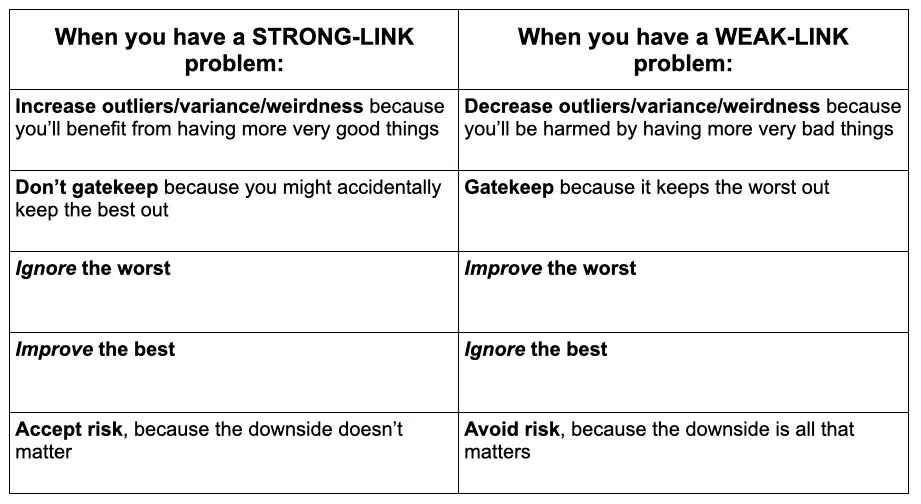
In the long run, the best stuff is basically all that matters, and the bad stuff doesn’t matter at all. The history of science is littered with the skulls of dead theories. No more phlogiston nor phlegm, no more luminiferous ether, no more geocentrism, no more measuring someone’s character by the bumps on their head, no more barnacles magically turning into geese, no more invisible rays shooting out of people’s eyes, no more plum pudding…
Our current scientific beliefs are not a random mix of the dumbest and smartest ideas from all of human history, and that’s because the smarter ideas stuck around while the dumber ones kind of went nowhere, on average—the hallmark of a strong-link problem. That doesn’t mean better ideas win immediately. Worse ideas can soak up resources and waste our time, and frauds can mislead us temporarily. It can take longer than a human lifetime to figure out which ideas are better, and sometimes progress only happens when old scientists die. But when a theory does a better job of explaining the world, it tends to stick around.
(Science being a strong-link problem doesn’t mean that science is currently strong. I think we’re still living in the Dark Ages, just less dark than before.)
Here’s the crazy thing: most people treat science like it’s a weak-link problem.
Peer reviewing publications and grant proposals, for example, is a massive weak-link intervention. We spend ~15,000 collective years of effort every year trying to prevent bad research from being published. We force scientists to spend huge chunks of time filling out grant applications—most of which will be unsuccessful—because we want to make sure we aren’t wasting our money…
…
I think there are two reasons why scientists act like science is a weak-link problem.
The first reason is fear. Competition for academic jobs, grants, and space in prestigious journals is more cutthroat than ever. When a single member of a grant panel, hiring committee, or editorial board can tank your career, you better stick to low-risk ideas. That’s fine when we’re trying to keep beetles out of asparagus, but it’s not fine when we’re trying to discover fundamental truths about the world…
The second reason is status. I’ve talked to a lot of folks since I published The rise and fall of peer review and got a lot of comments, and I’ve realized that when scientists tell me, “We need to prevent bad research from being published!” they often mean, “We need to prevent people from gaining academic status that they don’t deserve!” That is, to them, the problem with bad research isn’t really that it distorts the scientific record. The problem with bad research is that it’s cheating.
I get that. It’s maddening to watch someone get ahead using shady tactics, and it might seem like the solution is to tighten the rules so we catch more of the cheaters. But that’s weak-link thinking. The real solution is to care less about the hierarchy…
Here’s our reward for a generation of weak-link thinking.
The US government spends ~10x more on science today than it did in 1956, adjusted for inflation. We’ve got loads more scientists, and they publish way more papers. And yet science is less disruptive than ever, scientific productivity has been falling for decades, and scientists rate the discoveries of decades ago as worthier than the discoveries of today. (Reminder, if you want to blame this on ideas getting harder to find, I will fight you.)…
…
Whether we realize it or not, we’re always making calls like this. Whenever we demand certificates, credentials, inspections, professionalism, standards, and regulations, we are saying: “this is a weak-link problem; we must prevent the bad!”
Whenever we demand laissez-faire, the cutting of red tape, the letting of a thousand flowers bloom, we are saying: “this is a strong-link problem; we must promote the good!”
When we get this right, we fill the world with good things and rid the world of bad things. When we don’t, we end up stunting science for a generation. Or we end up eating a lot of asparagus beetles…
“Science is a strong-link problem,” from @a_m_mastroianni in @science_seeds.
* James Clerk Maxwell
###
As we ponder the process of progress, we might spare a thought for Sir Christopher Wren; he died on this date in 1723. A mathematician and astronomer (who co-founded and later served as president of the Royal Society), he is better remembered as one of the most highly acclaimed English architects in history; he was given responsibility for rebuilding 52 churches in the City of London after the Great Fire in 1666, including what is regarded as his masterpiece, St. Paul’s Cathedral, on Ludgate Hill.
Wren, whose scientific work ranged broadly– e.g., he invented a “weather clock” similar to a modern barometer, new engraving methods, and helped develop a blood transfusion technique– was admired by Isaac Newton, as Newton noted in the Principia.

“The spirit of inquiry and the courage to challenge the status quo are at the heart of scientific progress”*…

Adam Mastroianni on the challenges– and opportunities– facing science…
Randomized-controlled trials only caught on about 80 years ago, and whenever I think about that, I have to sit down and catch my breath for a while. The thing everybody agrees is the “gold standard” of evidence, the thing the FDA requires before it will legally allow you to sell a drug—that thing is younger than my grandparents.
There are a few records of things that kind of look like randomized-controlled trials throughout history, but people didn’t really appreciate the importance of RCTs until 1948, when the British Medical Research Council published a trial on streptomycin for tuberculosis. Humans have possessed the methods of randomization for thousands of years—dice, coins, the casting of lots—and we’ve been trying to cure diseases for as long as we’ve been human. Why did it take us so long to put them together?
I think the answer is: first, we had to stop trusting Zeus.
To us, coin flips are random (“Heads: I go first. Tails: you go first.”). But to an ancient human, coin flips aren’t random at all—they reveal the will of the gods (“Heads: Zeus wants me to go first. Tails: Zeus wants you to go first”). In the Bible, for instance, people are always casting lots to figure out what God wants them to do: which goat to kill, who should get each tract of land, when to start a genocide, etc.
This is, of course, a big problem for running RCTs. If you think that the outcome of a coin flip is meaningful rather than meaningless, you can’t use it to produce two equivalent groups, and you can’t study the impact of doing something to one group and not the other. You can only run a ZCT—a Zeus controlled trial.
It’s easy to see how technology can lead to scientific discoveries. Make microscope -> discover mitochondria.
Clearly, though, sometimes those technologies get invented entirely inside our heads. Stop trusting Zeus -> develop RCTs.
Which raises the question: what mental technologies haven’t we invented yet? What brain switches are just waiting to be flipped?…
On reinvigorating science: “Declining trust in Zeus is a technology,” from @a_m_mastroianni.
Apposite to an issue he raises: “Citation cartels help some mathematicians—and their universities—climb the rankings,” from @ScienceMagazine.
[Image above: source]
###
As we deliberate on discovery, we might send micro-biological birthday greetings to a woman who modeled the attitude and behavior that Mastroianni suggests: Ruth Sager; she was born on this date in 1918. A pioneering geneticist, she had, in effect, two careers.
In the 1950s and 1960s, she pioneered the field of cytoplasmic genetics by discovering transmission of genetic traits through chloroplast DNA, the first known example of genetics not involving the cell nucleus. She identified a second set of genes were found outside of the cell’s nucleus, which, even though they were nonchrosomomal, also influenced inherited characteristics. The academic community did not acknowledge the significance of her contribution until after the second wave of feminism in the 1970s.
Then, in the early 1970s, she moved into cancer genetics (with a specific focus on breast cancer); she proposed and investigated the roles of tumor suppressor genes. She identified over 100 potential tumor suppressor genes, developed cell culture methods to study normal and cancerous human and other mammalian cells in the laboratory, and pioneered the research into “expression genetics,” the study of altered gene expression.

You must be logged in to post a comment.