Posts Tagged ‘Physics’
“The story of the events and the people who, over centuries, came together to bring us in from the cold and to wrap us in a warm blanket of technology is a matter of vital importance, since more and more of that technology infiltrates every aspect of our lives”*…

From Étienne Fortier-Dubois, the Historical Tech Tree, “a timeline to visualize the full history of all major technologies (or 1,780 of them, at least), from 3.3 million years ago to today. More importantly, it also contains more than 2,000 connections between them: prerequisites, improvements, inspirations: anything that allows you to understand how one thing led to another”…
The historical tech tree is a project by Étienne Fortier-Dubois to visualize the entire history of technologies, inventions, and (some) discoveries, from prehistory to today. Unlike other visualizations of the sort, the tree emphasizes the connections between technologies: prerequisites, improvements, inspirations, and so on.
These connections allow viewers to understand how technologies came about, at least to some degree, thus revealing the entire history in more detail than a simple timeline, and with more breadth than most historical narratives. The goal is not to predict future technology, except in the weak sense that knowing history can help form a better model of the world. Rather, the point of the tree is to create an easy way to explore the history of technology, discover unexpected patterns and connections, and generally make the complexity of modern tech feel less daunting….
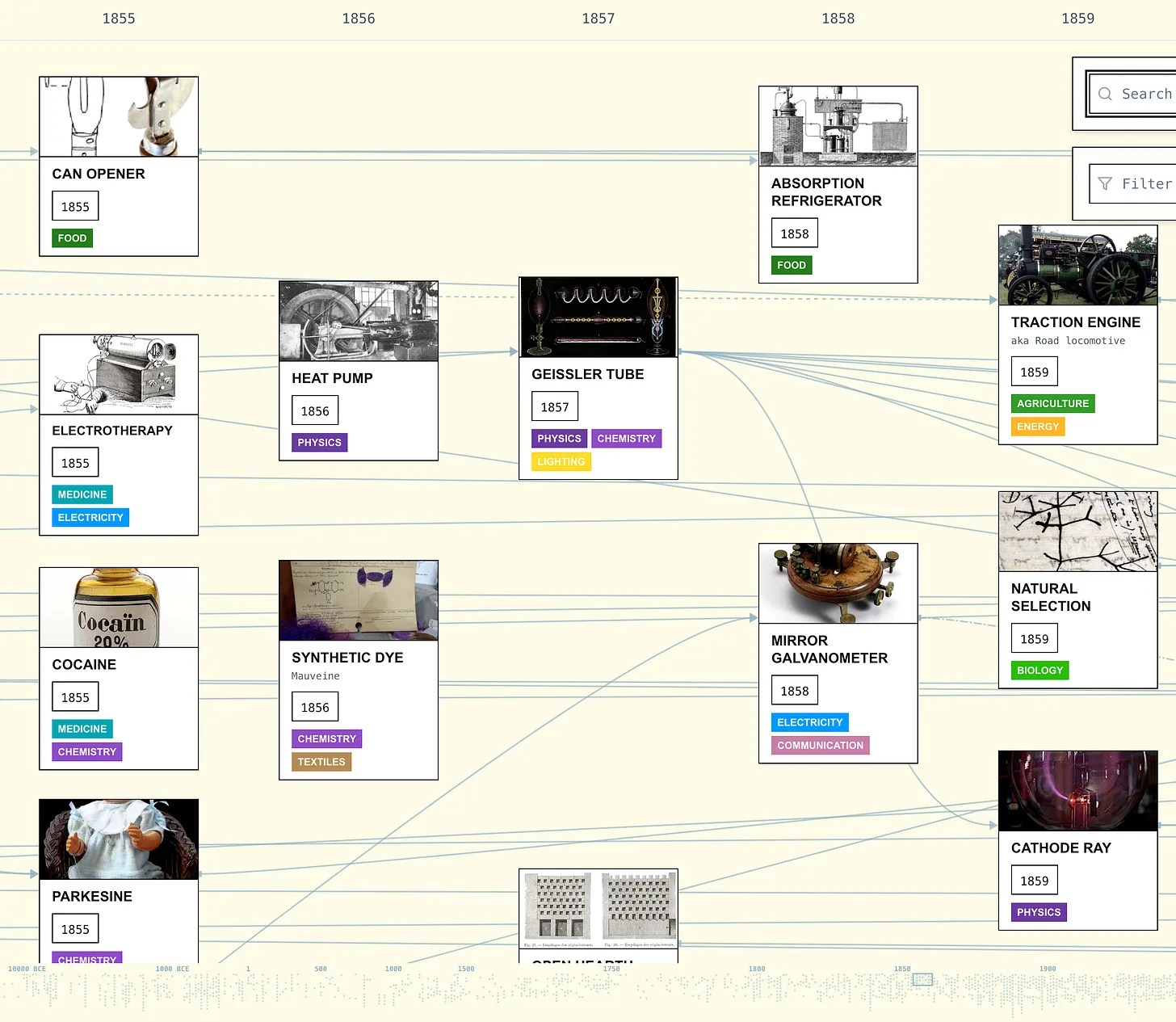
How one thing led to another: “Historical Tech Tree.”
See also: “Introducing the Historical Tech Tree.”
* “The story of the events and the people who, over centuries, came together to bring us in from the cold and to wrap us in a warm blanket of technology is a matter of vital importance, since more and more of that technology infiltrates every aspect of our lives. It’s become a life-support system without which we can’t survive. And yet, how much of it do we understand?”- James Burke, in the first episode of Connections.
###
As we ponder progress, we might recall that it was on this date in 1633, following an Inquisition, that the Holy Office in Rome forced Galileo Galilei to recant his view that the Sun, not the Earth, is the center of the Universe in the form in which he presented it. Gaileo had used a telescope (1603 on the Timeline) to reach his (correct) conclusion.
He refused to recant, and put under house arrest, where he effectively remained for the rest of his life. He dedicated his time in restriction to one of his finest works, Two New Sciences, in which he summarised work he had done some forty years earlier, on the two sciences now called kinematics and strength of materials, and published in Holland to avoid the censor. As a result of this work– highly praised by Albert Einstein– Galileo is often called the “father of modern physics.”

“Form follows function – that has been misunderstood. Form and function should be one, joined in a spiritual union”*…

In the quote above, Frank Lloyd Wright was glossing his mentor, Louis Sullivan… He might have been alluding to the work of L. Mahadevan. In a conversation with Steven Strogatz, Mahadeven explains how complex biological forms and behaviors– from brain folds to insect architecture– emerge through the interplay of physical forces, environment and embodiment…
What links a Möbius strip, brain folds and termite mounds? The answer is Harvard University’s L. Mahadevan, whose career has been devoted to using mathematics and physics to explore the form and function of common phenomena.
Mahadevan, or Maha to his friends and colleagues, has long been fascinated by questions one wouldn’t normally ask — from the equilibrium shape of inert objects like a Möbius strip, to the complex factors that drive biological systems like morphogenesis or social insect colonies…
… Mahadevan tells Steven Strogatz what inspires him to tackle these questions, and how gels, gypsum and LED lights can help uncover form and function in biological systems. He also offers some provocative thoughts about how noisy random processes might underlie our intuitions about geometry…
… STROGATZ: I feel like it’s relevant for our discussion today because it seems like you’ve been interested in this interplay between shape and force, certainly from your early work and it looks like you’re still thinking about it these days.
MAHADEVAN: Partly, yes. I would say a lot of what I am trying to do nowadays is more biologically motivated and inspired. But flow, shape and increasingly now thinking about sentient systems, understanding how we learn what we learn. I’m very much interested in embodiment as a way in which sentient organisms find their way and function in the world… and particularly with social insects, but a little bit with humans as well…
“Does Form Really Shape Function?” It’s so much more interesting than that… @stevenstrogatz.com and @quantamagazine.bsky.social.
(Image above: source)
* Frank Lloyd Wright
###
As we blend, we might recall that it was on this date in 1987 that Ben & Jerry’s Ice Cream introduced a new flavor, Cherry Garcia.

“Gravity. It’s not just a good idea; it’s the law!”*…

… But what is gravity? George Musser unpacks a new argument that explores how the growth of disorder could cause massive objects to move toward one another– one that has left some physicists interested, and some skeptical…
Isaac Newton was never entirely happy with his law of universal gravitation. For decades after publishing it in 1687, he sought to understand how, exactly, two objects were able to pull on each other from afar. He and others came up with several mechanical models, in which gravity was not a pull, but a push. For example, space might be filled with unseen particles that bombard the objects on all sides. The object on the left absorbs the particles coming from the left, the one on the right absorbs those coming from the right, and the net effect is to push them together.
Those theories never quite worked, and Albert Einstein eventually provided a deeper explanation of gravity as a distortion of space and time. But Einstein’s account, called general relativity, created its own puzzles, and he himself recognized that it could not be the final word. So the idea that gravity is a collective effect — not a fundamental force, but the outcome of swarm behavior on a finer scale — still compels physicists.
Earlier this year, a team of theoretical physicists put forward what might be considered a modern version of those 17th-century mechanical models. “There’s some kind of gas or some thermal system out there that we can’t see directly,” said Daniel Carney of Lawrence Berkeley National Laboratory, who led the effort. “But it’s randomly interacting with masses in some way, such that on average you see all the normal gravity things that you know about: The Earth orbits the sun, and so forth.”
This project is one of the many ways that physicists have sought to understand gravity, and perhaps the bendy space-time continuum itself, as emergent from deeper, more microscopic physics. Carney’s line of thinking, known as entropic gravity, pegs that deeper physics as essentially just the physics of heat. It says gravity results from the same random jiggling and mixing up of particles — and the attendant rise of entropy, loosely defined as disorder — that governs steam boilers, car engines and refrigerators.
Attempts at modeling gravity as a consequence of rising entropy have cropped up now and again for several decades. Entropic gravity is very much a minority view. But it’s one that won’t die, and even detractors are loath to dismiss it altogether. The new model has the virtue of being experimentally testable — a rarity when it comes to theories about the mysterious underpinnings of the universal attraction…
[Musser explains the hypothesis, traces is origin, and reviews other scientists’ reactions, and traces possible approaches to testing it…]
… if this long-shot theory does work out, physicists will need to update the artist Gerry Mooney’s famous gravity poster, which reads: “Gravity. It isn’t just a good idea. It’s the law.” Perhaps gravity is not, in fact, a law, just a statistical tendency…
“Is Gravity Just Entropy Rising? Long-Shot Idea Gets Another Look” from @georgemusser.com in @quantamagazine.bsky.social.
###
As we fumble with forces, we might send insightful birthday greetings to a man who encourages us to see in different ways, M. C. Escher; he was born on this date in 1898. A graphic artist inspired by mathematics, he created woodcuts, lithographs, and mezzotints, that— while largely ignored by the art world in his lifetime, have become widely celebrated. He’s been recognized as an heir to Parmigianino, Hogarth, and Piranesi.
His work features mathematical objects and operations including impossible objects, explorations of infinity, reflection, symmetry, perspective, truncated and stellated polyhedra, hyperbolic geometry, and tessellations. And though Escher believed he had no mathematical ability, he interacted with the mathematicians George Pólya, Roger Penrose, and Donald Coxeter, and the crystallographer Friedrich Haag, and conducted his own research into tessellation.
For more on (and more examples of) Escher’s work, see here.


“I think the next century will be the century of complexity”*…

… and as Philip Ball reports, a team of scientists at Carnegie Science agrees…
In 1950 the Italian physicist Enrico Fermi was discussing the possibility of intelligent alien life with his colleagues. If alien civilizations exist, he said, some should surely have had enough time to expand throughout the cosmos. So where are they?
Many answers to Fermi’s “paradox” have been proposed: Maybe alien civilizations burn out or destroy themselves before they can become interstellar wanderers. But perhaps the simplest answer is that such civilizations don’t appear in the first place: Intelligent life is extremely unlikely, and we pose the question only because we are the supremely rare exception.
A new proposal by an interdisciplinary team of researchers challenges that bleak conclusion. They have proposed nothing less than a new law of nature, according to which the complexity of entities in the universe increases over time with an inexorability comparable to the second law of thermodynamics — the law that dictates an inevitable rise in entropy, a measure of disorder. If they’re right, complex and intelligent life should be widespread.
In this new view, biological evolution appears not as a unique process that gave rise to a qualitatively distinct form of matter — living organisms. Instead, evolution is a special (and perhaps inevitable) case of a more general principle that governs the universe. According to this principle, entities are selected because they are richer in a kind of information that enables them to perform some kind of function.
This hypothesis, formulated by the mineralogist Robert Hazen [here] and the astrobiologist Michael Wong [here] of the Carnegie Institution in Washington, D.C., along with a team of others, has provoked intense debate. Some researchers have welcomed the idea as part of a grand narrative about fundamental laws of nature. They argue that the basic laws of physics are not “complete” in the sense of supplying all we need to comprehend natural phenomena; rather, evolution — biological or otherwise — introduces functions and novelties that could not even in principle be predicted from physics alone. “I’m so glad they’ve done what they’ve done,” said Stuart Kauffman, an emeritus complexity theorist at the University of Pennsylvania. “They’ve made these questions legitimate.”…
[Ball explains the origin and outline of Hazen’s and Wong’s conjecture, explores the critiques– among them, that it’s not clear how to test the hypothesis– and examines the resonant work on Assembly Theory being done by Lee Cronin and Sara Walker…]
… Wong said there is more work still to be done on mineral evolution, and they hope to look at nucleosynthesis and computational “artificial life.” Hazen also sees possible applications in oncology, soil science and language evolution. For example, the evolutionary biologist Frédéric Thomas of the University of Montpellier in France and colleagues have argued that the selective principles governing the way cancer cells change over time in tumors are not like those of Darwinian evolution, in which the selection criterion is fitness, but more closely resemble the idea of selection for function from Hazen and colleagues.
Hazen’s team has been fielding queries from researchers ranging from economists to neuroscientists, who are keen to see if the approach can help. “People are approaching us because they are desperate to find a model to explain their system,” Hazen said.
But whether or not functional information turns out to be the right tool for thinking about these questions, many researchers seem to be converging on similar questions about complexity, information, evolution (both biological and cosmic), function and purpose, and the directionality of time. It’s hard not to suspect that something big is afoot. There are echoes of the early days of thermodynamics, which began with humble questions about how machines work and ended up speaking to the arrow of time, the peculiarities of living matter, and the fate of the universe…
A new suggestion that complexity increases over time, not just in living organisms but in the nonliving world, promises to rewrite notions of time and evolution: “Why Everything in the Universe Turns More Complex,” from @philipcball.bsky.social and @quantamagazine.bsky.social.
See also: Benjamin Bratton‘s explantion of the work he and his collegues are doing at a new institute at UCSD: “Antikythera.” See his recent Long Now Foundation talk on this same subject here.
* Stephen Hawking
###
As we celebrate complication, we might spare a thought for G. N. Ramachandran (Gopalasamudram Narayanan Ramachandran); he died on this date in 2001. A biophysicist, he discovered the triple helical “coiled coil” structure of the collagen molecule, among other remarkable contributions to structural biology.
Ramachandran was a master of X-ray crystallography, and with his colleagues, constructed space filling models of protein molecules. He devised the Ramachandran Plot, a method to diagram the conformation of polypeptides, polysaccharides and polynucleotides– which remains the international standard to describe protein structures.
Ramachandran, inspired by the ancient Syaad Nyaaya (doctrine of “may be”), also explored artificial intelligence. He developed the Boolean Vector Matrix Formulation which has important application in writing software for AI.

“Truth is ever to be found in the simplicity, and not in the multiplicity and confusion of things”*…

From Kim (Scott) Morrison‘s and Dror Bar-Natan‘s, The Knot Atlas, “a complete user-editable knot atlas, in the wiki spirit of Wikipedia“– a marvelous example of a wide-spread urge in mathematics to find order through classification. As Joseph Howlett explains, that quest continues, even as it proves vexatious…
Biology in the 18th century was all about taxonomy. The staggering diversity of life made it hard to draw conclusions about how it came to be. Scientists first had to put things in their proper order, grouping species according to shared characteristics — no easy task. Since then, they’ve used these grand catalogs to understand the differences among organisms and to infer their evolutionary histories. Chemists built the periodic table for the same purpose — to classify the elements and understand their behaviors. And physicists made the Standard Model to explain how the fundamental particles of the universe interact.
In his book The Order of Things, the philosopher Michel Foucault describes this preoccupation with sorting as a formative step for the sciences. “A knowledge of empirical individuals,” he wrote, “can be acquired only from the continuous, ordered and universal tabulation of all possible differences.”
Mathematicians never got past this obsession. That’s because the menagerie of mathematics makes the biological catalog look like a petting zoo. Its inhabitants aren’t limited by physical reality. Any conceivable possibility, whether it lives in our universe or in some hypothetical 200-dimensional one, needs to be accounted for. There are tons of different classifications to try — groups, knots, manifolds and so on — and infinitely many objects to sort in each of those classifications. Classification is how mathematicians come to know the strange, abstract world they’re studying, and how they prove major theorems about it.Take groups, a central object of study in math. The classification of “finite simple groups” — the building blocks of all groups — was one of the grandest mathematical accomplishments of the 20th century. It took dozens of mathematicians nearly 100 years to finish. In the end, they figured out that all finite simple groups fall into three buckets, except for 26 itemized outliers. A dedicated crew of mathematicians has been working on a “condensed” proof of the classification since 1994 — it currently comprises 10 volumes and several thousand pages, and still isn’t finished. But the gargantuan undertaking continues to bear fruit, recently helping to prove a decades-old conjecture that you can infer a lot about a group by examining one small part of it.
Mathematics, unfettered by the typical constraints of reality, is all about possibility. Classification gives mathematicians a way to start exploring that limitless potential…[Howlett reviews attempts to classify numbers by “type” (postive/negative, rational/irrational), and mathematical objects by “equivalency” (shapes that can be stretched or squeezed into the other without breaking or tearing, like a doughnut and and coffee cup (see here)…]
… Similarly, classification has played an important role in knot theory. Tie a knot in a piece of string, then glue the string’s ends together — that’s a mathematical knot. Knots are equivalent if one can be tangled or untangled, without cutting the string, to match the other. This mundane-sounding task has lots of mathematical uses. In 2023, five mathematicians made progress on a key conjecture in knot theory that stated that all knots with a certain property (being “slice”) must also have another (being “ribbon”), with the proof ruling out a suspected counterexample. (As an aside, I’ve often wondered why knot theorists insist on using nouns as adjectives.)
Classifications can also get more meta. Both theoretical computer scientists and mathematicians classify problems about classification based on how “hard” they are.
All these classifications turn math’s disarrayed infinitude into accessible order. It’s a first step toward reining in the deluge that pours forth from mathematical imaginings…
“The Never-Ending Struggle to Classify All Math,” from @quantamagazine.bsky.social.
* Isaac Newton
###
As we sort, we might spare a thought for the author of our title quote, Sir Isaac Newton; he died in this date in 1727. A polymath, Newton excelled in– and advanced– mathematics, physics, and astronomy; he was a theologian and a government offical (Master of the Mint)… and a dedicated alchemist. He was key to the Scientific Revolution and the Enlightenment that followed.
Newton’s book Philosophiæ Naturalis Principia Mathematica (Mathematical Principles of Natural Philosophy), first published in 1687, achieved the first great unification in physics and established classical mechanics (e.g., the Laws of Motion and the principle of universal gravitation). He also made seminal contributions to optics, and shares credit with German mathematician Gottfried Wilhelm Leibniz for formulating infinitesimal calculus. Indeed, Newton contributed to and refined the scientific method to such an extent that his work is considered the most influential in the development of modern science.

You must be logged in to post a comment.