Posts Tagged ‘resistance’
“If you do not resist the apparently inevitable, you will never know how inevitable the inevitable was.”*…

Ah, but how best to resist?
In a short piece adapted from his recent book, On Resistance- A Manifesto, Curtis White offers a plain-spoken, almost playful– but at the same time provocative– prescription in the form of “seven theses on resistance”…
(1) Our politics are a binary melodrama: humanist against evangelical, Democrat against Republican, socialist against fascist, woke against racist, Kimmel against Trump, comedians against reality-show celebrities. By dominating the stage, these dramas exclude other ways of understanding who we are and what we want, in other words, what we lack.
(2) These melodramatic struggles distract us from the real question—what values shall we live by? Our true values are not to be found in what we think, or in what we say we believe, but in how we live.
(3) This contradicts the idea, common among us, that we are a free country rich in belief. “I believe X,” we are told, with the expectation that others will respect that belief, even if it makes no sense. It is as if belief has been reserved only for the unbelievable.
(4) The value we live through in the present moment is no different from the foundational value of ancient Greece and Rome: the “right of conquest.” This may sound hyperbolic, but the people of Gaza, Venezuela, and even Greenland understand it well. This value instructs friend and foe alike, “You can do whatever you want on the condition that you make your desires fit my ends, or else.” As Trump aide Stephen Miller acknowledged in a CNN interview in January 2026, “We live in a world … that is governed by strength, that is governed by force, that is governed by power.” Vae victis, woe to the victims.
(5) The worst psychopathology of everyday life is to be treated unjustly and not to know it. This injustice inevitably concerns money, its inequities, and its specious allure. Buddhist philosopher David Loy writes, “Money is the flight from emptiness that makes life empty.” This is the truth, but it is also something that we don’t know.
(6) Rather than seeing emptiness as a mark of failure, can we see it as something to reclaim? Emptiness is a fundamental human joy if we feel free to respond to it. Freedom to play, to create, to live in our own strength. As Tibetan Buddhist Tarthang Tulku thought, “Life is the play of energy in the void.” Children are primed for life through play, but their play only prepares them for a world that doesn’t exist.
(7) Jesus was a heretic because he hated hypocrites, those whose “throats were open graves.” In Nietzsche’s estimation, this made him “the noblest of men.” Jesus made himself useless to the ways of the Temple and useless to the ways of Empire. He encouraged us to take back our emptiness from the ethical absolutes of the Mosaic Law and from the false gods of Rome. He began the very human remaking of his Father’s earthly kingdom without any ethical guidance beyond the primordial aspirations of love. As Saint Augustine taught, simply, “Love and do what you will.”
Make yourself useless! Take back your emptiness! Make something beautiful!
As universities rid themselves of the arts, humanities, and social sciences, they become glorified vocational schools for those seeking jobs in tech or business. One might object that there is no human interest in the skills developed in such schools, but at least the people are employed, we’re told, and they’re getting the “good jobs.”
But even that logic is in doubt when so many students find that entry-level employment has been monopolized by AI, and, amid the West’s never-ending Industrial Revolution, by automation. This reality is leaving tens of thousands of people, heads filled with expensive skills that nobody wants or needs, living in their childhood bedrooms or their parents’ basement, gloomily doom-scrolling through the day, wondering how in the world their student loans will ever be repaid, and feeling just generally unneeded and unwanted. Not surprisingly, the consequences for mental health have been bad. According to a 2023 Gallup poll, 47 percent of Gen Z adults are anxious or depressed “often or always” because of social media, financial stress, and isolation.
But the numbers are, indeed, brow-raising: in late 2025, the unemployment rate among college graduates stood at nearly 6 percent, while the general unemployment rate was just over 4 percent. So, why go to college at all? Sure, apprentice to one of the trades. Go for construction, as if there were no downside to manual labor.
Techno-capitalism’s circle in hell is the hole (or parental basement) of the Empty Self. Imagine Dante walking in this hell, wondering about the devilish devices that the damned are staring into, fingers flying, and Virgil commenting, “They’re looking for themselves.”
Dante asks, “What are they seeing, master?”
Virgil replies, “Ghosts.”
“And what sin did they commit for this punishment?”
“Their sin was their lifelessness.”
Virgil has Bob Dylan’s “Desolation Row” on heavy rotation.
Gen Z youth imagine that their future is dependent on studying subjects for which they have no living interest. They have only the failing assumption that writing code, analyzing data, programming, or engineering software will eventually lead to prosperous material lives—or just survival, no matter how dull the reality is.
This is made even more hellish by the fact that the people in it are alone. My generation had to disengage from television, but a life lived online is another level of insidious alienation and, worse yet, it is all on the inside, eroding inner life, leaving nothing for the soul, nothing for soul-work, everything for addictive pleasure and profit. As David Foster Wallace commented in a 1996 interview with David Lipsky for Rolling Stone, sounding out a now familiar doom:
At a certain point we’re going to have to build up some machinery inside our guts to help us deal with this. The technology is just going to get better and better. And it’s going to get easier and easier and more and more convenient, and more and more pleasurable, to be alone with images on a screen, given to us by people who do not love us but want our money. If we don’t do that, then (a) as individuals, we’re going to die, and (b) the culture’s going to grind to a halt.
But Wallace didn’t mean to blame the young. The difference between Gen Z and earlier generations is that our young have to suffer the effects of techno-alienation much more intensely because the technology has indeed gotten “better and better.” They will be caught within it for a much longer time, and without the helpful memory of any sort of “time before tech.” Perhaps this is why Gen Z is currently experiencing a paradoxical nostalgia for the analogue world of the 1990s.
Well, then, what are we to do? How about, “Workers of the world, relax! Make yourselves useless, you have nothing to lose but your virtual chains!”
In On Tyranny, Timothy Snyder asks us to say no to rising fascism by preserving liberal democratic institutions. But he never imagines that there might be reasons to say no to those institutions, to our “managers of despair,” as well. He offers little understanding of the importance of a resistant culture, innately anarchic, opposing all that is anti-human. Resistant cultures seek to provide a place where we can become who we really are, a place where we are not mere functions of the world we happened to be born into, not diminished creatures whose being has been reduced to a marketable “skill set.”
Resistant cultures work through honesty, intelligence, and beauty. They ask of us what Buddha asked of his followers: listen, consider, and cultivate. Listen to what we have discovered; consider what you have heard; and if you like what you have heard and considered, if it speaks to you, then join with others in the sangha, the Buddhist community, where you can cultivate a path that others in their turn may follow. This is the ideal way to join any human group: not by thoughtlessly inhabiting its damaged forms and conditions, but by freely engaging, considering, choosing, and, with this freedom in place, making something beautiful. As Thich Nhat Hanh taught, “The next Buddha will be a sangha” [community].
I have written this manifesto in what Vladimir Nabokov called “a state of aesthetic bliss,” which he defined as: a sense of being somehow, somewhere, connected with other states of being where art (curiosity, tenderness, kindness, ecstasy) is the norm.
That’s the hill I intend to die on, for all the good intending will do me. Because that hill may already be gone. I have reclined in its grasses for so long—gazing down on moving water, assuming that all I had to do was turn and I’d be looking up toward the crest—that I may have missed the moment when the earthmovers came in, noisy though they are, and the mountaintop removal began. And then a guy in an orange vest and a hard hat comes up and explains to me that, “Son, you’re living in the world of yesterday.”
Stefan Zweig’s complaint in The World of Yesterday was exactly this: A form of moral beauty had disappeared beneath him and he was left suspended in air. As Goth Rock legend Robert Smith of the Cure sings in “Endsong,” the last song on their album Songs of a Lost World (2024): it’s gone, gone, “Nothing left of all I loved.”
And yet, I hope that this manifesto, in its playfulness, its nonlinear anarchy, expresses not a longing for the work of the past but energy for the future. Not illustrations for an ideology, but the pure energy of worldmaking. In a sense, we need to “forget the Beatles” and the countercultures they inspired. Presently, that culture lives only a gray half-life through Spotify playlists, Hollywood biopics about Dylan and the Doors (et tu, Led Zep?), and the blasphemous productions of corporate giants like Universal Music Group, selling us our own past. That music has been, in tech parlance, the victim of “enshittification,” the apotheosis of which will be that quickly approaching time when music’s “zone” is flooded with AI slop. As one AI music generator named “imoliver” commented, “I have no musical talent at all. I can’t sing, I can’t play instruments, and I have no musical background.” All this under the cover of “democratizing songmaking,” never mind that the mark of the best music has heretofore been its soulful heresies. What was once alive and full of the warmth of sharing is now only about creating a brand and making a buck in a world where anyone, anywhere, could make the next big hit.
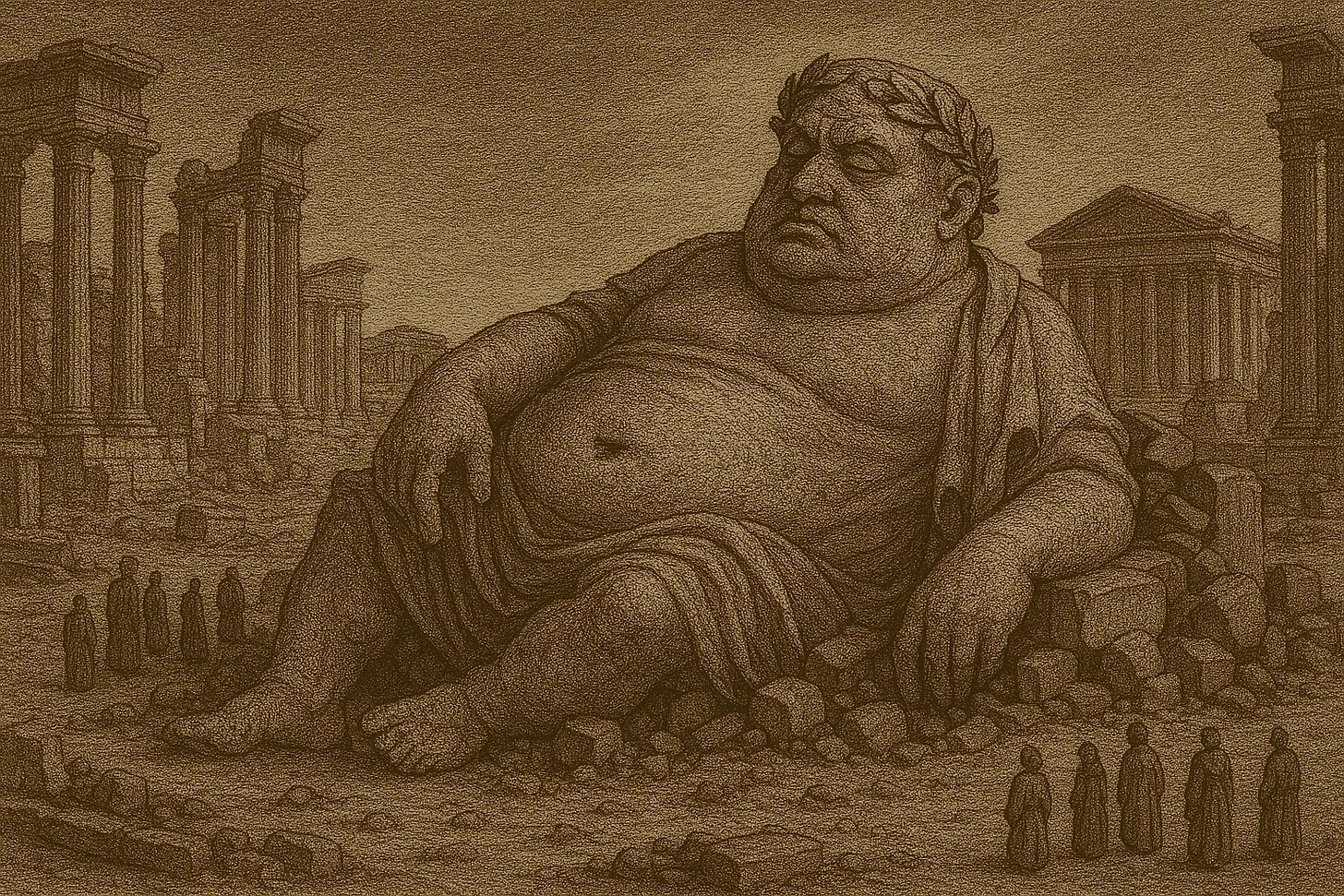
You’ve heard of the Land of Cockaigne, that fanciful place where abundance reigns [see image at top, and here]. Well, welcome to the Land of Cliché, where AI rummages through all that has been said and sung and then throws it against the wall to see what sticks. Someone should be ashamed, but we’re all too excited about this brave new world to know it.
The arts need to de-shittify and return to peasant energies, ready to be changed, changed utterly, into something a new generation can live in and live through. In the Imagination, a new comedy will rise, because its loving playfulness, its caring embrace of others, is always with us, regardless of every inhuman distortion of the world as it stands. Hegel called this comedy the “World in Love.” Ultimately, that is what Nietzsche’s “transvaluation of all values” seeks, too: love not as an ethical command but as an artful metaphysic.
Suddenly it is at an end. THE WORLD IS NEW!”—William Carlos Williams, Spring and All
Seven theses on resistance: “Song of a Lost World,” from @laphamsquarterly.bsky.social.
Triangulate with: “Planetary Politics Now,” from Susan Buck-Morss (“The planet is indifferent to political discourses. It counts time in eons, not presidential tenures. Planetary-thinking forces awareness that the cognitive maps of modernity no longer make sense. Neither conservative nor liberal political positions are up to the task of the present.”)
… to all of which your correspondent would humbly add, yes and– VOTE.
###
As we ponder positive possibilities, we might recall that on this date in 1635, in Massachusetts, the General Court of the then-Colony banished Roger Williams for speaking out for the separation of church and state and against the right of civil authorities to punish religious dissension and to confiscate Indian land. Williams moved out to edge of the Narragansett Bay, where with the assistance of the Narragansett tribe, he established a settlement at the junction of two rivers near Narragansett Bay, located in (what is now) Rhode Island. He declared the settlement open to all those seeking freedom of conscience and the removal of the church from civil matters– and many dissatisfied Puritans came. Taking the success of the venture as a sign from God, Williams named the community “Providence.”
Williams stayed close to the Narragansett Indians and continued to protect them from the land greed of European settlers. His respect for the Indians, his fair treatment of them, and his knowledge of their language enabled him to carry on peace negotiations between natives and Europeans, until the eventual outbreak of King Philip’s War in the 1670s. And although Williams preached to the Narragansett, he practiced his principle of religious freedom by refraining from attempts to convert them.

“Power tends to corrupt, and absolute power corrupts absolutely”*…
The estimable Henry Farrell has re-posted a (slightly revised) piece that was sub-linked in an early (R)D– a compelling argument that “we need, right at the moment, to think very clearly about how power is won or lost”…
… The current U.S. president is looking to seize power that he clearly is not entitled to under the law and the constitution, and that will usher through some kind of regime change if he succeeds. Many people are trying to resist. What are Trump’s strengths and weaknesses? What are the strengths and weaknesses of those who want to oppose him?
There’s a simple account of power that I think is useful here. It is developed in this paper by the late Russell Hardin, but really descends from David Hume’s understanding of politics.
The fundamental argument is this: that power in modern societies depends on social coordination. That is just as true of aspiring authoritarians like Trump as of the people who want to mobilize against him. As Hume says (quoted in Hardin):
No man would have any reason to fear the fury of a tyrant, if he had no authority over any but from fear; since, as a single man, his bodily force can reach but a small way, and all the farther power he possesses must be founded either on our own opinion, or on the presumed opinion of others.
Those who want to win power can only do so by persuading others. All tyrants must worry that their grip on power rests on such opinion. Hardin:
As a contemporary lawyer puts this argument: “No state could possibly compel people to obey all these rules at gunpoint; there would not be enough soldiers and policemen to hold the guns (a sort of Orwellian vision of society), they would have to sleep sooner or later, and then anarchy might break out.”
Equally, even if the people might overwhelm the tyrant if they ever joined together, it is very hard for them to organize against him, especially in a fully developed authoritarian state.
That is why authoritarian rulers devote a lot of time to preventing unrest from breaking out. Their best strategy for survival is to actually be popular. But that is hard to keep up. Acceptable substitutes include preventing people from discovering how unpopular the regime is, controlling media (to prevent coordination), and deploying the threat of physical violence to intimidate.
The problem with all of these strategies is that the ruler can do none of it on their own. Even the threat of violence, when looked at closely, requires some degree of willing coordination among the soldiers and policemen. That is why dictators are so careful about how they treat their armed forces. Authoritarians need to worry about the masses, but even more about their own coalitions.
More generally: struggles for power are struggles over the means of coordination. Who is capable of coordinating better, wins. And want-to-be authoritarians and mass publics face different coordination problems.
If you are an aspiring authoritarian, your strategy is to persuade others that they need to be part of your coalition. Hardin (this time on Adam Smith):
In a competitive world of pastoralists, one benefits best from association with the most powerful tribe. Hence, if someone rises to capable leadership with [sic] a tribe, others will be attracted to join with it. The result eventually will be remarkable power in the control of the leader of the tribe. Combination for the sake of survival then makes it possible not merely to survive but to thrive and even to plunder.
In more modern circumstances, your best strategy as an aspiring tyrant is likely to convince others (a) that they do live in a society of competing groups, and (b) that the smart money will always be on joining the dominant group, and not being one of the dominated ones.
Hardin continues:
This is essentially an argument from coordination. We coalesce because it is individually in our interest to do so as long as others do so as well. What we need to guide is in coalescing with others is merely the evidence of sufficient leadership and sufficient members to make our joining them clearly beneficial.
That, however, isn’t quite right. The authoritarian who wants to build a ruling coalition needs not only to make her success seem like a fait accompli. She also needs to persuade others that they will prosper rather than suffer from joining. The aspiring authoritarian needs to persuade allies that she (and they) will predate on outgroups, and that she will not predate on the allies themselves.
That process of persuasion becomes more difficult, the more unbounded the ambitions of the wannabe authoritarian are (I lay out a version of this argument here, in a paper that began from a conversation with Hardin and Margaret Levi a quarter of a century ago). The more powerful and unruly the authoritarian becomes, the more readily they can make promises or threats. Equally, the less credible those promises or threats become, both to allies and to enemies.
Absolute power implies absolute impunity: if I enjoy such power, I have no incentive to behave trustworthily to anyone. For just the same reason, no-one has any incentive to trust me. You will not believe my promises, and you may fear that if you give in to my threats, you will only open yourself to further abuse. Thus – as I, as an aspiring authoritarian move closer to unbounded control, I need to artfully balance the benefits that my power can bring to my allies with the fear those allies may reasonably have over what happens should that power be turned against them.
The problem faced by mass publics is different. For all the language about the ‘tyranny of the masses,’ they find it difficult to coordinate on rewarding friends and punishing enemies. That makes them less likely to go bad, at least in the way that tyrants can go bad. But it also makes it more difficult for them to coordinate against incipient tyranny, even when they know that everyone would be better off if they did.
On the one hand, under some circumstances, the costs of action may be quite low. If protest is cheap, then protestors are playing a nearly pure coordination game, where everyone will resist if they reasonably assume that everyone else will resist too. Hardin:
coordination may so greatly reduce costs that the latter are almost negligible, so that the slightest moral commitment may tip the scales toward action. Just as it would be odd for many Americans in communities in which voting is easy to balk at the minor cost in inconvenience, so it might seem odd for many workers or soldiers or others to balk at joining a crowd to march on the palace or the Bastille. This is not identical to a multiple coordination problem, such as that in the driving convention, in which one simply wants to go with the majority. In the revolutionary coordination, one has an active preference between the outcome of full attack and that of no attack. Still, one prefers to attack if enough others do and not to attack if enough others do not.
On the other, rulers and aspiring rulers can recognize this risk and counter-attack.
It was perhaps the startling ease with which spontaneous revolutions took control in cities that led the French under Thiers to put down the Paris Commune with such thoroughgoing brutality as to make it seem more nearly like murder than warfare. The answer to the coordination explanation of revolutionary action is draconian force. This lesson of the Commune has been learned well by many later regimes and leaders in various places, such as the Nazis in Czechoslovakia, Stalin in the Soviet Union, Pinochet in Chile, and Videla in Argentina, with their harsh, blanket suppression of dissenters and potential dissenters. They raise the likely costs of revolutionary activity enough to change its structure. … If the old state raises the costs enough to individuals for revolutionary activity, it overcomes the power of coordination to reduce the costs of revolutionary activity. It forces potential revolutionaries to see their problem overwhelmingly as a prisoner’s dilemma in which free-riding is in the individuals’ interest.
This helps explain some of the actions of Trump and those around him. Their approach to both universities and law firms has been to make simple coordination seem like a prisoner’s dilemma, by picking off opponents, one by one, and by trying to create a common understanding that collective resistance is useless, since your potential allies are likely to defect. The early decision of one extremely prominent law firm, Paul Weiss, to defect, shaped common expectations so that several others rushed immediately to defect too, for fear that they would be stranded amidst the dominated group, rather than joining the dominating coalition in a subordinated role.
To bring the different strands of the argument together, Trump’s strategy has been much less effective than it might have been. Trump has shown he is unwilling to stick by deals. Law firms that have submitted find that they are on the hook for far more than they bargained for. Columbia University, after making humiliating and profound concessions, finds that it is expected to make far greater ones, with no guarantee that even these will satisfy the Trump administration’s demands
As a whole body of research on “tying the king’s hands” argues, independent actors will prefer to flee monarchs who refuse to be bound rather than to cooperate with them, because they know that such monarchs can’t be trusted. Any deal that they make can later be un-made, and probably will be, if unmaking it is to the king’s advantage. The best option may be not to submit, especially if you believe that others are similarly unwilling to comply. This may, in effect, turn what was a prisoner’s dilemma (in which everyone’s best strategy is to defect) back into a nearly pure coordination game again, allowing easier collective resistance.
Or, it may not. If people don’t have reason to believe that others will stand up, then they still are unlikely to stand up themselves.
This then, gives us a simplified but useful understanding of where we are right now. The good news is that the Trump administration is playing its hand very badly. If Trump had been more willing to accept defectors into his camp, by sticking to deals that gave them something worth having, he would be in a much stronger situation than he is at the moment. Furthermore, and somewhat less obviously, this may also disrupt his own existing coalition. Wall Street, for example, may worry that it is next for the chopping block. Silicon Valley the same.
The bad news is that the opposition is much more disorganized than it ought to be. Coordination is bolstered by shared knowledge that others will coordinate too. We don’t have that, in part because of lack of leadership, in part because of a media landscape that makes it difficult to generate such shared knowledge. Remember Hume’s phrase about the “presumed opinion of others.” Our presumptions about what other people think can play an extraordinarily powerful role in shaping how we ourselves think, and what we are prepared to do. And in a country where such presumptions can be grossly skewed, it can be very hard to generate coordinated action. Finally, exactly because the opposition is disorganized, and because humans are human, it faces its own collective version of Trump’s temptation to humiliate and subjugate defectors from the other side, rather than welcoming them in.
The strategic implications for what to do are not surprising. Leadership is crucial. It is really, really hard to make a coalition cohere if the plausible leaders abdicate. More generally, figure out how to generate common knowledge that will enable coordination. Protests – especially if they are widespread, and especially if they happen in unusual places, or involve surprising coalitions can help generate information cascades. But getting media coverage and broader conversation is important.
Welcome in the strayed sheep, and work on widening the cracks in the other coalition. Leopard-face-eating memes may feel personally satisfying, but they usually do not ease the process of converting disillusioned opponents into active allies. As Adam Przeworski says, the Polish coalition to push back against the populists only succeeded when people who were ferociously divided over a moral issue agreed to make common cause.
Crucially, the parties forming the alliance agreed not to confront the major issue that divided them: abortion. They agreed that defending democracy was more important than whatever values divided them, and that conflicts over abortion would be managed once victory over PiS was secured. Hence, both the opponents and the supporters of the freedom of choice could promise their respective electorates that they would promote their values if democracy was restored, while claiming that the immediate task was to restore it.
If power involves coordination, coordinate! Help build your coalition as far as it can go. Do everything you can to minimize defections from it, and to maximize defections from the other side. Take advantage of the opposition’s vulnerabilities and mistakes – especially the trust problems that are likely to flourish in a coalition around an actor who aspires to untrammeled power and is deeply untrustworthy.. Assume that the other side is trying to attack your own vulnerabilities, and mitigate as much as possible. And do what you can now; things are likely to get much harder, very quickly, if the opposition’s victory becomes a self-confirming expectation…
The respective vulnerabilities of tyrants and crowds: “Absolute power can be a terrible weakness,” from @himself.bsky.social.
Pair with: “Power always reveals.”
And apposite: “Two scholars ask whether democracy can survive if AI does all the jobs,” gift article from The Economist.
###
As we get it together, we might recall that it was on this date in 1962 that Bob Dylan appeared for the first time at Carnegie Hall in New York City as part of a hootenanny which included his first public performance of “A Hard Rain’s a-Gonna Fall.”
“Archive as if the future depends on it”*…

UbuWeb, an open online collection of avant garde materials created by poet Kenneth Goldsmith, went live almost 30 years ago…
Founded in 1996, UbuWeb is a pirate shadow library consisting of hundreds of thousands of freely downloadable avant-garde artifacts. By the letter of the law, the site is questionable; we openly violate copyright norms and almost never ask for permission. Most everything on the site is pilfered, ripped, and swiped from other places, then reposted. We’ve never been sued—never even come close. UbuWeb functions on no money—we don’t take it, we don’t pay it, we don’t touch it; you’ll never find an advertisement, a logo, or a donation box. We’ve never applied for a grant or accepted a sponsorship; we remain happily unaffiliated, keeping us free and clean, allowing us to do what we want to do, the way we want to do it. Most important, UbuWeb has always been and will always be free and open to all: there are no memberships or passwords required. All labor is volunteered; our server space and bandwidth are donated by a likeminded group of intellectual custodians who believe in free access to knowledge. A gift economy of plentitude with a strong emphasis on global education, UbuWeb is visited daily by tens of thousands of people from every continent. We’re on numerous syllabuses, ranging from those for kindergarteners studying pattern poetry to those for postgraduates listening to hours of Jacques Lacan’s Séminaires. When the site goes down from time to time, as most sites do, we’re inundated by emails from panicked faculty wondering how they are going to teach their courses that week.
The site is filled with the detritus and ephemera of great artists better known for other things—the music of Jean Dubuffet, the poetry of Dan Graham, the hip-hop of Jean-Michel Basquiat, the punk rock of Martin Kippenberger, the films of John Lennon, the radio plays of Ulrike Meinhof, the symphonies of Hanne Darboven, the country music of Julian Schnabel—most of which were originally put out in tiny editions, were critically ignored, and quickly vanished. However, the web provides the perfect place to restage these works. With video, sound, and text remaining more faithful to the original experience than, say, painting or sculpture, Ubu proposes a different sort of revisionist art history based on the peripheries of artistic production rather than on the perceived, hyped, or market-based center…
… These days there’s a lot of support for the way we go about things. Many think of UbuWeb as an institution. Artists both well established and lesser known try to contact us asking to be on the site. But it wasn’t always this way; for a long time many people despised UbuWeb, fearing that it was contributing to the erosion of long-standing hierarchies in the avant-garde world, fearing that it was leading to the decimation of certain art forms, fearing that it would tank entire art-based economies. Of course, none of that happened. We just happened to be there at the beginning of the web and had to ride the choppy currents of change as each successive wave washed over. Whereas we once used to receive daily cease-and-desist letters, today we rarely get any. It’s not that we’re doing anything different; it’s just that people’s attitudes toward copyright and distribution have evolved as the web has evolved.
By the time you read this, UbuWeb may be gone. Never meant to be a permanent archive, Ubu could vanish for any number of reasons: our internet service provider (ISP) pulls the plug, we get sued, or we simply grow tired of it. Beggars can’t be choosers, and we gladly take whatever is offered to us. We don’t run on the most stable of servers or on the swiftest of machines; crashes eat into the archive on a periodic basis; sometimes the site as a whole goes down for days; more often than not, the already small group of volunteers dwindles to a team of one. But that’s the beauty of it: UbuWeb is vociferously anti-institutional, eminently fluid, refusing to bow to demands other than what we happen to be moved by at a specific moment, allowing us flexibility and the ability to continually surprise even ourselves…
And indeed, in January of last year, UbuWeb announced it was no longer active, posting: “As of 2024, UbuWeb is no longer active. The archive is preserved for perpetuity, in its entirety.”
But last month, the site reappeared…
A year ago, we decided to shutter UbuWeb. Not really shutter it, per se, but instead to consider it complete. After nearly 30 years, it felt right. But now, with the political changes in America and elsewhere around the world, we have decided to restart our archiving and regrow Ubu. In a moment when our collective memory is being systematically eradicated, archiving reemerges as a strong form of resistance, a way of preserving crucial, subversive, and marginalized forms of expression. We encourage you to do the same. All rivers lead to the same ocean: find your form of resistance, no matter how small, and go hard. It’s now or never. Together we can prevent the annihilation of the memory of the world.
(Image above: source)
###
As we celebrate collective memory, we might (make ourselves) remember that it was on this date in 1933 that Nazi Germany opened its first and longest-operaating concentration camp, Dachau. Initially intended to intern (then still Chancellor) Hitler’s political opponents (communists, social democrats, and other dissidents), it seeded what became a network of more than a thousand concentration camps, including subcamps, on Germany’s own territory and in parts of German-occupied Europe. About 1.65 million people were registered prisoners in the camps, of whom about a million died during their imprisonment.

“I love to talk about nothing. It’s the only thing I know anything about.”*…

It took centuries for people to embrace the zero. Now, as Benjy Barnett explains, it’s helping neuroscientists understand how the brain perceives absences…
When I’m birdwatching, I have a particular experience all too frequently. Fellow birders will point to the tree canopy and ask if I can see a bird hidden among the leaves. I scan the treetops with binoculars but, to everyone’s annoyance, I see only the absence of a bird.
Our mental worlds are lively with such experiences of absence, yet it’s a mystery how the mind performs the trick of seeing nothing. How can the brain perceive something when there is no something to perceive?
For a neuroscientist interested in consciousness, this is an alluring question. Studying the neural basis of ‘nothing’ does, however, pose obvious challenges. Fortunately, there are other – more tangible – kinds of absences that help us get a handle on the hazy issue of nothingness in the brain. That’s why I spent much of my PhD studying how we perceive the number zero.
Zero has played an intriguing role in the development of our societies. Throughout human history, it has floundered in civilisations fearful of nothingness, and flourished in those that embraced it. But that’s not the only reason it’s so beguiling. In striking similarity to the perception of absence, zero’s representation as a number in the brain also remains unclear. If my brain has specialised mechanisms that have evolved to count the owls perched on a branch, how does this system abstract away from what’s visible, and signal that there are no owls to count?
The mystery shared between the perception of absences and the conception of zero may not be coincidental. When your brain recognises zero, it may be recruiting fundamental sensory mechanisms that govern when you can – and cannot – see something. If this is the case, theories of consciousness that emphasise the experience of absence may find a new use for zero, as a tool with which to explore the nature of consciousness itself…
[Barnett provides a fascinating history of the zero, of its uses, and of brain scientost’s attepts to understand the (not so masterful) human ability to perceive absence…]
… All of this returns us to zero. The question is, does the same underlying neural mechanism drive experiences of both zero and perceptual absence? If it does, this would show us that, when we’re engaged in mathematics using zero, we’re also invoking a more fundamental and automatic cognitive system – one that is, for instance, responsible for detecting an absence of birds when I’m birdwatching.
The brain systems used to extract positive numbers from the environment are relatively well understood. Parts of the parietal cortex have evolved to represent the number of ‘things’ in our environment while stripping away information of what those ‘things’ are. This system would simply indicate ‘four’ if I saw four owls, for example. It is thought to be central to learning the structure of our environment. If the neural systems that govern our ability to decide if we consciously see something or not were found to rely on this same mechanism, it would help theories like HOSS and PRM get a handle on how exactly this ability arises. Perhaps, just as this system learns the structure and regularities of our environment, it also learns the structure of our brain’s sensory activity to help determine when we have seen something. This is what PRM and HOSS already predict, but grounding the theories in established ideas about how the brain works may provide them with a stronger foothold in explaining the precise mechanisms that allow us to become aware of the world.
An intriguing hypothesis inspired by the ideas above is that, if the brain basis of zero relies on the kinds of absence-related neural mechanisms that the above frameworks take to be necessary for conscious experience, then for any organism to successfully employ the concept of zero, it might first need to be perceptually conscious. This would mean that understanding zero could act as a marker for consciousness. Given that even honeybees have been shown to enjoy a rudimentary concept of zero, this may seem – at least to some – far fetched. Nonetheless, it seems attractive to suggest that the similarities between numerical and perceptual absences could help reveal the neural basis of not only experiences of absence but conscious awareness more broadly. Jean-Paul Sartre testified that nothingness was at the heart of being, after all.
The evolution of the number zero helped unlock the secrets of the cosmos. It remains to be seen whether it can help to unpick the mysteries of the mind. For now, studying it has at least led to less disappointment about my birdwatching failures. Now I know that there’s great complexity in seeing nothing and that, more importantly, nothing really matters…
Noodling on nowt: “Why nothing matters,” from @benjyb.bsky.social in @aeon.co.
Apposite: Percival Everett‘s glorious novel, Dr. No.
* Oscar Wilde
###
As we analyze our apprehension of absence, we might send empty bithday greetings to a man who ruled out the use of “0” in one specific case: Georg Ohm; he was born on this date in 1789. A mathematician and physicist, he demonstrated by experiment (in 1825) that there are no “perfect” electrical conductors– that’s to say, no conductors with 0 resistance.
Working with the new electrochemical cell, invented by Italian scientist Alessandro Volta, Ohm found that there is a direct proportionality between the potential difference (voltage) applied across a conductor and the resultant electric current— a relationship since known as Ohm’s law (V=iR). The SI unit of resistance is the ohm (symbol Ω).

“The strength and power of despotism consists wholly in the fear of resistance”*…

Interference Archive was founded in 2011 by Kevin Caplicki, Molly Fair, Dara Greenwald, and Josh MacPhee. Our initial collection grew out of the personal accumulation of Dara and Josh… through their involvement in social movements, DIY and punk, and political art projects over the past 25 years…
The mission of Interference Archive is to explore the relationship between cultural production and social movements. This work manifests in an open stacks archival collection, publications, a study center, and public programs including as exhibitions, workshops, talks, and screenings, all of which encourage critical and creative engagement with the rich history of social movements…
The archive contains many kinds of objects that are created as part of social movements by the participants themselves: posters, flyers, publications, photographs, books, T-shirts and buttons, moving images, audio recordings, and other materials.
Through our programming, we use this cultural ephemera to animate histories of people mobilizing for social transformation. We consider the use of our collection to be a way of preserving and honoring histories and material culture that is often marginalized in mainstream institutions…
Visit the Archive online, and if you’re in the New York area, visit their current exhibit.

[TotH to the always-inspirational Ganzeer]
* Thomas Paine
###
As we question authority, we might recall that it was on this date in 1864 that the U.S. Senate passed the Thirteenth Amendment to the Constitution, declaring “Neither slavery nor involuntary servitude, except as a punishment for crime whereof the party shall have been duly convicted, shall exist within the United States, or any place subject to their jurisdiction.”
The House passed the Amendment January 31, 1865, and it was ratified by the required number of states on December 6, 1865. On December 18, 1865, Secretary of State William H. Seward proclaimed its adoption.

Thomas Nast’s engraving, “Emancipation,” 1865
You must be logged in to post a comment.