Posts Tagged ‘Life’
“Oh how wrong we were to think immortality meant never dying”*…

The John Templeton Foundation has undertaken a undertaken a deep investigation into the biology, philosophy, and theology of immortality research. Lorraine Boissoneault offers the first in a series of reports on their work…
Around 100,000 years ago, humans living in the region that would come to be called “Israel” did something remarkable. When members of the community died, those left behind buried the dead in a cave, placing some of the bodies with great care and arranging them near colorful pigments and shells. Although burial is so common today as to be almost unremarkable, for ancient humans to exhibit such behavior suggested a major development in cultural practices. The Qafzeh Cave is one of the oldest examples that humans understand death differently than many other creatures. We seem to have an innate desire to mark it with ritual.
It is an unavoidable fact of biology that all organisms die, whether by disease, disaster, or simply old age. Yet our species, Homo sapiens, seems to be the only creature blessed—or cursed—with the cognitive ability to understand our mortality. And thanks to our powerful intelligence, we’re also the only beings to imagine and seek out death’s opposite: immortality.
In religious traditions, spiritual afterlives and reincarnation offer continuation of the self beyond death. In myth and legend, sources of everlasting life abound, from the Fountain of Youth to elixirs of life. Some people seek symbolic immortality through procreation. Others aim for contributions to society, whether artistic, academic or scientific. And still others have pushed the bounds of technology in search of dramatic life extension or a digital self.
Where does this impulse come from?…
Find out: “Pre-life, Afterlife, and the Drive for Immortality,” from @boissolm @templeton_fdn.
###
As we internalize eternity, we might recall that it was on this date in 1826 that the HMS Beagle set sail from Plymouth on its first voyage, an expedition to conduct a hydrographic survey of Patagonia and Tierra del Fuego in support of the larger ship HMS Adventure.
The Beagle‘s second voyage (1831-1836) is rather better remembered, as it was on that expedition that the ship’s naturalist, a young Charles Darwin (whose published journal of the journey, quoted above, earned him early fame as a writer) made the observations that led him to even greater fame for his theory of evolution.

“Nothing from nothing ever yet was born”*…

Lacy M. Johnson argues that there is no hierarchy in the web of life…
… Humans have been lumbering around the planet for only a half million years, the only species young and arrogant enough to name ourselves sapiens in genus Homo. We share a common ancestor with gorillas and whales and sea squirts, marine invertebrates that swim freely in their larval phase before attaching to rocks or shells and later eating their own brain. The kingdom Animalia, in which we reside, is an offshoot of the domain Eukarya, which includes every life-form on Earth with a nucleus—humans and sea squirts, fungi, plants, and slime molds that are ancient by comparison with us—and all these relations occupy the slenderest tendril of a vast and astonishing web that pulsates all around us and beyond our comprehension.
The most recent taxonomies—those based on genetic evidence that evolution is not a single lineage, but multiple lineages, not a branch that culminates in a species at its distant tip, but a network of convergences—have moved away from their histories as trees and chains and ladders. Instead, they now look more like sprawling, networked webs that trace the many points of relation back to ever more ancient origins, beyond our knowledge or capacity for knowing, in pursuit of the “universal ancestors,” life-forms that came before metabolism, before self-replication—the several-billion-year-old plasmodial blobs from which all life on Earth evolved. We haven’t found evidence for them yet, but we know what we’re looking for: they would be simple, small, and strange.
…
Slime molds can enter stasis at any stage in their life cycle—as an amoeba, as a plasmodium, as a spore— whenever their environment or the climate does not suit their preferences or needs. The only other species who have this ability are the so-called “living fossils” such as tardigrades and Notostraca (commonly known as water bears and tadpole shrimp, respectively). The ability to become dormant until conditions are more favorable for life might be one of the reasons slime mold has survived as long as it has, through dozens of geologic periods, countless ice ages, and the extinction events that have repeatedly wiped out nearly all life on Earth.
Slime mold might not have evolved much in the past two billion years, but it has learned a few things during that time. In laboratory environments, researchers have cut Physarum polycephalum into pieces and found that it can fuse back together within two minutes. Or, each piece can go off and live separate lives, learn new things, and return later to fuse together, and in the fusing, each individual can teach the other what it knows, and can learn from it in return.
Though, in truth, “individual” is not the right word to use here, because “individuality”—a concept so central to so many humans’ identities—doesn’t apply to the slime mold worldview. A single cell might look to us like a coherent whole, but that cell can divide itself into countless spores, creating countless possible cycles of amoeba to plasmodium to aethalia, which in turn will divide and repeat the cycle again. It can choose to “fruit” or not, to reproduce sexually or asexually or not at all, challenging every traditional concept of “species,” the most basic and fundamental unit of our flawed and imprecise understanding of the biological world. As a consequence, we have no way of knowing whether slime molds, as a broad class of beings, are stable or whether climate change threatens their survival, as it does our own. Without a way to count their population as a species, we can’t measure whether they are endangered or thriving. Should individuals that produce similar fruiting bodies be considered a species? What if two separate slime molds do not mate but share genetic material? The very idea of separateness seems antithetical to slime mold existence. It has so much to teach us…
More at: “What Slime Knows,” from @lacymjohnson in @Orion_Magazine.
See also, “Slime Molds Remember — but Do They Learn?” (from whence the image above) and “Now, in addition to penicillin, we can credit mold with elegant design.”
* Lucretius, On the Nature of Things
###
As we contemplate kinship, we might send insightful birthday greetings to Johann Hedwig; he was born on this date in 1730. A botanist noted for his study of mosses, he is considered “the father of bryology” (the study of mosses… cousins of mold).

“Why has our age surrendered so easily to the controllers, the manipulators, the conditioners of an authoritarian technics?”*…

Half a century ago, Lewis Mumford developed a concept that explains why we trade autonomy for convenience…
… Surveying the state of the high-tech life, it is tempting to ponder how it got so bad, while simultaneously forgetting what it was that initially convinced one to hastily click “I agree” on the terms of service. Before certain social media platforms became foul-smelling swamps of conspiratorial misinformation, many of us joined them for what seemed like good reasons; before sighing at the speed with which their batteries die, smartphone owners were once awed by these devices: before grumbling that there was nothing worth watching, viewers were astounded by how much streaming content was available at one’s fingertips. Overwhelmed by the way today’s tech seems to be burying us in the bad, it’s easy to forget the extent to which tech won us over by offering us a share in the good — or to be more precise, in “the goods.”
Nearly 50 years ago, long before smartphones and social media, the social critic Lewis Mumford put a name to the way that complex technological systems offer a share in their benefits in exchange for compliance. He called it a “bribe.” With this label, Mumford sought to acknowledge the genuine plentitude that technological systems make available to many people, while emphasizing that this is not an offer of a gift but of a deal. Surrender to the power of complex technological systems — allow them to oversee, track, quantify, guide, manipulate, grade, nudge, and surveil you — and the system will offer you back an appealing share in its spoils. What is good for the growth of the technological system is presented as also being good for the individual, and as proof of this, here is something new and shiny. Sure, that shiny new thing is keeping tabs on you (and feeding all of that information back to the larger technological system), but it also lets you do things you genuinely could not do before. For a bribe to be accepted it needs to promise something truly enticing, and Mumford, in his essay “Authoritarian and Democratic Technics,” acknowledged that “the bargain we are being asked to ratify takes the form of a magnificent bribe.” The danger, however, was that “once one opts for the system no further choice remains.”
For Mumford, the bribe was not primarily about getting people into the habit of buying new gadgets and machines. Rather it was about incorporating people into a world that complex technological systems were remaking in their own image. Anticipating resistance, the bribe meets people not with the boot heel, but with the gift subscription.
The bribe is a discomforting concept. It asks us to consider the ways the things we purchase wind up buying us off, it asks us to see how taking that first bribe makes it easier to take the next one, and, even as it pushes us to reflect on our own complicity, it reminds us of the ways technological systems eliminate their alternatives. Writing about the bribe decades ago, Mumford was trying to sound the alarm, as he put it: “This is not a prediction of what will happen, but a warning against what may happen.” As with all of his glum predictions, it was one that Mumford hoped to be proven wrong about. Yet as one scrolls between reviews of the latest smartphone, revelations about the latest misdeeds of some massive tech company, and commentary about the way we have become so reliant on these systems that we cannot seriously speak about simply turning them off — it seems clear that what Mumford warned “may happen” has indeed happened…
Eminently worth reading in full: “The Magnificent Bribe,” by Zachary Loeb in @_reallifemag.
As to (some of) the modern implications of that bargain, see also Shoshana Zuboff‘s: “You Are the Object of a Secret Extraction Operation.”
As we move into the third decade of the 21st century, surveillance capitalism is the dominant economic institution of our time. In the absence of countervailing law, this system successfully mediates nearly every aspect of human engagement with digital information. The promise of the surveillance dividend now draws surveillance economics into the “normal” economy, from insurance, retail, banking and finance to agriculture, automobiles, education, health care and more. Today all apps and software, no matter how benign they appear, are designed to maximize data collection.
Historically, great concentrations of corporate power were associated with economic harms. But when human data are the raw material and predictions of human behavior are the product, then the harms are social rather than economic. The difficulty is that these novel harms are typically understood as separate, even unrelated, problems, which makes them impossible to solve. Instead, each new stage of harm creates the conditions for the next stage…
And resonantly: “AI-tocracy” a working paper from NBER that links the development of artificial intelligence with the interests of autocracies: from the abstract:
Can frontier innovation be sustained under autocracy? We argue that innovation and autocracy can be mutually reinforcing when: (i) the new technology bolsters the autocrat’s power; and (ii) the autocrat’s demand for the technology stimulates further innovation in applications beyond those benefiting it directly. We test for such a mutually reinforcing relationship in the context of facial recognition AI in China. To do so, we gather comprehensive data on AI firms and government procurement contracts, as well as on social unrest across China during the last decade. We first show that autocrats benefit from AI: local unrest leads to greater government procurement of facial recognition AI, and increased AI procurement suppresses subsequent unrest. We then show that AI innovation benefits from autocrats’ suppression of unrest: the contracted AI firms innovate more both for the government and commercial markets. Taken together, these results suggest the possibility of sustained AI innovation under the Chinese regime: AI innovation entrenches the regime, and the regime’s investment in AI for political control stimulates further frontier innovation.
(And, Anne Applebaum warns, “The Bad Guys Are Winning.”)
* “Why has our age surrendered so easily to the controllers, the manipulators, the conditioners of an authoritarian technics? The answer to this question is both paradoxical and ironic. Present day technics differs from that of the overtly brutal, half-baked authoritarian systems of the past in one highly favorable particular: it has accepted the basic principle of democracy, that every member of society should have a share in its goods. By progressively fulfilling this part of the democratic promise, our system has achieved a hold over the whole community that threatens to wipe out every other vestige of democracy.
The bargain we are being asked to ratify takes the form of a magnificent bribe. Under the democratic-authoritarian social contract, each member of the community may claim every material advantage, every intellectual and emotional stimulus he may desire, in quantities hardly available hitherto even for a restricted minority: food, housing, swift transportation, instantaneous communication, medical care, entertainment, education. But on one condition: that one must not merely ask for nothing that the system does not provide, but likewise agree to take everything offered, duly processed and fabricated, homogenized and equalized, in the precise quantities that the system, rather than the person, requires. Once one opts for the system no further choice remains. In a word, if one surrenders one’s life at source, authoritarian technics will give back as much of it as can be mechanically graded, quantitatively multiplied, collectively manipulated and magnified.”
– Lewis Mumford in “Authoritarian and Democratic Technics,” via @LMSacasas
###
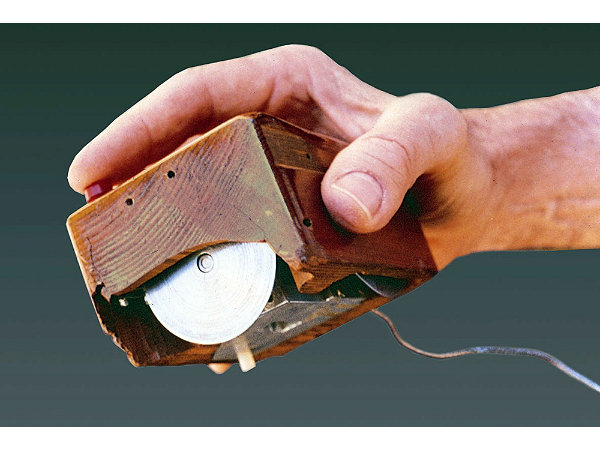
As we untangle user agreements, we might recall that it was on this date in 1970 that Douglas Engelbart (see here, here, and here) was granted a patent (US No. 3,541,541) on the “X-Y Position Indicator for a Display System,” the world’s first prototype computer mouse– a wooden block containing the tracking apparatus, with a single button attached.

“Attend to mushrooms and all other things will answer up”*…

The living– and conscious?– infrastructure of the biosphere…
Imagine that you are afloat on your back in the sea. You have some sense of its vast, unknowable depths—worlds of life are surely darting about beneath you. Now imagine lying in a field, or on the forest floor. The same applies, though we rarely think of it: the dirt beneath you, whether a mile or a foot deep, is teeming with more organisms than researchers can quantify. Their best guess is that there are as many as one billion microbes in a single teaspoon of soil. Plant roots plunge and swerve like superhighways with an infinite number of on-ramps. And everywhere there are probing fungi.
Fungi are classified as their own kingdom, separate from plants and animals. They are often microscopic and reside mostly out of sight—mainly underground—but as Merlin Sheldrake writes in Entangled Life: How Fungi Make Our Worlds, Change Our Minds and Shape Our Futures, they support and sustain nearly all living systems. Fungi are nature’s premiere destroyers and creators, digesting the world’s dead and leaving behind new soil. When millions of hair-like fungal threads—called hyphae—coalesce, felting themselves into complex shapes, they emerge from the ground as mushrooms. A mushroom is to a fungus as a pear is to a pear tree: the organism’s fruiting body, with spores instead of seeds. Mushrooms disperse spores by elaborate means: some species generate puffs of air to send them aloft, while others eject them by means of tiny, specialized catapults so they accelerate ten thousand times faster than a space shuttle during launch.
But Sheldrake is most interested in fungi’s other wonders—specifically, how they challenge our understanding of nonhuman intelligence and stretch the notion of biological individuality. Fungi infiltrate the roots of almost every plant, determining so much about its life that researchers are now asking whether plants can be considered plants without them. They are similarly interwoven throughout the human body, busily performing functions necessary to our health and well-being or, depending on the fungi’s species and lifestyle, wreaking havoc. All of this prompts doubts about what we thought we knew to be the boundaries between one organism and another…
ungi themselves form large networks of hyphae strands in order to feed. These strands, when massed together, are called mycelium. The total length of mycelium threaded through the globe’s uppermost four inches of soil is believed to be enough to span half the width of our galaxy. Mycelium is constantly moving, probing its surroundings in every direction and coordinating its movements over long distances. When food is found—a nice chunk of rotting wood, for example—disparate parts of the mycelium redirect to coalesce around it, excrete enzymes that digest it externally, and then absorb it. As Sheldrake puts it, “The difference between animals and fungi is simple: Animals put food in their bodies, whereas fungi put their bodies in the food.”
Fungi are literally woven into the roots and bodies of nearly every plant grown in natural conditions. “A plant’s fungal partners,” Sheldrake writes, “can have a noticeable impact on its growth.” In one striking example, he describes an experiment in which strawberries grown with different fungal partners changed their sweetness and shape. Bumblebees seemed able to discern the difference and were more attracted to the flowers of strawberry plants grown with certain fungal species. Elsewhere he discusses an experiment in which researchers took fungi that inhabited the roots of a species of coastal grass that grew readily in saltwater and added it to a dry-land grass that could not tolerate the sea. Suddenly the dry-land grass did just fine in brine.
Much has been written lately about trees communicating and sharing resources among themselves; healthy trees have been documented moving resources toward trees that have fallen ill. This is often characterized as friendship or altruism between trees, but it is not at all clear whether trees pass information or nutrients intentionally. What is clear, though, is that the fungal networks entwined in every tree root make this communication possible. “Why might it benefit a fungus to pass a warning between the multiple plants that it lives with?” Sheldrake asks. The answer is survival. “If a fungus is connected to several plants and one is attacked by aphids, the fungus will suffer as well as the plant,” he writes. “It is the fungus that stands to benefit from keeping the healthy plant alive.”…
Fungi are genetically closer to animals than to plants, and similar enough to humans at the molecular level that we benefit from many of their biochemical innovations. In fact, many of our pharmaceuticals are borrowed innovations from fungi. Penicillin, discovered in 1928 by the Scottish researcher Alexander Fleming, is a compound produced by fungus for protection against bacterial infection. The anti-cancer drug Taxol was originally isolated from the fungi that live inside yew trees. More than half of all enzymes used in industry are generated by fungi, Sheldrake notes, and 15 percent of all vaccines are produced using yeast. We are, as he puts it, “borrowing a fungal solution and rehousing it within our own bodies.”..
We know that fungi maintain “countless channels of chemical communication with other organisms,” and that they are constantly processing diverse information about their environment. Some can recognize color, thanks to receptors sensitive to blue and red light, though it is not entirely clear what they do with that information. Some even have opsins, light-detecting proteins also found within the rods and cones of the animal eye. One fungus, Phycomyces blakesleeanus, has a sensitivity to light similar to that of a human eye and can “detect light at levels as low as that provided by a single star” to help it decide where to grow. It is also able to sense the presence of nearby objects and will bend away from them before ever making contact. Still other fungi recognize texture; according to Sheldrake, the bean rust fungus has been demonstrated to detect grooves in artificial surfaces “three times shallower than the gap between the laser tracks on a CD.”
Can fungi, then, be said to have a mind of their own? That is, as Sheldrake puts it, a “question of taste”—there is no settled scientific definition for “intelligence,” not even for animals. The Latin root of the word means “to choose between,” an action fungi clearly do all the time. But the application of this kind of term to fungi is loaded with something more mystical than that simple definition and demands a willingness to rattle our sense of where we ourselves fall in the imagined hierarchy of life. If fungi can be said to think, it is a form of cognition so utterly different that we strain to see it.
After all, philosophers of mind like Daniel Dennett argue that drawing any neat line between nonhumans and humans with “real minds” is an “archaic myth.” Our brains evolved from nonmental material. “Brains are just one such network,” Sheldrake writes, “one way of processing information.” We still don’t know how the excitement of brain cells gives rise to experience. Can we really dismiss the possibility of cognition in an organism that clearly adapts, learns, and makes decisions simply based on the lack of a brain structure analogous to ours?
Perhaps there is intelligent life all around us, and our view is too human-centric to notice. Are fungi intelligent? Sheldrake reserves judgment, deferring instead to scientific mystery: “A sophisticated understanding of mycelium is yet to emerge.” Still, after spending long enough in the atmosphere of Sheldrake’s sporulating mind, I began to adopt the fungal perspective. I can’t help now but see something like a mind wherever there might be fungal threads—which is to say everywhere, a mesh-like entangled whole, all over the earth.
Fungi challenge our understanding of nonhuman intelligence and complicate the boundaries between one organism and another: “Our Silent Partners“– Zoë Schlanger (@zoeschlanger) reviewing Merlin Sheldrake’s Entangled Life: How Fungi Make Our Worlds, Change Our Minds and Shape Our Futures in @nybooks.
“Why did the mushroom go to the party? Because he was a fungi.” – Lewis Tomlinson
* A. R. Ammons
###
As we ponder partnership, we might spare a thought for Jens Wilhelm August Lind; he died on this date in 1939. An apothecary, botanist and mycologist, he published a full account of all fungi collected in Denmark by his teacher, Emil Rostrup. Combining his pharmaceutical and mycological knowledge, he was early in experimenting with chemical control of plant pathogens.
Lind also collaborated with Knud Jessen on an account on the immigration history of weeds to Denmark.

“Life’s a little weird”…

Needs must…
You may have ridden out the pandemic in compact living quarters without, say, much natural light or air conditioning. Perhaps you lived with roommates or family in an atmosphere that, as time wore on, grew increasingly toxic.
Things could be worse! You could be a member of the Alviniconcha species—specifically, a small, spike-studded snail who thrives in an environment inhospitable to most aquatic life; mere meters from deep-sea hydrothermal vents that constantly spew toxic chemicals into the water. Think you have limited natural light? Try living nearly 10,000 feet below the surface of the ocean, where complete darkness envelops you 24 hours a day, under pressure so intense all the air pockets in your body would instantly collapse.
And forget Seamless. Forget food—at least the kind you ingest with your mouth. Your survival hinges on bacteria living in your gills (you have gills!) in a symbiotic relationship that provides you with energy, via a process called chemosynthesis. It’s like photosynthesis, but chemosynthesis is driven by chemical reactions instead of light. As there’s no sunlight and minimal oxygen present, the bacteria that dwell within Alviniconcha use hydrogen and sulfur molecules to produce sugars and other macronutrients that the animals then use as food. “There’s very little food so deep in the ocean,” says Dr. Corinna Breusing, postdoctoral researcher at the University of Rhode Island and co-author of a recent paper on the snails and their symbionts. “Having your own food-producing machine is much better than waiting for it to fall to you.” While chemosynthesis is common around hydrothermal vents, it can occur in places outside of vents, such as in cold seeps and whale falls and even salt marshes: anyplace the proper mélange of inorganic compounds is brewing.
The researchers studied Alviniconcha living at the bottom of the Lau Basin, in the southwestern Pacific Ocean, and found that the type of bacterial symbiont determined where their particular host species could live. “The symbionts have different metabolic capacities and adaptations, so we think that the symbionts influence the distribution of the animal,” Breusing says, adding that snails with Campylobacteria dominated at vents with higher concentrations of sulfide and hydrogen, while those with Gammaproteobacteria were able to thrive at sites with lower concentrations of sulfide and hydrogen. Meaning: your chef-roommate, who happens to live in your respiratory system, also decides where you hang your hat (so to speak).
…
Most hydrothermal vent-dwelling animals, such the aforementioned snails and deep-sea anemones, as well as some species of mussels and tube worms, depend on bacteria that they pick up from the environment, but there is a species of deep-sea clam that passes their symbiont down from mother to offspring, like a fancy set of dinner plates. (This is rare in the marine world, Breusing says.) In the case of the deep-sea clams, where the symbiont is inherited, the symbiont cannot thrive outside the host and dies with it. But if a symbiont is taken up from the environment, it can be released back into the environment after its host dies, ready to help feed a brand-new host.
Alviniconcha might not pack the same visual punch as much marine life does much closer to the surface, but their very existence points to the origins of life on Earth. Before oxygen was free and plentiful, microbial life had to work with inorganic compounds like methane and ammonia, which over millennia dissolved into the seas. Much is still murky about how these little snails co-evolved with the bacteria that enable them to survive, but these fascinating ecosystems indicate that our education about life at the margins is just getting started…
“Life at the Edge of Impossible“: ten thousand feet under the sea, these snails thrive with a little help from their friends; from Adrienne Day (@adrienneday).
* Dr. Seuss
###
As we examine extremes, we might send redefining birthday greetings to Carl Woese; he was born on this date in 1928. A microbiologist and biophysicist, he made many contributions to biology; but he is best remembered for defining the Archaea (a new domain of life).
For much of the 20th century, prokaryotes were regarded as a single group of organisms and classified based on their biochemistry, morphology and metabolism. In a highly influential 1962 paper, Roger Stanier and C. B. van Niel first established the division of cellular organization into prokaryotes and eukaryotes, defining prokaryotes as those organisms lacking a cell nucleus. It became generally assumed that all life shared a common prokaryotic (implied by the Greek root πρό [pro-], before, in front of) ancestor.
But in 1977 Woese (and his colleague George E. Fox) experimentally disproved this universally held hypothesis. They discovered a kind of microbial life which they called the “archaebacteria” (Archaea), “a third kingdom” of life as distinct from bacteria as plants are from animals, Having defined Archaea as a new “urkingdom” (later domain) which were neither bacteria nor eukaryotes, Woese redrew the taxonomic tree. His three-domain system, based on phylogenetic relationships rather than obvious morphological similarities, divided life into 23 main divisions, incorporated within three domains: Bacteria, Archaea, and Eucarya.


You must be logged in to post a comment.