Posts Tagged ‘evolution’
“Memory resides not just in brains but in every cell”*…
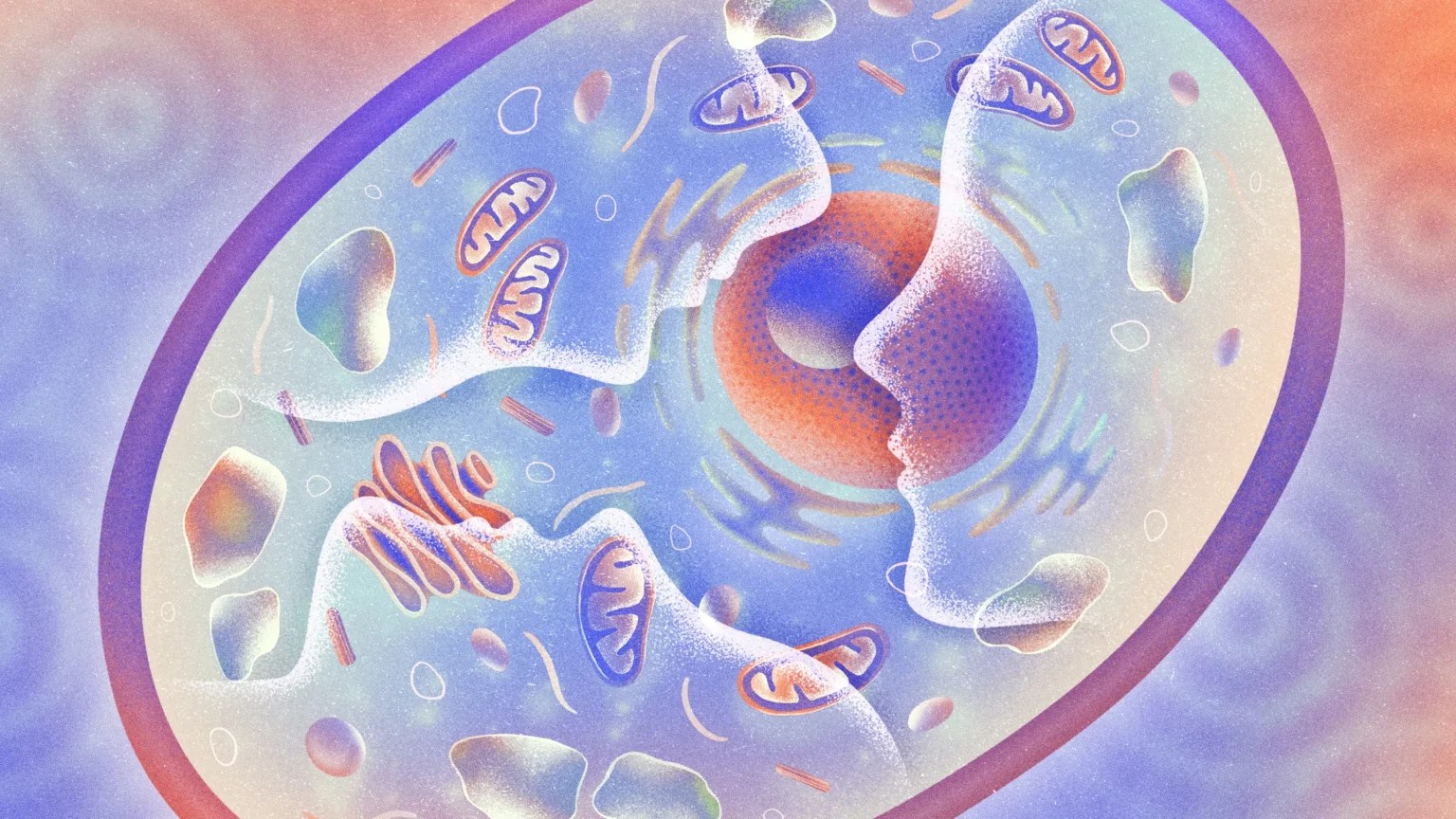
As the redoubtable Claire L. Evans [and here] reports, a small but enthusiastic group of neuroscientists is exhuming overlooked experiments and performing new ones to explore whether cells record past experiences — fundamentally challenging our understanding of what memory is…
In 1983, the octogenarian geneticist Barbara McClintock stood at the lectern of the Karolinska Institute in Stockholm. She was famously publicity averse — nearly a hermit — but it’s customary for people to speak when they’re awarded a Nobel Prize, so she delivered a halting account of the experiments that had led to her discovery, in the early 1950s, of how DNA sequences can relocate across the genome. Near the end of the speech, blinking through wire-framed glasses, she changed the subject, asking: “What does a cell know of itself?”
McClintock had a reputation for eccentricity. Still, her question seemed more likely to come from a philosopher than a plant geneticist. She went on to describe lab experiments in which she had seen plant cells respond in a “thoughtful manner.” Faced with unexpected stress, they seemed to adjust in ways that were “beyond our present ability to fathom.” What does a cell know of itself? It would be the work of future biologists, she said, to find out.
Forty years later, McClintock’s question hasn’t lost its potency. Some of those future biologists are now hard at work unpacking what “knowing” might mean for a single cell, as they hunt for signs of basic cognitive phenomena — like the ability to remember and learn — in unicellular creatures and nonneural human cells alike. Science has long taken the view that a multicellular nervous system is a prerequisite for such abilities, but new research is revealing that single cells, too, keep a record of their experiences for what appear to be adaptive purposes.
In a provocative study published in Nature Communications late last year, the neuroscientist Nikolay Kukushkin and his mentor Thomas J. Carew at New York University showed that human kidney cells growing in a dish can “remember” patterns of chemical signals when they’re presented at regularly spaced intervals — a memory phenomenon common to all animals, but unseen outside the nervous system until now. Kukushkin is part of a small but enthusiastic cohort of researchers studying “aneural,” or brainless, forms of memory. What does a cell know of itself? So far, their research suggests that the answer to McClintock’s question might be: much more than you think…
[Evans explains the prevailing wisdom, outlines the experiments that have challenged it, and unpacks (at least some reasons for) resistance to the notion of cellular-scale memory, both sociological and semantic…]
… In neuroscience, [biochemist and neuroscientist Nikolay] Kukushkin writes, the most common definition of memory is that it’s what remains after experience to change future behavior. This is a behavioral definition; the only way to measure it is to observe that future behavior. Think of S. roeselii snapping back into its holdfast, or a lab rat freezing up at the sight of an electrified maze it’s tangled with before. In these cases, how an organism reacts is a clue that prior experience left a lingering trace.
But is a memory only a memory when it’s associated with an external behavior? “It seems like an arbitrary thing to decide,” Kukushkin said. “I understand why it was historically decided to be that, because [behavior] is the thing you can measure easily when you’re working with an animal. I think what happened is that behavior started as something that you could measure, and then it ended up being the definition of memory.”
Behavior tells us that a memory has formed but says nothing about why, how or where. Further, it’s constrained by scale. Take Aplysia californica, a muscular sea slug with enormous neurons (the largest is about the size of a letter on a U.S. penny). Neuroscientists love to conduct memory experiments on Aplysia because its physical responses are easy to measure — poke it and it flinches — and they map cleanly to the handful of sensory and motor neurons involved.
The sea slug, Kukushkin said, can complicate neuroscience’s behavioral bias. Say you shock its tail, triggering a defensive reflex. If you shock it again the next day and find that the defensive reflex is stronger than it was before, that’s behavioral evidence that the slug remembers its initial shock. Any neuroscientist would associate it with a memory.
But what if (apologies to the squeamish) you take that sea slug apart and leave only its immobile neurons? Unlike the intact creature, the neurons can’t retract, so there will be no visible response. Is the memory gone? Certainly not, but without external validation, a behavioral definition of memory breaks down. “We no longer call that a memory,” Kukushkin said. “We call that a mechanism for a memory, we call that synaptic change underlying memory, we call that an analogue of memory. But we don’t call that a memory, and I think that it’s arbitrary.”
Perhaps a definition of memory should extend beyond behavior to encompass more records of the past. A vaccination is a kind of memory. So is a scar, a child, a book. “If you make a footprint, it’s a memory,” Gershman said. An interpretation of memory as a physical event — as a mark made on the world, or on the self — would encompass the biochemical changes that occur within a cell. “Biological systems have evolved to harness those physical processes that retain information and use them for their own purposes,” [cognitive scientist Sam] Gershman said.
So, what does a cell know of itself? Perhaps a better version of Barbara McClintock’s question is: What can a cell remember? When it comes to survival, what a cell knows of itself isn’t as important as what it knows of the world: how it incorporates information about its experiences to determine when to bend, when to battle and when to make a break for it.
A cell preserves the information that preserves its existence. And in a sense, so do we. As today’s cellular memory researchers revisit abandoned experimental threads from the past, they too are discovering what memory owes to its context, how science’s sociological environment can determine which ideas are preserved and which are forgotten. It’s almost as though a field is waking up from a 50-year spell of amnesia. Fortunately, the memories are flooding back…
“What Can a Cell Remember?” from @theuniverse.bsky.social in @quantamagazine.bsky.social.
For more on the work that got Barbara McClintock onto the Nobel podium see here.
And, also apposite, a pair of cautionary historical examples of scientists who followed Jean-Baptiste Lamarck, who argued in the early 19th century that an organism can pass on to its offspring physical characteristics that the parent organism acquired through use or disuse during its lifetime– that’s to say that learning (a kind of memory) is heritable… and went astray: Lysenko and Kammerer.
* James Gleick, The Information
###
As we muse on memory (and note that one cannot remember– and learn from– what one cannot know), we might recall that it was on this date in 1735 that New York Weekly Journal publisher and writer John Peter Zenger was acquitted of seditious libel against the royal governor of New York, William Cosby, on the basis that what he had published was true.
In 1733, Zenger had begun printing The New York Weekly Journal, voicing opinions critical of the colonial governor. On November 17, 1734, on Cosby’s orders, the sheriff arrested Zenger. After a grand jury refused to indict him, the Attorney General Richard Bradley charged him with libel. Zenger’s lawyers, Andrew Hamilton and William Smith, Sr., successfully argued that truth is a defense against charges of libel… and Zenger became a symbol for freedom of the press.

“Brains exist because the distribution of resources necessary for survival and the hazards that threaten survival vary in space and time”*…
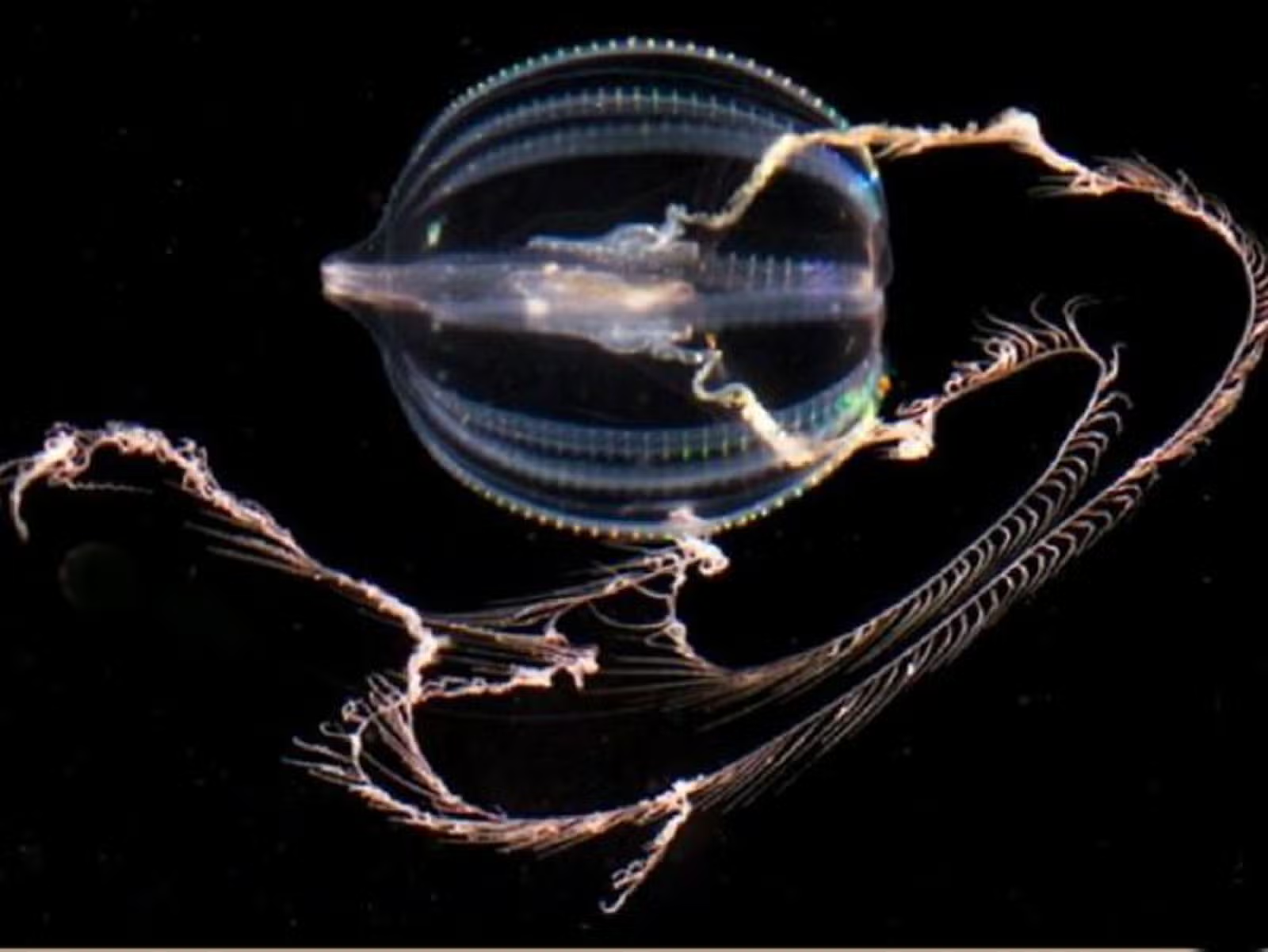
And, it seems, they not only evolve, but in ways and with a frequency we’ve only just begun to appreciate. It’s long been noted that evolution seems to have a thing for “carcinization”– crabs have evolved separately at least five times. (Oh, and apparently also for anteaters…) Recent findings hint that evolution might have the same sort of jones for the brain. Amy Maxmen reports…
Our brains, perched atop a network of nerve cells that ascend the length of our bodies, are thought to have arisen once in an animal hundreds of millions of years ago and then evolved over time. However, new findings suggest instead that brains and nervous systems originated multiple times from scratch.
The findings, published today in Nature, highlight an ancient and gelatinous marine predator called a comb jelly [pictured at top]. Unlike pulsating jellyfish, comb jellies swim by “rowing” their many hair-like cilia, which are arranged in rows called combs. They possess rudimentary brains and sophisticated nervous systems replete with elongated cells that communicate through synapses much like our own. Some comb jellies show mirror-like bilateral symmetry, as do we. And like most animals, their muscles derive from a middle tissue layer, which does not exist in jellyfish or sponges, another ancient type of aquatic creature.
So it’s little wonder that biologists have long placed the comb jelly group close to worms, flies, and humans on the evolutionary tree of life; sponges emerge at the base, meaning that this group appeared first. In this traditional view, complex body parts like the brain and muscles arose gradually, and only once, since those parts look similar across related animals, and the chances of that same evolutionary process being repeated seems slim.
But this scenario was shaken by a report in Science last year, which suggested that the comb jelly group emerged before jellyfish and even the brainless, muscle-less sponges, more than 550 million years ago.
Some biologists doubted the rearrangement because it implied two equally uncomfortable possibilities: that the ancestor of all living animals had true muscles and a rudimentary brain, and then sponges and jellyfish lost those parts without a trace; or that the great animal ancestor was simple, and comb jellies evolved separately from all the other animals, yet ended up with rather similar nervous systems, muscles, and bilateral symmetry. When paleontologist Graham Budd heard the news last year, he said, “It is effectively saying animals evolved twice. Frankly, I’m not ready to believe it.”
Without a time machine, it’s impossible to know what our great ancestor looked like. However, today’s report adds more support to the notion that she was simple and comb jellies independently evolved their complex body parts. Leonid Moroz, a neurobiologist at the University of Florida’s Whitney Laboratory for Marine Bioscience, and his colleagues confirm comb jellies’ position below sponges at the base of the evolutionary tree with an analysis of genetic sequences from 11 comb jelly species…
… In an essay for Nautilus called “Evolution, You’re Drunk,” I described how hypotheses entrenched in the notion that evolution leads toward increasing complexity have recently begun to teeter. Now Moroz’s study adds another shove. It seconds the finding that simple sponges, long placed at the base of the evolutionary tree, actually evolved after the sophisticated comb jelly group arose. The story of how complexity evolves is more complex than scientists realized.
Furthermore, the brain—the epitome of complexity—seems to have sprouted up at least twice over evolutionary time. This clashes with the traditional notion that complex, multifaceted features come about in a very specific way, and each emerges just one time. “What everyone has said about complexity is wrong,” Moroz says. “It can happen more than once.”
Finding that comb jellies independently arrived at similar ends as other animals might also have surprised the late paleontologist Stephen Jay Gould, who famously doubted that animals would look the same today if the world were to begin again—if we could replay “the tape of life.”
Is such convergence in design a coincidence? Probably not, guesses Andreas Hejnol, an evolutionary developmental biologist at the Sars International Centre for Marine Molecular Biology in Norway. “If you need a fast communication system, it helps to have extended cells that communicate through chemicals,” he says. In other words, the structure of the nervous system reflects its function. So if intelligent life exists elsewhere in the universe, it’s not too far a stretch to think it could possess a brain comprised of trillions of neurons. Hejnol asks, “How else could it be?”…
The mysterious mechanism of evolution: “Evolution May Be Drunk, But It’s Serious About Making Brains,” from @amymaxmen.bsky.social in @nautil.us.
* John M. Allman, Evolving Brains
###
As we contemplate the changing comprehension of cerebra, we might send thoughtful birthday greetings to Sir Karl Raimund Popper; he was born on this date in 1902. One of the greatest philosophers of science of the 20th century, Popper is best known for his rejection of the classical inductivist views on the scientific method, in favor of empirical falsification: a theory in the empirical sciences can never be proven, but it can be falsified, meaning that it can and should be scrutinized by decisive experiments. (Or more simply put, whereas classical inductive approaches considered hypotheses false until proven true, Popper reversed the logic: conclusions drawn from an empirical finding are true until proven false.)
Popper was also a powerful critic of historicism in political thought, and (in books like The Open Society and Its Enemies and The Poverty of Historicism) an enemy of authoritarianism and totalitarianism (in which role he was a mentor to George Soros).


“An understanding of the natural world, and what’s in it is a source of not only great curiosity but great fulfillment”*…
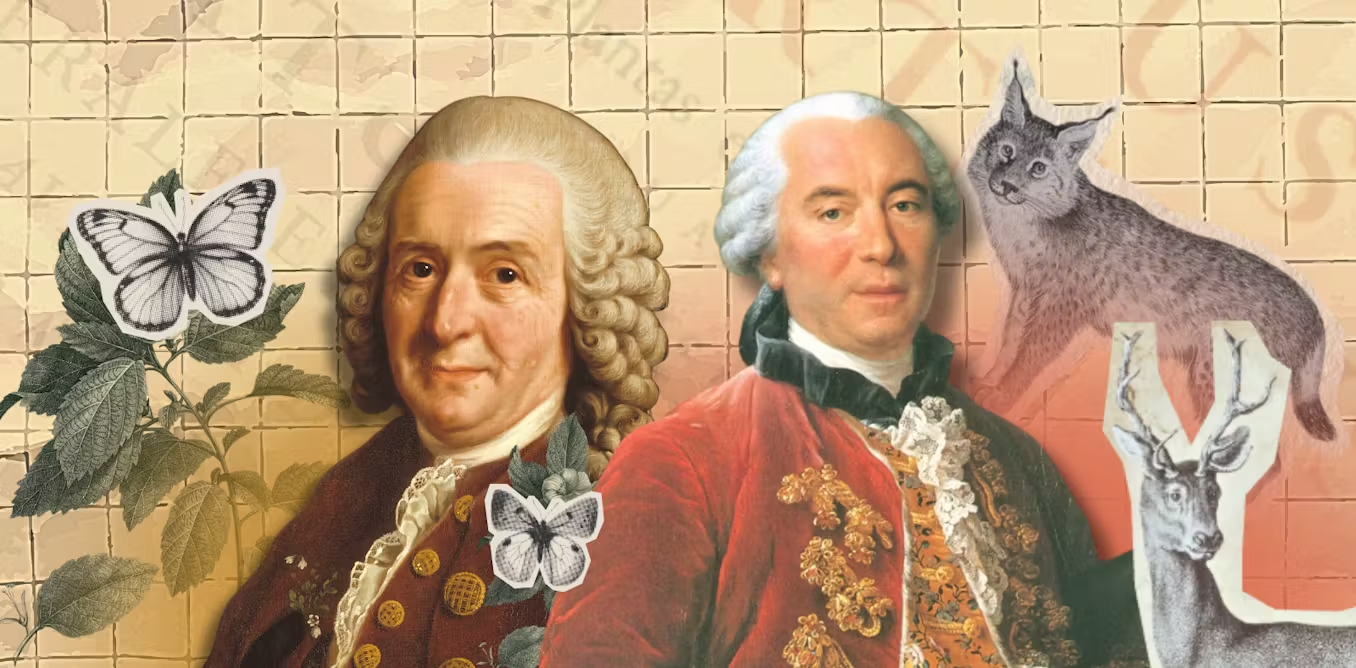
Ah yes, but in what does that understanding consist? John Long considers the competing frameworks of Linnaeus and Buffon…
The modern science biography must hold back no punches in its mission to represent the subject’s life, equally celebrating their great works while including their personal shortcomings.
Jürgen Neffe’s Einstein: A Biography (2005) and Dava Sobel’s The Elements of Marie Curie (2024) are wonderful examples of this style. Such books succeed in clearly explaining the complex science of their subject’s work for non-scientific readers, enabling a deep appreciation of their achievements and bringing them to life as rounded, flawed humans.
The modern science biography must hold back no punches in its mission to represent the subject’s life, equally celebrating their great works while including their personal shortcomings.
Jürgen Neffe’s Einstein: A Biography (2005) and Dava Sobel’s The Elements of Marie Curie (2024) are wonderful examples of this style. Such books succeed in clearly explaining the complex science of their subject’s work for non-scientific readers, enabling a deep appreciation of their achievements and bringing them to life as rounded, flawed humans.
Jason Roberts’ Every Living Thing – The Great and Deadly Race to Know all Life is another of these rare works. This engrossing, precisely researched book focuses on two central characters born in the same year: Carl Linnaeus (1707-1778), a Swede, and Frenchman Georges-Louis LeClerc, the Compte de Buffon (1707-1788), better known as just Buffon.
Roberts’ book won the 2025 Pulitzer Prize for biography. His writing pulls the reader effortlessly through the story, revealing delightful, unexpected twists and turns in the two men’s complex and disparate lives. Each worked diligently to reach a level of global notoriety for their many published books. Both are revered in the natural history world today.
Linnaeus, a biologist and physician, is known for his system of hierarchical classification: how all living things comprise a genus and species, (we humans are Homo sapiens), which fit into families, orders, classes and so on. (A good many intermediate ranks were added later). While his work has been hugely influential, Linnaeus is portrayed by Roberts at times as being lazy, vain and unethical.
Linnaeus was primarily driven to be the first to name new species. Buffon was working on a grand thesis of how all life’s organisms function and are related to one another. A wealthy count who inherited a vast fortune at the age of ten, Buffon trained as a lawyer but became fascinated by the trees that grew in his large garden.
Buffon is best known today for his extensive books on natural history and works on mathematics and cosmology. He calculated the Earth was much older than the Bible predicted and that life sprung from unorganised matter. He explored the relationships between organisms rather than how they were classified. His core work formed the basis for modern evolutionary theory.
Why was all this important? At the time, the task of classifying plants was vital to the growing economies of nations. Travellers to the far reaches of the globe brought back examples of economically valuable new species, like plant foods, medicinal plants or beautiful ornamental specimens.
The author’s central thesis is Linnaeus was not as brilliant as history paints him and Buffon was a far greater genius for his day.
Where does genius come from, Roberts asks? Is it inherent by birth, grown from an inspiring education, or is it something within that is nurtured by passion?
Both these brilliant men who made a lasting mark on science came from not very inspiring families. Nor did they excel at school or university. This story shows success in academic work is not just about intellect, but intimately tied to the ethics and morality of doing research…
Eminently worth reading in full: “How do we understand life on Earth? A prize-winning biography charts the tension between two types of science ‘genius’” from @theconversation.com.
* David Attenborough, who also observed, “We moved from being a part of nature to being apart from nature.”
###
As we noodle on knowing, we might send birthday greetings to Gregor Mendel; he was born on this date in 1822 (though some sources give the date as July 20). A botanist, geneticist, and monk, he pioneered in the study of heredity.
Mendel spent his adult life with the Augustinian monastery in Brunn, where as a plant experimenter, he was the first to lay the mathematical foundation of the science of genetics, in what came to be called Mendelism. Over the period 1856-63, Mendel grew and analyzed over 28,000 pea plants. He carefully studied for each their plant height, pod shape, pod color, flower position, seed color, seed shape and flower color. He made two very important generalizations from his pea experiments, known today as the Laws of Heredity, and coined the genetic terms recessiveness and dominance. He read a paper on his studies in 1865 to the Brünn Society for Natural Sciences in Moravia– but it lay unappreciated until 1900.

“Good night, sleep tight, don’t let the bedbugs bite”*…

As Rodrigo Pérez Ortega reports, that admonition has a very long history…
Long before rats roamed sewers and cockroaches lurked in kitchen corners, another unwelcome guest plagued early civilizations. A new genomic study published today in Biology Letters suggests that bedbugs—the blood-feeding insects that haunt our hotel stays—were the first urban pests, proving an itchy menace for tens of thousands of years.
“This is really amazing,” says Klaus Reinhardt, an evolutionary biologist at the Dresden University of Technology who was not involved in the new study. “I think the hypothesis is quite solid.” Still, other researchers quibble over whether bedbugs can indisputably claim that title.
Many species of bedbugs depend on us—and our blood—to survive, but long ago, their prey of choice was probably exclusively bats. Genetic evidence suggests that about 245,000 years ago, some bedbugs made the jump to early humans.
This split led to two genetically distinct bedbug lineages. One kept feeding on bats and today remains largely confined to caves and natural habitats in Europe and the Middle East. The other followed humans into modern dwellings. Exactly how that scenario played out remained a mystery, however. That’s why Warren Booth, an evolutionary biologist at the Virginia Polytechnic Institute and State University, and his team set out to study the genome of the common bedbug (Cimex lectularius) in depth…
… [Their findings make] bedbugs strong contenders for the title of the world’s first true urban pest that relies solely on humans, the researchers claim. Unlike more recent urban interlopers that feast on our stored food and enjoy our cozy homes—like the German cockroach (Blattella germanica), which formed a close association with humans just 2000 years ago, or the black rat (Rattus rattus), whose commensal relationship began about 5000 years ago—bedbugs may have started parasitizing humans just as our ancestors started building permanent settlements…
… the new findings underscore how humans have shaped the evolution of urban insects. Compared with their bat-feeding cousins, human-feeding bedbugs are smaller, less hairy, and have larger limbs—adaptations likely suited to navigating smooth walls and synthetic bedding. Today’s bedbugs also carry many DNA mutations linked to insecticide resistance, a relatively recent trait that reflects the pressures of modern pest control. “They’re a remarkable yet horrible species,” Booth says.
Understanding how these pests evolved together with us could help improve strategies for controlling them, especially as cities continue to grow—and as bedbugs now feed on the poultry we raise. Further research could also help us understand how our own immune system evolved, since some people develop allergies for bedbug bites. As a start, Booth and his team are analyzing centuries-old bedbug specimens in museums, to track how the insects’ genomes—and populations—have evolved over the past century alongside us.
“There’s a pretty intimate association, whether we like it or not,” Booth says. “That’s not going away anytime soon.”…
“Bedbugs may be the first urban pest,” from @rpocisv.bsky.social in @science.org.
* common children’s rhyme
###
As we contemplate the chronicle of a co-evolved curse, we might recall that it was on this date in 1789 that Richard Kirwan published his essay in support of the phlogiston theory (the belief, that dates to alchemical times, in the existence of a fire-like element (dubbed “phlogiston”) contained within combustible bodies and released during burning. Kirwan was among the last of its advocates.
A well-regarded scientist in the late 18th and early 19th centuries, Kirwan met and corresponded with Black, Lavoisier, Priestley, and Cavendish. Indeed, while scientific history remembers him as a defender of an incorrect theory, his work probably spurred Priestley and Lavoisier, who respectively discovered and named the actual elemental agent of combustion, oxygen.
But Kirwan is also remembered for a personal eccentricity (one of many) relevant to this post: he hated bugs (especially flies). He paid his servant a bounty for each one they killed.

“I think the next century will be the century of complexity”*…

… and as Philip Ball reports, a team of scientists at Carnegie Science agrees…
In 1950 the Italian physicist Enrico Fermi was discussing the possibility of intelligent alien life with his colleagues. If alien civilizations exist, he said, some should surely have had enough time to expand throughout the cosmos. So where are they?
Many answers to Fermi’s “paradox” have been proposed: Maybe alien civilizations burn out or destroy themselves before they can become interstellar wanderers. But perhaps the simplest answer is that such civilizations don’t appear in the first place: Intelligent life is extremely unlikely, and we pose the question only because we are the supremely rare exception.
A new proposal by an interdisciplinary team of researchers challenges that bleak conclusion. They have proposed nothing less than a new law of nature, according to which the complexity of entities in the universe increases over time with an inexorability comparable to the second law of thermodynamics — the law that dictates an inevitable rise in entropy, a measure of disorder. If they’re right, complex and intelligent life should be widespread.
In this new view, biological evolution appears not as a unique process that gave rise to a qualitatively distinct form of matter — living organisms. Instead, evolution is a special (and perhaps inevitable) case of a more general principle that governs the universe. According to this principle, entities are selected because they are richer in a kind of information that enables them to perform some kind of function.
This hypothesis, formulated by the mineralogist Robert Hazen [here] and the astrobiologist Michael Wong [here] of the Carnegie Institution in Washington, D.C., along with a team of others, has provoked intense debate. Some researchers have welcomed the idea as part of a grand narrative about fundamental laws of nature. They argue that the basic laws of physics are not “complete” in the sense of supplying all we need to comprehend natural phenomena; rather, evolution — biological or otherwise — introduces functions and novelties that could not even in principle be predicted from physics alone. “I’m so glad they’ve done what they’ve done,” said Stuart Kauffman, an emeritus complexity theorist at the University of Pennsylvania. “They’ve made these questions legitimate.”…
[Ball explains the origin and outline of Hazen’s and Wong’s conjecture, explores the critiques– among them, that it’s not clear how to test the hypothesis– and examines the resonant work on Assembly Theory being done by Lee Cronin and Sara Walker…]
… Wong said there is more work still to be done on mineral evolution, and they hope to look at nucleosynthesis and computational “artificial life.” Hazen also sees possible applications in oncology, soil science and language evolution. For example, the evolutionary biologist Frédéric Thomas of the University of Montpellier in France and colleagues have argued that the selective principles governing the way cancer cells change over time in tumors are not like those of Darwinian evolution, in which the selection criterion is fitness, but more closely resemble the idea of selection for function from Hazen and colleagues.
Hazen’s team has been fielding queries from researchers ranging from economists to neuroscientists, who are keen to see if the approach can help. “People are approaching us because they are desperate to find a model to explain their system,” Hazen said.
But whether or not functional information turns out to be the right tool for thinking about these questions, many researchers seem to be converging on similar questions about complexity, information, evolution (both biological and cosmic), function and purpose, and the directionality of time. It’s hard not to suspect that something big is afoot. There are echoes of the early days of thermodynamics, which began with humble questions about how machines work and ended up speaking to the arrow of time, the peculiarities of living matter, and the fate of the universe…
A new suggestion that complexity increases over time, not just in living organisms but in the nonliving world, promises to rewrite notions of time and evolution: “Why Everything in the Universe Turns More Complex,” from @philipcball.bsky.social and @quantamagazine.bsky.social.
See also: Benjamin Bratton‘s explantion of the work he and his collegues are doing at a new institute at UCSD: “Antikythera.” See his recent Long Now Foundation talk on this same subject here.
* Stephen Hawking
###
As we celebrate complication, we might spare a thought for G. N. Ramachandran (Gopalasamudram Narayanan Ramachandran); he died on this date in 2001. A biophysicist, he discovered the triple helical “coiled coil” structure of the collagen molecule, among other remarkable contributions to structural biology.
Ramachandran was a master of X-ray crystallography, and with his colleagues, constructed space filling models of protein molecules. He devised the Ramachandran Plot, a method to diagram the conformation of polypeptides, polysaccharides and polynucleotides– which remains the international standard to describe protein structures.
Ramachandran, inspired by the ancient Syaad Nyaaya (doctrine of “may be”), also explored artificial intelligence. He developed the Boolean Vector Matrix Formulation which has important application in writing software for AI.

You must be logged in to post a comment.