Posts Tagged ‘evolution’
“Alcohol may be man’s worst enemy, but the Bible says love your enemy”*…

It turns out, Andrew Coletti reports, that alcohol is consumed widely in nature– and may have played a role in human evolution…
… There’s something charmingly funny about the image of an animal drinking alcohol; it seems so incongruously humanlike. Some documentaries that show wild animals getting drunk off boozy rotten fruit, like this one from Botswana, use music and narration to emphasize the unexpected comedy of the scene. Scientists once believed that such behavior was random and accidental, especially in species not closely related to humans and other great apes. But more recent studies paint a very different picture. A research review published in October 2024 in Trends in Ecology & Evolution found that wherever ethanol—the active ingredient in alcoholic beverages—occurs in nature, it is routinely consumed by a variety of species, from insects and birds to rodents and monkeys.
In nature, “ethanol ingestion is far more common than was previously thought,” says Anna Bowland, a Ph.D. student in bioscience at the University of Exeter, England, who worked on the review. The paper cites research mainly from tropical regions like Central America and Southeast Asia, where yeast and bacteria ferment the natural sugars in fruit and nectar into ethanol in the hot sun. But a similar effect has also been observed in completely different environments. In Finland, when wild berries thaw in the warm sun after being bruised by frost, “they ferment quite quickly,” says Bowland. “And then as the birds come and feed on them, they’re ingesting alcohol.”
Because animals that feed on fruit and nectar ingest more ethanol on average, many of them show evolutionary adaptations to tolerate it. The review cites a study from the rainforests of Malaysia, which found that arboreal mammals like treeshrews, lorises, and squirrels regularly feed on fermented palm nectar with an alcohol concentration as high as 3.8 percent, comparable to a light beer. But intriguingly, says Bowland, “they don’t—in our anthropogenic sense—seem to get drunk,” meaning that they don’t display behaviors associated with inebriation in humans, like drowsiness or reduced motor skills. This suggests that treeshrews are particularly good at metabolizing ethanol.
Bowland explains that from an evolutionary standpoint, “it’s not beneficial for [animals] to get drunk, because that can lead to predation and injury and reduce survival, so they might not pass on their genes.” Animals that feed on a boozy food source have a better chance of survival if they can hold their liquor, so the presence of ethanol creates evolutionary pressure for tolerance….
… Another prominent example is the great apes. “Humans, chimpanzees, and gorillas—we all possess a mutation in one of our genes that greatly increases the rate at which we can metabolize and break down ethanol,” says Bowland, thanks to a digestive enzyme called ADH4. While other primates like Central American spider monkeys consume ethanol in fruit, and may, like fruit flies, be drawn to the smell, apes are particularly efficient at processing it. This has led some researchers to propose that the human fondness for ethanol goes back long before deliberate brewing and fermenting, to a dietary shift in our common ancestor with other apes.
Robert Dudley, a professor of Integrative Biology at the University of California, Berkeley, explored the evolutionary origins of human alcohol consumption in his book The Drunken Monkey Hypothesis. “Primates are ancestrally fruit-eaters, going back 45 million years,” says Dudley, based on evidence like the shape of their teeth. In modern apes, fruit still makes up 60 to 80 percent of the diet for chimpanzees and 90 percent for gibbons. According to Dudley, who was not affiliated with the 2024 study, genetic analysis of ADH4 in early apes shows that the enzyme became 20 times better at degrading ethanol about 12 million years ago. “This is right when the great apes are coming out of the trees and going bipedal, walking around, and, we think, now going after more ripe fruit crops that have already fallen down,” he says. Other foods becoming scarce, as well as the increased availability of fermenting fruit on the ground, may have increased pressure for prehistoric primates to adapt to an ethanol-rich source of nutrients.
“We’ve evolved with this molecule,” Dudley says of ethanol. His research suggests that the scent of ethanol “acts as a long-distance sensory cue” for primates, alerting them to the presence of edible fruit hidden among dense foliage. “Where there’s ethanol, there has to be sugar,” Dudley explains, and the scent of ethanol might even allow monkeys and apes to “assess individual fruits without wasting time biting into them.” Dudley also suggests that ethanol-rich fruit may stimulate the appetite of wild primates, encouraging them to take as much advantage of the available nutrition as possible. He compares this with the “aperitif effect” observed in humans, where consuming alcohol before a meal leads to increased food consumption, perhaps due to the stimulation of brain areas that regulate feeding behavior…
… Bowland is hopeful that her review will encourage further research into the interactions between animals and ethanol. Dudley agrees. “I think that the nice thing about that paper [is it] just points out the ubiquity of ethanol,” he says of the 2024 review. Ethanol is just a part of nature, found wherever there is sugar and microbes to ferment it. And while there’s still much to be explored, one thing is clear: If there’s anything that truly separates human beings from animals, it’s not alcohol…
No “dry January” in much of the animal kindom: “The Booze-Soaked Lives of Wild Animals,” from @aoofficial.bsky.social.
Apposite (or many better said, subsequent): “Peeing is contagious in chimpanzees, study suggests.”
* Frank Sinatra
###
As we investigate intoxicants, we might recall that it was on this date in 1935 that the beer can (created by the American Can Co.) was introduced by the Gottfried Krueger Brewing Company of Newark, New Jersey. Made of tin, it weighed 4 ounces– still lighter than glass bottles– and required a “churchkey” opener. Pabst, based in Milwaukee, followed quickly, introducing their own (“Blue Ribbon”) line of canned beer later in the year.

“Purple, formalized, iridescent, gelatinous”*…

Doug Muir on one of Nature’s more striking creations…
There’s been a a certain amount of negativity floating around lately. So, let’s talk about a toxic, venomous freak of nature and the parasite that afflicts it.
Biology warning, this gets slightly squicky.Let’s start with the toxic, venomous freak of nature: the Portuguese man-o’-war…
… So it’s a jellyfish. Except it isn’t really: it’s several jellyfish, smooshed together. And here’s where the “freak of nature” part kicks in.
I mean, yeah, strictly speaking nature has no freaks; every species that exists, belongs; everything is a product of evolution and Life’s Rich Pageant, yadda yadda. But the Portuguese man-o’-war — Physalia physalis, for you biologists — is honestly kinda freaky. Because Physalia is a colonial organism.
What this means: a single Portuguese man-o’-war is composed of four or five separate animals. (We’re not actually sure how many.) One animal is the balloon-sail-thingy on top; another is the stinging tentacles; another is the digestive system; another is the gonads. And they’re completely distinct organisms.
How this happens: when a Physalia egg is fertilized, it starts dividing, like every other fertilized egg. But pretty quickly it breaks apart into two and then more distinct embryos — genetically identical, but physically separate. And those embryos develop into completely different creatures. Then, later in development, those creatures re-attach to form a single Frankenstein organism. The various parts have their own nervous systems, which don’t seem to connect.
Here’s an analogy: imagine that before birth, you are identical twins. But instead of growing into two babies, one twin grows into a bodiless head, the other into a headless body. Then just before birth they stick together, but they don’t actually merge back into one. No, going forward you are a bodiless head glued on top of a headless body, ever after. It’s kind of like that.
Now, colonial animals aren’t unknown in nature. But most of them are either dinky (Volvox, don’t ask) or they’re big, but it’s basically cut-and-pasting the same creatures over and over. So, some corals are colonial, but all this means is that the individual polyps have grown into each other to produce a sort of living carpet interlaced through their stony skeleton. But the man-o’-war is a respectably large animal — they can grow as big as a large house cat — and so are its colonial components. And the components are extremely specialized: the float-animal part of it looks and acts nothing like the tentacle-animal part.
Physalia is by far the largest complex colonial animal. And — this bit is odd — it doesn’t have any relatives. It’s the only genus in its family. Put another way, within the jellyfish it has no siblings and only a few very distant cousins. (One of which is the ridiculous creature known as the Flying Spaghetti Monster Jellyfish, but never mind that now.) It’s a very successful organism! There are millions and millions of them, found all over the world in tropical and subtropical oceans. So you would expect to see speciation, different relatives — big ones, little ones, a bunch of variations on a theme. More on this shortly.
But meanwhile, the whole “colonial animal” thing looks like evolution’s first attempt to figure out, you know, organs. I mean, the first multicellular animals were probably sponges, and sponges don’t actually have organs. But more complex animals have distinct and differentiated organs, modules of specialized tissue performing particular functions, because those turn out to be super useful. Physalia and other colonial animals look like a beta-test platform for this new “organ” technology. Most of the animal kingdom moved on to “oh wait, why don’t we just have one single creature that grows the different modules inside it”, but a few colonial animals stuck with Plan A and made it work.
Okay, so that’s the “freak of nature” part. What about the “toxic and venomous”?…
Read on to be astounded: “Occasional Paper: Four Hidden Species of Portuguese man-o’-war,” from the always-illuminating @crookedtimber, via Ingrid Burrington‘s exquisite newsletter, Perfect Sentences.
* “The purple, formalized, iridescent, gelatinous bladder of a Portuguese man-of-war was floating close beside the boat. It turned on its side and then righted itself. It floated cheerfully as a bubble with its long deadly purple filaments trailing a yard behind in the water.” – Ernest Hemingway, The Old Man and the Sea
###
As we tangle with tentacles, we might spare a thought for Columbus Iselin; he died on this date in 1971. An oceanographer, he taught at both Harvard and MIT, and was a long-time Director of the Woods Hole Oceanographic Institution, which grew materially in both scope and impact under his leadership.
His own work included both the invention of the bathythermograph and other deep-sea instruments responsible for saving ships during World War II and foundational scholarship on the oceanography of the Gulf Stream… where, of course, one can find the Portuguese man-of-war.

“The past lives within the present, and our ancestors breathe through our children”*…
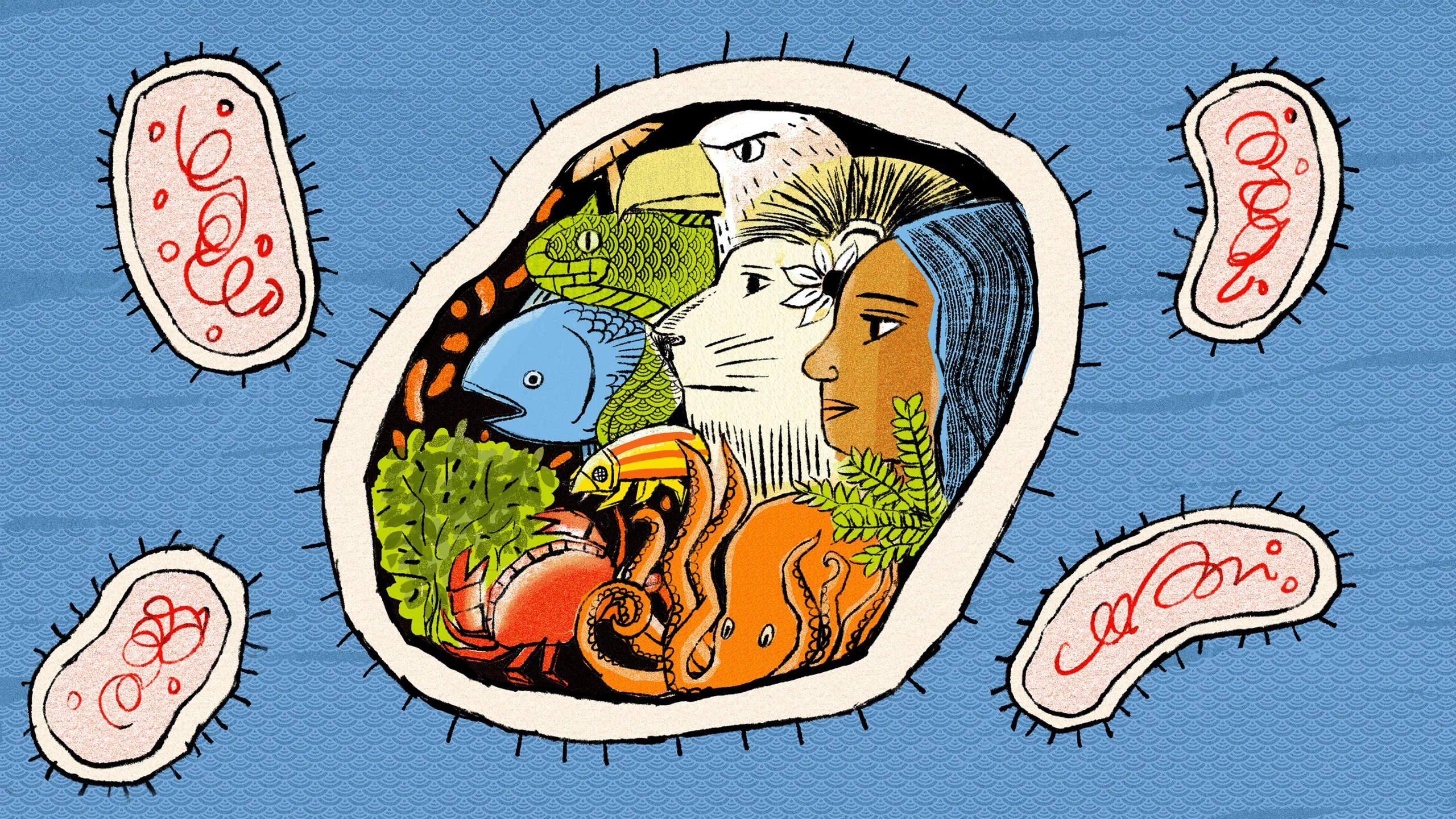
Indeed, that’s true all the way back. And as Jonathan Lambert explains, we now have more visibility on that distant past. The emerging understanding of our “last universal common ancestor” suggests it was a relatively complex organism living 4.2 billion years ago, a time long considered too harsh for life to flourish…
If you follow any path of ancestry back far enough, you’ll reach the same single point. Whether you begin with gorillas or ginkgo trees or bacteria that live deep in the bowels of the Earth — or yourself, for that matter — all roads lead to LUCA, the “last universal common ancestor.” This ancient, single-celled organism (or, possibly, population of single-celled organisms) was the progenitor of every varied form that makes a life for itself on our planet today.
LUCA does not represent the origin of life, the instance whereby some chemical alchemy snapped molecules into a form that allowed self-replication and all the mechanisms of evolution. Rather, it’s the moment when life as we know it took off. LUCA is the furthest point in evolutionary history that we can glimpse by working backward from what’s alive today. It’s the most recent ancestor shared by all modern life‚ our collective lineage traced back to a single ancient cellular population or organism.
“It’s not the first cell, it’s not the first microbe, it’s not the first anything, really,” said Greg Fournier, an evolutionary biologist at the Massachusetts Institute of Technology. “In a way, it is the end of the story of the origin of life.”
Still, understanding LUCA — whether it was simple or complex, and how quickly it emerged after life’s origin — could help answer some of our deepest questions about where we come from and whether we’re alone in the universe.
“[LUCA] tells our own story,” said Edmund Moody (opens a new tab), an evolutionary biologist at the University of Bristol. “It gives us a point from which we can look even further back.”
For half a century, biologists have focused on different kinds of physiological, genomic and fossil evidence to paint portraits of LUCA that sometimes clash dramatically. In 2024, Moody and a team of interdisciplinary researchers, including geologists, paleontologists, system modelers and phylogeneticists, combined their knowledge to build a probabilistic model that reconstructs modern life’s shared ancestor and estimates when it lived.
The analysis, published in Nature Ecology and Evolution in July, sketched a surprisingly complex picture of the cell. LUCA lived off hydrogen gas and carbon dioxide, boasted a genome as large as that of some modern bacteria, and already had a rudimentary immune system, according to the study. Its genomic complexity, the authors argue, suggests that LUCA was one of many lineages — the rest now extinct — living about 4.2 billion years ago, a turbulent time relatively early in Earth’s history and long thought too harsh for life to flourish.
The analysis reaches two conclusions that seem in conflict with each other, according to Aaron Goldman, who studies the molecular evolution of early life at Oberlin College and wasn’t involved in the new research. “The first is that LUCA was a complex cellular organism that likely lived in a complex ecological setting,” he said. “The second is that LUCA dates to a time that is pretty early in the history of Earth.” The results could mean that life evolved from a simple replicator into something resembling modern microbes remarkably quickly, he said. “That’s really exciting.”
“Our work suggests that those early steps of evolution weren’t hard; they’re pretty easy,” said co-author Phil Donoghue, an evolutionary biologist at the University of Bristol. “If you’re concerned with the origin of microbial-grade life, then that’s apparently very easy, and it should be quite common in the universe.”
Not all experts in the field agree, however. Some argue that a few hundred million years is not enough time for complex life to have evolved. The authors stress that their analysis is a first attempt to paint a fuller, admittedly fuzzy, picture of LUCA. “I fully expect and hope people prove us wrong in certain aspects,” said Moody, the paper’s lead author, especially if those new results offer a clearer view of the ancient ancestor of all life we know…
Eminently worth reading in full: “All Life on Earth Today Descended From a Single Cell. Meet LUCA,” from @evolambert in @QuantaMagazine.
###
As we look back, we might send microscopic birthday greetings to Lewis Thomas; he was born on this date in 1913. A physician, poet, etymologist, essayist, administrator, educator, policy advisor, and researcher, he distinguished himself in medicine and microbiology both for his suggestion that an immunosurveillance mechanism protects us from the possible ravages of mutant cells (an idea later championed by Macfarlane Burnett) and for his proposal that viruses have played a major role in the evolution of species by their ability to move pieces of DNA from one individual or species to another.
But Lewis is more widely known for his writing, perhaps most especially for his first two books– The Lives of a Cell: Notes of a Biology Watcher (which won National Book Awards in two categories) and The Medusa and the Snail: More Notes of a Biology Watcher (which won another National Book Award)– which underscored the interconnectedness of life by sketching the ways that what is seen under the microscope is similar to the way human beings live.

“Tennyson said that if we could understand a single flower we would know who we are and what the world is”*…

Reality feels “stable” enough to talk about it– though all logic seems to point away from that possibility. Marco Giancotti unpacks what he suggests is the only line of reasoning that resolves that paradox…
What is the source of what we call order? Why do many things look too complex, too perfectly organized to arise unintentionally from chaos? How can something as special as a star or a flower even happen? And, for that matter, why do some natural phenomena seem designed for a purpose?
We live in a universe of forces eternally straining to crush things together or tear them apart. There is no physical law for “forming shapes”, no law for being separated from other things, no law for staying still.
Boundaries are in the eye of the beholder, not in the world out there. Out there is only tumult, clashing, and shuffling of everything with everything else.
And yet, our familiar world is filled with things stable and consistent enough for us to give them names—and to live our whole lives with.
In this essay we’ll tackle these questions at the very root. We need good questions to get good answers, so we’ll begin by clarifying the problem. It has to do with probabilities—we’ll see why those natural objects seem so utterly unlikely to happen by chance, and we’ll find the fundamental process that solves the dilemma.
This will take us most of the way, but we’ll have one final obstacle to overcome, a cognitive Last Boss: living things still feel a little magical in some way, imbued with a mysterious substance called “purpose” that feels qualitatively different from how inanimate things work. This kind of confusion runs very deep in our culture. To remove it, I’ll give a name to something that, as far as I know, hasn’t been named before: phenomena that I’ll be calling—enigmatically, for now—“Water Lilies.”…
Applying systems dynamics, complexity, and emergence to understanding reality itself: “Recursion, Tidy Stars, and Water Lilies,” from @marco_giancotti (the second in a trilogy of essays: part one here; subscribe to his newsletter for Part Three when it drops).
* Jorge Luis Borges, “The Zahir“
###
As we explore existence, we might spare a thought for Francis Simpson; he died on this date in 2003. An English naturalist, conservationist, and chronicler of the countryside and wild flowers of his native Suffolk, he became a botanist at Ipswich Museum, where he worked until his retirement in 1977.
He published one of the most highly regarded county floras, simply entitled Simpson’s Flora of Suffolk, and in 1938 saved a small meadow, famous for its snakeshead fritillaries, from being drained and ploughed into farmland. Using donations amounting to £75, he was able to purchase the field, Mickfield Meadow, for the Society for the Promotion of Nature Reserves. Today, it is one of the oldest nature reserves in the country, protecting the meadow flowers now surrounded by farmland.

“A horse! a horse! my kingdom for a horse!”*…

The horse transformed human history—and now, as Christina Larson reports, scientists have a clearer idea of when humans began to transform the horse…
Around 4,200 years ago, one particular lineage of horse quickly became dominant across Eurasia, suggesting that’s when humans started to spread domesticated horses around the world, according to research published [recently] in the journal Nature.
There was something special about this horse: It had a genetic mutation that changed the shape of its back, likely making it easier to ride.
“In the past, you had many different lineages of horses,” said Pablo Librado, an evolutionary biologist at the Spanish National Research Council in Barcelona and co-author of the new study. That genetic diversity was evident in ancient DNA samples the researchers analyzed from archaeological sites across Eurasia dating back to 50,000 years ago.
But their analysis of 475 ancient horse genomes showed a notable change around 4,200 years ago.
That’s when a specific lineage that first arose in what’s known as the Pontic-Caspian Steppe, a plains region that stretches from what is now northeastern Bulgaria across Ukraine and through southern Russia, began to pop up all across Eurasia and quickly replaced other lineages. Within three hundred years, the horses in Spain were similar to those in Russia.
“We saw this genetic type spreading almost everywhere in Eurasia—clearly this horse type that was local became global very fast,” said co-author Ludovic Orlando, a molecular archaeologist at the Centre for Anthropobiology and Genomics of Toulouse in France.
The researchers believe that this change was because a Bronze Age people called the Sintashta had domesticated their local horse and begun to use these animals to help them dramatically expand their territory.
Domesticating wild horses on the plains of Eurasia was a process, not a single event, scientists say.
Archaeologists have previously found evidence of people consuming horse milk in dental remains dating to around 5,500 years ago, and the earliest evidence of horse ridership dates to around 5,000 years ago. But it was the Sintashta who spread the particular horses they had domesticated across Eurasia, the new study suggests…
People had domesticated other animals several thousand years before horses—including dogs, pigs, cattle, goats and sheep. But the new research shows that the shrinking genetic diversity associated with domestication happened much faster in horses.
“Humans changed the horse genome stunningly quickly, perhaps because we already had experience dealing with animals,” said Laurent Frantz, who studies the genetics of ancient creatures at the Ludwig Maximilian University of Munich and was not involved in the study.
“It shows the special place of horses in human societies.”…
“Scientists have traced the origin of the modern horse to a lineage that emerged 4,200 years ago,” from @larsonchristina in @physorg_com.
* Shakespeare, Richard III
###
As we mount up, we might recall that it was on this date in 1878 that Eadweard Muybridge took a series of photographs to prove that all four feet of a horse leave the ground when it runs. He had been retained by former California Governor (and university founder) Leland Stanford to help settle a bet. While Muybridge was best known in his own day for his large photographs of Yosemite Valley, he did seminal early work on motion picture projection, and the approaches he developed for the study of motion are at the heart of both animation and computer analysis today.

You must be logged in to post a comment.