Posts Tagged ‘bugs’
“A simile is just a metaphor with the scaffolding still up”*…
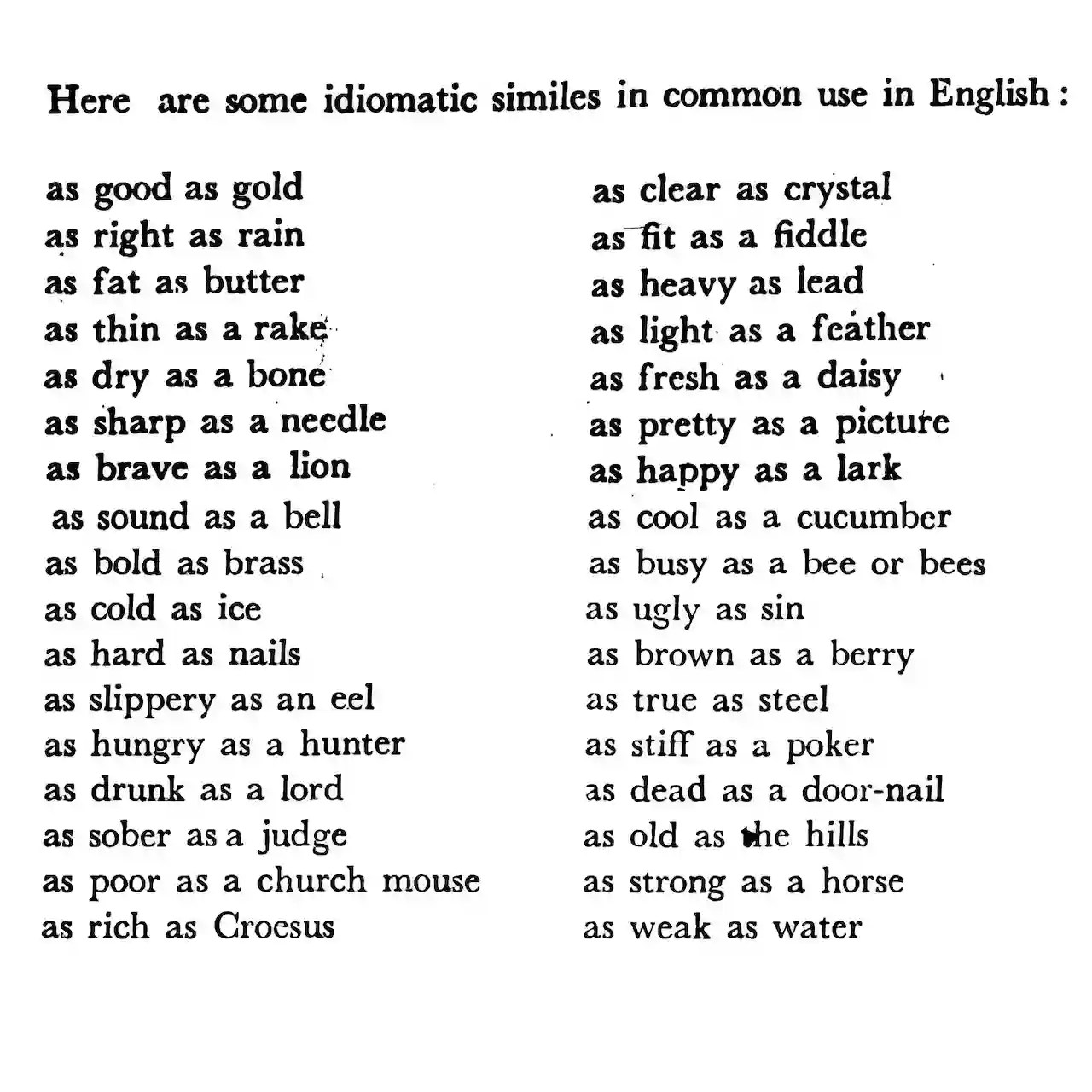
Russell Samora has been fooling around with figures of speech; with his colleagues at The Pudding, he’s fielded a fascinating analysis of of that comparative workhorse, the simile…
Similes are all around us. But, if you haven’t considered this figure of speech since grade school, here’s a refresher: similes compare a shared quality of two things, often using “like” or “as.”
I pulled every simile in the form “as ___ as ___” from tens of thousands of fiction books for the top 500 most common adjectives… I thought it would be a trivial exercise, but the more I poked around, the more questions I had…
Samora explains how similes are structured and how they are used (and with what relative frequency) in literature. He examines some of the most common– and several special cases (“The Ironic Ones”). And he explains his methodology and sources… all in the context of a lovely interactive data visualization.
It’s as cool as hell: “Comparisons as Predictable as the Sunrise,” from @pudding.cool.
###
As we agree with Steve Martin that “a day without sunshine is like, you know, night,” we might recall that it was on this date in 1789 that Richard Kirwan published his essay in support of the phlogiston theory (the belief, that dates to alchemical times, in the existence of a fire-like element (dubbed “phlogiston”) contained within combustible bodies and released during burning. Kirwan was among the last of its advocates.
A well-regarded scientist in the late 18th and early 19th centuries, Kirwan met and corresponded with Black, Lavoisier, Priestley, and Cavendish. Indeed, while scientific history remembers him as a defender of an incorrect theory, his work probably spurred Priestley and Lavoisier, who respectively discovered and named the actual elemental agent of combustion, oxygen.
But Kirwan is also remembered for a personal eccentricity (one of many) that led to some referring to him (all too poignantly) as “crazy as a bed bug”: he hated bugs (especially flies). Kirwan paid his servants a bounty for each one they killed.

“In the natural world, anything that is colored so brightly must be some kind of serious evolutionary badass”*…

There are an estimated 10 quintillion (10,000,000,000,000,000,000) individual insects alive on earth today; they’ve been around for over 350 million years and ihabit nearly every environment, from deserts to snowy mountains. Their total biomass is massive, estimated to be around 70 times more than all humans combined. Often considered pests, only about 3% of species are harmful to humans; the vast majority are crucial for pollination, decomposition, and as food sources for other animals. (More insect data.)
“Loren” (and here) is a microbiologist fascinated by bugs– and ready to share…
I am incredibly fond of insects. They’re small and usually pretty fast, so it’s rewarding to successfully capture a photo of one. from 2017 to 2023, I was fairly consistent about chasing down bugs and sharing the photos on instagram, but sticking them all in a square grid can only do so much for me (or you). Here, I want to have a little more fun with my photos, and share other bug-related things that I like. There’s a lot! I am not an entomologist, merely a bug fan, so this page in its current state skews more towards the entertaining than the informative, but who knows what it may turn into. Right now there’s an entomology textbook sitting on my coffee table, and plenty of time to read it while the bugs overwinter…
Browse and learn: “The Bug Zone,” via Matt Muir (@mattmuir.bsky.social) and his always-illuminating Web Curios (@curiobot.bsky.social).
* Neal Stephenson, Cryptonomicon
###
As we creep and crawl, we might spare a thought for a man concerned with “bugs” of a different sort, Joseph Lister (1st Baron Lister, OM, PC, FRS, FRCSE, FRCPGlas, FRCS); he died on this date in 1912. A surgeon, medical scientist, and experimental pathologist, he was a pioneer of antiseptic surgery and preventive healthcare. Just as John Hunter revolutionised the science of surgery, Lister’s revolutionized the craft of surgery.
Lister researched the role of inflammation and tissue perfusion in the healing of wounds, and advanced diagnostic science by analysing specimens using microscopes. But his biggest contributions were a function of his application of Louis Pasteur‘s then-novel germ theory. Lister introduced carbolic acid (modern-day phenol) as a steriliser for surgical instruments, patients’ skins, sutures, surgeons’ hands, and wards, promoting the principle of antiseptics. And he devised strategies to increase the chances of survival after surgery by reducing post-operative infections (e.g., segragating post-op patients from pre-op patients who had germ-riddled wounds).

“Good night, sleep tight, don’t let the bedbugs bite”*…

As Rodrigo Pérez Ortega reports, that admonition has a very long history…
Long before rats roamed sewers and cockroaches lurked in kitchen corners, another unwelcome guest plagued early civilizations. A new genomic study published today in Biology Letters suggests that bedbugs—the blood-feeding insects that haunt our hotel stays—were the first urban pests, proving an itchy menace for tens of thousands of years.
“This is really amazing,” says Klaus Reinhardt, an evolutionary biologist at the Dresden University of Technology who was not involved in the new study. “I think the hypothesis is quite solid.” Still, other researchers quibble over whether bedbugs can indisputably claim that title.
Many species of bedbugs depend on us—and our blood—to survive, but long ago, their prey of choice was probably exclusively bats. Genetic evidence suggests that about 245,000 years ago, some bedbugs made the jump to early humans.
This split led to two genetically distinct bedbug lineages. One kept feeding on bats and today remains largely confined to caves and natural habitats in Europe and the Middle East. The other followed humans into modern dwellings. Exactly how that scenario played out remained a mystery, however. That’s why Warren Booth, an evolutionary biologist at the Virginia Polytechnic Institute and State University, and his team set out to study the genome of the common bedbug (Cimex lectularius) in depth…
… [Their findings make] bedbugs strong contenders for the title of the world’s first true urban pest that relies solely on humans, the researchers claim. Unlike more recent urban interlopers that feast on our stored food and enjoy our cozy homes—like the German cockroach (Blattella germanica), which formed a close association with humans just 2000 years ago, or the black rat (Rattus rattus), whose commensal relationship began about 5000 years ago—bedbugs may have started parasitizing humans just as our ancestors started building permanent settlements…
… the new findings underscore how humans have shaped the evolution of urban insects. Compared with their bat-feeding cousins, human-feeding bedbugs are smaller, less hairy, and have larger limbs—adaptations likely suited to navigating smooth walls and synthetic bedding. Today’s bedbugs also carry many DNA mutations linked to insecticide resistance, a relatively recent trait that reflects the pressures of modern pest control. “They’re a remarkable yet horrible species,” Booth says.
Understanding how these pests evolved together with us could help improve strategies for controlling them, especially as cities continue to grow—and as bedbugs now feed on the poultry we raise. Further research could also help us understand how our own immune system evolved, since some people develop allergies for bedbug bites. As a start, Booth and his team are analyzing centuries-old bedbug specimens in museums, to track how the insects’ genomes—and populations—have evolved over the past century alongside us.
“There’s a pretty intimate association, whether we like it or not,” Booth says. “That’s not going away anytime soon.”…
“Bedbugs may be the first urban pest,” from @rpocisv.bsky.social in @science.org.
* common children’s rhyme
###
As we contemplate the chronicle of a co-evolved curse, we might recall that it was on this date in 1789 that Richard Kirwan published his essay in support of the phlogiston theory (the belief, that dates to alchemical times, in the existence of a fire-like element (dubbed “phlogiston”) contained within combustible bodies and released during burning. Kirwan was among the last of its advocates.
A well-regarded scientist in the late 18th and early 19th centuries, Kirwan met and corresponded with Black, Lavoisier, Priestley, and Cavendish. Indeed, while scientific history remembers him as a defender of an incorrect theory, his work probably spurred Priestley and Lavoisier, who respectively discovered and named the actual elemental agent of combustion, oxygen.
But Kirwan is also remembered for a personal eccentricity (one of many) relevant to this post: he hated bugs (especially flies). He paid his servant a bounty for each one they killed.
You must be logged in to post a comment.