Posts Tagged ‘Lysenko’
“When you mix science and politics, you get politics:*…
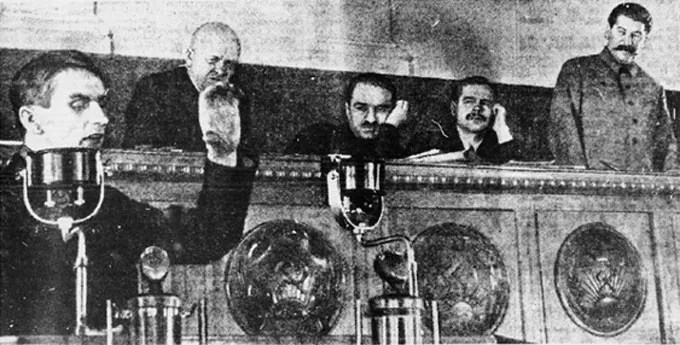
Tina Hesman Saey on a looming threat to the U.S…
Soviet scientists in the 1930s knew what could happen if they bucked the party line: denunciation, firing and banishment from the scientific establishment, even imprisonment and death. Political reprisals against those who opposed the views of dictator Joseph Stalin and his followers — and the dubious science they endorsed — led to the starvation of millions, as well as to decades of lost progress in fields from agriculture to molecular biology.
Now, scientists are warning that history could repeat itself — but in the United States.
A new proposal from the U.S. Office of Management and Budget would put political appointees in charge of funding decisions traditionally overseen by scientists. In recent years, the federal government has funded about 40 percent of basic science research in the United States.
The OMB’s more than 400-page proposed rule change would let political appointees decide how to hand out federal research funds and who can get them. It would cut funding for collaboration with scientists in other countries and restrict scientists’ ability to communicate their findings. What’s more, it could prevent research on matters that President Donald Trump’s administration has deemed “not in the national interest” — such as studies on health disparities, mRNA-based vaccines and research that doesn’t recognize biological sex as a strict binary.
The new rules would also give OMB the power to rescind previously approved research funds. The proposal “poses a sweeping threat to federal grantmaking and the responsible stewardship of American taxpayer dollars,” the science advocacy group Stand Up for Science Foundation said in a report. In addition, it would impact nonscientific grants supporting services for mental health, housing, education, veterans and Tribal nations, affecting the health and well-being of millions.
So far, OMB has received more than 98,000 comments on the proposal. The public comment period closes July 13. It then will be up to OMB to decide whether to keep the rule as is, revise it or scrap it.
These far-reaching measures are already drawing parallels to dark moments in scientific history. Some researchers say the recent mass firings, policy changes and grant cancellations at federal research institutions, including the U.S. National Institutes of Health and Centers for Disease Control and Prevention, closely mirror what happened in the U.S.S.R. under Stalin. “A similar threat now hangs over U.S. science,” the editorial board of The New England Journal of Medicine wrote in June.
Its editorial invoked the example of Trofim Lysenko [see here], an agronomist and astute political operator who rose to power in the 1930s Soviet Union under Stalin.
Until the 1930s, “the Soviet Union was a real powerhouse in the field of genetics,” says Lee Dugatkin, an evolutionary biologist and historian of science at the University of Louisville in Kentucky.
Then, Lysenko came along. “This guy was your sort of classic charlatan,” Dugatkin says. “He had the equivalent of a mail order degree in agriculture, but he was quite good with the press, and he started to basically spread this idea out there that he was capable of dramatically increasing crop yield, particularly wheat.”
Lysenko’s supposed innovation was a process called vernalization and amounted to soaking seeds in freezing water. The resulting plants — and all their offspring — should be resistant to the U.S.S.R.’s famously cold winters, Lysenko reasoned.
His reasoning was based on a disproven idea in evolutionary biology called Lamarckian inheritance. French biologist Jean-Baptiste Lamarck and his followers thought that things an organism experiences in its lifetime can be handed down to the next generation. The classic example is a giraffe that has to stretch to reach leaves producing offspring with long necks.
This idea ran counter to Mendelian genetics, which holds that genes — not environmental influences — control traits and are passed to offspring. Mendelian geneticists thought it would take five years to breed more cold-tolerant crops. Lysenko said he could do it in two to three years.
Stalin didn’t have time to wait. He was trying to get collective farms going and needed to increase crop yields to feed more than 150 million people. Large parts of the country had already suffered from famine in 1932 and 1933 and about 6 million people died. Some resorted to cannibalism.
Stalin embraced Lysenko’s quick-fix approach. That decision, says Michael Gordin, a historian of science at Princeton University, was “something that the majority of people at the time, and everyone since, considers the wrong side of the dispute.”
Lysenko was put in charge of a prestigious genetics institute and forced his scientifically unsound farming practices on the collective farms. His methods were disastrous.
Soaking seeds in freezing water hampered germination, leading to crop losses. Millions starved. Meanwhile, Mendelian genetics was branded a “whore of capitalism,” and geneticists were forced to renounce their views or lose their jobs. Many were jailed, and almost a dozen were executed or died in prison.
The Soviet Union lost its scientific leadership role and sat on the sidelines for important scientific discoveries of the 1950s and beyond. One, Gordin says, was the development of “massively” productive hybrid corn. The country also missed out on the discovery of DNA and the advent of molecular biology, putting Soviet genetics decades behind the rest of the world.
Soviet genetics did not recover from Lysenko’s influence until after the break-up of the Soviet Union in the late 1980s and early 1990s, Gordin says. “I think you’d be hard pressed to find anybody who thinks that … Russia is today, or Ukraine, or any post-Soviet successor state, is a leading molecular biology country.”…
The Soviets did it, and it didn’t end well: “Here’s what happens when you put politicians in charge of science,” from @thsaey.bsky.social in @sciencenews.bsky.social.
See also: Idiocracy
###
As we remember the past so as not to repeat it, we might recall that it was on this date in 1834 that the Spanish Inquisition (finally) ended. Authorized by Pope Sixtus IV in 1478, the Inqusition was initially led by inquisitors (Miguel de Morillo and Juan de San Martín) who were appointed by the future Catholic monarchs, King Ferdinand II of Aragon and Queen Isabella I of Castile. It was originally (ostensibly) intended primarily to identify heretics; its aim, to maintain Christian orthodoxy. But it became an effective instrument of state power by replacing the Medieval Inquisition, which was under Papal control.
Over its course, the Inquisition prosecuted an estimated 150,000 people for various offences. An estimated 3,000–5,000 were turned over to the state for execution, particularly in the initial 50 years, mostly by burning at the stake. Other punishments included penance and public flogging, exile, enslavement on galleys, and prison terms ranging from several years to life. In many of these punishments an important motive was the confiscation of all the victims’ property.
As Monty Python observed, “nobody expects the Spanish Inquisition.” And nobody expected it to last 356 years.

“There is no such thing as a dysfunctional organization, because every organization is perfectly aligned to achieve the results it currently gets”*…

… and if we’re not careful, we might not be too pleased with what we get. Sam Altman says the one-person billion-dollar company is coming. Evan Ratliff tells the tale of his attempt to build a completely AI-automated venture…
… If you’ve spent any time consuming any AI news this year—and even if you’ve tried desperately not to—you may have heard that in the industry, 2025 is the “year of the agent.” This year, in other words, is the year when AI systems are evolving from passive chatbots, waiting to field our questions, to active players, out there working on our behalf.
There’s not a well agreed upon definition of AI agents, but generally you can think of them as versions of large language model chatbots that are given autonomy in the world. They are able to take in information, navigate digital space, and take action. There are elementary agents, like customer service assistants that can independently field, triage, and handle inbound calls, or sales bots that can cycle through email lists and spam the good leads. There are programming agents, the foot soldiers of vibe coding. OpenAI and other companies have launched “agentic browsers” that can buy plane tickets and proactively order groceries for you.
In the year of our agent, 2025, the AI hype flywheel has been spinning up ever more grandiose notions of what agents can be and will do. Not just as AI assistants, but as full-fledged AI employees that will work alongside us, or instead of us. “What jobs are going to be made redundant in a world where I am sat here as a CEO with a thousand AI agents?” asked host Steven Bartlett on a recent episode of The Diary of a CEO podcast. (The answer, according to his esteemed panel: nearly all of them). Dario Amodei of Anthropic famously warned in May that AI (and implicitly, AI agents) could wipe out half of all entry-level white-collar jobs in the next one to five years. Heeding that siren call, corporate giants are embracing the AI agent future right now—like Ford’s partnership with an AI sales and service agent named “Jerry,” or Goldman Sachs “hiring” its AI software engineer, “Devin.” OpenAI’s Sam Altman, meanwhile, talks regularly about a possible billion-dollar company with just one human being involved. San Francisco is awash in startup founders with virtual employees, as nearly half of the companies in the spring class of Y Combinator are building their product around AI agents.
Hearing all this, I started to wonder: Was the AI employee age upon us already? And even, could I be the proprietor of Altman’s one-man unicorn? As it happens, I had some experience with agents, having created a bunch of AI agent voice clones of myself for the first season of my podcast, Shell Game.
I also have an entrepreneurial history, having once been the cofounder and CEO of the media and tech startup Atavist, backed by the likes of Andreessen Horowitz, Peter Thiel’s Founders Fund, and Eric Schmidt’s Innovation Endeavors. The eponymous magazine we created is still thriving today. I wasn’t born to be a startup manager, however, and the tech side kind of fizzled out. But I’m told failure is the greatest teacher. So I figured, why not try again? Except this time, I’d take the AI boosters at their word, forgo pesky human hires, and embrace the all-AI employee future…
Eminently worth reading in full: “All of My Employees Are AI Agents, and So Are My Executives,” from @evrat.bsky.social in @wired.com.
Via Caitlin Dewey (@caitlindewey.bsky.social), whose tease/summary puts it plainly:
Ratliff, the undefeated king of tech journalism stunts, is back with another banger: For this piece and the accompanying podcast series, he created a start-up staffed entirely by so-called AI agents. The agents can communicate by email, Slack, text and phone, both with Ratliff and among themselves, and they have free range to complete tasks like writing code and searching the open internet. Despite their capabilities, however, the whole project’s a constant farce. A funny, stupid, telling farce that says quite a lot about the future of work that many technologists envision now…
###
As we analyze autonomy, we might we might spare a jaundiced thought for Trofim Denisovich Lysenko; he died on this date in 1976. A Soviet biologist and agronomist, he believed the Mendelian theory of heredity to be wrong, and developed his own, allowing for “soft inheritance”– the heretability of learned behavior. (He believed that in one generation of a hybridized crop, the desired individual could be selected and mated again and continue to produce the same desired product, without worrying about separation/segregation in future breeds–he assumed that after a lifetime of developing (acquiring) the best set of traits to survive, those must be passed down to the next generation.)
In many way Lysenko’s theories recall Lamarck’s “organic evolution” and its concept of “soft evolution” (the passage of learned traits), though Lysenko denied any connection. He followed I. V. Michurin’s fanciful idea that plants could be forced to adapt to any environmental conditions, for example converting summer wheat to winter wheat by storing the seeds in ice. With Stalin’s support for two decades, he actively obstructed the course of Soviet biology, caused the imprisonment and death of many of the country’s eminent biologists who disagreed with him, and imposed conditions that contributed to the disastrous decline of Soviet agriculture and the famines that resulted.
Interestingly, some current research suggests that heritable learning– or a semblance of it– may in fact be happening by virtue of epigenetics… though nothing vaguely resembling Lysenko’s theory.

“Memory resides not just in brains but in every cell”*…
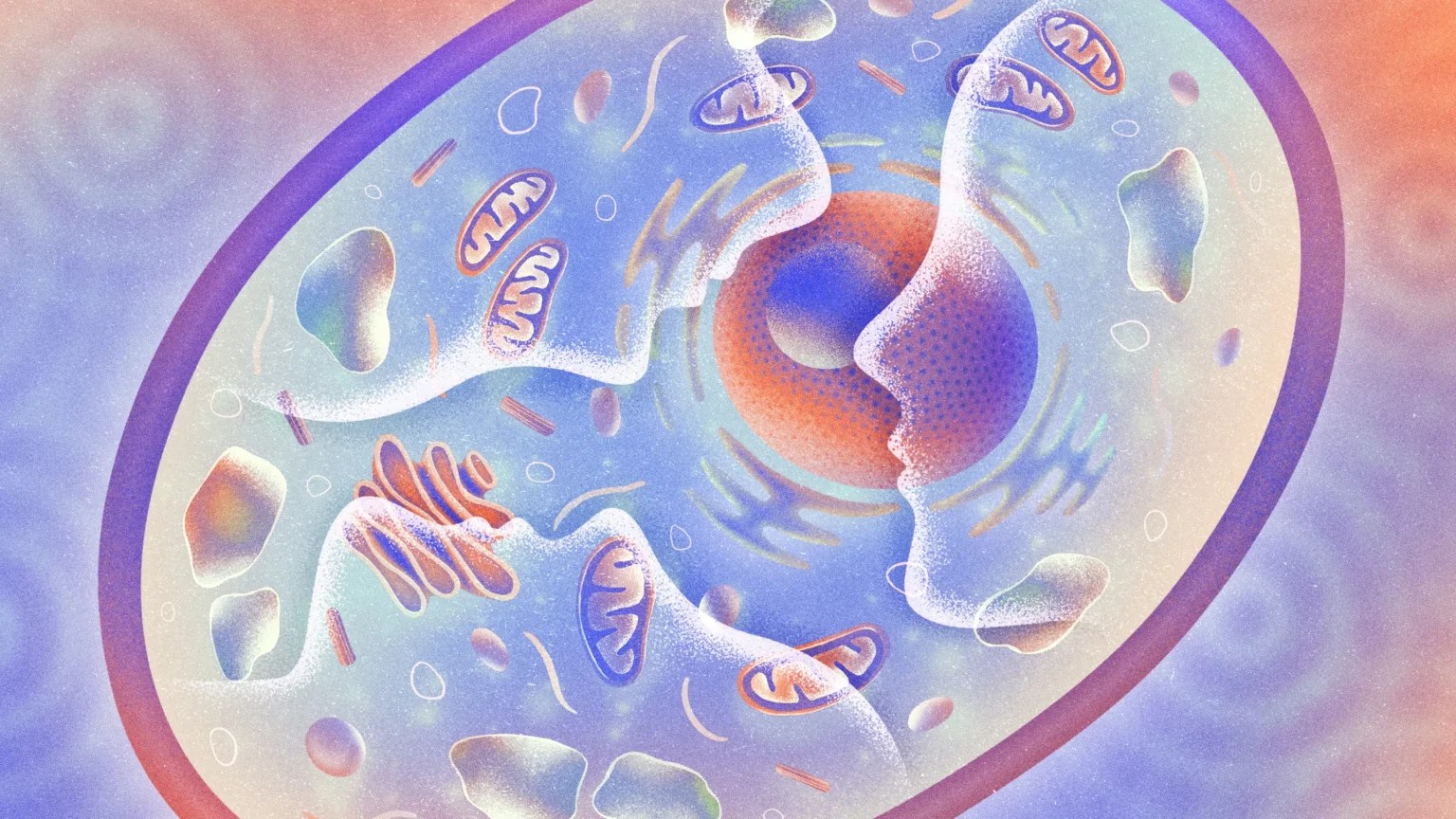
As the redoubtable Claire L. Evans [and here] reports, a small but enthusiastic group of neuroscientists is exhuming overlooked experiments and performing new ones to explore whether cells record past experiences — fundamentally challenging our understanding of what memory is…
In 1983, the octogenarian geneticist Barbara McClintock stood at the lectern of the Karolinska Institute in Stockholm. She was famously publicity averse — nearly a hermit — but it’s customary for people to speak when they’re awarded a Nobel Prize, so she delivered a halting account of the experiments that had led to her discovery, in the early 1950s, of how DNA sequences can relocate across the genome. Near the end of the speech, blinking through wire-framed glasses, she changed the subject, asking: “What does a cell know of itself?”
McClintock had a reputation for eccentricity. Still, her question seemed more likely to come from a philosopher than a plant geneticist. She went on to describe lab experiments in which she had seen plant cells respond in a “thoughtful manner.” Faced with unexpected stress, they seemed to adjust in ways that were “beyond our present ability to fathom.” What does a cell know of itself? It would be the work of future biologists, she said, to find out.
Forty years later, McClintock’s question hasn’t lost its potency. Some of those future biologists are now hard at work unpacking what “knowing” might mean for a single cell, as they hunt for signs of basic cognitive phenomena — like the ability to remember and learn — in unicellular creatures and nonneural human cells alike. Science has long taken the view that a multicellular nervous system is a prerequisite for such abilities, but new research is revealing that single cells, too, keep a record of their experiences for what appear to be adaptive purposes.
In a provocative study published in Nature Communications late last year, the neuroscientist Nikolay Kukushkin and his mentor Thomas J. Carew at New York University showed that human kidney cells growing in a dish can “remember” patterns of chemical signals when they’re presented at regularly spaced intervals — a memory phenomenon common to all animals, but unseen outside the nervous system until now. Kukushkin is part of a small but enthusiastic cohort of researchers studying “aneural,” or brainless, forms of memory. What does a cell know of itself? So far, their research suggests that the answer to McClintock’s question might be: much more than you think…
[Evans explains the prevailing wisdom, outlines the experiments that have challenged it, and unpacks (at least some reasons for) resistance to the notion of cellular-scale memory, both sociological and semantic…]
… In neuroscience, [biochemist and neuroscientist Nikolay] Kukushkin writes, the most common definition of memory is that it’s what remains after experience to change future behavior. This is a behavioral definition; the only way to measure it is to observe that future behavior. Think of S. roeselii snapping back into its holdfast, or a lab rat freezing up at the sight of an electrified maze it’s tangled with before. In these cases, how an organism reacts is a clue that prior experience left a lingering trace.
But is a memory only a memory when it’s associated with an external behavior? “It seems like an arbitrary thing to decide,” Kukushkin said. “I understand why it was historically decided to be that, because [behavior] is the thing you can measure easily when you’re working with an animal. I think what happened is that behavior started as something that you could measure, and then it ended up being the definition of memory.”
Behavior tells us that a memory has formed but says nothing about why, how or where. Further, it’s constrained by scale. Take Aplysia californica, a muscular sea slug with enormous neurons (the largest is about the size of a letter on a U.S. penny). Neuroscientists love to conduct memory experiments on Aplysia because its physical responses are easy to measure — poke it and it flinches — and they map cleanly to the handful of sensory and motor neurons involved.
The sea slug, Kukushkin said, can complicate neuroscience’s behavioral bias. Say you shock its tail, triggering a defensive reflex. If you shock it again the next day and find that the defensive reflex is stronger than it was before, that’s behavioral evidence that the slug remembers its initial shock. Any neuroscientist would associate it with a memory.
But what if (apologies to the squeamish) you take that sea slug apart and leave only its immobile neurons? Unlike the intact creature, the neurons can’t retract, so there will be no visible response. Is the memory gone? Certainly not, but without external validation, a behavioral definition of memory breaks down. “We no longer call that a memory,” Kukushkin said. “We call that a mechanism for a memory, we call that synaptic change underlying memory, we call that an analogue of memory. But we don’t call that a memory, and I think that it’s arbitrary.”
Perhaps a definition of memory should extend beyond behavior to encompass more records of the past. A vaccination is a kind of memory. So is a scar, a child, a book. “If you make a footprint, it’s a memory,” Gershman said. An interpretation of memory as a physical event — as a mark made on the world, or on the self — would encompass the biochemical changes that occur within a cell. “Biological systems have evolved to harness those physical processes that retain information and use them for their own purposes,” [cognitive scientist Sam] Gershman said.
So, what does a cell know of itself? Perhaps a better version of Barbara McClintock’s question is: What can a cell remember? When it comes to survival, what a cell knows of itself isn’t as important as what it knows of the world: how it incorporates information about its experiences to determine when to bend, when to battle and when to make a break for it.
A cell preserves the information that preserves its existence. And in a sense, so do we. As today’s cellular memory researchers revisit abandoned experimental threads from the past, they too are discovering what memory owes to its context, how science’s sociological environment can determine which ideas are preserved and which are forgotten. It’s almost as though a field is waking up from a 50-year spell of amnesia. Fortunately, the memories are flooding back…
“What Can a Cell Remember?” from @theuniverse.bsky.social in @quantamagazine.bsky.social.
For more on the work that got Barbara McClintock onto the Nobel podium see here.
And, also apposite, a pair of cautionary historical examples of scientists who followed Jean-Baptiste Lamarck, who argued in the early 19th century that an organism can pass on to its offspring physical characteristics that the parent organism acquired through use or disuse during its lifetime– that’s to say that learning (a kind of memory) is heritable… and went astray: Lysenko and Kammerer [and here].
* James Gleick, The Information
###
As we muse on memory (and note that one cannot remember– and learn from– what one cannot know), we might recall that it was on this date in 1735 that New York Weekly Journal publisher and writer John Peter Zenger was acquitted of seditious libel against the royal governor of New York, William Cosby, on the basis that what he had published was true.
In 1733, Zenger had begun printing The New York Weekly Journal, voicing opinions critical of the colonial governor. On November 17, 1734, on Cosby’s orders, the sheriff arrested Zenger. After a grand jury refused to indict him, the Attorney General Richard Bradley charged him with libel. Zenger’s lawyers, Andrew Hamilton and William Smith, Sr., successfully argued that truth is a defense against charges of libel… and Zenger became a symbol for freedom of the press.

“Energy is liberated matter, matter is energy waiting to happen”*…

We’ve certainly come a long way since the ancient Greek atomists speculated about the nature of material substance, 2,500 years ago. But for much of this time we’ve held to the conviction that matter is a fundamental part of our physical universe. We’ve been convinced that it is matter that has energy. And, although matter may be reducible to microscopic constituents, for a long time we believed that these would still be recognizable as matter—they would still possess the primary quality of mass.
Modern physics teaches us something rather different, and deeply counter-intuitive. As we worked our way ever inward—matter into atoms, atoms into sub-atomic particles, sub-atomic particles into quantum fields and forces—we lost sight of matter completely. Matter lost its tangibility. It lost its primacy as mass became a secondary quality, the result of interactions between intangible quantum fields. What we recognize as mass is a behavior of these quantum fields; it is not a property that belongs or is necessarily intrinsic to them.
Despite the fact that our physical world is filled with hard and heavy things, it is instead the energy of quantum fields that reigns supreme. Mass becomes simply a physical manifestation of that energy, rather than the other way around…
Modern physics has taught us that mass is not an intrinsic property: “Physics Has Demoted Mass.”
* Bill Bryson, A Short History of Nearly Everything
###
As we watch all that is solid melt into air, we might spare a jaundiced thought for Trofim Denisovich Lysenko; he died on this date in 1976. A Soviet biologist and agronomist, he believed the Mendelian theory of heredity to be wrong, and developed his own, allowing for “soft inheritance”– the heretability of learned behavior. (He believed that in one generation of a hybridized crop, the desired individual could be selected and mated again and continue to produce the same desired product, without worrying about separation/segregation in future breeds.–he assumed that after a lifetime of developing (acquiring) the best set of traits to survive, those must be passed down to the next generation.)
In many way Lysenko’s theories recall Lamarck’s “organic evolution” and its concept of “soft evolution” (the passage of learned traits), though Lysenko denied any connection. He followed I. V. Michurin’s fanciful idea that plants could be forced to adapt to any environmental conditions, for example converting summer wheat to winter wheat by storing the seeds in ice. With Stalin’s support for two decades, he actively obstructed the course of Soviet biology and caused the imprisonment and death of many of the country’s eminent biologists who disagreed with him.
Interestingly, some current research suggests that heritable learning– or a semblance of it– may in fact be happening, by virtue of epigenetics… though nothing vaguely resembling Lysenko’s theory.
“The greatest enemy of knowledge is not ignorance, it is the illusion of knowledge”*…

We’ve looked before at the methodological problems that beset (too) much science, and at the work of John Ioannidis, who’s done more than anyone else to uncover them (see here and here). Ioannidis is back… and the news is troubling:
Over the past decade, scientists have increasingly become ashamed at the failings of their own profession: due to a lack of self-policing and quality control, a large proportion of studies have not been replicable, scientific frauds have flourished for years without being caught, and the pressure to publish novel findings—instead of simply good science—has become the commanding mantra. In what might be one of the worst such failings, a new study suggests that even systematic reviews and meta-analyses—typically considered the highest form of scientific evidence—are now in doubt.
The study comes from a single author: John Ioannidis, a highly respected researcher at Stanford University, who has built his reputation showing other scientists what they get wrong. In his latest work, Ioannidis contends that “the large majority of produced systematic reviews and meta-analyses are unnecessary, misleading, or conflicted.”
Systematic reviews and meta-analyses are statistically rigorous studies that synthesize the scientific literature on a given topic. If you aren’t a scientist or a policymaker, you may have never heard of them. But you have almost certainly been affected by them.If you’ve ever taken a medicine for any ailment, you’ve likely been given the prescription based on systematic reviews of evidence for that medication. If you’ve ever been advised to use a standing desk to improve your health, it’s because experts used meta-analyses of past studies to make that recommendation. And government policies increasingly rely on conclusions stemming from evidence found in such reviews. “We put a lot of weight and trust on them to understand what we know and how to make decisions,” Ioannidis says…
More at “The man who made scientists question themselves has just exposed huge flaws in evidence used to give drug prescriptions.” See also “The Inevitable Evolution of Bad Science” and “Trouble at the Lab.”
And lest we think “hard scientists” alone in their misery, consider the plight of economists: “The Emperor’s New Paunch.”
*Daniel J. Boorstin
###
As we check, check, and check again, we might send disingenuous birthday greetings to Trofim Denisovich Lysenko; he was born on this date in 1898. A Soviet biologist and agronomist, he believed the Mendelian theory of heredity to be wrong, and developed his own, allowing for “soft inheritance”– the heretability of learned behavior. (He believed that in one generation of a hybridized crop, the desired individual could be selected and mated again and continue to produce the same desired product, without worrying about separation/segregation in future breeds.–he assumed that after a lifetime of developing (acquiring) the best set of traits to survive, those must be passed down to the next generation.)
In many way Lysenko’s theories recall Lamarck’s “organic evolution” and its concept of “soft evolution” (the passage of learned traits), though Lysenko denied any connection. He followed I. V. Michurin’s fanciful idea that plants could be forced to adapt to any environmental conditions, for example converting summer wheat to winter wheat by storing the seeds in ice. With Stalin’s support for two decades, he actively obstructed the course of Soviet biology and caused the imprisonment and death of many of the country’s eminent biologists who disagreed with him.
Interestingly, some current research suggests that heretable learning– or a semblance of it– may in fact be happening, by virtue of epigenetics… though nothing vaguely resembling Lysenko’s theory.

You must be logged in to post a comment.