Posts Tagged ‘funding’
“When you mix science and politics, you get politics:*…
Tina Hesman Saey on a looming threat to the U.S…
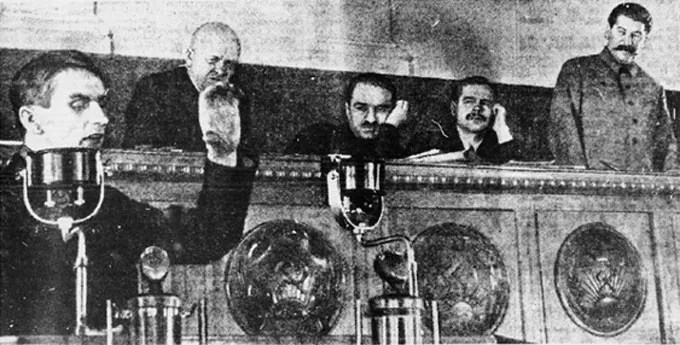
Soviet scientists in the 1930s knew what could happen if they bucked the party line: denunciation, firing and banishment from the scientific establishment, even imprisonment and death. Political reprisals against those who opposed the views of dictator Joseph Stalin and his followers — and the dubious science they endorsed — led to the starvation of millions, as well as to decades of lost progress in fields from agriculture to molecular biology.
Now, scientists are warning that history could repeat itself — but in the United States.
A new proposal from the U.S. Office of Management and Budget would put political appointees in charge of funding decisions traditionally overseen by scientists. In recent years, the federal government has funded about 40 percent of basic science research in the United States.
The OMB’s more than 400-page proposed rule change would let political appointees decide how to hand out federal research funds and who can get them. It would cut funding for collaboration with scientists in other countries and restrict scientists’ ability to communicate their findings. What’s more, it could prevent research on matters that President Donald Trump’s administration has deemed “not in the national interest” — such as studies on health disparities, mRNA-based vaccines and research that doesn’t recognize biological sex as a strict binary.
The new rules would also give OMB the power to rescind previously approved research funds. The proposal “poses a sweeping threat to federal grantmaking and the responsible stewardship of American taxpayer dollars,” the science advocacy group Stand Up for Science Foundation said in a report. In addition, it would impact nonscientific grants supporting services for mental health, housing, education, veterans and Tribal nations, affecting the health and well-being of millions.
So far, OMB has received more than 98,000 comments on the proposal. The public comment period closes July 13. It then will be up to OMB to decide whether to keep the rule as is, revise it or scrap it.
These far-reaching measures are already drawing parallels to dark moments in scientific history. Some researchers say the recent mass firings, policy changes and grant cancellations at federal research institutions, including the U.S. National Institutes of Health and Centers for Disease Control and Prevention, closely mirror what happened in the U.S.S.R. under Stalin. “A similar threat now hangs over U.S. science,” the editorial board of The New England Journal of Medicine wrote in June.
Its editorial invoked the example of Trofim Lysenko [see here], an agronomist and astute political operator who rose to power in the 1930s Soviet Union under Stalin.
Until the 1930s, “the Soviet Union was a real powerhouse in the field of genetics,” says Lee Dugatkin, an evolutionary biologist and historian of science at the University of Louisville in Kentucky.
Then, Lysenko came along. “This guy was your sort of classic charlatan,” Dugatkin says. “He had the equivalent of a mail order degree in agriculture, but he was quite good with the press, and he started to basically spread this idea out there that he was capable of dramatically increasing crop yield, particularly wheat.”
Lysenko’s supposed innovation was a process called vernalization and amounted to soaking seeds in freezing water. The resulting plants — and all their offspring — should be resistant to the U.S.S.R.’s famously cold winters, Lysenko reasoned.
His reasoning was based on a disproven idea in evolutionary biology called Lamarckian inheritance. French biologist Jean-Baptiste Lamarck and his followers thought that things an organism experiences in its lifetime can be handed down to the next generation. The classic example is a giraffe that has to stretch to reach leaves producing offspring with long necks.
This idea ran counter to Mendelian genetics, which holds that genes — not environmental influences — control traits and are passed to offspring. Mendelian geneticists thought it would take five years to breed more cold-tolerant crops. Lysenko said he could do it in two to three years.
Stalin didn’t have time to wait. He was trying to get collective farms going and needed to increase crop yields to feed more than 150 million people. Large parts of the country had already suffered from famine in 1932 and 1933 and about 6 million people died. Some resorted to cannibalism.
Stalin embraced Lysenko’s quick-fix approach. That decision, says Michael Gordin, a historian of science at Princeton University, was “something that the majority of people at the time, and everyone since, considers the wrong side of the dispute.”
Lysenko was put in charge of a prestigious genetics institute and forced his scientifically unsound farming practices on the collective farms. His methods were disastrous.
Soaking seeds in freezing water hampered germination, leading to crop losses. Millions starved. Meanwhile, Mendelian genetics was branded a “whore of capitalism,” and geneticists were forced to renounce their views or lose their jobs. Many were jailed, and almost a dozen were executed or died in prison.
The Soviet Union lost its scientific leadership role and sat on the sidelines for important scientific discoveries of the 1950s and beyond. One, Gordin says, was the development of “massively” productive hybrid corn. The country also missed out on the discovery of DNA and the advent of molecular biology, putting Soviet genetics decades behind the rest of the world.
Soviet genetics did not recover from Lysenko’s influence until after the break-up of the Soviet Union in the late 1980s and early 1990s, Gordin says. “I think you’d be hard pressed to find anybody who thinks that … Russia is today, or Ukraine, or any post-Soviet successor state, is a leading molecular biology country.”…
The Soviets did it, and it didn’t end well: “Here’s what happens when you put politicians in charge of science,” from @thsaey.bsky.social in @sciencenews.bsky.social.
See also: Idiocracy
###
As we remember the past so as not to repeat it, we might recall that it was on this date in 1834 that the Spanish Inquisition (finally) ended. Authorized by Pope Sixtus IV in 1478, the Inqusition was initially led by inquisitors (Miguel de Morillo and Juan de San Martín) who were appointed by the future Catholic monarchs, King Ferdinand II of Aragon and Queen Isabella I of Castile. It was originally (ostensibly) intended primarily to identify heretics; its aim, to maintain Christian orthodoxy. But it became an effective instrument of state power by replacing the Medieval Inquisition, which was under Papal control.
Over its course, the Inquisition prosecuted an estimated 150,000 people for various offences. An estimated 3,000–5,000 were turned over to the state for execution, particularly in the initial 50 years, mostly by burning at the stake. Other punishments included penance and public flogging, exile, enslavement on galleys, and prison terms ranging from several years to life. In many of these punishments an important motive was the confiscation of all the victims’ property.
As Monty Python observed, “nobody expects the Spanish Inquisition.” And nobody expected it to last 356 years.

“The sole aim of journalism should be service”*…

Journalism in the U.S. is in turmoil, beset by cultural shifts, technology, economics, and politics. Today, two thoughful pieces on what its future could hold.
First, from Richard Gingras, a long (and fascinating and provocative) piece that diagnoses the situation, traces its evolution, and posits (at least approaches to) solutions. Eminently worth reading in full. Here, an excerpt especially resonant for your correspondent…
… I recently revisited the work of Robert Putnam. Putnam has researched the connection between effective governance and community engagement for five decades. He began his work in Italy, which in 1975 shifted power from the central government to the provinces. He found that the strongest corollary with effective governance was community engagement.
Basically, people in regions of ineffective governance were not joining clubs, they weren’t going on picnics or joining bowling leagues. They weren’t getting to know people who were different from them. They weren’t building a shared reality. They weren’t building social capital.
This is the result of many factors: the rise of television, increased suburbanization, the impact of technology and the Internet. The result is increased isolation, a narrowing of empathy, a reduction in common interest. Without community and real world social engagement we are not exposed to the diversity of our communities. We lose the opportunity to understand the challenges and the attributes of people who are not like us. If we don’t engage with the other, with those who are not like us, we become more vulnerable to perceiving the other from an isolated, removed, silo of fear.
Our greatest opportunity may be at the community level, by rethinking the role of a community news organization as a community platform suited to our modern digital world.
First, its explicit mission would be to strengthen the community, to both address the community’s information needs and create opportunities for engagement. In seeking to bring the diversity of a community together, it would also strive to be assiduously apolitical. Again, we inform, you decide.
Second, it would celebrate the community’s hopes and dreams, giving focus to its successes, to examples of civic empathy, as well as being the watchdog for misbehavior.
It would purposely address the community’s broad information needs — community events, local sports, the progression of life from birth to obituary. It would leverage topics of community interest that aren’t controversial. A recent mega-study coordinated by Stanford University determined the best method of addressing divisiveness is to engage the community on non-controversial subjects. This can help unify a community and build the trust necessary to address more difficult topics.
We see accountability journalism as the priority, to ferret out corruption, to expose criminal behavior. It is critical. But the audience for serious accountability journalism is small, in the low single digits. By addressing a community’s comprehensive information needs with service journalism, we can provide value to the community and gain exponentially higher engagement. This both drives the business model and increases the impact of accountability journalism by exposing it to those who might not seek it out…
– “The evolution of media and democracy. How we got here. How we might move forward.“
Next, a piece from Patrice Schneider, the Chief Strategy Officer of Media Development Investment Fund, suggesting a funding approach that might make (more quality) journalism (more) viable. While his lens is global, the applicability to the U.S. is clear…
In the dynamic landscape of independent media funding, a three-decade-old model is gaining renewed attention among European foundations. It challenges the traditional dichotomy between grant support and market-driven investments. This innovative approach, known as the Third Way, offers a nuanced economic strategy that quantifies the intrinsic societal value of quality public interest information.
The Third Way recognizes quality information as critical infrastructure, akin to highways or electrical grids. Its value extends beyond immediate monetary returns, encompassing its capacity to sustain democratic dialogue, enable informed citizenship, and provide systemic transparency…
… The Third Way’s most profound insight is recognising the broad constituency invested in quality information:
- Corporations require reliable, unbiased data for strategic decision-making.
- Financial institutions depend on transparent market intelligence.
- Civil society organizations need independent reporting to monitor power structures
- Individual citizens seek credible narratives to navigate complex global challenges
- Sustainable Development Goals (SDGs) fundamentally rely on access to accurate, independent information
By aligning these diverse interests, the model transcends traditional funding dichotomies; grants versus investments or market versus public funding.
And it’s not just about extracting more from philanthropy, but about creating a blended infrastructure of funding that recognises information as a shared societal resource...
– “The Third Way of Funding Independent Media” (again, eminently worth reading in full)
(Full disclosure, both Richard and Patrice are colleagues. MDIF– originally Media Development Loan Fund– was founded by an old friend, Saša Vučinić, and your correspondent was an early investor.)
* Mahatma Gandhi
###
As we nourish the news, we might spare a thought for Alistair Cooke; he died on this date in 2004. While best known ot American audiences as a television host (Omnibus, Masterpiece Theatre), he had a long career as a journalist (for the BBC, NBC, The Gaurdian, and others) and author.
After Alistair Cooke’s death the Fulbright Alistair Cooke Award in Journalism was established as a tribute to his life and career achievements. The award supports students from the United Kingdom to undertake studies in the United States, and for Americans to study in the United Kingdom.

“You’re mugging old ladies every bit as much if you pinch their pension fund”*…

Who benefits from the commercial biomedical research and development (R&D)? Patients-consumers and investors-shareholders have traditionally been viewed as two distinct groups with conflicting interests: shareholders seek maximum profits, patients – maximum clinical benefit. However, what happens when patients are the shareholders?…
Adding investments by governmentally-mandated retirement schemes, central and promotional banks, and sovereign wealth funds to tax-derived governmental financing shows that the majority of biomedical R&D funding is public in origin. Despite this, even in the high-income countries patients can be denied access to effective treatments due to their high cost. Since these costs are set by the drug development firms that are owned in substantial part by the retirement accounts of said patients, the complex financial architecture of biomedical R&D may be inconsistent with the objectives of the ultimate beneficiaries…
It has been estimated that of the total $265 billion spent annually on biomedical research worldwide, over a third – $103 billion comes from public sources. Nevertheless, as public input capital is allocated predominantly into early stage research, nearly all output – medicines – is ultimately brought to the market by private firms. Importantly, these firms are not independent agents. They have owners-shareholders to report to. Until the end of the previous century the major type of owners-shareholders were individual households. At the turn of the millennium, however, they have been displaced by institutional investors, the largest of which are public retirements schemes or quasi-public funds, such as occupational pensions.

First, government money underwrites the basic R&D that goes into drug discovery and development, then public pension monies fund the private companies that bring those drugs to market. As the private companies are solving for highest profits, as opposed to optimal public health, those drugs are often priced out of the reach of the very people whose pension contributions funded their development. Drugs “priced out of reach” is certainly not a new phenomenon; AIDS drugs (to take one example) were priced by Western pharma companies at prices that rendered them inaccessible to most citizens of low-income countries in Africa and Asia. The pensioners in wealthy nations were, effectively, living off of the misery of those in poorer companies.
But the dynamic has continued, deepened– and come home to roost. Now patients in high-income countries are denied access to effective treatments due to their high cost, while these costs are being set by the drug development firms, owned in substantial part by the retirement accounts of those same patients, and benefiting from direct and indirect governmental support.
Investing in one’s own misery– the painful irony of pharma funding: “Pension and state funds dominating biomedical R&D investment: fiduciary duty and public health.”
[Image above: source]
* Ben Elton, Meltdown
###
As we untangle unintended consequences, we might send healthy birthday greetings to Charles Value Chapin; he was born on this date in 1856. A physician and epidemiologist, he was a pioneer in American public health. He co-founded in first bacteriological laboratory in the U.S. (in 1888) in Providence, were he was Superintendent of Health– a position he held for 48 years. In 1910, he established Providence City Hospital where infectious disease carriers could be isolated under aseptic nursing conditions; his success inspired similar health control measures throughout the U.S. A professor (at Brown) and prolific writer, his impact on health policy and practice was so broad that he was hailed as “the Dean of City Public Health Officials.”

“The very existence of libraries affords the best evidence that we may yet have hope for the future of man”*…

The Annual Library Budget Survey, a global study that queries 686 senior librarians about their budget spending predictions for the year, was published last week by the Publishers Communication Group (PCG), a consultancy wing of Ingenta, the self-described “largest supplier of technology and related services for the publishing industry.” The survey found uneven growth expectations for libraries worldwide…
Check it out at “How Are Libraries Doing Around the World?”
* (Groucho Marx’s buddy) T.S. Eliot
###
As we keep our voices down, we might send informative birthday greetings to Sir Timothy John Berners-Lee OM KBE FRS FREng FRSA FBCS; he was born on this date in 1955. While working as a Fellow at CERN in 1989, he invented the World Wide Web, developing and demonstrating the first successful communication between a Hypertext Transfer Protocol (HTTP) client and server via the Internet. Currently the director of the World Wide Web Consortium (W3C), which oversees the continued development of the Web, he remains a staunch defender of an open Web and the free flow of information.
[On the heels of yesterday’s almanac entry, should “Internet” be capitalized?]

You must be logged in to post a comment.