Posts Tagged ‘OMB’
“When you mix science and politics, you get politics:*…
Tina Hesman Saey on a looming threat to the U.S…
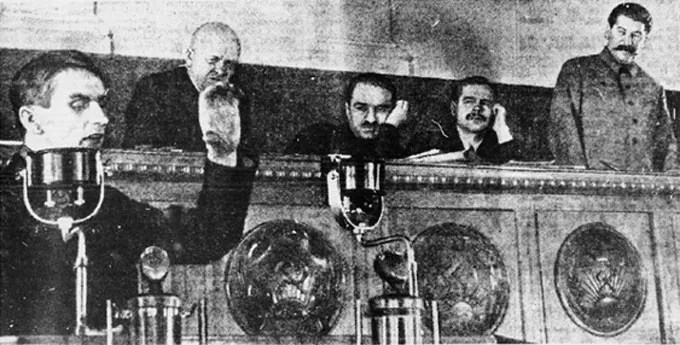
Soviet scientists in the 1930s knew what could happen if they bucked the party line: denunciation, firing and banishment from the scientific establishment, even imprisonment and death. Political reprisals against those who opposed the views of dictator Joseph Stalin and his followers — and the dubious science they endorsed — led to the starvation of millions, as well as to decades of lost progress in fields from agriculture to molecular biology.
Now, scientists are warning that history could repeat itself — but in the United States.
A new proposal from the U.S. Office of Management and Budget would put political appointees in charge of funding decisions traditionally overseen by scientists. In recent years, the federal government has funded about 40 percent of basic science research in the United States.
The OMB’s more than 400-page proposed rule change would let political appointees decide how to hand out federal research funds and who can get them. It would cut funding for collaboration with scientists in other countries and restrict scientists’ ability to communicate their findings. What’s more, it could prevent research on matters that President Donald Trump’s administration has deemed “not in the national interest” — such as studies on health disparities, mRNA-based vaccines and research that doesn’t recognize biological sex as a strict binary.
The new rules would also give OMB the power to rescind previously approved research funds. The proposal “poses a sweeping threat to federal grantmaking and the responsible stewardship of American taxpayer dollars,” the science advocacy group Stand Up for Science Foundation said in a report. In addition, it would impact nonscientific grants supporting services for mental health, housing, education, veterans and Tribal nations, affecting the health and well-being of millions.
So far, OMB has received more than 98,000 comments on the proposal. The public comment period closes July 13. It then will be up to OMB to decide whether to keep the rule as is, revise it or scrap it.
These far-reaching measures are already drawing parallels to dark moments in scientific history. Some researchers say the recent mass firings, policy changes and grant cancellations at federal research institutions, including the U.S. National Institutes of Health and Centers for Disease Control and Prevention, closely mirror what happened in the U.S.S.R. under Stalin. “A similar threat now hangs over U.S. science,” the editorial board of The New England Journal of Medicine wrote in June.
Its editorial invoked the example of Trofim Lysenko [see here], an agronomist and astute political operator who rose to power in the 1930s Soviet Union under Stalin.
Until the 1930s, “the Soviet Union was a real powerhouse in the field of genetics,” says Lee Dugatkin, an evolutionary biologist and historian of science at the University of Louisville in Kentucky.
Then, Lysenko came along. “This guy was your sort of classic charlatan,” Dugatkin says. “He had the equivalent of a mail order degree in agriculture, but he was quite good with the press, and he started to basically spread this idea out there that he was capable of dramatically increasing crop yield, particularly wheat.”
Lysenko’s supposed innovation was a process called vernalization and amounted to soaking seeds in freezing water. The resulting plants — and all their offspring — should be resistant to the U.S.S.R.’s famously cold winters, Lysenko reasoned.
His reasoning was based on a disproven idea in evolutionary biology called Lamarckian inheritance. French biologist Jean-Baptiste Lamarck and his followers thought that things an organism experiences in its lifetime can be handed down to the next generation. The classic example is a giraffe that has to stretch to reach leaves producing offspring with long necks.
This idea ran counter to Mendelian genetics, which holds that genes — not environmental influences — control traits and are passed to offspring. Mendelian geneticists thought it would take five years to breed more cold-tolerant crops. Lysenko said he could do it in two to three years.
Stalin didn’t have time to wait. He was trying to get collective farms going and needed to increase crop yields to feed more than 150 million people. Large parts of the country had already suffered from famine in 1932 and 1933 and about 6 million people died. Some resorted to cannibalism.
Stalin embraced Lysenko’s quick-fix approach. That decision, says Michael Gordin, a historian of science at Princeton University, was “something that the majority of people at the time, and everyone since, considers the wrong side of the dispute.”
Lysenko was put in charge of a prestigious genetics institute and forced his scientifically unsound farming practices on the collective farms. His methods were disastrous.
Soaking seeds in freezing water hampered germination, leading to crop losses. Millions starved. Meanwhile, Mendelian genetics was branded a “whore of capitalism,” and geneticists were forced to renounce their views or lose their jobs. Many were jailed, and almost a dozen were executed or died in prison.
The Soviet Union lost its scientific leadership role and sat on the sidelines for important scientific discoveries of the 1950s and beyond. One, Gordin says, was the development of “massively” productive hybrid corn. The country also missed out on the discovery of DNA and the advent of molecular biology, putting Soviet genetics decades behind the rest of the world.
Soviet genetics did not recover from Lysenko’s influence until after the break-up of the Soviet Union in the late 1980s and early 1990s, Gordin says. “I think you’d be hard pressed to find anybody who thinks that … Russia is today, or Ukraine, or any post-Soviet successor state, is a leading molecular biology country.”…
The Soviets did it, and it didn’t end well: “Here’s what happens when you put politicians in charge of science,” from @thsaey.bsky.social in @sciencenews.bsky.social.
See also: Idiocracy
###
As we remember the past so as not to repeat it, we might recall that it was on this date in 1834 that the Spanish Inquisition (finally) ended. Authorized by Pope Sixtus IV in 1478, the Inqusition was initially led by inquisitors (Miguel de Morillo and Juan de San Martín) who were appointed by the future Catholic monarchs, King Ferdinand II of Aragon and Queen Isabella I of Castile. It was originally (ostensibly) intended primarily to identify heretics; its aim, to maintain Christian orthodoxy. But it became an effective instrument of state power by replacing the Medieval Inquisition, which was under Papal control.
Over its course, the Inquisition prosecuted an estimated 150,000 people for various offences. An estimated 3,000–5,000 were turned over to the state for execution, particularly in the initial 50 years, mostly by burning at the stake. Other punishments included penance and public flogging, exile, enslavement on galleys, and prison terms ranging from several years to life. In many of these punishments an important motive was the confiscation of all the victims’ property.
As Monty Python observed, “nobody expects the Spanish Inquisition.” And nobody expected it to last 356 years.

You must be logged in to post a comment.