Posts Tagged ‘Spanish Inquisition’
“When you mix science and politics, you get politics:*…
Tina Hesman Saey on a looming threat to the U.S…
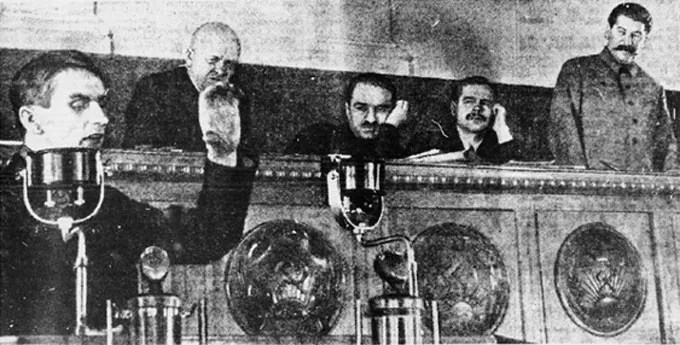
Soviet scientists in the 1930s knew what could happen if they bucked the party line: denunciation, firing and banishment from the scientific establishment, even imprisonment and death. Political reprisals against those who opposed the views of dictator Joseph Stalin and his followers — and the dubious science they endorsed — led to the starvation of millions, as well as to decades of lost progress in fields from agriculture to molecular biology.
Now, scientists are warning that history could repeat itself — but in the United States.
A new proposal from the U.S. Office of Management and Budget would put political appointees in charge of funding decisions traditionally overseen by scientists. In recent years, the federal government has funded about 40 percent of basic science research in the United States.
The OMB’s more than 400-page proposed rule change would let political appointees decide how to hand out federal research funds and who can get them. It would cut funding for collaboration with scientists in other countries and restrict scientists’ ability to communicate their findings. What’s more, it could prevent research on matters that President Donald Trump’s administration has deemed “not in the national interest” — such as studies on health disparities, mRNA-based vaccines and research that doesn’t recognize biological sex as a strict binary.
The new rules would also give OMB the power to rescind previously approved research funds. The proposal “poses a sweeping threat to federal grantmaking and the responsible stewardship of American taxpayer dollars,” the science advocacy group Stand Up for Science Foundation said in a report. In addition, it would impact nonscientific grants supporting services for mental health, housing, education, veterans and Tribal nations, affecting the health and well-being of millions.
So far, OMB has received more than 98,000 comments on the proposal. The public comment period closes July 13. It then will be up to OMB to decide whether to keep the rule as is, revise it or scrap it.
These far-reaching measures are already drawing parallels to dark moments in scientific history. Some researchers say the recent mass firings, policy changes and grant cancellations at federal research institutions, including the U.S. National Institutes of Health and Centers for Disease Control and Prevention, closely mirror what happened in the U.S.S.R. under Stalin. “A similar threat now hangs over U.S. science,” the editorial board of The New England Journal of Medicine wrote in June.
Its editorial invoked the example of Trofim Lysenko [see here], an agronomist and astute political operator who rose to power in the 1930s Soviet Union under Stalin.
Until the 1930s, “the Soviet Union was a real powerhouse in the field of genetics,” says Lee Dugatkin, an evolutionary biologist and historian of science at the University of Louisville in Kentucky.
Then, Lysenko came along. “This guy was your sort of classic charlatan,” Dugatkin says. “He had the equivalent of a mail order degree in agriculture, but he was quite good with the press, and he started to basically spread this idea out there that he was capable of dramatically increasing crop yield, particularly wheat.”
Lysenko’s supposed innovation was a process called vernalization and amounted to soaking seeds in freezing water. The resulting plants — and all their offspring — should be resistant to the U.S.S.R.’s famously cold winters, Lysenko reasoned.
His reasoning was based on a disproven idea in evolutionary biology called Lamarckian inheritance. French biologist Jean-Baptiste Lamarck and his followers thought that things an organism experiences in its lifetime can be handed down to the next generation. The classic example is a giraffe that has to stretch to reach leaves producing offspring with long necks.
This idea ran counter to Mendelian genetics, which holds that genes — not environmental influences — control traits and are passed to offspring. Mendelian geneticists thought it would take five years to breed more cold-tolerant crops. Lysenko said he could do it in two to three years.
Stalin didn’t have time to wait. He was trying to get collective farms going and needed to increase crop yields to feed more than 150 million people. Large parts of the country had already suffered from famine in 1932 and 1933 and about 6 million people died. Some resorted to cannibalism.
Stalin embraced Lysenko’s quick-fix approach. That decision, says Michael Gordin, a historian of science at Princeton University, was “something that the majority of people at the time, and everyone since, considers the wrong side of the dispute.”
Lysenko was put in charge of a prestigious genetics institute and forced his scientifically unsound farming practices on the collective farms. His methods were disastrous.
Soaking seeds in freezing water hampered germination, leading to crop losses. Millions starved. Meanwhile, Mendelian genetics was branded a “whore of capitalism,” and geneticists were forced to renounce their views or lose their jobs. Many were jailed, and almost a dozen were executed or died in prison.
The Soviet Union lost its scientific leadership role and sat on the sidelines for important scientific discoveries of the 1950s and beyond. One, Gordin says, was the development of “massively” productive hybrid corn. The country also missed out on the discovery of DNA and the advent of molecular biology, putting Soviet genetics decades behind the rest of the world.
Soviet genetics did not recover from Lysenko’s influence until after the break-up of the Soviet Union in the late 1980s and early 1990s, Gordin says. “I think you’d be hard pressed to find anybody who thinks that … Russia is today, or Ukraine, or any post-Soviet successor state, is a leading molecular biology country.”…
The Soviets did it, and it didn’t end well: “Here’s what happens when you put politicians in charge of science,” from @thsaey.bsky.social in @sciencenews.bsky.social.
See also: Idiocracy
###
As we remember the past so as not to repeat it, we might recall that it was on this date in 1834 that the Spanish Inquisition (finally) ended. Authorized by Pope Sixtus IV in 1478, the Inqusition was initially led by inquisitors (Miguel de Morillo and Juan de San Martín) who were appointed by the future Catholic monarchs, King Ferdinand II of Aragon and Queen Isabella I of Castile. It was originally (ostensibly) intended primarily to identify heretics; its aim, to maintain Christian orthodoxy. But it became an effective instrument of state power by replacing the Medieval Inquisition, which was under Papal control.
Over its course, the Inquisition prosecuted an estimated 150,000 people for various offences. An estimated 3,000–5,000 were turned over to the state for execution, particularly in the initial 50 years, mostly by burning at the stake. Other punishments included penance and public flogging, exile, enslavement on galleys, and prison terms ranging from several years to life. In many of these punishments an important motive was the confiscation of all the victims’ property.
As Monty Python observed, “nobody expects the Spanish Inquisition.” And nobody expected it to last 356 years.

“I imagine one of the reasons people cling to their hates so stubbornly is because they sense, once hate is gone, they will be forced to deal with pain”*…

Your correspondent is off again, so (R)D will be on hiatus until Friday the 4th. In the meantime…
Dr. Sam Goldstein with an all-to-timely reminder…
Hate is often described as an emotion, but it is actually a learned behavior. Unlike fear, sadness, or love—emotions that are instinctive and universal—hate does not exist independently. It is shaped by fear, anger, stress, and social conditioning, developing over time rather than emerging naturally. Hate can be directed at people, ideas, or entire groups, influencing individuals and societies in ways that range from casual dislike to extreme violence. But if hate is learned, can it be unlearned? To break the cycle, we must understand how hate forms, how it manifests in our language and actions, and what we can do to replace it with something better.
The word “hate” has deep historical roots, originating from the Old English hatian, meaning “to despise” or “to wish evil upon.” It stems from the Proto-Germanic hatajan and the Proto-Indo-European kad, which means “to grieve” or “to suffer.” This connection suggests that hate was initially tied to pain, not necessarily hostility.
Over time, its meaning evolved. Today, people use “hate” casually—saying things like “I hate traffic” or “I hate Mondays”—to express mild annoyance. On social media, phrases like “haters gonna hate” trivialize the concept, making it seem inevitable and dismissing criticism as a product of jealousy or negativity.
But the same word is also used to describe serious moral opposition, such as “I hate injustice” or “I hate oppression.” In its most dangerous form, hate leads to profound social and political divisions, fueling discrimination, violence, and even war. While language shapes how we perceive hate, the real question is why it develops in the first place.
If hate isn’t an emotion, what is it? At its core, hate is a response to fear, stress, and anger. It is reinforced through experience, social pressure, and cultural narratives. Hate is not something we are born with—it is something we learn.
Fear plays a significant role. People often hate what they don’t understand or perceive as a threat. This is why xenophobia and racial prejudice exist. The unfamiliar makes people uncomfortable, and in that discomfort, hate is cultivated.
Stress and anger also fuel hate. When individuals feel powerless, overwhelmed, or frustrated, they search for something to blame. Hate becomes a means to direct negative emotions outward. This is evident in scapegoating, where specific groups are held responsible for economic hardship, crime, or societal decline.
The us vs. them mentality fuels hatred. Humans are inherently tribal, creating groups based on identity—race, nationality, religion, or ideology. This fosters the belief that our group is superior while viewing their group as the enemy. Hatred deepens this divide, making it easier to rationalize discrimination and violence.
Personal experience can turn resentment into hate. A betrayal, ongoing mistreatment, or a history of injustice can lead someone to develop deep-seated hostility. In many cases, what starts as personal pain becomes generalized toward an entire group, reinforcing division cycles.
Hate is also learned. From childhood, individuals absorb beliefs from family, media, and society. When a child grows up in an environment that demonizes certain groups, that perspective often becomes deeply ingrained. This is why racism, sexism, and religious intolerance persist across generations.
Finally, the internet has amplified hate like never before. Social media allows people to express extreme views without accountability. Hate spreads through online mobs, echo chambers, and misinformation, making it more difficult to challenge false narratives and prejudices.
Hate is destructive not just to its targets but also to those who hold it. It consumes energy, distorts reality, and fosters resentment. Research shows that people who cling to hate experience higher levels of stress, anxiety, and even physical health issues. Hate undermines mental and emotional well-being.
On a larger scale, hate causes social division. It tears families apart, fuels political and racial tensions, and makes it nearly impossible for societies to progress together. Hate-driven violence—including hate crimes, terrorism, and genocide—has tragically shaped history, demonstrating that unchecked hatred leads to devastating consequences. However, if hate is learned, it can also be unlearned. The cycle is not inevitable.
The first step in breaking free from hate is awareness. Recognizing that hate is not an emotion, but a response driven by fear, stress, and conditioning allows us to question the origins of our biases. Education plays a crucial role in this process. Exposure to diverse cultures, perspectives, and ideas challenges misconceptions and diminishes fear.
Challenging stereotypes is another powerful tool. Many forms of hate are based on false generalizations. Real-life interactions with people from different backgrounds help dissolve these misconceptions and build bridges instead of walls.
Empathy is the most potent antidote to hate. When we take the time to understand another person’s experiences, it becomes difficult to hold onto hostility. Compassion takes the place of resentment when we realize that those we dislike have struggles, dreams, and fears just like our own.
Letting go of hate requires emotional regulation. Practicing mindfulness, engaging in therapy, or using basic stress management techniques can help individuals break free from cycles of anger and resentment. Though challenging, forgiveness often serves as the key to moving forward.
Constructive dialogue is essential. Many people avoid discussions about complex topics because they fear conflict. But avoiding conversation only deepens the divide. Engaging in open, respectful discussions about race, politics, and ideology can break down barriers and create understanding.
We all share the responsibility of taking action against hate. This can be as simple as opposing discrimination when we see it or supporting organizations that work to dismantle hate. Every act of kindness, every moment of patience, and every attempt to understand another perspective contributes to a world with less hate.
Hate is neither an emotion nor an instinct—it is a habit, a behavior, a learned response. It represents a destructive way of thinking. Just like any habit, it can be changed. While it may feel powerful in the moment, hate ultimately weakens the person who harbors it. It isolates, consumes, and destroys. But we have a choice. Instead of hate, we can choose curiosity. Instead of division, we can select understanding. Instead of anger, we can opt for growth. The opposite of hate isn’t necessarily love—it’s the willingness to listen, learn, and let go. That is something every single one of us can strive for…
How to break a habit that isolates, consumes, and destroys: “Why Do We Hate?” from @drsamgoldstein.bsky.social in @psychologytoday.com.
(Image above: source)
* James Baldwin, The Fire Next Time
###
As we look beyond loathing, we might recall that it was on this date in 1492 that the joint Catholic Monarchs of Spain (Isabella I of Castile and Ferdinand II of Aragon, the patrons of Columbis) issued and “executive order” commanding the expulsion of practising Jews from the Crowns of Castile and Aragon and its territories and possessions within four months, by July 31 of that year– the Alhambra Decree (AKA, the Edict of Expulsion). It had been strongly advocated by the Inquisitor General of Spain, Tomás de Torquemada, “the hammer of heretics, the light of Spain, the saviour of his country, the honor of his order,” per Spanish chronicler Sebastián de Olmedo. Subsequent history has been less kind. By virtue of his approval, even advocacy, of practices including torture and burning at the stake, his name has become synonymous with cruelty, religious intolerance, and fanaticism.

“Nobody expects the Spanish Inquisition”*…

On the long-term effects of suppression and persecution…
From Imperial Rome to the Crusades, to modern North Korea or the treatment of Rohingya in Myanmar, religious persecution has been a tool of state control for millennia.
While its immediate violence and human consequences are obvious, less obvious is whether it leaves scars centuries after it ends.
In a new study we have attempted to examine the present day consequences of one of the longest-running and most meticulously documented persecutions of them all – the trials of the Spanish Inquisition between 1478 to 1834…
Details at “Extraordinarily, the effects of the Spanish Inquisition linger to this day.”
###
As we tolerate, we might recall that it was on this date in 1492 that Catholic monarchs, King Ferdinand II of Aragon and Isabella I of Castile took control of the Emirate of Grenada (1238-1492), the last Moorish stronghold in Spain. King Boabdil surrendered to Spanish forces in the Alhambra palace, surrendering the key to the city– an event Christopher Columbus witnessed as he received the support of the monarchy to sail to the Indies.
Pursuant to the Inquisition, Ferdinand and Isabella had targeted Muslims and Sephardic Jews (also called the Megorashim), forcing them either to convert to Christianity or to leave Spain within four months without any possessions. Failure to leave resulted in torture and/or death.

Boo! (It’s that time again…)

…from the always-amusing xkcd. (The last panel? The Banach-Tarski Paradox: explained here; illustrated here. The “Axiom of Choice”– of which the the B-T Paradox is a case– is explained here.)
As we gird ourselves for the season of horrors, we might recall that it was on this date in 1483 that Tomás de Torquemada was appointed Inquisitor General of Spain (at the behest of Queen Isabella, whose confessor he had been). Called “the hammer of heretics, the light of Spain, the saviour of his country, the honor of his order” by Spanish chronicler Sebastián de Olmedo, Torquemada was a key advocate for the Alhambra Decree (Ferdinand’s and Isabella’s expulsion of the Jews from Spain in 1492) and a zealous prosecutor of “crypto-Jews” and “crypto-Muslims.” While the precise number of deaths on his watch is a matter of debate, there is a general agreement that, between 1480 and 1530, about 2000 people burned in the autos-de-fé of the Spanish Inquisition.

You must be logged in to post a comment.