Posts Tagged ‘demographics’
“You see much more of your children after they leave home”*…

… And so, American parents are seeing less of their 18-24 year-old kids. From David Crowther, a graphic reminder that a historic rite of passage for young people and their parents has changed…
As we enter the peak summer months, many students and newly-minted college graduates are taking their first steps into the big bad world of work. In decades gone by, a wave of weddings often followed and young newlyweds shacked up to leave a huge cohort of “empty nesters” behind. That is no longer the case.
In the late 1960s, nearly 40% of 18-24 year-olds lived with their spouse. Last year, just 6% did.
Indeed, data plotted from the Census Bureau (and inspired by reddit user u/theimpossiblesalad) reveals how dramatically the living arrangements of America’s youngest adults have changed in the last 50+ years…

More on how we now live: “Who do Gen Z and Millennials live with in America?” from @ChiefChartmaker in @chartrdaily.
* Lucille Ball
###
As we ruminate on residence, we might recall that it was on this date in 1910 that those epic enactors of the human condition Krazy Kat (and Ignatz Mouse) first appeared in print, in New York Journal (as the “downstairs” strip in George Herriman’s predecessor comic, The Dingbat Family (later, The Family Upstairs). Krazy, Ignatz, and Offisa Pup stepped out on their own in 1913 and ran until 1944– but never actually succeeded financially. It was only the admiration (and support) of publisher William Randolph Hearst that kept those bricks aloft.

“The braid is always stronger than the strand”*…

From Grace Ebert, a novel look at the world’s densest “city”…
At its height in the 1990s, Kowloon Walled City in Hong Kong housed about 50,000 people. Its population is unremarkable for small cities, but what set Kowloon apart from others of its size was its density. Spanning only 2.6 hectares, the tiny enclave contained [the equivalent of] 1,255,000 people per square kilometer, making it the densest city in the world. For context, New York City boasts about 11,300 per square kilometer, while Manila, the most highly concentrated municipality today, tops out at about 42,000.
Kowloon was built as a small military fort around the turn of the 20th century. When the Chinese and English governments abandoned it after World War II, the area attracted refugees and people in search of affordable housing. With no single architect, the urban center continued to grow as people stacked buildings on top of one another and tucked new structures in between existing ones to accommodate the growing population without expanding beyond the original fort’s border.
With only a small pocket of community space at the center, Kowloon quickly morphed into a labyrinth of shops, services, and apartments connected by narrow stairs and passageways through the buildings. Rather than navigate the city through alleys and streets, residents traversed the structures using slim corridors that always seemed to morph, an experience that caused many to refer to Kowloon as “a living organism.”
The city devolved into a slum with crime and poor living conditions and was razed in 1994. Before demolition, though, a team of Japanese researchers meticulously documented the architectural marvel, which had become a sort of cyberpunk icon that even inspired a gritty arcade as tribute.
For a now out-of-print book titled Kowloon City: An Illustrated Guide, artist Hitomi Terasawa drew a meticulous cross-sectioned rendering of the urban phenomenon to preserve its memory. The massive panorama peers into the compact neighborhood, glimpsing narrow dance halls, laundry dangling from balconies, and entire factories tucked inside cramped quarters.
Thanks to psychologist Greg Jensen, we now have a stunning high-resolution scan of Terasawa’s illustration complete with annotations and diagramming. It’s worth viewing the full panorama in its entirety to zoom in on all the details of this infamous city [and here, animated]. And, for photos of Kowloon and its inhabitants, check out this incredibly informative video detailing its history…
A real-life human hive: “A Rare Cross-Section Illustration Reveals the Infamous Happenings of Kowloon Walled City,” from @Colossal.
* Ryan Graudin, The Walled City
###
As we pack it in, we might we might send the simplest of birthday greetings to a writer, philosopher, and naturalist who might not have gravitated naturally to Kowloon City, Henry David Thoreau; he was born on this date in 1817. From 1845 to 1847, Thoreau lived in a small cabin on the banks of Walden Pond, a small lake near Concord, Massachusetts. Striving to “simplify, simplify,” he strictly limited his expenditures, his possessions, and his contact with others, intending “to live deliberately, to front only the essential facts of life, and see if I could not learn what it had to teach.”
Thoreau became a pillar of New England Transcendentalism, embracing and exemplifying the movement’s belief in the universality of creation and the primacy of personal insight and experience. Perhaps best remembered for his advocacy of simple, principled living, his writings on the relationship between humans and the environment also helped define the nature essay.

“The young, no doubt, make mistakes; but the old, when they try to think for them, make even greater mistakes.”*…
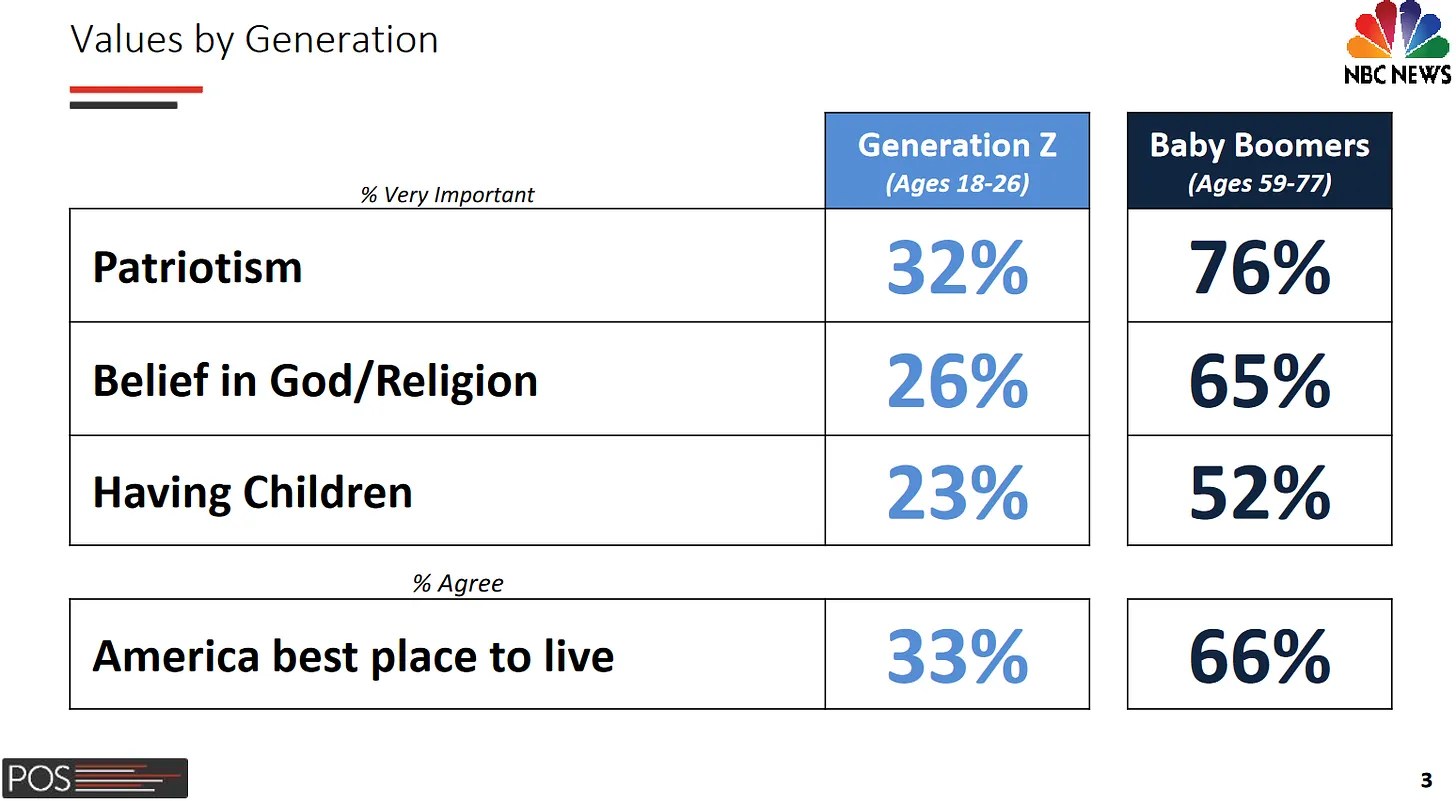
Every Sunday Bruce Mehlman, a Washington insider (a “government relations consultant”) publishes “Six Chart Sunday” in his newsletter, Age of Disruption. They’re always fascinating and informative; this week’s was especially striking.
The chart above and five others, each with brief explanatory summaries, tell the tale of wide “Generation Gaps.”
As Victor Klemperer observed, “A generation has more in common, after all, than a nation, than a profession.”
* Bertrand Russell, Mortals and Others: American Essays 1931-35
###
As we mind the gap, we might recall that it was on this date in 1971 that the Rolling Stones’ Sticky Fingers hit #1 on the U.S. album chart (their second chart-topping album). A critical and popular success, it is also remembered for its cover (conceived by Andy Warhol and photographed and designed by members of his art collective, the Factory, featuring a zippable image of a man’s jeans) and for its introduction of the now ubiquitous tongue and lips logo.

“And these children that you spit on / “As they try to change their worlds / Are immune to your consultations. / They’re quite aware of what they’re going through.”*…

From our friends at The Pudding— specifically, from Alvin Chang— a thorough (and illuminating and bracing) look at how the conditions in which our young are raised have everything to do with how their lives unfold…
In this story, we’ll follow hundreds of teenagers for the next 24 years, when they’ll be in their late-30s. They’re among the thousands of kids who are part of the National Longitudinal Survey of Youth. This means researchers have followed them since their teenage years to the present day – and beyond.
As Matt Muir observes in his invaluable Web Curios…
… Very North America-centric in terms of the data it’s drawing on, but wherever you are in the world the themes that it speaks to will apply – drawing on data about the life experiences of young people tracked by US statisticians….
As you scroll you see visual representations of the proportion of kids in each agegroup coterie who will experience ‘significant’ life events, from crime to poverty and beyond, and how those life events will go on to impact their academic prospects and, eventually, their life prospects – none of this should be surprising, but it’s a hugely-effective way of communicating the long-term impacts of relatively small differences in early-stage life across a demographic swathe…
Data visualization at its best and most compelling: “This Is a Teenager,” from @alv9n in @puddingviz via @Matt_Muir.
* David Bowie, “Changes”
###
As we analyze adolescence, we might recall that it was on this date in 1961 that the Cleftones, a group of teens who had formed a vocal group a 3 years earlier in high school, released “Heart and Soul” (a rearrangement of the 1938 standard); it reached #18 on the pop chart and #10 on the R&B chart and was later used in the 1973 movie American Graffiti.
Then fifteen-year-old Duane Hitchings, who went on to win a Grammy award for his work on the Flashdance soundtrack in 1984, played keyboards on the track– his first professional gig. In an interview with Rock United, he recalls that the recording session was cut short when singer Pat Spann, who was dating drummer Panama Francis, was caught in a compromising position with the guitarist. “That ended the session. So the last track we recorded was the record.”
“Anyone who believes exponential growth can go on forever in a finite world is either a madman or an economist”*…

… something that nature seems to know. The population of the world, now roughly 8.1 billion, seems poised to shrink. To some, this is good news; to others, a cause for alarm. Phoebe Arslanagić-Wakefield and Anvar Sarygulov, co-founders of Boom, fall into that latter camp. But their provocative analysis of the dynamics of the Baby Boom is relevant to anyone concerned with the future of population on earth…
… In the countries that it touched, the Baby Boom created generations massive in size. In the US alone, 76 million babies were born in its peak 18 years, 30 million more than were born in the previous 18, a demographic difference bigger than the 1960 population of Egypt, the Philippines, or Ethiopia. By 1965, people born during the Baby Boom made up 40 percent of America’s population.
Today, a fifth of both the UK’s and the USA’s population are baby boomers and we live in the world they created. Despite that, as mentioned above, the most widely known piece of information about the Boom is its most pervasive myth, that it was caused by the end of World War Two.
The Baby Boom was not the result of people making up for lost time during the war: it saw total lifetime fertility rates rise, meaning that people did not simply shift when they had their children but had more of them overall. And in many countries, including the US, UK, Sweden and France, the rise in birth rates began years before the war had even started, while neutral Ireland and Switzerland experienced Booms that began during the war, in 1940.
Instead, to explain the Baby Boom, we must consider why it was that the iron law of fertility – that as incomes go up, births must come down – was suspended for this extraordinary period of time…
Fascinating and important: “Understanding the Baby Boom,” from @PMArslanagic and @ASarygulov.
By way of further background on our current situation: “Population bomb, bust – or boon? New UNFPA report debunks 8 myths about a world of 8 billion.“
[image above: source]
###
As we grapple with growth, we might send hygienic birthday greetings to Melville Bissell; he was born on this date in 1843. An inventor and entrepreneur, he created and marketed the first modern carpet sweeper… which, as explained in the article featured above, was a seminal contribution to the advances in household technology that helped fuel the Baby Boom.

You must be logged in to post a comment.