Posts Tagged ‘demographics’
“Land is the only thing in the world that amounts to anything”*…

A “great reshuffle” of the land is underway, Michael Albertus explains– and it will force us to reconsider traditional ideas of property and ownership…
… It can be easy to forget the significance of the ground beneath our feet – and how much it has shaped the societies we live in. For most people, their home is their house – or their landlord’s. It is bought, sold or rented along with the land underneath it, passing between families over the years. But at some point – and probably several times – there have been abrupt changes to that seemingly permanent arrangement. Land tenure can be profoundly reshuffled. It has in the past and it will be again in the future.
As a political scientist, I’ve studied how land power has shaped societies all over the world. From Ireland to Italy, from Chile to South Africa, and across the US West, struggles over ownership and land use are etched in family histories and have determined the fate of nations…
… Today we are in the middle of a ‘great reshuffle’ of land. Over the past two centuries, nearly every society has reallocated land ownership and property rights. And because of the power that land confers to those who hold it, this reshuffling has set societies on distinct trajectories of development. It’s helped some countries become more egalitarian and productive, whereas for others it has embedded racial hierarchies, deep inequalities and economic stagnation.
The global population bubble and climate change will amplify the reshuffling, and a picture of how that will happen is starting to emerge. Land will become ever scarcer and more valuable as populations increase – and the opposite could occur in the next century as the world’s population plummets. Meanwhile, a changing climate will make vast areas of land more attractive and productive while rendering other areas uninhabitable. Amid these changes, the question is how to reshuffle land well. One thing is clear: centuries-old approaches to property rights and ownership are not up to that task…
[Albertus quickly reviews the hstory of property regimes, with special emphasis on the devlopment of today’s, whihc he calls “the Great Reshuffle”…]
… This great reshuffle began in different ways. In some cases, it entailed the appropriation of Indigenous lands on the part of settlers. Other times, it involved stripping large landowners of their property and granting it to peasants, whether collectively, in cooperatives or as individuals. My ancestors in southern Poland won a small plot of land – presumably taken from the local noble family – through the 1848 revolutions that swept across Europe.
Land reshuffling rewired nearly every country on Earth and set societies on new trajectories of development, race and gender relations, and treatment of the environment. For some societies, that meant becoming more egalitarian. In the years after the Second World War, Japan, South Korea and Taiwan all adopted sweeping programmes that transferred land from landlords to their tenants in small, family-sized plots. The governments of these countries followed that up with generous subsidies. Within a generation, families were sending their children to schools rather than the fields. Urbanisation and industrialisation followed, vaunting these nations to the forefront of the global economy.
Far more countries stumbled. Following the end of China’s civil war in the late 1940s, the Communist Party seized all private land in the country, nationalised it, and then formed large land collectives that incorporated some 430 million people. It was one of the largest experiments in land reshuffling in human history. And it wreaked havoc as China’s forests were felled and underproductivity in agriculture drove the Great Famine. Walking through the fields of a place like Dali in Yunnan province today, as I have done, paints a different picture of productivity that emerged only after China broke up its collectives and allowed families to farm specific plots of land…
In the US, land reshuffling had varied consequences. The displacement of Indigenous communities and reallocation of their land to settlers set the stage for a radical experiment in democracy among smallholding settlers in New England, the slavery and plantation system in the South, and a system of Indian reservations in the West. When I did fieldwork at the Agua Caliente Reservation that centres on Palm Springs, California in late 2023, tribal members pointed to repeated land grabs as the root of attempts by outsiders to break down tribal cohesion and cultural preservation.
Around the world today, people are living and breathing the consequences of how the great reshuffle has rewired societies – from resource depletion to racism, gender inequalities, prosperity levels, and the global pecking order. In the coming decades, addressing problems linked to these shifts will require recognising their origins and crafting policies that turn land into a force for positive social change.
After all, land is still the world’s most valuable asset, despite the economic rotation toward technology and manufacturing in advanced economies. Growing populations and the need to feed them and generate resources for them have driven a spiralling demand for land. This is true even in urban areas, where land prices typically skyrocket. Pressure on the land is only going to increase in the coming decades. More land reshuffles are coming…
… The future lies to the north. Latitudes north of the 45th parallel make up only 15 per cent of the world’s surface area but have 29 per cent of its ice-free land and are very sparsely populated. Even more northern land is set to shed its ice and permafrost in the coming decades and become more temperate and productive. Much of this land is owned directly by governments and Indigenous communities, often with colliding claims; little of it is privately owned.
Canada and Russia, the world’s two largest northerly countries, will undergo the most dramatic changes. Agriculture could dramatically expand through longer growing seasons, warmer temperatures and the melting of millions of acres of permafrost. One recent climate model shows Canada gaining 4.2 million square kilometres of arable land suitable for growing crops like wheat, corn and potatoes by 2080 – a fourfold increase of its current stock of suitable land. A comparable amount of land will become newly arable in Russia, positioning these two countries as the world’s key breadbaskets of the future. At the same time, these changes will threaten expansive boreal forests and the forestry industry.
The more temperate climate and increased economic activity in these countries will drive population growth and migration, placing pressure to reshuffle lands. In Canada, 89 per cent of all land is ‘Crown land’ – publicly owned by the federal government and provincial governments. Indigenous First Nations people lay claim to large portions, so tensions could boil over as private interest strengthens…
… As for the US, the picture in Alaska parallels that in Canada. The US federal government owns 61 per cent of Alaska’s land, and a growing share will become arable within decades. With Indigenous claims to a large portion, there will be campaigns to reallocate this land – for instance by privatising more federal land – as it becomes more attractive for settlement and economic activity.
And alongside this thawing, governments, private interests and, where present, Indigenous communities, are poised to clash over sparsely populated territories like Greenland and Antarctica with weak, absent or transitional sovereignty. Indeed, under President Donald Trump, that has already begun.
While looming northern land reshuffles will catch outsized attention, climate change will also foster internal reshuffles on the land in countries across the globe. That dynamic could be scary and destabilising, but it is also an opportunity. Changing land relationships and migration patterns associated with climate change present a possibility to put land in service of society in ways that have rarely been attempted in human history…
[Albertus describes some of the approaches to land rights developing around the world…]
… There will inevitably be mistakes and growing pains associated with such approaches. But these efforts will be increasingly important if we are going to manage future land reshuffling to the benefit of societies as a whole, and without systemic conflict. Everyone from Aboriginal Australian leaders to Minnesotan farmers have expressed excitement to me about this future under new land arrangements.
In the 22nd century, the great reshuffle will shift once again. There will be major changes in the size of human populations, the climate, technology and, inevitably, in politics. The result will be new relationships with the land that could look foreign to what we experience today. Experiments with new forms of property rights will need to go mainstream in order to accommodate shifting populations and climate change in an orderly and equitable fashion.
There is considerable uncertainty in population projections beyond 2100 but, if fertility rates continue their steady decline, the several-millennia-old human population boom is most likely going to bust. If the world converges to today’s average low fertility rate in East Asia, the 22nd century would be one of rapid depopulation, tracing back to some 2 billion people…
… In the 22nd century, many cities may trace Detroit’s trajectory. If housing remains dense, city footprints will have to shrink dramatically. Meanwhile, in the countryside, there will be far more land to go around, but that land may be degraded if it was not adequately protected.
The climate picture in the 22nd century will also drastically alter where people live on the land and how they relate to it. Even if emissions slow considerably, global temperatures and sea levels will rise, and weather patterns will be more extreme. As we explored earlier, a thawing North will continue to open up to agriculture, but land elsewhere will undergo drastic change. Arid and drought-prone areas like northeastern Brazil, the US Southwest and the African Sahel will become increasingly hot and pose a challenge for human livelihoods. Crop yields in the US Southwest are already declining and farmers are struggling to access water for their fields. Some are giving up and fallowing or leaving the land. Meanwhile, low-lying coastal areas in places like Florida and Bangladesh will disappear, as well as entire island nations like the Maldives.
That changing land use will inform the political landscape. Some countries may trace the path that Canada envisions for itself: welcoming immigrants into a dynamic economy. An influential group of Canadian leaders are already organising around an idea known as the Century Initiative that aims to triple the country’s population by 2100, largely by supercharging immigration. Other countries may wall themselves off to protect existing landholdings, resources and wealth from outsiders.
Growing wealth inequality could directly impact who owns the land, too. Powerful multinational companies have increasingly amassed land in order to secure their supply chains, crowding out local populations. If wealthy individuals and investors buy up land at a large scale, a significant portion of the world’s population could end up as renters, mimicking patterns of concentrated large landholding and widespread landlessness that prevailed prior to the onset of the great reshuffle.
Amid all these climatic and economic changes, future generations will make choices once again about whether to spread out on the land or to concentrate in shrinking cities. Land will once more undergo a radical reshuffle in either scenario.
If humanity is to flourish, the next century and beyond will again require a rethink of land relationships…
Reconsidering property rights and ownership: “On unstable ground,” from @mikealbertus.bsky.social in @aeon.co.
* Margaret Mitchell, Gone With The Wind
###
As we ponder just how real real estate is, we might recall that on this date in 1916, the Easter Rising, an insurrection launched by Irish republicans against British rule in Ireland with the aim of establishing an independent Irish Republic. It was the most significant uprising in Ireland since the rebellion of 1798 and the first armed conflict of the Irish revolutionary period.
High on the republicans’ list of grievences with their colonial masters was the issue of land reform.

“Every picture tells a story”*…

The world’s populations is unevenly spread across the globe. But, plotted by latitude (as per this visualization from Engaging Data), it’s a little more concentrated…

… which is interesting (perhaps better said, “bracing”) to consider aside this illustration from NOAA…

Global warming is coming for most of us: “World Population Distribution by Latitude and Longitude,” from @engagingdata.bsky.social and @climate.noaa.gov.
See also: “The world is heating up. How much can our bodies handle?” from @gristnews.bsky.social and “Understanding Climate Migration,” from RAND.
* traditional saying
###
As we feel the heat, we might spare a thought for John Graunt; he died on this date in 1674. A haberdasher turned statistician, he is considered by many to be the father of demography (the statistical study of human populations).
A charter member of The Royal Society, Graunt distributed a 90-page book, Natural and Political Observations Mentioned in a Following Index, and Made upon the Bills of Mortality at the February, 1662 Society meeting. He described his work as having “reduced several great confused volumes” of parish records into a few easily to understood tables, and “abridged such Observations… into a few succinct Paragraphs.” He initiated “life tables” of life expectancy. His use of demographics was further pioneered by his friend Sir William Petty and Edmond Halley, the Astronomer Royal.
Graunt’s work also gives him some claim to having been the first epidemiologist.

“By improving health, empowering women, population growth comes down”*…

… And increasingly across the globe, starting in the developed world, we’ve been doing a better job of that. Indeed, some are beginning to worry about a kind of problem that the modern world has never faced– depopulation.
History Today offers a fascinating snapshot…
During the 1930s and early 1940s, many Americans held off on starting families because of the economic insecurity of the Great Depression and uncertainty of World War II. But the prosperous postwar era led to an increase of births between 1946 and 1964 that gave the baby boomer generation its nickname. Over this 19-year period, the booming birth rate helped the U.S. population grow by more than 50%. The country’s demographic makeup shifted so rapidly that by 1960, there were 64.2 million Americans under age 18, out of 180 million overall — a whopping 36% of the population. For context, in 2022, an estimated 22.4% of the U.S. population was under 18.
General fertility rates in the baby boom era peaked in 1957 at 122.9 live births for every 1,000 women aged 15 to 44 — that’s 4.3 million babies that year alone. The general fertility rate took a nosedive throughout the 1960s as the birth control pill became more widely available and women entered the workforce at much higher rates. By 1970, the general fertility rate was 87.9, and the much smaller Generation X was well underway.
The baby boomer generation didn’t reproduce at the same rapid clip as their parents, but because there were so many of them, they still produced a lot of offspring. Indeed, 1990 — the year all those 1957 babies turned 33 — was another banner year for births, with 4.2 million millennials entering the world, despite a general fertility rate of just 70.9…
Consider these population pyramids from the U.S. Census Bureau:


This picture is of course in aggregate: some locales (e.g., Utah) continue to grow and are “younger”; others, like Alexander County, Illinois are much “older.” And globally, the picture is even more mixed:
The global population reached nearly 8.2 billion by mid-2024 and is expected to grow by another two billion over the next 60 years, peaking at around 10.3 billion in the mid-2080s. It will then fall to around 10.2 billion, which is 700 million lower than expected a decade ago. However, changes in global population are uneven and the demographic landscape is evolving, with rapid population growth in some places and rapid ageing in others…
… The world’s overall fertility rates are dropping, with women having one child fewer on average than they did around 1990.
In more than half of all countries and areas, the average number of live births per woman is below 2.1 – the level required for a population to maintain a constant size.
Meanwhile, nearly a fifth of all countries and areas, including China, Italy, the Republic of Korea and Spain, now have “ultra-low fertility,” with fewer than 1.4 live births per woman over a lifetime. As of 2024, population size has peaked in 63 countries and areas, including China, Germany, Japan and the Russian Federation, and the total population of this group is projected to decline by 14 per cent over the next thirty years…
While the slow growth or decline of populations is occurring mainly in high-income countries, rapid population growth will occur in low-income and lower-middle-income countries.
Specifically, Angola, the Central African Republic, the Democratic Republic of Congo, Niger, and Somalia, very rapid growth is projected, with their total population doubling between 2024 and 2054.
This population growth will increase demand for resources, especially in sub-Saharan Africa and South Asia and, combined with poorly managed urbanisation and rising living standards, it will worsen environmental impacts.
Climate change, a major challenge, affects these countries the most, where many rely on agriculture – and food insecurity is prevalent.
In countries including India, Indonesia, Nigeria, Pakistan and the United States [our inherent decline offset to some extent by immigration… at least until now], population is also expected to increase through 2054 and could potentially peak in the second half of the century or later…
Implicit assumptions of a growing population underlie many– if not most– of the decisions we’ve made about everything from social policies (e.g., social security) to business plans (e.g., growing markets).
Populations grow for some combination of three reasons: fertility is above replacement level, people live longer, and/or immigration swells the ranks. For quite a while, the U.S. was hitting on all three cylinders; more lately, on the latter two. But recently, life expectancy has stalled.
Immigration is currently strong (and, as noted above, keeping U.S. population growth positive), but it’s looking increasingly uncertain: political energy to restrict (indeed, to undo) immigration is high, even as the pressures of climate change and political upheaval are increasing numbers of people from around the world hoping to find a home in the U.S.
If, as Comte is said to have suggested, demography is destiny, then what is ours? “In 1960, more than a third of the U.S. population was under 18.”
Apposite: “Why people over the age of 55 are the new problem generation,” gift article from The Economist
* Bill Gates
###
As we dig into demographics, we might send thoughtful birthday greetings to Robinson Jeffers; he was born on this date in 1887. A poet renowned both for his longer (narrative and epic) verse and his shorter work, he was an icon of the environmental movement. His philosophy of “inhumanism” argued that transcending conflict required human concerns to be de-emphasized in favor of the boundless whole.

“All the world is made of faith, and trust, and pixie dust”*…

The Gen Z gender divide, especially as it relates to ever-more conservative males and ever-more liberal females, is widely remarked. (E.g., see here [gift article].) Ruth Graham explores that divide in a different dimension– one that may be fueling the political divergence…
… For the first time in modern American history, young men are now more religious than their female peers. They attend services more often and are more likely to identify as religious.
“We’ve never seen it before,” Ryan Burge, an associate professor of political science at Eastern Illinois University, said of the flip.
Among Generation Z Christians, this dynamic is playing out in a stark way: The men are staying in church, while the women are leaving at a remarkable clip.
Church membership has been dropping in the United States for years. But within Gen Z, almost 40 percent of women now describe themselves as religiously unaffiliated, compared with 34 percent of men, according to a survey last year of more than 5,000 Americans by the Survey Center on American Life at the American Enterprise Institute.
In every other age group, men were more likely to be unaffiliated. That tracks with research that has shown that women have been consistently more religious than men, a finding so reliable that some scholars have characterized it as something like a universal human truth.
The men and women of Gen Z are also on divergent trajectories in almost every facet of their lives, including education, sexuality and spirituality.
Young women are still spiritual and seeking, according to surveys of religious life. But they came of age as the #MeToo movement opened a national conversation about sexual harassment and gender-based abuse, which inspired widespread exposures of abuse in church settings under the hashtag #ChurchToo. And the overturning of Roe v. Wade in 2022 compelled many of them to begin paying closer attention to reproductive rights.
Young men have different concerns. They are less educated than their female peers. In major cities, including New York and Washington, they earn less.
At the same time, they place a higher value on traditional family life. Childless young men are likelier than childless young women to say they want to become parents someday, by a margin of 12 percentage points, according to a survey last year by Pew…
… This growing gender divide has the potential to reshape the landscape of not just religion, but also of family life and politics. In a Times/Siena poll of six swing states in August, young men favored former President Donald J. Trump by 13 points, while young women favored Vice President Kamala Harris by 38 points — a 51-point gap far larger than in other generational cohorts.
It is too early to know if this new trend in churchgoing indicates a long-term realignment, said Russell Moore, the editor in chief of Christianity Today.
But he marveled at its strangeness in Christian history.
“I’m not sure what church life looks like with a decreasing presence of women,” he said, pointing out that they historically have been crucial forces in missionary work and volunteering. “We need both spiritual mothers and spiritual fathers.”…
Eminently worth reading in full: “In a First Among Christians, Young Men Are More Religious Than Young Women” (gift article) by @publicroad in @nytimes.
* J.M. Barrie, Peter Pan
###
As we ponder piety, we might spare a thought for Aimee Semple McPherson; she died on this date in 1944. A Pentecostal evangelist and media celebrity in the 1920s and 1930s, she is best known for founding the Los Angeles-based Foursquare Church and for pioneering the use of media to build her following. She broadcast on radio (spiced with popular entertainment and stage techniques) to draw in both audience and revenue for her weekly sermons at Foursquare’s Angelus Temple, an early megachurch. In her time, she was the most well-known (and publicized) Protestant evangelist, surpassing Billy Sunday and other predecessors.
While McPherson certainly undertook her own promotion, her fame was ignited in 1926, when (a la Agatha Christie) she disappeared– in McPherson’s case for five weeks. The evangelist insisted that she had been kidnapped and taken to Mexico; many believed that she had “retreated” into a tryst with a male colleague. Indeed, she was investigated and charged by L.A. authorities with fabricating a hoax. That charge was never proved, though many still believe that she was in fact the architect of her own disappearance. In any event, the turmoil was national news– and supercharged her rise.

“An imbalance between rich and poor is the oldest and most fatal ailment of all republics”*…

Plutarch’s warning is one to take seriously–as then, now. So, how is the American Dream doing?…
In late 20th-century music, the elusiveness of the American Dream is a recurring theme. From Stevie Wonder’s ode to a boy “born in hard time Mississippi” in 1973 to Bruce Springsteen’s anthems to the working class in factory-shuttered towns in the 1980s, frustration with people’s inability to outgrow their circumstances is rife. The timing of the peak of that genre is no coincidence: whereas nearly all American children born in 1940 could still expect to do better than their parents, only two in five could by 1984…
… A new study by Raj Chetty, of Harvard University, and colleagues provides fresh data on how America’s landscape of opportunity has shifted sharply over the past decades. Although at the national level there have been only small declines in mobility, the places and groups that have become more (or less) likely to enable children to rise up have changed a lot. The most striking finding is that, compared with the past, a child’s race is now less relevant for predicting their future and their socioeconomic class more so.
The greatest drops in mobility have been not in the places evoked in song, but on the coasts and the Great Plains, which historically provided pathways up (see maps). “Fifteen years ago, the American Dream was alive and well for white children born to low-income parents in much of the North-east and West Coast,” says Benjamin Goldman of Cornell University, one of the co-authors. “Now those areas have outcomes on par with Appalachia, the rustbelt and parts of the South-east.”
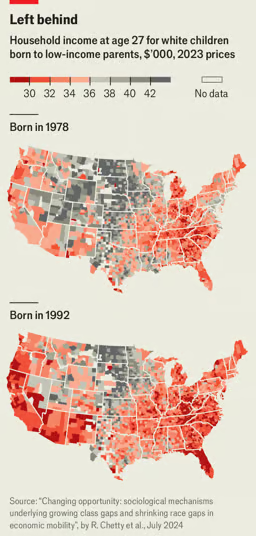
The fact that white children have become more likely to remain in poverty than before, whereas for black children the reverse is true, raises many questions. The finding comes from tracing the trajectories of 57m children born in America between 1978 and 1992 and looking at their outcomes by the age of 27. “This is really the first look with modern big data into how opportunity can change within a place over time,” says Mr Goldman. For children born into high-income families, household income increased for all races between birth cohorts. Yet among those from low-income families, earnings rose for black children and fell for white children.
A black child born to poor parents in 1992 earned $1,400 a year more than one born in 1978. A similar white child earned $2,000 less than one born in 1978. But on average, a poor white child still earned $9,500 more than a poor black child.
This pattern has played out in virtually every county, though with big regional differences. As a result, the earnings gap between rich and poor white children (the “class gap”) grew by 27%, whereas the earnings gap between poor white and poor black children (the “race gap”) fell by 28%…
… None of this means that race is no longer relevant for Americans’ chances in life. Although the reversal of the direction of travel is striking, a young black American born in 1992 to poor parents was still four percentage points more likely to remain in poverty than a poor white peer, down from a 15 percentage-point gap for those born in 1978. And while the near doubling in rates of mortality among young, lower-income white Americans is deeply alarming, mortality rates for their black counterparts have increased too, and they are still (a bit) more likely to die young…
… Convergence has not yet brought equality. Despite improvements across America for poor black children, there is still no county where their outcomes match those of poor white ones. Yet the decline of the white working class is steep, and bound to cause grief. Telling a young white man with lower life outcomes than previous generations that he is still doing better than the average black peer is about as useful as telling a young black man that he’s doing well “for a black man”.
Another possible misconception is that social mobility is a zero-sum game: that poor white children are doing worse because poor black children are doing better. The authors tackle this by showing how in places where black children have done well, white children’s outcomes have remained stable; and in places where white children have done particularly poorly, their black peers have also not thrived.
In his previous work Mr Chetty demonstrated [see here for a summary of his 2018 study] just how much a child’s chances of outperforming their parents depended on their race and where they grew up. One of the questions the authors were left with was how “sticky” these effects would be over time: could opportunities for the next cohorts of children change within these same places, or were they fixed? The new study’s most hopeful finding is that, far from being fixed, opportunities within a place can change significantly and rapidly. Neither history nor place is destiny…
… Americans love a rags-to-riches story. In his acceptance speech [at the Republican Convention], Mr Vance pledged to “make this country a place where every dream…will be possible once again”. In his bestselling book “Hillbilly Elegy” he writes that the assumption “that only a truly extraordinary person could have made it to where I am today…I think that theory is a load of bullshit.”
But the story of Mr. Vance, who grew up in a poor part of the rustbelt, rose to be a venture capitalist and now, at 39, is a potential American president, remains extraordinarily rare. While there has been a reshuffling of opportunities for Americans trying to escape the lowest rung, there has been no progress at all for routes into the upper class. For the vast majority of poor black children, who continue to have a 3% chance of rising from the bottom to the top quintile, and poor white children, whose chances have fallen from 14% to 12%, that door remains firmly shut…
“Class, race and the chances of outgrowing poverty in America,” a big-data analysis– a gift article from @TheEconomist.
* Plutarch
###
As we optimize opportunity, we might send mortgaged birthday greetings to Charles Darrow; he was born on this date in 1889. He designed (in 1933) and patented (in 1935) the board game Monopoly. He later sold his patent to Parker Brothers, which credits him as its creator.
In fact, the history of Monopoly is much longer. It can be traced back to 1903, when American anti-monopolist Lizzie Magie created a game called The Landlord’s Game that she hoped would explain the single-tax theory of Henry George. It was intended as an educational tool to illustrate the negative consequences of concentrating land in private monopolies.
After losing his job at a sales company following the Stock Market Crash of 1929, Darrow worked at various odd jobs. Seeing his neighbors and acquaintances play a board game in which the object was to buy and sell property, he decided to publish his own version of the game.
In fact, Darrow and his friends were just a few of many people in the American Midwest and East Coast who had been playing a game of buying and trading property– all based on Magie’s original… but most having morphed as warnings of that sort too often do) into the opposite of Magie’s intent– a celebration of accumulation. The game was used by college professors and their students, and another variant, called The Fascinating Game of Finance, was published in the Midwest in 1932. From there the game traveled back east, where it had remained popular in Pennsylvania, and became popular with a group of Quakers in Atlantic City. Darrow was taught to play the game by Charles Todd, who had played it in Atlantic City, where it had been customized with that city’s street and property names– to wit Monopoly‘s nomenclature.

You must be logged in to post a comment.