Posts Tagged ‘climate change’
“We are the first generation to feel the effect of climate change and the last generation who can do something about it”*…

One of the issues that vexes coordinated response is a paradox that lies at the heart of the phenomenon: Earth’s climate is chaotic and volatile. Climate change is simple and predictable. How can both be true? Joseph Howlett explains…
The Earth’s atmosphere is nothing but freely roaming molecules. Left alone, they would drift and collide, and eventually even out into a mixture that’s dynamic, yet stable and broadly unchanging.
The sun’s rays complicate things. Energy enters the Earth system in daily cycles, the bulk of it going to whichever half of the planet is tilted toward the sun (and experiencing summer). The molecules in that half acquire more energy than others, which sets the global atmosphere steadily swirling. Depending on the season and location, molecules in our atmosphere might traverse warm land, then cold seas. They might encounter a mountain range that forces them to high altitudes, where the air pressure is low and water condenses. Then they might become part of large-scale phenomena, such as currents, atmospheric rivers, turbulent jet streams and continental fronts.
These phenomena are erratic. They interact at every scale and manifest as weather, from clear sunny days to blustery blizzards and the anomalous events — from hurricanes and polar vortices to hailstorms and tornadoes — that are happening with increasing intensity. Any thought of stability is illusory; no patch of molecules dances in isolation.
The result, from seemingly simple inputs of molecules and energy, is emergent, incalculable chaos. Some individual molecule in the room you are sitting in is careening about blindly and colliding with its immediate neighbors. Zoom out — block to city, field to landscape, region to continent — and patterns appear and intermix. Complexity abounds and compounds. Nothing in the atmosphere is untethered from the rest of the global picture.
We live with this unpredictable mess of an atmosphere every day. We tote around unopened umbrellas, or refresh weather apps and watch our weekend plans dissolve. Anticipating conditions any further out than a week or two is a fool’s errand. The Earth is a complex dynamical system — an interwoven mass of moving parts, each of which requires a different branch of science to understand. Even with advanced knowledge, sophisticated algorithms and modern instruments, it defies and eludes us.
Yet this engine of chaos is now under our influence. It is incontrovertible fact that we are changing the Earth’s temperature by adding more carbon dioxide to the atmosphere. We know exactly how we are changing it — that when we double the proportion of carbon dioxide in the thin layer that rests over the surface of the Earth, the planet will become 2 to 4 degrees Celsius warmer, overall, than it is today. This conclusion has remained essentially unchanged since 1896, when the Swedish scientist Svante Arrhenius arrived at an estimate of 2 to 5 degrees. (Using an extraordinarily simplified picture of Earth, he made a number of mistakes that, in the end, balanced out.) Some details may remain uncertain, some chaos untamable, but the basic conclusion is a matter of unwavering scientific agreement — 97% is a rare degree of consensus on almost any subject. We are nearly as sure of this as we are of the causes of infectious disease, or how stars form, or the fact that life evolves through natural selection.
oth things are true: The climate system is vastly complex, and we’re certain about what we are doing to it. How can we be so confident in a hundred-year projection when we can’t predict the weather with any reliability more than a week out?
“How can it be that both are true?” said Nadir Jeevanjee, an atmospheric physicist at NOAA’s Geophysical Fluid Dynamics Laboratory, a leading institution for cutting-edge simulations of the atmosphere. “It’s a huge tension that’s lurking behind the whole conversation.”
It turns out that complexity can be a veil concealing more basic truths. An enormously complicated system can yield simple answers. You just have to ask a simple enough question…
Read on for Howlett’s fascinating– and important– explanation: “The Climate Change Paradox,” from @quantamagazine.bsky.social.
And for a reminder that this matters (as though we need one…): “Human-Caused Warming Tripled the Death Toll of European Heat Waves This Summer, New Report Shows,” from @insideclimatenews.org.
* Barack Obama
###
As face reality, we might recall that on this date in 1988, the #1 song in the U.S. was Bobby McFerrin‘s “Don’t Worry, Be Happy,” the first a cappella song to reach the top of the Billboard Hot 100 chart, a position it held for two weeks.
(Produced by Colossal Pictures, Directed by Drew Takahashi)
“It’s not a bug, it’s a feature”*…

Anna Marija Helt reports that, as global warming challenges tradtional agriculture, scientists are looking to “probiotics” for crops as a new green revolution in agriculture…
Potatoes contain something about which most people are entirely unaware: endophytes, which means “within plants.” Endophytes can also be found in other vegetables, fruits, and grains. In fact, all plants harbor endophytes in the form of bacteria, fungi, and other microbes.
Endophytes eat plant-derived nutrients but typically don’t cause disease. Instead, they bolster plant growth, disease resistance, antioxidant status, or tolerance to stressors such as drought, heat, and cold. Endophytes enable plants to respond quickly to such stressors by expanding their genetic repertoire, according to a review by ecologist Christine Hawkes and colleagues. To improve crop health and sustainability, Hawkes studies how plants, their fungal residents, and such stressors interact.
Given climate-related drought and temperature extremes, declining soil quality, and a decrease in arable land, endophytes, argue Pankaj Trivedi, Chakradhar Mattupalli, Kellye Eversole, and Jan E. Leach, might undergird a sustainable “green revolution” to improve agricultural productivity while lessening reliance on environmentally damaging and health-threatening agricultural chemicals. Endophytes can have an impact, says plant biotechnologist Julissa Ek-Ramos, on “climate change, recovering the soil, and having more healthy food to eat.”…
… “It’s really amazing how strongly these endophytes can combat the fungal pathogens of crops,” [microbiologist Sharon] Doty says. And she notes regarding their growth-promoting effects, “It works in maize, in rice, in tomatoes, in bell peppers, and strawberries.” Her team has also isolated endophytes from sweet potatoes that improve the rooting of poplars, a promising biofuels crop.
Endophytes confer additional traits useful for a changing planet. For example, those from geothermal habitats can confer heat tolerance, based on studies led by geneticist Regina Redman. And crop physiologist K. M. Manasa demonstrated salt-tolerance in rice plants inoculated with an endophyte from seaside plants. Rice is salt-sensitive and one of the world’s main food crops. But increasing soil salinity is impacting a fifth of farmable land globally due to climate change and human water and land use practices…
Nitrogen is often the most limiting soil nutrient for crops, something nineteenth-century farmers recognized. Agronomist and Nobel Prize nominee Johanna Döbereiner discovered nitrogen-fixing endophytes in non-legume plants in the twentieth century that, like rhizobia, might reduce the need for financially and environmentally costly synthetic fertilizers. Many of the endophytes Doty has characterized over twenty-five years fix nitrogen and promote growth in lab, greenhouse, and field trials but have a much broader host range than rhizobia, extending from farm lands to forests…
… Developing real-world endophyte applications is a complicated challenge, but a necessary one given the need for more productive and sustainable agriculture. In the meantime, skeptical farmers are getting onboard.
“There’s a lot of conversations going on between researchers and farmers,” says Friesen, to “move the needle on our understanding of these processes that are so important for soil health but also plant health and the stability and security of our food supply.”…
More at “Better Farming Through Endophytes,” from @ahelt.bsky.social in @jstordaily.bsky.social.
###
As we muse on microbes, we might send healthy birthday greetings to John Boyd Orr (1st Baron Boyd-Orr); he was born on this date in 1880. A teacher, medical doctor, biologist, nutritional physiologist, politician, businessman, and farmer, he was awarded the Nobel Peace Prize in 1949 for his scientific research into nutrition and for his work as the first Director-General of the United Nations Food and Agriculture Organization.

“The beaver told the rabbit as they stared at the Hoover Dam: ‘No, I didn’t build it myself, but it’s based on an idea of mine’.”*…

A warming climate is enabling rodents– notably beavers– to move north. Warren Cornwall reports…
In the summer of 2023, University of Alaska Fairbanks ecologist Ken Tape walked across the tundra on the outskirts of Nome, Alaska, to a site where a shallow stream just a few meters wide had flowed 2 years before. In its place he found an enormous pond, created by a dam made of branches bearing the distinctive marks of beaver incisors.
It was a vivid illustration of how beavers are transforming the Arctic. In Tape’s past work studying Arctic landscapes, such places changed little over decades. “It gives you a sense of timelessness,” he says. “With beavers, that couldn’t be further from the truth,” as the chunky rodents quickly replumb vast areas by building dams that can stretch hundreds of meters.
Soon, the land-altering power of beavers could be felt in a region currently beyond their reach: the farthest northern parts of the Alaskan Arctic. In a 30 July paper in Environmental Research Letters, Tape and James Speed of the Norwegian University of Science and Technology forecast that as a warming climate eases Arctic temperatures, beaver populations will march northward, sweeping across Alaska’s North Slope this century. Their arrival could bring dramatic change, the researchers say, upending ecosystems in places such as the Arctic National Wildlife Refuge and accelerating the loss of permafrost that stores vast amounts of carbon…
… Today, satellite images show more than 11,000 beaver ponds dotting the Arctic tundra south of the Brooks Range, a wall of mountains running east to west that isolates the North Slope. The number there doubled from 2003 to 2017.
The end of widespread fur trapping, which has allowed beavers to recolonize many parts of North America where they had been eliminated, might be driving some of the increase. But the new analysis finds that rising average temperature is a major factor in the beavers’ advance.
Tape suspects warmer weather is critical because it means more unfrozen water in winter. A completely frozen pond can trap beavers in their lodges and make food caches inaccessible. Milder winters could preserve pockets of liquid water around springs or ponds. Melting permafrost also creates more groundwater-fed springs. And earlier spring thaws enable beavers to forage just as their food supplies dwindle.
“The ecological bottleneck for beavers is the end of winter,” Tape says. “Now imagine that comes 2 weeks earlier.”
Using computer models that forecast how a warming climate could expand the amount of Alaskan tundra suitable for beavers, the researchers found that the area dotted with ponds could nearly double by 2050, and more than triple by the end of the century, from 30,000 square kilometers to 99,000 square kilometers. In these scenarios, beavers would breach the Brooks Range and spread across the North Slope to the shores of the Beaufort Sea…
… Residents of the Arctic have mixed feelings about their new neighbors. Ezra Adams, a member of the Native Village of Noatak, just south of the Brooks Range, says his father first saw a beaver there in the late 1990s, when Adams was 6 years old. Now, the animals have altered his family’s way of life. Their dams have reduced creeks where Adams once caught whitefish and salmon to a trickle. When out trapping or gathering firewood in the winter, he must beware of breaking through the ice on beaver ponds. Whereas his father once drank straight from lakes in the backcountry, Adams now brings treated water to avoid giardia in beaver feces. There are some upsides. Adams uses beaver meat to bait traps and beaver pelts for garments. “They provide a lot for our trapping,” Adams says. “But then for the general population it would be beneficial if there weren’t as many.”
Researchers, too, see both risks and benefits in beaver expansion. New ponds could become hot spots for songbirds and other wildlife. But they also hasten the thaw of permafrost, promoting the release of planetwarming carbon dioxide. A soon-to-be-published survey of 11 beaver pond systems in Arctic Alaska, for example, found that the water-covered area increased more than 600% once beavers arrived. Nearby ground thawed so much that researchers could plunge 1.2-meter-long rods used to test permafrost all the way to the tip.
Ponds could also create ample new habitat for microorganisms that convert carbon to methane, an even more potent warming gas, Griffin notes. “If we are going to start having expansion of wetlands because of beaver dams, how is that going to tip the balance between carbon and methane?” he wonders.
He might soon find out. Tape has already stumbled on one beaver pond on the northern slope of the Brooks Range. Although it disappeared a few years later, the pond showed beavers can cross the mountains. To spread even farther north, Tape notes, “they just have to swim downstream.”…

A report on climate migration already underway: “Beavers are poised to invade and radically remake the Arctic,” from @science.org.
###
As we give it up for Gaia, we might might recall that on this date in 1805, the Lewis and Clark expedition had reached the forks of the Jefferson River in Montana. Lewis and a small group had gone ahead scouting, and had sent back word, left in the form of a note pinned to a tree in the camp, for Clark and the rest of the party. But Clark never got the note, and headed down the branch (the Big Hole River) against which Lewis had warned… his canoes capsized and one of his party was injured. As they regrouped at their camp, a member of Lewis’ party arrived and explained that there had been a miscommunication. Clark’s journal entry for August 6, 1985 recounts:
… Capt Lewis had left a Letter on a pole in the forks informing me what he had discovered & the course of the rivers &c. this lettr was Cut down by the [beaver] as it was on a green pole & Carried off. Three Skins which was left on a tree was taken off by the Panthers or wolvers…

“Heap high the farmer’s wintry hoard! Heap high the golden corn! No richer gift has Autumn poured From out her lavish horn!”*…

… but exercise care. In an excerpt from his new book, We Are Eating the Earth- The Race to Fix Our Food System and Save Our Climate, Michael Grunwald with the story of Tim Searchinger, the cascading impact of ethanol production on climate change, and the importance of fighting for lost causes…
Something felt off.
Tim Searchinger lacked the proper credentials to say exactly what was off that day in the spring of 2003. He was a lawyer, not a scientist or economist. He was reading a complex technical paper on an unfamiliar topic, produced by well-respected researchers at the world-renowned Argonne National Laboratory. Sitting at his cluttered desk in the Environmental Defense Fund’s sixth-floor offices in Washington, D.C., overlooking the famous back entrance to the Hilton where President Ronald Reagan was shot, he just had a sense the paper didn’t add up.
Searchinger tended to distrust new information until he could study it to a pulp. He never assumed consensus views were correct, conventional wisdom was wise, or sophisticated-looking scientific analyses reflected reality. He questioned everything, so his unease that day didn’t feel particularly unusual. He had no inkling it would eventually lead him to a new profession—and the world to a new way of thinking about food, farming, land use, and climate change.
The Argonne study analyzed whether fueling cars with corn ethanol rather than gasoline reduced greenhouse gas emissions, which did not seem like a particularly urgent question in 2003. And Searchinger was a wetlands guy fighting to save the streams and swamps that provide kitchens and nurseries for fish and wildlife, not an energy-and-climate guy trying to keep carbon out of the atmosphere. So it was a bit odd that he would slog through such an obscure report.
But not too odd.
He was also an agriculture guy, because farms were the main threat to the wetlands he wanted to protect. And he was above all a details guy, a data sponge willing to soak up minutiae far too technical for less obsessive laymen. The revelatory stuff usually seemed to be hidden in arcane modeling assumptions and other fine print. He was a compulsive reader of boring papers, all the way through the footnotes, and he had learned from his uphill legal and political battles that knowledge could be a powerful weapon against money. He always did the reading, and his burden in life was that others didn’t.
Ethanol was just his latest uphill battle.
It was the most common form of alcohol, the fermented magic in beer, wine, and liquor. It was also a functional automotive fuel; it had powered the first internal combustion engine, and Henry Ford once called it the future of transportation. Gasoline turned out to be more efficient and better for engines, so ethanol mostly ended up in solvents and booze. But in the 1970s, ethanol distilled from corn—the “field corn,” or maize, grown by grain farmers, not the “sweet corn” you eat off the cob—had carved out a small role as an additive in US fuel markets.
That was the start of a twisted political love story. Farm interests, whose outsized political influence dated back to America’s origins as an agrarian nation, seized on ethanol as a new government gravy train. The U.S. Department of Agriculture, founded under President Abraham Lincoln for the express purpose of supporting farmers, backed ethanol as enthusiastically as it backed farm subsidies, farm loans, and other federal farm aid. And presidential candidates sucked up to farm interests so reliably that a West Wing episode lampooned the quadrennial tradition of ethanol pandering before the Iowa caucus, as the fictional future president Matt Santos considered denouncing subsidies he considered stupid and wasteful.
“You come out against ethanol, you’re dead meat,” an aide warned Santos. “Bambi would have a better shot at getting elected president of the NRA than you’ll have of getting a single vote in this caucus.”
The Midwestern grain interests behind ethanol did have serious political swat. The top ethanol producer was agribusiness giant Archer Daniels Midland, whose former CEO helped finance the Watergate burglary, and whose reputation as an all-powerful force of corporate darkness would soon be satirized in The Informant! The U.S. industry owed its existence to a lavish tax break for domestic ethanol and a punitive tariff on foreign ethanol, both of which owed their existence to Big Ag lobbyists. The corn the industry distilled into fuel was also subsidized through “loan deficiency payments,” “counter-cyclical payments,” and a slew of other bureaucratically differentiated programs that all diverted taxpayer dollars into farmer wallets. The farm lobby usually got what it wanted out of Washington—not only subsidies and tax breaks, but exemptions from wetlands protections, pollution limits, and other regulations. Even the federal rule limiting the hours truckers could drive had a carve-out for agricultural deliveries.
Still, barely 1 percent of America’s fuel was ethanol, and barely 1 percent of America’s corn became ethanol. The issue wasn’t on Searchinger’s radar until Big Ag began pushing an ethanol mandate, and he began worrying it could become the corn industry’s new growth engine.
His concern had nothing to do with climate change, because that wasn’t on his radar, either. It wasn’t yet a front-burner issue in Washington, and he knew no more about it than the average newspaper reader. He was focused on preserving what was left of nature in farm country, and preventing polluted farm runoff from fouling rivers and streams. More ethanol would mean more cornfields, more pollution, and more drainage of the Midwest’s few remaining wetlands.
Most Americans seemed to think the middle of the country was somehow ordained to be amber waves of grain—he used to think so, too—but he always kept in mind that it had once been a vibrant landscape of tallgrass prairies and forested swamps, a temperate-zone Serengeti with spectacularly diverse plant communities and birds that darkened the sky. Washington had accelerated the near-total obliteration of that ecosystem, with incentives as well as rhetoric encouraging farmers to grow crops from “fence row to fence row,” and ethanol seemed like the latest excuse to complete Middle America’s metamorphosis into an uninterrupted cornfield. Searchinger was on the prowl for science he could use to prevent that, so when he heard about the Argonne paper, in those days before studies were routinely posted online, he called the lead author, a Chinese-born environmental scientist named Michael Wang, and asked him to FedEx it.
Unfortunately, Wang’s team had calculated that ethanol generated 20 percent fewer greenhouse gases than gasoline, a modest but measurable improvement. Wang had helped pioneer the “life-cycle analyses” that were becoming standard in the field, and the emissions model known as GREET that he developed at Argonne was considered state-of-the-art, while Searchinger had never even read a climate study. So he didn’t really have standing to object.
But he did know models could mislead, because one of his professional obsessions was exposing how the U.S. Army Corps of Engineers cooked the books of cost-benefit analyses to justify its own ridiculously destructive water projects. He had learned from Army Corps documents how economic and scientific models could be structured and twisted to reach convenient conclusions, how garbage in plus garbage assumptions could produce garbage out. And when he started thumbing through the ethanol study, he had familiar bad vibes.
Wang had found that drilling oil and refining it into gasoline emitted much fewer greenhouse gases than planting, fertilizing, and harvesting corn and refining it into ethanol. Initially, Searchinger was confused: If the agro-industrial complex was twice as carbon-intensive as the petro-industrial complex, why would ethanol have a smaller carbon footprint?
The study’s answer was that cornfields, unlike oil wells, were carbon sinks. The Argonne team assumed that growing corn on a farm offset the tailpipe emissions from burning corn in an engine, because cornstalks sucked carbon out of the atmosphere through photosynthesis. The climate case for farm-grown fuels was that ethanol merely recycled carbon, while gasoline liberated carbon that had been buried for eons. It made sense that ethanol, a renewable fuel, would be climate-friendlier than gasoline, a fossil fuel. “Renewable” sounded clean and green, while “fossil” evoked zombies coming back from the dead to destroy the earth.
Searchinger’s spidey-sense kept tingling, though. His father, another question-everything guy, liked to quote H. L. Mencken: “For every complex human problem, there’s a solution that’s clear, simple and wrong.” That’s what ethanol felt like. And the more he thought about the study, the less he understood its conclusions.
Yes, corn soaked up carbon as it grew. But it soaked up just as much carbon whether it was grown for fuel or food! Why would growing corn for ethanol and burning it in an engine be any climate-friendlier than growing that same corn for food and burning an equivalent amount of gasoline in an engine? The carbon absorbed in the field wouldn’t change; neither would the carbon emitted from the car. If the only difference was that producing ethanol emitted much more carbon than producing gasoline, where were ethanol’s benefits?
That led back to his original concern: If more corn was diverted from food to fuel, how would the lost food be replaced? Presumably, Midwest farmers would plant more corn, converting more wetlands into farmland that would get blasted with more chemicals. Again, he wasn’t focused on the climate impact, just the environmental impact of losing habitat and increasing pollution. But he had a hunch the Argonne researchers and their spiffy analytical tools were also understating the climate costs of using grain to fuel our cars instead of ourselves.
Searchinger loved figuring things out, and he was on the verge of figuring something out that would transform climate analysis.
Uncharacteristically, though, he lost interest.
For one thing, it became clear that climate would be irrelevant to the debate over the proposed “Renewable Fuels Standard.” With America at war in Iraq, ethanol’s boosters were touting the mandate as a win-win that would reduce reliance on Middle Eastern oil while propping up demand for Midwestern corn. They weren’t touting it as a climate solution, because Washington wasn’t looking for climate solutions. The Senate had unanimously rejected the Kyoto Protocol a few years earlier, and Congress had ignored the issue ever since.
It also became clear the biofuels debate would be another charade controlled by farm interests and farm-friendly politicians. President George W. Bush had genuflected to ethanol in Iowa, as future presidents always do. (Even The West Wing’s Santos caved.) Senate Democratic Leader Tom Daschle of South Dakota, whose top aide later became an ethanol lobbyist, and Republican House Speaker Dennis Hastert of Illinois—who also became an ethanol lobbyist, before going to jail in a child molestation scandal—were both farm-state biofuels boosters.
Searchinger did try to lobby some non-Midwestern politicians to oppose the mandate, arguing it would punish their constituents at the pump to subsidize out-of-state agribusinesses. But even an aide to Democratic Senator Jon Corzine, a former Wall Street titan from corn-free New Jersey, sheepishly admitted his boss couldn’t buck the ethanol lobby, because he might need Iowans someday.
Come on, Searchinger pleaded, the guy who ran Goldman Sachs thinks he’s running for president?
“Tim, they’re all running for president,” the aide replied.
Searchinger sometimes joked that he was the patron saint of almost-lost causes, because he spent his days failing to save wetlands, failing to stop farms from degrading the environment, and failing to reform the Army Corps. He didn’t go looking for uphill battles—he’s a generally friendly guy with no particular lust for conflict—but he didn’t shy away from them, and as an enviro in ag world, he ended up in a lot of them. Even his victories felt temporary, because defenders of nature have to win again and again to keep wild places wild, while despoilers of nature only have to win once. And unlike campaigns to save the whales or the Grand Canyon, causes that inspired public outrage and sympathetic press, his fine-print fights to limit the damage from American agriculture went mostly unnoticed.
Usually, he was fine with that. He was a relatively happy warrior who believed knowledge could at least sometimes be power. But sometimes, power was power, and the anti-ethanol cause felt unusually lost. ADM, which owned half of America’s ethanol plants, seemed to own half of Congress, too. The proposed mandate wasn’t big enough to transform the Midwest, anyway, so he moved on to issues where victory was at least conceivable.
In retrospect, he’s embarrassed by how much he failed to grasp in 2003. At the time, he was totally unaware of the climate benefits of the wetlands he was fighting to save. He also knew almost nothing about international agriculture and its intrusions into tropical rainforests, so he overlooked how mandating farm-grown fuel in America could trigger deforestation and food shortages abroad. It certainly hadn’t dawned on him that biofuels represented a larger land-use problem that threatened humanity’s future on a planet with limited land to use.
Then again, it hadn’t dawned on anyone else, either.
Searchinger would later return to ethanol and climate, making scientific and economic connections the field’s scientists and economists had missed. He would then figure out how agriculture was eating the earth, and create the first serious plan for preventing that. It was an odd plot twist for an urban lawyer whose closest encounter with farm life growing up had been the petting zoo in Central Park.
But not too odd.
Taking on biofuels, and then the broader food and climate problem, required a wonk-crusader smart and stubborn enough to master the intricacies of esoteric models in unfamiliar disciplines, intellectually arrogant enough to believe he could parachute into the new fields and prove the experts wrong, and foolishly romantic enough to believe his impertinent crusades could help save the world. That’s always been who he is…
“How Big Agriculture Mislead the Public About the Benefits of Biofuels,” from @mikegrunwald.bsky.social via @literaryhub.bsky.social.
For more, see this World Resources Institute reports authored by Searchinger: “Why Dedicating Land to Bioenergy Won’t Curb Climate Change.”
* John Greenleaf Whittier
###
As we tackle tradeoffs, we might spare a thought for James Lovelock; he died on this date in 2022 (which was also his 103rd birthday). An independent scientist, environmentalist, and futurist, he invented (in 1957) the Electron Capture Detector, a portable analytical instrument able to detect infinitesimal traces of halogenated organic compounds. The device revealed once untraceable amounts in the biosphere, of man-made chemicals such as CFCs or pesticide pollutants. French philosopher Bruno Latour compared that technological advance to the leap when Galileo’s telescope invention could peer deeper into space, revealing so much previously unseen.
He is better known for his Gaia Hypothesis, which he developed in the 1960s while designing scientific instruments for NASA and working with Royal Dutch Shell. Lovelock suggested that the Earth functions as a planet-sized superorganism—subterranean bacteria to the ice crystals of the stratosphere, working in a gigantic living network.
For more on the remarkable man, his accomplishments, and the Gaia Hypothesis, see Jon Watts‘ The Many Lives of James Lovelock: Science, Secrets and Gaia Theory.

“Sooner or later everyone sits down to a banquet of consequences”*…
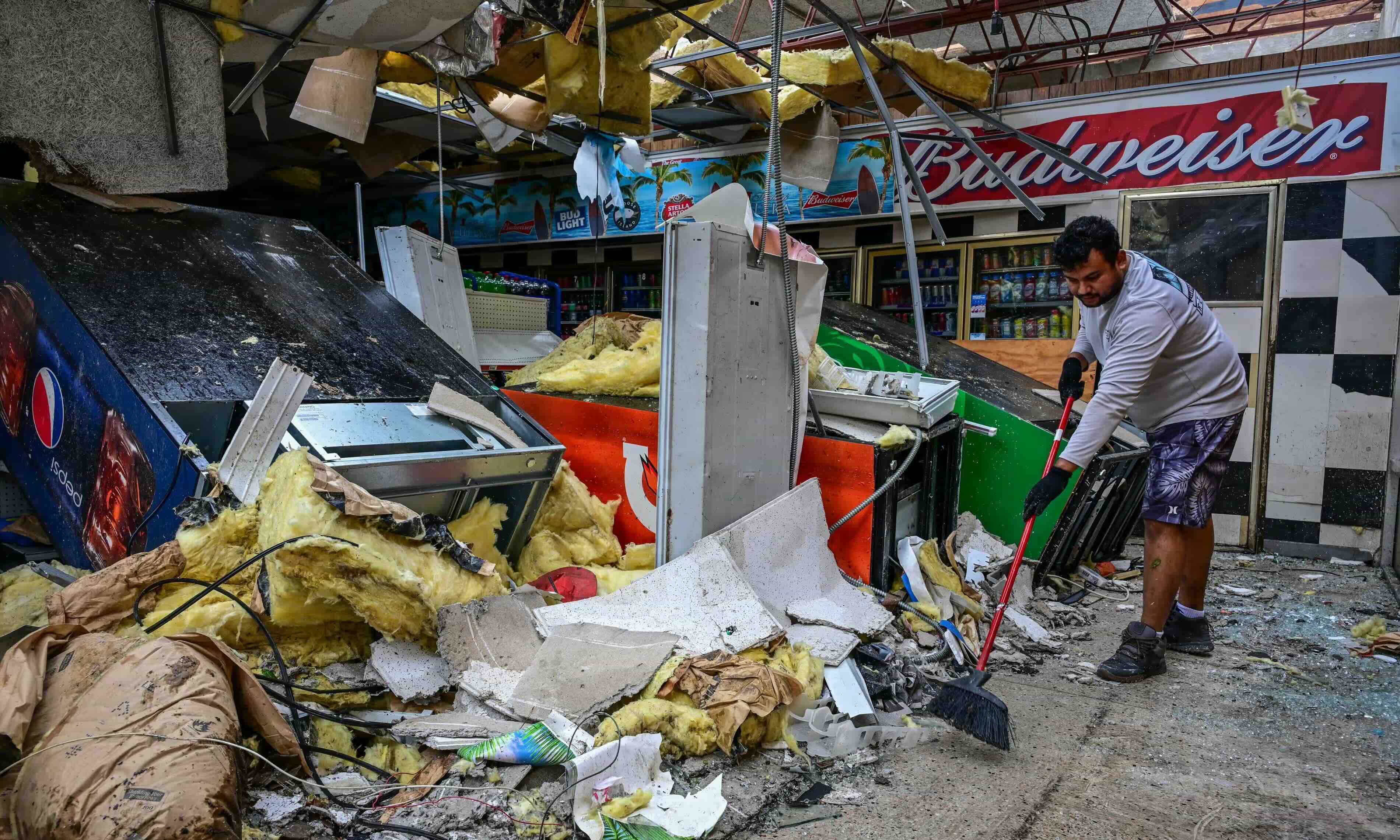
A report issued by International Chamber of Commerce late last year found that extreme weather cost $2tn globally over last decade; the U.S. suffered the greatest losses. As Damian Carrington reports, a leading insurance executive is warning that urgent action is needed to save the conditions under which markets – and civilization itself – can operate…
The climate crisis is on track to destroy capitalism, a top insurer has warned, with the vast cost of extreme weather impacts leaving the financial sector unable to operate.
The world is fast approaching temperature levels where insurers will no longer be able to offer cover for many climate risks, said Günther Thallinger, on the board of Allianz SE, one of the world’s biggest insurance companies. He said that without insurance, which is already being pulled in some places, many other financial services become unviable, from mortgages to investments.
Global carbon emissions are still rising and current policies will result in a rise in global temperature between 2.2C and 3.4C above pre-industrial levels. The damage at 3C will be so great that governments will be unable to provide financial bailouts and it will be impossible to adapt to many climate impacts, said Thallinger, who is also the chair of the German company’s investment board and was previously CEO of Allianz Investment Management.
The core business of the insurance industry is risk management and it has long taken the dangers of global heating very seriously. In recent reports, Aviva said extreme weather damages for the decade to 2023 hit $2tn, while GallagherRE said the figure was $400bn in 2024. Zurich said it was “essential” to hit net zero by 2050.
Thallinger said: “The good news is we already have the technologies to switch from fossil combustion to zero-emission energy. The only thing missing is speed and scale. This is about saving the conditions under which markets, finance, and civilisation itself can continue to operate.”
Nick Robins, the chair of the Just Transition Finance Lab at the London School of Economics, said: “This devastating analysis from a global insurance leader sets out not just the financial but also the civilisational threat posed by climate change. It needs to be the basis for renewed action, particularly in the countries of the global south.”
“The insurance sector is a canary in the coalmine when it comes to climate impacts,” said Janos Pasztor, former UN assistant secretary-general for climate change.
The argument set out by Thallinger in a LinkedIn post begins with the increasingly severe damage being caused by the climate crisis: “Heat and water destroy capital. Flooded homes lose value. Overheated cities become uninhabitable. Entire asset classes are degrading in real time.”
“We are fast approaching temperature levels – 1.5C, 2C, 3C – where insurers will no longer be able to offer coverage for many of these risks,” he said. “The math breaks down: the premiums required exceed what people or companies can pay. This is already happening. Entire regions are becoming uninsurable.” He cited companies ending home insurance in California due to wildfires.
Thallinger said it was a systemic risk “threatening the very foundation of the financial sector”, because a lack of insurance means other financial services become unavailable: “This is a climate-induced credit crunch.”
“This applies not only to housing, but to infrastructure, transportation, agriculture, and industry,” he said. “The economic value of entire regions – coastal, arid, wildfire-prone – will begin to vanish from financial ledgers. Markets will reprice, rapidly and brutally. This is what a climate-driven market failure looks like.”
No governments will realistically be able to cover the damage when multiple high-cost events happen in rapid succession, as climate models predict, Thallinger said. Australia’s disaster recovery spending has already increased sevenfold between 2017 and 2023, he noted.
The idea that billions of people can just adapt to worsening climate impacts is a “false comfort”, he said: “There is no way to ‘adapt’ to temperatures beyond human tolerance … Whole cities built on flood plains cannot simply pick up and move uphill.”
At 3C of global heating, climate damage cannot be insured against, covered by governments, or adapted to, Thallinger said: “That means no more mortgages, no new real estate development, no long-term investment, no financial stability. The financial sector as we know it ceases to function. And with it, capitalism as we know it ceases to be viable.”
The only solution was to cut fossil fuel burning, or capture the emissions, he said, with everything else being a delay or distraction. He said capitalism must solve the crisis, starting with putting its sustainability goals on the same level as financial goals.
Many financial institutions have moved away from climate action after the election of the US president, Donald Trump, who has called such action a “green scam”. Thallinger said in February: “The cost of inaction is higher than the cost of transformation and adaptation. If we succeed in our transition, we will enjoy a more efficient, competitive economy [and] a higher quality of life.”…
It’s time, if not past time, to act: “Climate crisis on track to destroy capitalism, warns top insurer,” from @dpcarrington.bsky.social in @theguardian.com.
Further to the point: “Get ready for several years of killer heat, top weather forecasters warn.”
See also: “Q&A: Kiley Bense on Climate Journalism in a New Information Environment.”
(Image above: source)
* Robert Louis Stevenson
###
As we contemplate craziness, we might recall that it was on this date in 2011 that the Wallow Fire started. A wildfire that started in the White Mountains near Alpine, Arizona, it was named for the Bear Wallow Wilderness area where the fire originated.
The fire eventually spread across the stateline into western New Mexico. By the time the fire was contained on July 8, it had consumed 538,049 acres of land, 522,642 acres in Arizona and 15,407 acres in New Mexico. It was the largest wildfire in Arizona history and did an estimated estimated cost was $109 million in damages. Smoke from the Wallow Fires and others in Arizona and New Mexico extended through Texas and Oklahoma up into the Great Lakes region, affecting air quality for large areas east of the Rocky Mountains.

You must be logged in to post a comment.