Posts Tagged ‘art’
“Whoever wishes to foresee the future must consult the past; for human events ever resemble those of preceding times”*…

In times like these, perspective is at a premium. Here, Derek Thompson on what we might learn from our not-so-terribly-distant past…
When we hear about technological change and social crisis in the 21st century, it is easy to imagine that we are living through a special period of history. But many eras have grappled with the problems that seem to uniquely plague our own. The beginning of the 20th century was a period of speed and technological splendor (the automobile! the airplane! the bicycle!), shattered nerves, mass anxiety, and a widespread sense that the world had been forever knocked off its historical axis: a familiar stew of ideas. I think we can learn a lot about the present by studying historical periods whose challenges rhyme with our own.
My favorite period of history is the 30- to 40-year span between the end of the 19th century and the early innings of the 20th century. It was an era of incredible change. From Abundance (which Thompson co-authored with Ezra Klein):
Imagine going to sleep in 1875 in New York City and waking up thirty years later. As you shut your eyes, there is no electric lighting, Coca-Cola, basketball, or aspirin. There are no cars or “sneakers.” The tallest building in Manhattan is a church.
When you wake up in 1905, the city has been remade with towering steel-skeleton buildings called “skyscrapers.” The streets are filled with novelty: automobiles powered by new internal combustion engines, people riding bicycles in rubber-soled shoes—all recent innovations. The Sears catalog, the cardboard box, and aspirin are new arrivals. People have enjoyed their first sip of Coca-Cola and their first bite of what we now call an American hamburger. The Wright brothers have flown the first airplane. When you passed into slumber, nobody had taken a picture with a Kodak camera or used a machine that made motion pictures, or bought a device to play recorded music. By 1905, we have the first commercial versions of all three—the simple box camera, the cinematograph, and the phonograph.
No book on turn-of-the-century history has influenced me more, or brought me more joy, than The Vertigo Years: Europe 1900-1914 by Philipp Blom. I think it might be the most underrated history book ever written. In my favorite chapters focusing on the years around 1910, Blom describes how turn-of-the-century technology changed the way people thought about art and human nature and how it contributed to a nervous breakdown across the west. Disoriented by the speed of modern times, Europeans and Americans suffered from record-high rates of anxiety and a sense that our inventions had destroyed our humanity. Meanwhile, some artists channeled this disorientation to create some of the greatest art of all time.
[Thompson uses passages from Blom to unpack those issues– a world moving too fast, the anxiety occasioned by technological change, and the responses of artists and creators of culture. He concludes with a consideration of two influential new theories of human nature that arose at that point…]
… Blom closes his chapter “1910: Human Nature Changed” by considering two intellectual giants of the time: the sociologist Max Weber and the psychoanalyst Sigmund Freud, whose International Psychoanalytic Association was founded in 1910. The tension between their theories of human nature are profoundly relevant today.
In his famous work The Protestant Ethic and the Spirit of Capitalism, Weber, a German sociologist, argued that certain Protestant—especially Calvinist—traditions supported habits that aligned with the development of modern capitalism. He argued that the Protestant tradition of northern European worshippers cultivated a disciplined approach to work, savings, and investment that proved valuable in commerce, while the Calvinist doctrine of divine grace “could lead believers to read worldly success as a possible sign of God’s favor,” as Blom summarizes. Weber believed that Protestantism not only encouraged followers to pour their energies into labor (hence the allusion to Work Ethic in the book’s title) but also helped create a culture of trade and investment that supported the rise of modern capitalism.
“It is easy to see how Freud’s analysis follows on from Weber’s,” Blom writes. To Freud, human nature was at risk of being fully dissolved by capitalism and modern society, like chalk dropped in acid. Beneath the polite masks demanded by modern society, he said, there lurked a more atavistic and instinctual self. Freud saw our psyche as a tug-of-war between the id (our animal urges) and superego (the voice in our head that internalizes society’s rules), with the ego stuck in the middle trying to negotiate an authentic identity in the face of mass inauthenticity. One of Freud’s most fantastic insights was that some people can channel or redirect their most raw and unacceptable urges toward productive and acceptable work. His name for this bit of psychological alchemy was sublimation.
Modern capitalism, in Freudian terms, was the sublimation of self-interest—or, one might even say, the sublimation of greed. “The suppression of natural urges is a necessary precondition for capitalist success,” Blom writes in summary, “but while it is productive for the group and its wealth, such an approach will eventually exact its revenge on the individual.” By this interpretation, the mass anxiety of the early 1900s—whether you call it neurasthenia, American Nervousness, or Newyorkitis—was price of modernity, technological development, and even capitalism itself.
There is little evidence that Freud and Weber ever debated one another. Yet when you set their theories side by side, it’s hard not to hear a conversation that still shapes much modern commentary. Weber wrote that modern capitalism evolved from religious doctrines that fit our nature, while Freud argued that human nature is unfit for a modern world that distorts and represses our basic urges. Are our most impressive inventions the ultimate expression of our humanity, or are they the ultimate threat to it? This is the question that every generation must answer for itself, including our own. It is a question equally worthy of the automobile and artificial intelligence. The troubling answer—for Weber and for Freud; for 1910 and for 2025—is: perhaps, both.
Learning from our past: “1910: The Year the Modern World Lost Its Mind,” from @dkthomp.bsky.social. Eminently worth reading in full.
Pair with another “history lesson,” a consideration of American mechanisms of voter restriction/suppression over the years (as context for the current application of the Orban playbook by the Trump Administration and states like Texas: “Competitive authoritarianism” and America’s slide toward it.” moves fueled by appeals to the very anxieties (and to false nostalgia for times that were free of it) discussed above.
* Machiavelli
###
As we look back to look forward, we might send altitudinous birthday greetings to a man whose work figured into the tale that Thompson and Blom tell: Orville Wright; he was born on this date in 1871. An inventor and aviator, he American inventor and aviator, he invented, with his elder brother Wilbur, the first powered airplane, Flyer, capable of sustained, controlled flight. In 1903, at Kitty Hawk, North Carolina, Orville made the first ever manned powered flight, airborn for 12 sec. By 1905, the brothers had improved the design, built and and made several long flights in Flyer III, which was the first fully practical airplane, able to fly up to 38-min and travel 24 miles (though not without incident). Their Model A was produced later in 1908, capable of over two hours of flight. By 1909 their flights were the subject of wide public interest, watched by leaders (like President Taft) and by public crowds of as many as a million people (in Manhattan during the Hudson-Fulton Celebration in New York City)… by 1910, flight and its future had become one of the many accelerating vectors driving the turmoil that THompson describes.

“If I am to be remembered, I hope it will not be primarily for my specialized scientific work, but as a generalist; one to whom, enlarging Terence’s words, nothing human and nothing in external nature was alien.”*…
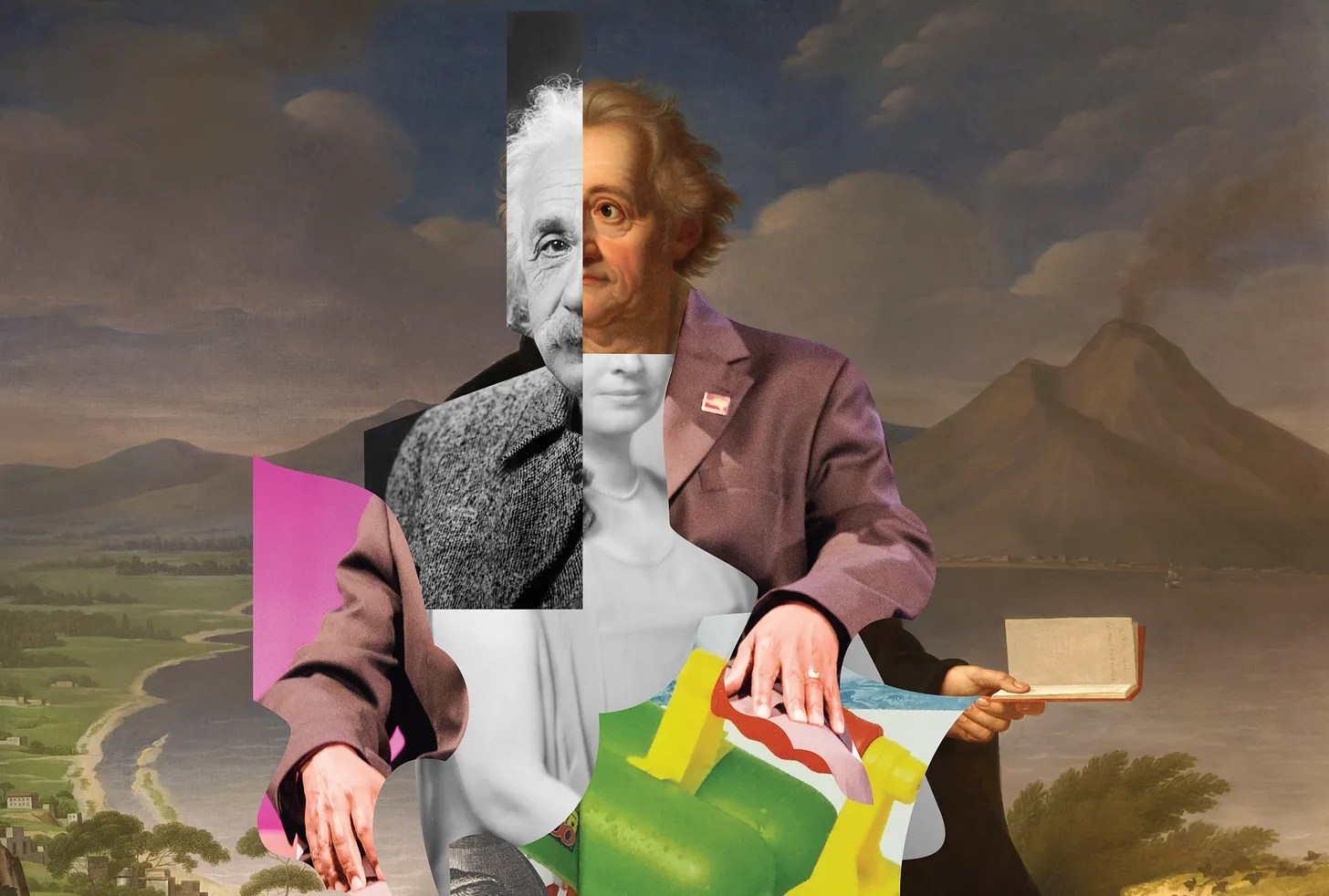
Interdisciplinary artist, writer, and musician Ross Simonini with 47 thoughts on the glory of looking– and living– beyond a specialty…
1. I was raised to believe that I was made to do one thing. Find that one pursuit that fills my life with meaning and empty all my energy into it. This is the realization of human potential: to excel with rigorous focus on a refined lifelong mission. This and only this will bring us to our greatest success and fulfillment.
For me, this was not something I even had to be told—though I was, many times, by many people—because I implicitly understood that this kind of teleology was woven into the fibers of my world. I also knew that rejecting a singular pursuit would be an insult to my very existence. Without this unifying reason for being alive, I would wander aimlessly into the barren void of nihilism. I’d heard about great artists who refused to create, who stepped away from their work to fritter away their time on leisure, and I knew this was a life of tragedy.
Likewise, I understood that sliding your attention across interests is a way to waste your gift. The more hours you put into a skill, the more skilled you become—right? To treat your gift with the proper deference, you must exhaust yourself into it.
Within this paradigm, the most unfortunate people are those who do not have a single, clear vocation. These types float from job to job without a trajectory; they are vagabonds who have given up on greatness.
This may sound a little dramatic, but somewhere inside me, these beliefs are there—and as a lifelong generalist, I spend every day rubbing up against them.
…
16. Let’s talk about mastery. Everyone wants to be a master, even if they are disgusted by the monstrous implications of the word. Mastery suggests dominance over something, but every true master knows that they are merely a supplicant at the mercy of their field, which existed long before them and will exist long after them. Anyone who believes in their own mastery likely suffers from hubris. Work hard enough at something and you watch your dominance slip ever further away.
Mastery is an illusion, a notion of a fictional purity that cannot be understood or measured in terms of time. Just look at those young savants who excel wildly after only a few years spent on their craft. For them, mastery cannot be the result of time plus work, as we all assume it is. In fact, maybe the newness of their skills is precisely what gives their work its value.
But these little wonders are exceptions, right? The rest of us have to dedicate our lives to something to achieve greatness, and anyone who doesn’t do this will likely be middling in their work. Most writers I know are immediately suspicious when an actor publishes a novel. We delight in calling the person a moonlighter. Literature is our territory, and the only way to live here is to put in the time and labor.
…
24. Isaiah Berlin, the political theorist, ethicist, philosopher, and historian, wrote a book called The Hedgehog and the Fox, in which he divides people into two types: hedgehogs, who see the entire world through one big thing, and foxes, who see the world as many things that cannot be reduced. According to Berlin, hedgehogs include Plato, Dostoyevsky, and Proust, while foxes include Aristotle, Shakespeare, and James Joyce.
“Everything I learned in my life, I learned because I decided to try something new,” said David Lynch (musician, filmmaker, painter, lamp maker, sculptor, writer, actor, and lecturer, mostly on meditation).
…
29. Sometimes history hides generalism to preserve a specialized agenda. Isaac Newton, a figure whom we consider the father of modern math, physics, and reasoned thinking, was also a dedicated alchemist. Alchemy, a generalist practice in itself, was a precursor to modern chemistry. It involves spirituality, myth, belief, and metallurgy, but its inclusion of belief stands in direct conflict with the scientific rationalism Newton now represents. Subsequent generations of historians and scientists buried Newton’s dedication to the occult, willfully ignoring the blow it deals to their obsessive, single-minded materialism. But Newton’s own records tell a different story. He wrote over a million words on alchemy in his lifetime, and his study of the subject helped inspire some of his most paradigm-shifting discoveries.
…
31. A filmmaker must understand aspects of sound design, photography, storytelling, music, acting, props, environment, finance, writing, and dialogue. In this way, some jobs are naturally suited to the generalist. A skilled homemaker, for example, understands everything from cooking to cleaning to healing to sociology. Acting, too, is a fairly generalist vocation. The practice of writing, what I am doing right now, is extremely broad, without consistent subject matter, form, or even mediums.
Generalism can be an approach of the neophyte or of the seasoned worker. Some entry-level positions (assistant, secretary, intern) are, in fact, compilations of micro-jobs, and some high-level positions—
managers, CEOs, directors, business owners, presidents—are positions of vast, nonspecific oversight. Sometimes the highest perch has the widest perspective.…
39. A generalist must engage with both sides of any argument: skepticism and belief, optimism and pessimism. So, for this essay, it would only be right to take a look at the dark side of generalism and the side effects of adopting it as a whole-life philosophy.
The glaring danger of general thinking in its extreme form is relativism, a sort of mushy non-position in which there are no universal standards: nothing can ever be condemnable or universally wrong. At the most dramatic levels, relativism might dismiss murder and genocide. It’s a slippery slope of open-mindedness.
Likewise, a generalist must contend with political centrism. In our bifurcated world, the center is one of the most reviled of all political positions, and a generalist will come to understand whether their own centrism is an evasion of choice or a refusal of unpalatable options.
Few things are more torturous than making decisions, and a mind will do anything to avoid such a relentlessly complex activity. Adherence to these vague philosophies, as I see them, can certainly be used as an excuse for escaping commitment. As a generalist, I must stay vigilant against this kind of laziness of mind and instead allow many fierce, contrary ideas to exist at once.
…
42. Generalism is not a thing. It’s definitely not an ism or some kind of doctrine. The general approach defies the nature of ideologies, which are characterized by the limits they place on understanding the world. There is no system of generalism. The general philosophy is to love variety.
For this reason, generalists don’t exist—not in the way that, say, Marxists do—because they can’t identify as generalists. I can call myself intra-, cross-, multi-, inter-, and trans-disciplinary—which, for some, are all legitimate and distinct prefixes—but that does more to distinguish and alienate me from others than to connect me with a community. There is no lineage of generalists, as there is for microbiologists or flutists, because every generalist works with their own complex bouquet of interests.
Probably this whole essay is my attempt to give a sense of unity to my life. Maybe I have to write a manifesto on “the art of doing many things”because I fear that if our culture doesn’t have a catchy keyword for my role, I’ll just fade away. So here I am, reducing generalism to a single, branded snap, just like a specialist.
After all, generalists are, in moments, great specialists. Likewise, a deep specialist can approach their niche from an ever-growing number of perspectives. A man with a repetitive job can endlessly engage with his work from fresh angles. And, of course, it’s all relative. A single task looked at from another angle is a plentiful cornucopia of individuated micro-tasks.
Some long-term generalists focus exclusively on a single activity for a number of years before moving on to the next. Rather than doing many things simultaneously, they do them sequentially.
Pure generalism and pure specialism are just intellectual games. Our minds drift between unified oneness and individuality without ever settling into either. Binary thinking is for computers.
These two states of being are not roles we need to inhabit but rather nodes to be considered. One situation requires diligent focus, but another benefits from a more diffuse form of attention. Certain qualities of engagement can occur only when you do multiple things at once. This is the value of the glance.
…
47. Generalism is not the opposite of specialism. It includes specialism. Everyone gets to experience both. Or maybe both approaches lead to the same place. Maybe the study of quantum physics brings a mind to the same conclusions as basketry. Maybe it’s like meditation: You can sit in open awareness and experience everything until you reach an unprejudiced understanding of life. Or you can unflinchingly focus on a single mantra for decades, repeating it with each breath, and as you plunge deeper toward a single infinite point, you discover that everything is already right there.
Eminently worth reading in full: “In praise of generalism” from @thebeliever.net.
###
As we widen our irises, we might send carefully-calculated birthday greetings to Pierre de Fermat; he was born on this date in 1601. While he is remembered as one of the two great mathematicians of the early 17th century (with Descartes), Fermat was (like Descartes) driven by wider interests. Fermat was a trained lawyer, who served as a councilor at the Parlement de Toulouse, one of the High Courts of Judicature in France. He was fluent in six languages and praised for his written verse in several of them; his advice was eagerly sought regarding the emendation of Greek texts… which is to say that mathematics was but one of his interests, and more a hobby than a profession at that. Still, Fermat made foundational contributions to analytical geometry, probability, number theory and calculus.

“Look out kid / It’s somethin’ you did / God knows when / But you’re doin’ it again”*…

Feeling for ferment, as we are in fraught times like these, we might wonder if something is brewing… and we might cast our eyes back to a somewhat analogous time…
Ben Arthur revisits a transformative moment in American culture through the lens of J. Hoberman’s Everything Is Now: The 1960s New York Avant-Garde—Primal Happenings, Underground Movies, Radical Pop….
… A few months before “Subterranean Homesick Blues” was released, Allen Ginsberg and Ed Sanders of the Fugs formed LeMar, short for Legalize Marijuana. The organization formed to push for the active use of marijuana, as well as to combat police oversight. On July 29, 1965, the New York Police Department took in two LeMar members (Jack William Martin III and Dale Wilbourne), but the man they really wanted was Ginsberg. When offered a lighter sentence in exchange for information on the poet, Martin declined to rat. His bail jumped from $5,000 to $100,000.
On August 11, LeMar had planned a benefit for their two fallen comrades at the Broadway Central, a sprawling hotel between the East and West Village. On the program was Jack Smith’s glamorous, experimental drag film Normal Love, and Barbara Rubin’s Allen for Allen,a tribute to her muse/lover. The Fugs were to play, along with the Falling Spikes, a garage rock band featuring John Cale, Lou Reed, and at one point Tony Conrad. Allen Ginsberg had poems to read, along with William S. Burroughs, Piero Heliczer, and Andrei Voznesensky.
The event never took place: the Great Bust finally happened. Dylan was a few months off, but who’s keeping track anyways? Heliczer, the benefit’s emcee, had just begun introducing the night’s proceedings when a group of plainclothes officers stormed in. They weren’t wearing trench coats, and they weren’t wearing coonskin caps; they wore Hawaiian shirts that Smith likened to the “moldy 1940’s saloon-rioting waterfront scum of Flatulandia.” Five cops lunged toward Martin, their former detainee, and dragged him out of the room. All hell broke loose. Cops shoved, punched, and kicked. The attendees returned the aggression, making it an all-out brawl. Outside, people were thrown into police cars, only to escape and keep fighting. Smith sucker punched an officer from behind. He was slammed onto the sidewalk and tossed into a cop car. The entire group, now outside on the street, turned into a so-called “mob,” refusing to let the NYPD leave. Once the officers took off, a full detail flanking them, they beat Smith and threw him in the Manhattan House of Detention, colloquially known as “the Tombs.” Just a few nights later, the narcotics division raided Ed Sanders’s apartment, searching for drugs. Instead, they took two of his films, Amphetamine Head: A Study of Power in America and Mongolian Cluster Fuck.
These raids were all too common in Manhattan’s underground: bookstores, studios, offices, apartments, theaters, churches, and gallery spaces were all targeted. Locally, the NYPD would press charges of obscenity, distribution of pornography, or drug possession, flying in blatant opposition to artists’ civil liberties. It seems that nearly everyone in an alternative scene was targeted. Nationally, FBI surveillance zeroed in on Bob Dylan, his manager John Hammond, and Broadside, a magazine that published Dylan’s lyrics alongside political satire. Cranking a cheap mimeograph machine, they published early Dylan protest songs, like “Talking John Birch,” a Guthrie-esque satire of communism. The jokey song, published in 1962, was a far cry from the deep, interwoven “Subterranean Homesick Blues” of 1965, which captures an intense surrealism that defined the decade.
In 1966, less than a year after the Broadway Central melee, the Falling Spikes were performing under a new name. Now under the guidance of the enigmatic Andy Warhol, the band morphed into the Velvet Underground. At the corner of Park and 59th stood the Hotel Delmonico, where the Velvets were attempting to attack the senses and minds of the New York Society for Clinical Psychiatry. This incarnation was called “The Chic Mystique of Andy Warhol,” and it combined the films of Warhol, the drone rock of the Velvets, and the transgressive interrogations of filmmakers Barbara Rubin and Jonas Mekas. Apparently, the event was a chance for the shrinks to understand the inner workings of the “creative mind.”
Cocktail hour began with two Warhol films: the first being 1964’s Harlot, in which Jack Smith’s prima donna Mario Montez sensually eats a banana. Next, the group was subjected to Henry Geldzahler, a 97-minute silent film in which the former curator of the Met smokes a cigar, becoming increasingly uncomfortable with the camera placed before him. One could connect this film, with Geldzahler’s literati status, to this group of psychiatrists: growing ever more disconcerted and fearful of the sights before them.
After nearly two hours of films, dinner was served, and the Velvets took the stage, accompanied by poet Gerard Malanga and superstars Edie Sedgwick, Mary Woronov, and Ingrid Superstar all fervently whip-dancing to the music. As these unsettling disturbances occurred on stage, Rubin and Mekas catechized the black-tied psychiatrists: “What does her vagina feel like?” “Is his penis big enough?” Shoving disorienting lights into the shrinks’ faces, Rubin insisted they would be stars in an upcoming Factory film. Grace Glueck, in a New York Times article the next day, documented the reactions of the doctors attending, who, of course, psychoanalyzed the night’s proceedings: “‘I suppose you could call this gathering a spontaneous eruption of the id,’ said Dr. Alfred Lilienthal. ‘Warhol’s message is one of super-reality.’ said another. […] “You want to do something for mental health?” asked another psychiatrist. “Kill the story.”
Over time, the one-off event morphed into something of a regular institution. At first, it was called “Andy Warhol, Up-tight,” but it would later become the “Exploding Plastic Inevitable,” an anti-hippie version of Ken Kesey’s Acid Tests with the Grateful Dead. “The auditorium, every aspect of it—singers, light throwers, strobe operators, dancers—at all times are screaming with screeching, piercing personality pain,” Mekas wrote in The Village Voice. “I say pain; it could also be called desperation. In any case, it is the last stand of the ego, before it either breaks down or goes to the other side.”…
So very much more at “Delicate and Dirty” from @lareviewofbooks.bsky.social.
* Bob Dylan, “Subterranean Homesick Blues” (and here, the “offical video” of the song, whihc was filmed by D. A. Pennebaker for the documentary Dont Look Back)
###
As we remember that, while history doesn’t repeat, it can rhyme, we might recall that it was on this date in 1977 that South Park premiered on Comedy Central– where it runs to this day. The animated saga of Stan, Kyle, Eric, and Kenny and their exploits in their (titular) Colorado hometown has won five Emmys and a Peabody Award. A theatrical film, South Park: Bigger, Longer & Uncut, was released in June, 1999 to commercial and critical success, and scored an Academy Award nomination.
The show’s 27th season recently launched– with a bang.

“Present at the creation”*…

The estimable Alan Jacobs on what we can learn from our elders…
There are a lot of stories about the intense conflicts between old Hollywood and new Hollywood. An oft-told one says that at a party Dennis Hopper went up to George Cukor, pointed a finger in his face, and said, “We’re gonna bury you.” This sense that the new Hollywood was at war with the old one — that the new could only live if the old died — was a commonplace idea at the time. But it was not a view held by one of the hot new directors of the Sixties, Peter Bogdanovich…
… When he came to Hollywood, Bogdanovich made a point of getting to know the people who had made so many of the movies he loved. He compiled a book of interviews with old-time directors — he also did one with old-time actors, but the one with directors is particularly noteworthy.
Of all those interviews, the most fascinating is the very first one, with Allan Dwan, because Dwan was present at the creation. He had played football at Notre Dame, got an engineering degree there, worked on designing lights for early filmmakers in Chicago — no one had thought of going to Los Angeles yet — and gradually drifted into making movies himself. He sold some stories, then became a scenario manager (that is, someone who sought and recommended stories for turning into screenplays) and ultimately a director, making dozens and dozens of films — none of them especially famous. His attitude towards movie-making was workmanlike, and he just accepted the tasks set before him.
(He told Bogdanovich that when directors started taking seventeen weeks to make a picture that he would have made in seventeen days, that brought in the producers to manage everything. After that, no director was safe from studio interference. This reminds me of something Christopher Nolan said in his Desert Island Discs interview a few years ago: that right from the beginning of his career he made a particular point of bringing his movies in ahead of schedule and under budget because that was the only way to keep the studio execs away from his sets.)
Dwan’s stories are wonderful because they show what it was like for Hollywood to be invented. Nobody knew what they were doing. He tells about his days as a writer and scenario manager: he showed up at a shoot in Arizona only to discover that the director had disappeared and the actors were just sitting around. He called his bosses in Chicago to report what had happened, and they told him, “Well, you’re the director now.” He had no idea what a director did — but, with the help of the actors, he directed the movie. This happened in 1911. Dwan kept directing movies until 1961.
He tells another story about getting his car repaired and talking to the mechanic, who turned out to be interested in photography. Dwan hired him as a cameraman because he desperately needed one and in those days they weren’t easy to find. That mechanic-turned-cameraman eventually became a director — his name was Victor Fleming, and one of his pictures was Gone with the Wind. Dwan remembered a prop man who liked to wear fake teeth and prosthetic noses. Dwan asked him, “Why are you doing this? Do you want to be on the other side of the camera?” The guy said, “Well, kind of.” That was Lon Chaney.
He also tells of watching a pickup baseball game near the Paramount lot and seeing a girl — maybe 11 or 12 — who was the best player out there and made sure everybody knew it. She was whacking the ball all over the field and taunting the boys mercilessly. Dwan talked to her; he thought she’d make a great impression in the pictures. Her name was Jane Peters, but eventually a studio changed it to Carole Lombard. (Lombard, by the way, was quite an athlete: Clark Gable fell in love with her after she thrashed him in a tennis match.)
Dwan had a thousand stories like this. It’s fascinating to see how this industry — this art form — developed when nobody knew how to make movies. Dwan himself was the first to figure out that you could dolly a camera backwards, putting it on rails or a truck and backing up. (This actually disoriented viewers at the time, made them feel woozy). He helped D.W. Griffith figure out how to do a crane shot for Intolerance. All such techniques had to be improvised — and when an improvisation worked it became an invention. You basically had to think like an engineer, and Dwan was an engineer.
And when you put all the improvised and then repreated techniques together, you get the dominant artistic medium — and the dominant form of entertainment — of the 20th century. But nobody could possibly have guessed any of that when Dwan was just getting started. It’s to Bogdanovich’s great credit that he listened to these people…
“Allan Dwan’s stories,” from @ayjay.bsky.social.
* a reference to the belief that Jesus was involved in the creation of the universe, appropriated by Dean Acheson as the title of his memoir.
###
As honor those on whose shoulders we stand, we might recall that it was on thus date in 1985 that Pee-wee’s Big Adventure premiered. Following the success of The Pee-wee Herman Show in 1981, Pee-wee (Paul Reubens) was hired by Warner Bros. to write (ultimately with help from Phil Hartman and Michael Varhol) the script for Pee-wee’s Big Adventure. Impressed with Burton’s work on the short film Frankenweenie (1984), the producers and Reubens hired him to direct. The film was scored by Danny Elfman, marking his first among many collaborations with Burton. It was a success in its initial release and has, of course, become a cult classic.

“Who would believe that so small a space could contain the image of all the universe? O mighty process!… Here the figures, here the colors, here all the images of every part of the universe are contracted to a point. O what a point is so marvelous!”*…
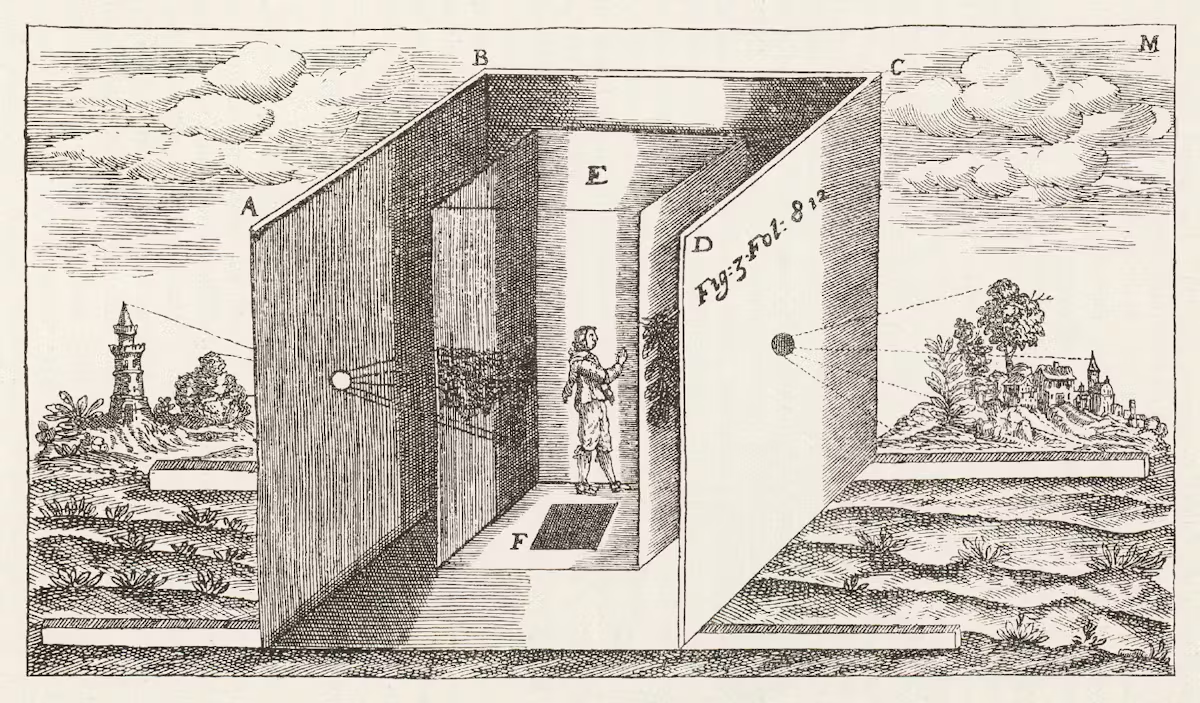
Centuries before photography froze the world into neat frames, scientists, poets, and artists streamed transient images into dark interior spaces with the help of a camera obscura. Julie Park explores the early modern fascination with this quasi-spiritual technology and the magic, melancholy, and dream-like experiences it produced…
The camera obscura, a device known as the photographic camera’s predecessor, was originally the size of a room. As an artist’s aid for rendering perspective, a scientific model for understanding optics, and a source of popular entertainment, it furnished observers with all kinds of information during the early modern period. In the context of pursuing knowledge about the natural world — whether in studying the sun, the light it emits, or the very organ for seeing, the eye — alchemists, astronomers, and mathematicians turned rooms in their homes into camera obscuras for revealing what was previously invisible.
In the most rudimentary terms, the camera obscura (whose Latin name means “dark chamber”) is a dark and enclosed environment with a hole on one side. This aperture allows light to stream into the interior space, casting moving images onto the opposite wall. Because its images of external reality appear reversed, both laterally and vertically — in colors deeper than their original, with movements intact but seemingly exaggerated — the camera obscura’s projections of the world re-envision it as a dream.
One of the very first mentions of the phenomenon behind the camera obscura is tied to the viewing of a solar eclipse. Aristotle, while observing a partial solar eclipse in the fourth century BCE, glimpsed its reflection in the play of light that seeped through the dense canopy of a tree. Here, the “dark chamber” is not a box or a room, but the critical space between solid things. Transposing this phenomenon onto the walls of domestic architecture, early modern natural philosophers made it possible to experience the domain of one’s personal space as a realm of marvelous reversal and illusion.
For Giambattista della Porta, polymath author of Natural Magic (1558), a book of natural philosophy and alchemy filled with magic tricks and scientific experiments, the camera obscura was a space for “see[ing] all things in the dark, that are outwardly done in the Sun, with the colours of them”. This evocative phrasing suggests the metaphysical happenings that the experience of being and peering inside a camera obscura offers. Della Porta’s instructions for engineering this “very pleasant and admirable” experience — among the “great secrets of Nature” — involve managing sources of light and creating the conditions by which it can be strategically channeled: “you must shut all the Chamber windows, and it will do well to shut up all holes besides”, except for one that is as wide and long as your hand. By covering the walls with paper or white cloth to create a viewing screen, the outside world will appear indoors, both familiar and estranged: “so shall you see all that is done without in the Sun, and those that walk in the streets, like to Antipodes, and what is right will be the left, and all things changed.”
A spiritual dimension inheres in this experience: the notion of illumination via obscuration that surrounds the early modern camera obscura carries remnants of the medieval period’s approach to darkness as the medium for perceiving the glorious light of God. Elina Gertsman explains how nowhere was this more evident than in windows through which light, both colored and clear, flooded into the darkness of cathedrals. Without the dimly lit cathedral space, this transmission of light as an expression of God’s splendor would not be so keenly felt. Both cathedrals and camera obscuras share the principle that dark places form the critical environment through which transformative light and its effects can be channeled. Yet in the case of camera obscuras, it was not just light alone, but ever more wondrous projections of the world that illuminated enclosed spaces…
[Park describes the camera obscuras of Johannes Kepler, Alexander Pope, Joshia Reynolds, and others…]
… While one might draw parallels with photographic technologies (both still and motion) — regarding how images are conjured by controlling an aperture — a key difference lies in the ephemerality of the viewing experience offered by the camera obscura. It captures life and its happenings as they take place, rather than preserving their images for the future. In other words, the moving images of the world it brings into its dark room are as transient as the dream state it appears to summon. And like dreams, the camera obscura could offer a new perspective on the world, to reveal things that might otherwise remain invisible. In 1764, the author of a dictionary entry on the camera obscura reflected on the ways in which the device underscores the motion of “the object itself”, such as a man walking, so that he appears to “have an undulating motion, or to rise up and down every step he takes”, in a way that could never be “observed in the man himself, as viewed by the naked eye”.
Despite their delight, the beguiled eighteenth-century viewers and inhabitants of the camera obscura’s worlds ineluctably expressed a sense of melancholy over the ephemerality of its projected scenes. Such sentiments are apparent in the numerous poems that appeared in the period conveying regret over the eventual disappearance of its pleasing phantoms. Yet, for a brief time, the camera obscura, especially when experienced as a room, gave individuals a sense of owning their own moving images of the world, in ways that might have felt far more vivid and evocative of one’s dream life than our own experiences with cinema are felt today. The moving images it mediates come from the viewer’s immediate environment, not from a world created by a scriptwriter and producer. This aspect of the camera obscura encouraged viewers to see reality in an unreal guise, both as an inner reality and a dream world, an elsewhere that is in fact quite nearby.
Paying attention to the historical role that the camera obscura played — allowing humans a safe and enclosed environment for accessing their imaginations, the sun, and many things in between — might transform the ways we look at our own spaces of solitude. Its visual effects can make us see that our emotional and mental landscapes are inseparable from the spaces in which we live and organize our lives. The very walls that provide us with shelter can also transform the world into scenes from a passing dream. By showing the world “with all things changed”, the camera obscura reveals just how clearly we can see in dark places…
More on– and many wonderful illustrations of– the early modern camera obscura: “Watching the World in a Dark Room,” from @publicdomainrev.bsky.social.
* Leonardo Da Vinci on the camera obscura
###
As we marvel, we might send birthday greetings to a modern photgrapher who has resurrected the technique, Abelardo Morell; he was born on this date in 1948. While his work is wide-ranging, he is perhaps best known for turning rooms into camera obscuras and then capturing the marriage of interior and exterior in large format photographs, for example:

More of Morell’s camera obscura work here.

You must be logged in to post a comment.