Posts Tagged ‘Alexander Pope’
“Who would believe that so small a space could contain the image of all the universe? O mighty process!… Here the figures, here the colors, here all the images of every part of the universe are contracted to a point. O what a point is so marvelous!”*…
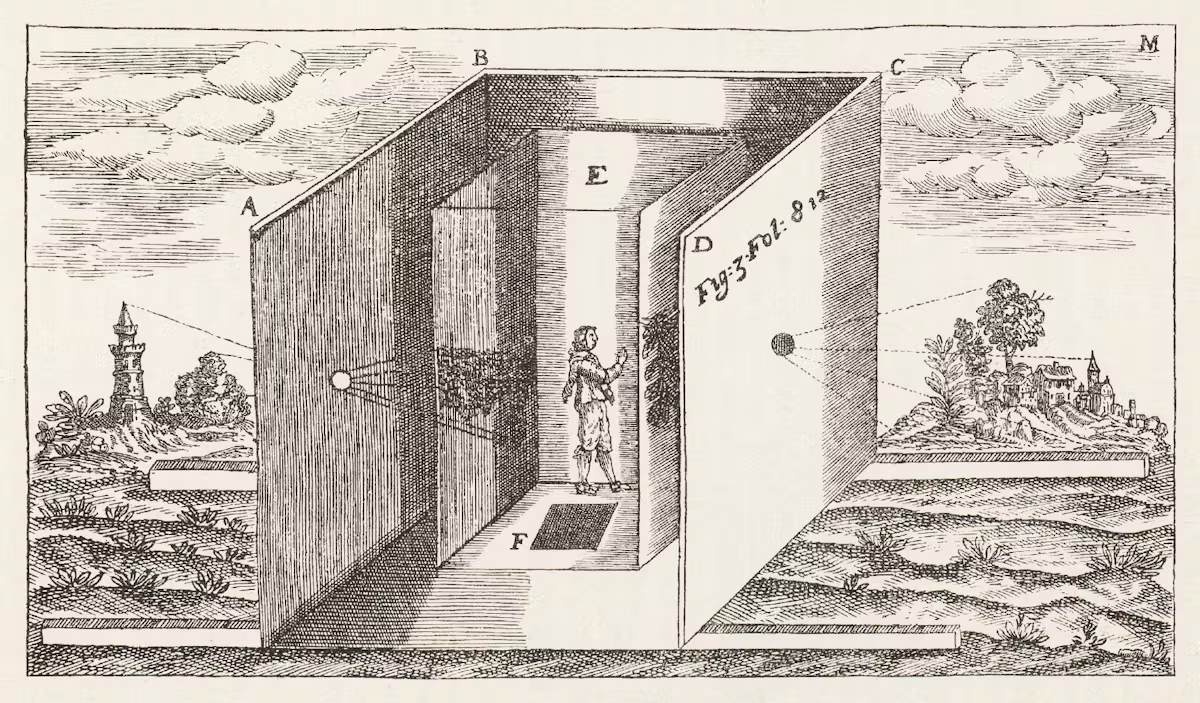
Centuries before photography froze the world into neat frames, scientists, poets, and artists streamed transient images into dark interior spaces with the help of a camera obscura. Julie Park explores the early modern fascination with this quasi-spiritual technology and the magic, melancholy, and dream-like experiences it produced…
The camera obscura, a device known as the photographic camera’s predecessor, was originally the size of a room. As an artist’s aid for rendering perspective, a scientific model for understanding optics, and a source of popular entertainment, it furnished observers with all kinds of information during the early modern period. In the context of pursuing knowledge about the natural world — whether in studying the sun, the light it emits, or the very organ for seeing, the eye — alchemists, astronomers, and mathematicians turned rooms in their homes into camera obscuras for revealing what was previously invisible.
In the most rudimentary terms, the camera obscura (whose Latin name means “dark chamber”) is a dark and enclosed environment with a hole on one side. This aperture allows light to stream into the interior space, casting moving images onto the opposite wall. Because its images of external reality appear reversed, both laterally and vertically — in colors deeper than their original, with movements intact but seemingly exaggerated — the camera obscura’s projections of the world re-envision it as a dream.
One of the very first mentions of the phenomenon behind the camera obscura is tied to the viewing of a solar eclipse. Aristotle, while observing a partial solar eclipse in the fourth century BCE, glimpsed its reflection in the play of light that seeped through the dense canopy of a tree. Here, the “dark chamber” is not a box or a room, but the critical space between solid things. Transposing this phenomenon onto the walls of domestic architecture, early modern natural philosophers made it possible to experience the domain of one’s personal space as a realm of marvelous reversal and illusion.
For Giambattista della Porta, polymath author of Natural Magic (1558), a book of natural philosophy and alchemy filled with magic tricks and scientific experiments, the camera obscura was a space for “see[ing] all things in the dark, that are outwardly done in the Sun, with the colours of them”. This evocative phrasing suggests the metaphysical happenings that the experience of being and peering inside a camera obscura offers. Della Porta’s instructions for engineering this “very pleasant and admirable” experience — among the “great secrets of Nature” — involve managing sources of light and creating the conditions by which it can be strategically channeled: “you must shut all the Chamber windows, and it will do well to shut up all holes besides”, except for one that is as wide and long as your hand. By covering the walls with paper or white cloth to create a viewing screen, the outside world will appear indoors, both familiar and estranged: “so shall you see all that is done without in the Sun, and those that walk in the streets, like to Antipodes, and what is right will be the left, and all things changed.”
A spiritual dimension inheres in this experience: the notion of illumination via obscuration that surrounds the early modern camera obscura carries remnants of the medieval period’s approach to darkness as the medium for perceiving the glorious light of God. Elina Gertsman explains how nowhere was this more evident than in windows through which light, both colored and clear, flooded into the darkness of cathedrals. Without the dimly lit cathedral space, this transmission of light as an expression of God’s splendor would not be so keenly felt. Both cathedrals and camera obscuras share the principle that dark places form the critical environment through which transformative light and its effects can be channeled. Yet in the case of camera obscuras, it was not just light alone, but ever more wondrous projections of the world that illuminated enclosed spaces…
[Park describes the camera obscuras of Johannes Kepler, Alexander Pope, Joshia Reynolds, and others…]
… While one might draw parallels with photographic technologies (both still and motion) — regarding how images are conjured by controlling an aperture — a key difference lies in the ephemerality of the viewing experience offered by the camera obscura. It captures life and its happenings as they take place, rather than preserving their images for the future. In other words, the moving images of the world it brings into its dark room are as transient as the dream state it appears to summon. And like dreams, the camera obscura could offer a new perspective on the world, to reveal things that might otherwise remain invisible. In 1764, the author of a dictionary entry on the camera obscura reflected on the ways in which the device underscores the motion of “the object itself”, such as a man walking, so that he appears to “have an undulating motion, or to rise up and down every step he takes”, in a way that could never be “observed in the man himself, as viewed by the naked eye”.
Despite their delight, the beguiled eighteenth-century viewers and inhabitants of the camera obscura’s worlds ineluctably expressed a sense of melancholy over the ephemerality of its projected scenes. Such sentiments are apparent in the numerous poems that appeared in the period conveying regret over the eventual disappearance of its pleasing phantoms. Yet, for a brief time, the camera obscura, especially when experienced as a room, gave individuals a sense of owning their own moving images of the world, in ways that might have felt far more vivid and evocative of one’s dream life than our own experiences with cinema are felt today. The moving images it mediates come from the viewer’s immediate environment, not from a world created by a scriptwriter and producer. This aspect of the camera obscura encouraged viewers to see reality in an unreal guise, both as an inner reality and a dream world, an elsewhere that is in fact quite nearby.
Paying attention to the historical role that the camera obscura played — allowing humans a safe and enclosed environment for accessing their imaginations, the sun, and many things in between — might transform the ways we look at our own spaces of solitude. Its visual effects can make us see that our emotional and mental landscapes are inseparable from the spaces in which we live and organize our lives. The very walls that provide us with shelter can also transform the world into scenes from a passing dream. By showing the world “with all things changed”, the camera obscura reveals just how clearly we can see in dark places…
More on– and many wonderful illustrations of– the early modern camera obscura: “Watching the World in a Dark Room,” from @publicdomainrev.bsky.social.
* Leonardo Da Vinci on the camera obscura
###
As we marvel, we might send birthday greetings to a modern photgrapher who has resurrected the technique, Abelardo Morell; he was born on this date in 1948. While his work is wide-ranging, he is perhaps best known for turning rooms into camera obscuras and then capturing the marriage of interior and exterior in large format photographs, for example:

More of Morell’s camera obscura work here.

“We use the term risk all too casually, and the term uncertainty all too rarely”*…

How private-equity giants are overhauling the financial system, and its potential impact on pensions…
A decade or so ago private equity was a niche corner of finance; today it is a vast enterprise in its own right. Having grabbed business and prestige from banks, private-equity firms manage $12trn of assets globally, are worth more than $500bn on America’s stockmarket and have their pick of Wall Street’s top talent. Whereas America’s listed banks are worth little more than they were before the pandemic, its listed private-equity firms are worth about twice as much. The biggest, Blackstone, is more valuable than either Goldman Sachs or Morgan Stanley—and has the confidence of a winner. “It’s the alternatives era,” proclaimed the company’s ebullient Taylor Swift-themed festive video in December. “We buy assets then we make ’em better.”
This is not, though, the business that has recently boomed for them. Traditional private equity—using lots of debt to buy companies, improving them, and selling or listing them—has been lifeless. High interest rates have cast doubt on the value of privately held companies and reduced investors’ willingness to provide new funds. It does not seem to matter. Core private-equity activity is now just one part of the industry’s terrain, which includes infrastructure, property and loans made directly to companies, all under the broad label of “private assets”. Here the empire-building continues. Most recently, as we report this week, the industry is swallowing up life insurers.
All of the three kings of private equity—Apollo, Blackstone and KKR—have bought insurers or taken minority stakes in them in exchange for managing their assets. Smaller firms are following suit. The insurers are not portfolio investments, destined to be sold for a profit. Instead they are prized for their vast balance-sheets, which are a new source of funding.
Judged by the fundamentals, the strategy makes sense. Insurance firms invest over long periods to fund payouts, including annuities sold to pensioners. They have traditionally bought lots of government and corporate bonds that are traded on public markets. Firms like Apollo can instead knowledgeably move their portfolios into the higher-yielding private investments in which they specialise. A higher rate of return should mean a better deal for customers. And because insurers’ liabilities stretch years into the future, the finance they provide is patient. In banking, long-term loans are funded with lots of instantly accessible deposits; with private assets and insurance, the duration of the assets matches the duration of the liabilities.
Yet the strategy brings risks—and not just to the firms. Pension promises matter to society. Implicitly or explicitly, the taxpayer backstops insurance to some degree, and regulators enforce minimum capital requirements so that insurers can withstand losses. Yet judging the safety-buffers of a firm stuffed with illiquid private assets is hard, because its losses are not apparent from movements in financial markets. And in a crisis insurance policyholders may sometimes flee as they seek to get out some of their money even if that entails a financial penalty. Last year an Italian insurer suffered just such a bank-run-like meltdown…
Funding pension providers with private equity: “The risks to global finance from private equity’s insurance binge” (gift article) from @TheEconomist.
And lest we think that publicly-funded defined benefit pensions are less risky, see “Akin to Fraud” by Mary Willliams Walsh, an account of the sorry state of the public pension fund in New Hampshire (the state with the second-oldest population in the nation).
###
As we rethink retirement, we might recall that it was on this date in 1728 that John Gay‘s The Beggar’s Opera premiered. A “ballad opera” (a satirical work with lyrics set to vernacular music), it was a huge hit– it has been called “the most popular play of the eighteenth century“– a watershed in Augustan drama.
The original idea of the opera came from Jonathan Swift, who wrote to Alexander Pope in 1716 asking “…what think you, of a Newgate pastoral among the thieves and whores there?” Their friend, Gay, decided that it would be a satire rather than a pastoral opera.
In 1928, Bertolt Brecht (working from a translation into German by Elisabeth Hauptmann) adapted the work into Die Dreigroschenoper (The Threepenny Opera) in 1928, sticking closely to the original plot and characters but with a new libretto, and mostly new music by Kurt Weill.

“The proper study of mankind is man”*…
 click here (and again) for larger
British engraver and publisher Valentine Green was one of the most accomplished mezzotint engravers in the later 18th and early 19th centuries in England. During his career he produced over four hundred plates after portraits by Reynolds, Romney, and other British artists, and after pictures by Van Dyck, Rubens, Murillo, and other old masters. But on occasion Green turned his hand to more personal projects- like the “abridgment” of Pope’s An Essay on Man, above.
Alexander Pope’s 1734 poem An Essay on Man, a philosophical poem using rationality to try and justify God’s ways to man. Pope’s poem was a particular favorite among the top Enlightenment thinkers of the time, including Kant, Rousseau and Voltaire, the latter[most] calling it “the most beautiful, the most useful, the most sublime didactic poem ever written in any language” (though he would later satirize Pope’s optimism in Candide).
Read more– and see another example of Green’s meditation on ephemerality and vanity– in “Life and Death Contrasted (ca.1770)”
* Alexander Pope, An Essay on Man, Epistle II
###
As we wonder what ever happened to good old Yorick, we might send memorable birthday greetings to Aloysius “Alois” Alzheimer; he was born on this date in 1864. A psychiatrist and neuropathologist, he was the first to recognize the condition he called “pre-senile dementia”– a progressive, degenerative disorder that begins with short-term memory loss– and to identify the amyloid plaques and neurofibrillary tangles that cause (or at least accompany) it. At the suggestion of his friend and collaborator Emil Kraepelin, the condition was re-named “Alzheimer’s Disease.”

From the Department of Stating the Obvious…

From AAAS’ Science, “It’s Official: Physics is Hard“:
Students and researchers alike have long understood that physics is challenging. But only now have scientists managed to prove it. It turns out that one of the most common goals in physics—finding an equation that describes how a system changes over time—is defined as “hard” by computer theory. That’s bad news for physics students who hope that a machine can solve all their homework problems, but at least their future jobs in the field are safe from automation.
Physicists are often interested in mathematically describing how a system behaves: for instance, a formula tracks the motions of the planets and their moons in their complicated dance around the sun. Researchers work out these equations by measuring the objects at various points in time and then developing a formula that links all of those points together, such as filling in a video from a set of snapshots.
With each new variable, however, it becomes tougher to find the right equation. Computers can speed things up by sifting through potential solutions at breakneck speed, but even the world’s top supercomputers meet their match with a certain class of problems, known as “hard” problems. These problems take exponentially more time to solve with every additional variable that is thrown into the mix—an extra planet’s motion, for instance…
[Full article here]
Problems like these, known in complexity theory as NP-hard, may be discouraging of the prospect of quick solutions; but at least they seem to offer physicists some measure of job security. Still, if a bankable short-cut could be found, it would have profound implications for math and it applications. So the Clay Mathematics Institute has chosen the challenge as one of its Millennium Problems: the scientist who comes up with a universal “problem tenderizer” wins $1 million.

As we remember that pie are square, we might spare a memorial thought for the polymathic John Arbuthnot; he died on this date in 1735. The mathematician, essayist, and physician published his translation of Huygens’ Of the Laws of Chance (1692), to which Arbuthnot added further games of chance– the first work on probability published in English. He wrote a series of satirical pamphlets introducing “john Bull” (the now-iconic “Englishman”), and co-founded Scriblerus Club, where he inspired co-founders Jonathan Swift (Gulliver’s Travels book III) and Alexander Pope (Peri Bathous, Or the Art of Sinking in Poetry, Memoirs of Martin Scriblerus, and The Dunciad). And from 1705, he was physician to Queen Anne until her death in 1714.

You must be logged in to post a comment.