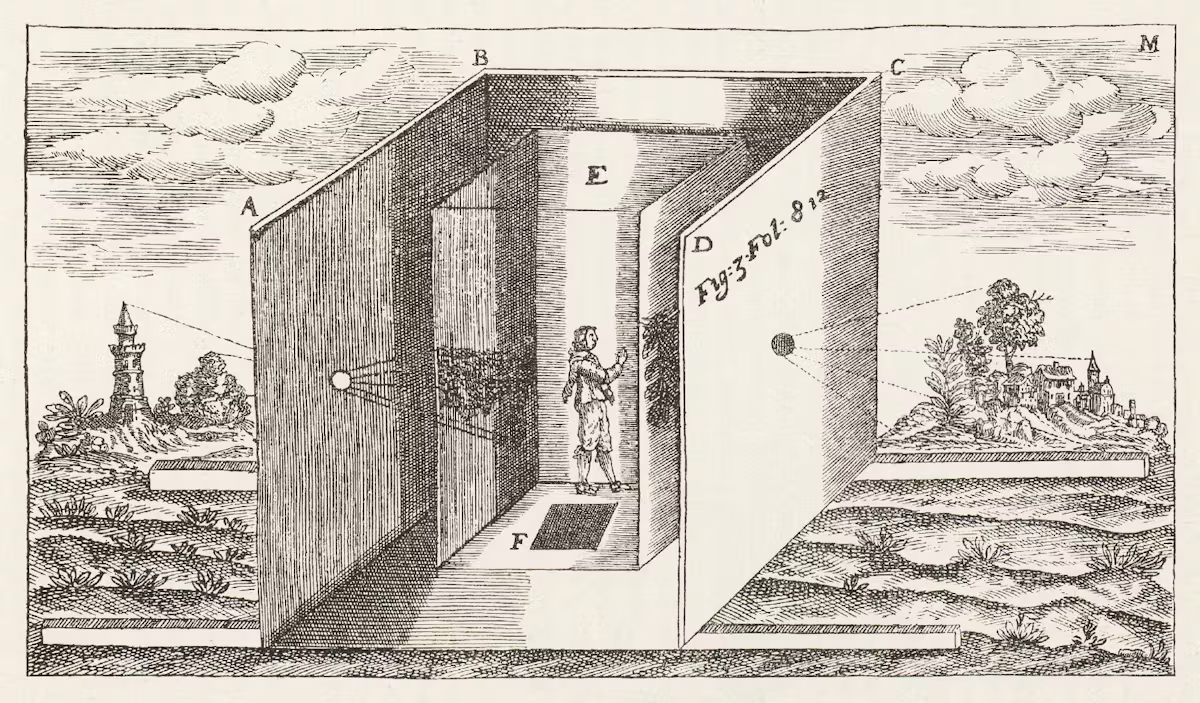
“Athanasius Kircher’s camera obscura,” illustration from Kirscher’s Ars magna lucis et umbrae (1671) reproduced in Josef Maria Eder’s Ausführliches Handbuch der Photographie (Detailed handbook of photography, 1905 — Source.
Centuries before photography froze the world into neat frames, scientists, poets, and artists streamed transient images into dark interior spaces with the help of a camera obscura. Julie Park explores the early modern fascination with this quasi-spiritual technology and the magic, melancholy, and dream-like experiences it produced…
The camera obscura, a device known as the photographic camera’s predecessor, was originally the size of a room. As an artist’s aid for rendering perspective, a scientific model for understanding optics, and a source of popular entertainment, it furnished observers with all kinds of information during the early modern period. In the context of pursuing knowledge about the natural world — whether in studying the sun, the light it emits, or the very organ for seeing, the eye — alchemists, astronomers, and mathematicians turned rooms in their homes into camera obscuras for revealing what was previously invisible.
In the most rudimentary terms, the camera obscura (whose Latin name means “dark chamber”) is a dark and enclosed environment with a hole on one side. This aperture allows light to stream into the interior space, casting moving images onto the opposite wall. Because its images of external reality appear reversed, both laterally and vertically — in colors deeper than their original, with movements intact but seemingly exaggerated — the camera obscura’s projections of the world re-envision it as a dream.
One of the very first mentions of the phenomenon behind the camera obscura is tied to the viewing of a solar eclipse. Aristotle, while observing a partial solar eclipse in the fourth century BCE, glimpsed its reflection in the play of light that seeped through the dense canopy of a tree. Here, the “dark chamber” is not a box or a room, but the critical space between solid things. Transposing this phenomenon onto the walls of domestic architecture, early modern natural philosophers made it possible to experience the domain of one’s personal space as a realm of marvelous reversal and illusion.
For Giambattista della Porta, polymath author of Natural Magic (1558), a book of natural philosophy and alchemy filled with magic tricks and scientific experiments, the camera obscura was a space for “see[ing] all things in the dark, that are outwardly done in the Sun, with the colours of them”. This evocative phrasing suggests the metaphysical happenings that the experience of being and peering inside a camera obscura offers. Della Porta’s instructions for engineering this “very pleasant and admirable” experience — among the “great secrets of Nature” — involve managing sources of light and creating the conditions by which it can be strategically channeled: “you must shut all the Chamber windows, and it will do well to shut up all holes besides”, except for one that is as wide and long as your hand. By covering the walls with paper or white cloth to create a viewing screen, the outside world will appear indoors, both familiar and estranged: “so shall you see all that is done without in the Sun, and those that walk in the streets, like to Antipodes, and what is right will be the left, and all things changed.”
A spiritual dimension inheres in this experience: the notion of illumination via obscuration that surrounds the early modern camera obscura carries remnants of the medieval period’s approach to darkness as the medium for perceiving the glorious light of God. Elina Gertsman explains how nowhere was this more evident than in windows through which light, both colored and clear, flooded into the darkness of cathedrals. Without the dimly lit cathedral space, this transmission of light as an expression of God’s splendor would not be so keenly felt. Both cathedrals and camera obscuras share the principle that dark places form the critical environment through which transformative light and its effects can be channeled. Yet in the case of camera obscuras, it was not just light alone, but ever more wondrous projections of the world that illuminated enclosed spaces…
[Park describes the camera obscuras of Johannes Kepler, Alexander Pope, Joshia Reynolds, and others…]
… While one might draw parallels with photographic technologies (both still and motion) — regarding how images are conjured by controlling an aperture — a key difference lies in the ephemerality of the viewing experience offered by the camera obscura. It captures life and its happenings as they take place, rather than preserving their images for the future. In other words, the moving images of the world it brings into its dark room are as transient as the dream state it appears to summon. And like dreams, the camera obscura could offer a new perspective on the world, to reveal things that might otherwise remain invisible. In 1764, the author of a dictionary entry on the camera obscura reflected on the ways in which the device underscores the motion of “the object itself”, such as a man walking, so that he appears to “have an undulating motion, or to rise up and down every step he takes”, in a way that could never be “observed in the man himself, as viewed by the naked eye”.
Despite their delight, the beguiled eighteenth-century viewers and inhabitants of the camera obscura’s worlds ineluctably expressed a sense of melancholy over the ephemerality of its projected scenes. Such sentiments are apparent in the numerous poems that appeared in the period conveying regret over the eventual disappearance of its pleasing phantoms. Yet, for a brief time, the camera obscura, especially when experienced as a room, gave individuals a sense of owning their own moving images of the world, in ways that might have felt far more vivid and evocative of one’s dream life than our own experiences with cinema are felt today. The moving images it mediates come from the viewer’s immediate environment, not from a world created by a scriptwriter and producer. This aspect of the camera obscura encouraged viewers to see reality in an unreal guise, both as an inner reality and a dream world, an elsewhere that is in fact quite nearby.
Paying attention to the historical role that the camera obscura played — allowing humans a safe and enclosed environment for accessing their imaginations, the sun, and many things in between — might transform the ways we look at our own spaces of solitude. Its visual effects can make us see that our emotional and mental landscapes are inseparable from the spaces in which we live and organize our lives. The very walls that provide us with shelter can also transform the world into scenes from a passing dream. By showing the world “with all things changed”, the camera obscura reveals just how clearly we can see in dark places…
As we marvel, we might send birthday greetings to a modern photgrapher who has resurrected the technique, Abelardo Morell; he was born on this date in 1948. While his work is wide-ranging, he is perhaps best known for turning rooms into camera obscuras and then capturing the marriage of interior and exterior in large format photographs, for example:
The once ubiquitous mechanical calculator were engineering marvels… and as Kevin Twomey‘s photos also demonstrate, things of beauty…
More stunning photos of calculators (and typewriters and more) on Twomey’s site.
* Gottfried Wilhelm Leibniz, describing, in 1685, the value to astronomers of the hand-cranked calculating machine he had invented in 1673
###
As we sum it up, we might send snappy birthday greetings to Nicéphore Niépce; he was born on this date in 1765. An inventor, he was a pioneer of photography…
The very first photograph was taken in 1826 by Joseph Nicéphore Niépce, who aimed a camera obscura, which held a polished pewter plate coated with bitumen of Judea (an asphalt derivative of petroleum), out the window of the upper-story workroom at his Saint-Loup-de-Varennes country house, Le Gras. After a day-long exposure, the plate was removed and the latent image of the view from the window was rendered visible by washing it with a mixture of oil of lavender and white petroleum, which dissolved away the parts of the bitumen which had not been hardened by light. The result was this permanent direct positive picture– a one-of-a-kind photograph on pewter:
(For more on Niépce and the story of his pioneering accomplishment [and a larger version of this inagural image], visit the source of this photo, the site of the Harry Ransom Center at the University of Texas.)
In Locked Down Looking Up, Bay Area photographer Doris Mitsch captures the swirling, shapeshifting flight patterns of birds and other winged creatures: a flock of vultures creates coils and whirls between rugged mesas, crows descend toward a forest in single-file trails, and gulls congregate above the sea in lengthy lines.
The ongoing project began early in 2020 when Mitsch set up a camera outside her front door and shot consecutive images of birds flying around her home. “While everything in my life has come to a standstill, up in the air, there is still a lot going on,” she writes. She’s since traveled along the California coast and to Moab’s desert landscapes capturing similar swarming phenomena featuring vultures, gulls, and crows…
“Nature is ever at work building and pulling down, creating and destroying, keeping everything whirling and flowing, allowing no rest but in rhythmical motion, chasing everything in endless song out of one beautiful form into another.” – John Muir
###
As we ponder patterns, we might send faithfully-captured birthday greetings to Thomas Wedgwood; he was born on this date in 1771. An English inventor, he was the first person reliably documented to have used light-sensitive chemicals to capture silhouette images on durable media such as paper, and the first known to have attempted to photograph the image formed in a camera obscura. His practical experiments yielded only shadow image photograms that were not light-fast, but his conceptual breakthrough and partial success have led some historians to call him “the first photographer.”
Wedgwood was the son of Josiah Wedgwood, and so the uncle of Charles Darwin (the son of Thomas’ sister, Susannah), and he was a friend and patron of Samuel Taylor Coleridge.
400,000 years ago, humans and Neanderthals discovered fire. This ignited a relationship between people and photons that changed the course of mankind—and continues to evolve to this day…
* Martin Luther King, Jr.
###
As we remove our sunglasses, we might spare a thought for Roger Bacon; he died on this date in 1292. A philosopher and Franciscan friar, Bacon was one of the first to propose mathematics and experimentation as appropriate methods of science. Working in mathematics, astronomy, physics, alchemy, and languages, he was particularly impactful in optics: he elucidated the principles of refraction, reflection, and spherical aberration, and described spectacles, which soon thereafter came into use. He developed many mathematical results concerning lenses, proposed mechanically propelled ships, carriages, and flying machines, and used a camera obscura to observe eclipses of the Sun. And he was the first European give a detailed description of the process of making gunpowder.
He began his career at Oxford, then lectured for a time at Paris, where his skills as a pedagogue earned him the title Doctor Mirabilis, or “wonderful teacher.” He stopped teaching when he became a Franciscan. But his scientific work continued, despite his Order’s restrictions on activity and publication, as Bacon enjoyed the protection and patronage of Pope Clement… until, on Clement’s death, he was placed under house arrest in Oxford, where he continued his studies, but was unable to publish and communicate with fellow investigators.
Statue of Roger Bacon in the Oxford University Museum
The very first photograph was taken in 1826 by Joseph Nicéphore Niépce, who aimed a camera obscura, which held a polished pewter plate coated with bitumen of Judea (an asphalt derivative of petroleum), out the window of the upper-story workroom at his Saint-Loup-de-Varennes country house, Le Gras. After a day-long exposure, the plate was removed and the latent image of the view from the window was rendered visible by washing it with a mixture of oil of lavender and white petroleum, which dissolved away the parts of the bitumen which had not been hardened by light. The result was this permanent direct positive picture– a one-of-a-kind photograph on pewter:
Les Horribles Cernettes (LHC... pun intended*), a band at CERN (where Tim Berners-Lee "created" the web), 1992
More– from the first photo of the whole earth and the first x-ray to the first color photo and the first picture of the surface of another planet– at OObject.
As we say “cheese,” we might recall that it was on this date in 1935 that George Gershwin signed his name to the completed orchestral score of the opera Porgy and Bess. The composer considered the 700-page work his masterpiece; many critics agree, considering this first American opera to be the finest American opera.


 (For more on Niépce and the story of his pioneering accomplishment, visit the source of this photo, the site of the Harry Ransom Center at the University of Texas.)


You must be logged in to post a comment.