“If I am to be remembered, I hope it will not be primarily for my specialized scientific work, but as a generalist; one to whom, enlarging Terence’s words, nothing human and nothing in external nature was alien.”*…
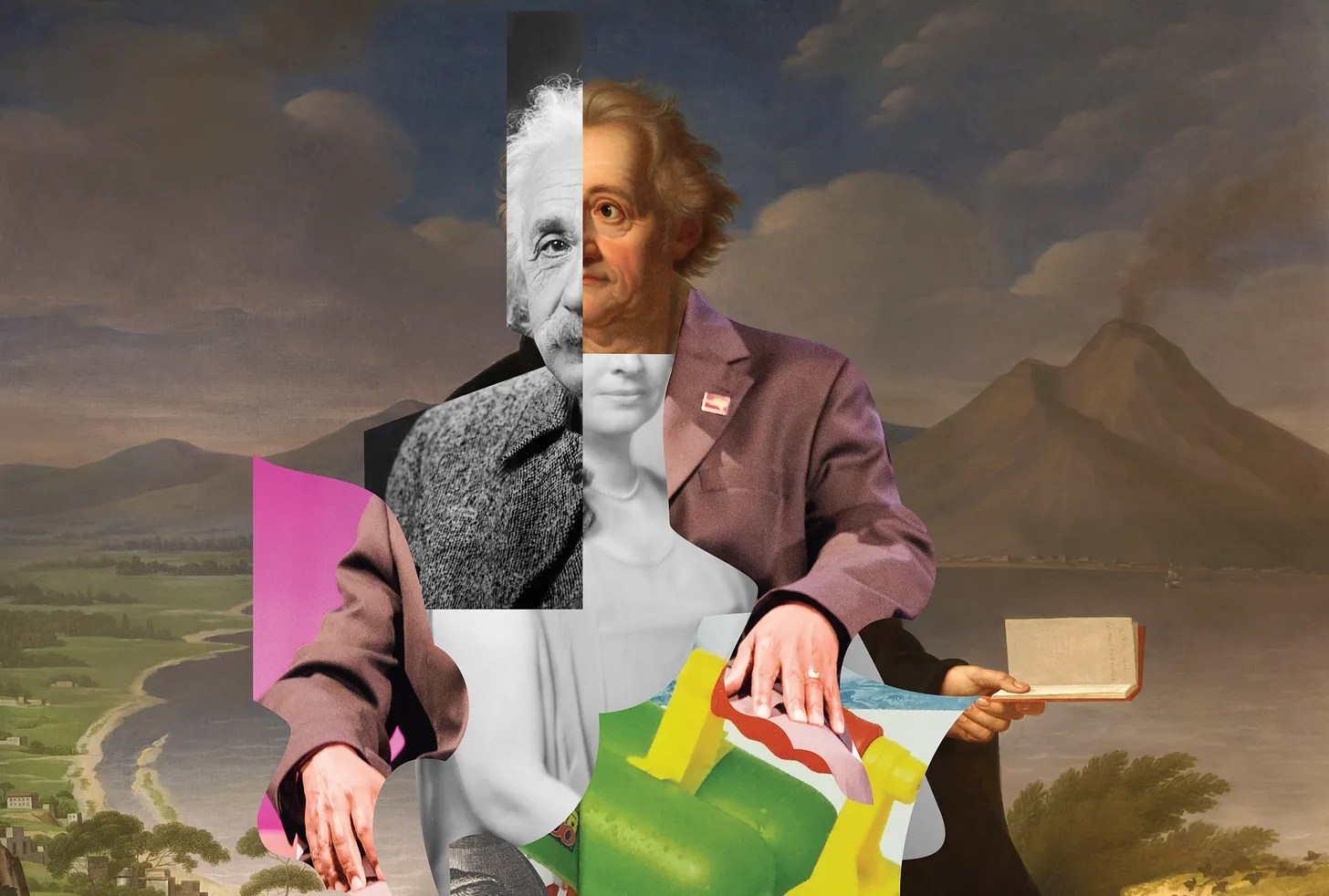
Interdisciplinary artist, writer, and musician Ross Simonini with 47 thoughts on the glory of looking– and living– beyond a specialty…
1. I was raised to believe that I was made to do one thing. Find that one pursuit that fills my life with meaning and empty all my energy into it. This is the realization of human potential: to excel with rigorous focus on a refined lifelong mission. This and only this will bring us to our greatest success and fulfillment.
For me, this was not something I even had to be told—though I was, many times, by many people—because I implicitly understood that this kind of teleology was woven into the fibers of my world. I also knew that rejecting a singular pursuit would be an insult to my very existence. Without this unifying reason for being alive, I would wander aimlessly into the barren void of nihilism. I’d heard about great artists who refused to create, who stepped away from their work to fritter away their time on leisure, and I knew this was a life of tragedy.
Likewise, I understood that sliding your attention across interests is a way to waste your gift. The more hours you put into a skill, the more skilled you become—right? To treat your gift with the proper deference, you must exhaust yourself into it.
Within this paradigm, the most unfortunate people are those who do not have a single, clear vocation. These types float from job to job without a trajectory; they are vagabonds who have given up on greatness.
This may sound a little dramatic, but somewhere inside me, these beliefs are there—and as a lifelong generalist, I spend every day rubbing up against them.
…
16. Let’s talk about mastery. Everyone wants to be a master, even if they are disgusted by the monstrous implications of the word. Mastery suggests dominance over something, but every true master knows that they are merely a supplicant at the mercy of their field, which existed long before them and will exist long after them. Anyone who believes in their own mastery likely suffers from hubris. Work hard enough at something and you watch your dominance slip ever further away.
Mastery is an illusion, a notion of a fictional purity that cannot be understood or measured in terms of time. Just look at those young savants who excel wildly after only a few years spent on their craft. For them, mastery cannot be the result of time plus work, as we all assume it is. In fact, maybe the newness of their skills is precisely what gives their work its value.
But these little wonders are exceptions, right? The rest of us have to dedicate our lives to something to achieve greatness, and anyone who doesn’t do this will likely be middling in their work. Most writers I know are immediately suspicious when an actor publishes a novel. We delight in calling the person a moonlighter. Literature is our territory, and the only way to live here is to put in the time and labor.
…
24. Isaiah Berlin, the political theorist, ethicist, philosopher, and historian, wrote a book called The Hedgehog and the Fox, in which he divides people into two types: hedgehogs, who see the entire world through one big thing, and foxes, who see the world as many things that cannot be reduced. According to Berlin, hedgehogs include Plato, Dostoyevsky, and Proust, while foxes include Aristotle, Shakespeare, and James Joyce.
“Everything I learned in my life, I learned because I decided to try something new,” said David Lynch (musician, filmmaker, painter, lamp maker, sculptor, writer, actor, and lecturer, mostly on meditation).
…
29. Sometimes history hides generalism to preserve a specialized agenda. Isaac Newton, a figure whom we consider the father of modern math, physics, and reasoned thinking, was also a dedicated alchemist. Alchemy, a generalist practice in itself, was a precursor to modern chemistry. It involves spirituality, myth, belief, and metallurgy, but its inclusion of belief stands in direct conflict with the scientific rationalism Newton now represents. Subsequent generations of historians and scientists buried Newton’s dedication to the occult, willfully ignoring the blow it deals to their obsessive, single-minded materialism. But Newton’s own records tell a different story. He wrote over a million words on alchemy in his lifetime, and his study of the subject helped inspire some of his most paradigm-shifting discoveries.
…
31. A filmmaker must understand aspects of sound design, photography, storytelling, music, acting, props, environment, finance, writing, and dialogue. In this way, some jobs are naturally suited to the generalist. A skilled homemaker, for example, understands everything from cooking to cleaning to healing to sociology. Acting, too, is a fairly generalist vocation. The practice of writing, what I am doing right now, is extremely broad, without consistent subject matter, form, or even mediums.
Generalism can be an approach of the neophyte or of the seasoned worker. Some entry-level positions (assistant, secretary, intern) are, in fact, compilations of micro-jobs, and some high-level positions—
managers, CEOs, directors, business owners, presidents—are positions of vast, nonspecific oversight. Sometimes the highest perch has the widest perspective.…
39. A generalist must engage with both sides of any argument: skepticism and belief, optimism and pessimism. So, for this essay, it would only be right to take a look at the dark side of generalism and the side effects of adopting it as a whole-life philosophy.
The glaring danger of general thinking in its extreme form is relativism, a sort of mushy non-position in which there are no universal standards: nothing can ever be condemnable or universally wrong. At the most dramatic levels, relativism might dismiss murder and genocide. It’s a slippery slope of open-mindedness.
Likewise, a generalist must contend with political centrism. In our bifurcated world, the center is one of the most reviled of all political positions, and a generalist will come to understand whether their own centrism is an evasion of choice or a refusal of unpalatable options.
Few things are more torturous than making decisions, and a mind will do anything to avoid such a relentlessly complex activity. Adherence to these vague philosophies, as I see them, can certainly be used as an excuse for escaping commitment. As a generalist, I must stay vigilant against this kind of laziness of mind and instead allow many fierce, contrary ideas to exist at once.
…
42. Generalism is not a thing. It’s definitely not an ism or some kind of doctrine. The general approach defies the nature of ideologies, which are characterized by the limits they place on understanding the world. There is no system of generalism. The general philosophy is to love variety.
For this reason, generalists don’t exist—not in the way that, say, Marxists do—because they can’t identify as generalists. I can call myself intra-, cross-, multi-, inter-, and trans-disciplinary—which, for some, are all legitimate and distinct prefixes—but that does more to distinguish and alienate me from others than to connect me with a community. There is no lineage of generalists, as there is for microbiologists or flutists, because every generalist works with their own complex bouquet of interests.
Probably this whole essay is my attempt to give a sense of unity to my life. Maybe I have to write a manifesto on “the art of doing many things”because I fear that if our culture doesn’t have a catchy keyword for my role, I’ll just fade away. So here I am, reducing generalism to a single, branded snap, just like a specialist.
After all, generalists are, in moments, great specialists. Likewise, a deep specialist can approach their niche from an ever-growing number of perspectives. A man with a repetitive job can endlessly engage with his work from fresh angles. And, of course, it’s all relative. A single task looked at from another angle is a plentiful cornucopia of individuated micro-tasks.
Some long-term generalists focus exclusively on a single activity for a number of years before moving on to the next. Rather than doing many things simultaneously, they do them sequentially.
Pure generalism and pure specialism are just intellectual games. Our minds drift between unified oneness and individuality without ever settling into either. Binary thinking is for computers.
These two states of being are not roles we need to inhabit but rather nodes to be considered. One situation requires diligent focus, but another benefits from a more diffuse form of attention. Certain qualities of engagement can occur only when you do multiple things at once. This is the value of the glance.
…
47. Generalism is not the opposite of specialism. It includes specialism. Everyone gets to experience both. Or maybe both approaches lead to the same place. Maybe the study of quantum physics brings a mind to the same conclusions as basketry. Maybe it’s like meditation: You can sit in open awareness and experience everything until you reach an unprejudiced understanding of life. Or you can unflinchingly focus on a single mantra for decades, repeating it with each breath, and as you plunge deeper toward a single infinite point, you discover that everything is already right there.
Eminently worth reading in full: “In praise of generalism” from @thebeliever.net.
###
As we widen our irises, we might send carefully-calculated birthday greetings to Pierre de Fermat; he was born on this date in 1601. While he is remembered as one of the two great mathematicians of the early 17th century (with Descartes), Fermat was (like Descartes) driven by wider interests. Fermat was a trained lawyer, who served as a councilor at the Parlement de Toulouse, one of the High Courts of Judicature in France. He was fluent in six languages and praised for his written verse in several of them; his advice was eagerly sought regarding the emendation of Greek texts… which is to say that mathematics was but one of his interests, and more a hobby than a profession at that. Still, Fermat made foundational contributions to analytical geometry, probability, number theory and calculus.

You must be logged in to post a comment.