Posts Tagged ‘art’
“Hollywood is a place where a man can get stabbed in the back while climbing a ladder.”*…

While William Faulkner spent most of his life in the Oxford, Mississippi area that he made famous, he did a considerable– and fascinating– stetch in Hollywood. John Meroney reports…
… It all started in 1932, when, riding on the success of his novel Sanctuary, Faulkner got word that Leland Hayward, a prominent Hollywood talent agent, had secured for him a $500-a-week contract (the equivalent of $8,500 today) to write scripts at Metro-Goldwyn-Mayer. Faulkner was a modernist, and film was still a new, exciting form of storytelling. But that wasn’t the reason Faulkner accepted. It was the money.
At the same time Faulkner received the offer from Metro, he got news that his publisher, Cape & Smith, was bankrupt. Faulkner had been planning on $4,000 ($68,000 in today’s money) from the company for Sanctuary but was informed he wouldn’t see any of it. Suddenly, he was broke. Word apparently got around Oxford. When he tried writing a check for three dollars at a sporting goods store, the owner told him, I’d rather have cash. All at once, Hollywood became attractive. Faulkner didn’t even have the money to send a wire to answer yes. Eventually MGM advanced him some cash and paid for his train ticket, and days later he arrived in Culver City.
He was so naive about the industry that he entertained hopes he would be writing for the famous movie star Mickey Mouse. But the folks at Metro informed him, No, Mickey lives at another studio out in the Valley—we want you for a Wallace Beery picture. “Who’s he?” Faulkner asked…
… Faulkner completed four story treatments in four weeks. That kind of productivity earned him a meeting with up-and-coming director Howard Hawks [see almanac entry here]. He liked Faulkner’s writing and purchased a Saturday Evening Post short story by him that he wanted Faulkner to adapt into a script for Hawks to direct. Over a “couple of quarts of whiskey,” as Hawks recalled in an interview, they clicked and found common cause. “[Faulkner] got up the next morning and started to work, and in five or six days, he had a script,” Hawks said. “It was one of the finest scripts I’ve ever read.” Hawks showed it to Metro’s head of production, Irving Thalberg, who concurred. “Go out and make it!” he ordered Hawks. The result was Today We Live, a drama starring Gary Cooper and Joan Crawford, released in 1933. William Faulkner now had a hit movie to his credit. And, more important, the beginning of what would become an ongoing professional connection with Hawks…
…Faulkner sometimes hunted with Hawks, and on one dove hunting trip recounted by the director, Hawks invited along Clark Gable, already a star. Faulkner and Hawks began discussing literature and eventually Gable asked, “Mr. Faulkner, what do you think somebody should read if he wants to read the best modern books? Who would you say are the best living writers?” Faulkner replied, “Thomas Mann, Willa Cather, John Dos Passos, Ernest Hemingway, and myself.” Gable asked, “Oh, do you write, Mr. Faulkner?” Faulkner replied, “Yeah. What do you do, Mr. Gable?”…
And so much (so very much) more: “William Faulkner’s Hollywood Odyssey” from Garden and Gun.
* William Faulkner
###
As we fathom fish out of water, we might recall that it was on this date in 1987 that the United States Postal Service issued a 22-cent postage stamp in Faulkner’s honor. Very early in his career, Faulkner had briefly served as Postmaster at the University of Mississippi, and in his letter of resignation in 1923 wrote:
As long as I live under the capitalistic system, I expect to have my life influenced by the demands of moneyed people. But I will be damned if I propose to be at the beck and call of every itinerant scoundrel who has two cents to invest in a postage stamp. This, sir, is my resignation.

“Read the best books first, or you may not have a chance to read them at all”*…

Ah, but “good”?… Past a certain level of quality, our definitions of “good”– that’s to say, the books that entertain and enlighten– vary for each of us. How to choose? Literature-Map is here to help…
The Literature-Map is part of Gnod, the Global Network of Discovery.
It is based on Gnooks, Gnod’s literature recommendation system. The more people like an author and another author, the closer together these two authors will move on the Literature-Map.
If you found a typo or a duplicate, please report it here.
Is an author missing on the map? Please vote for them here.
Want to jump to a random place on the map? Click here
Help in finding your next book: “The Literature-Map.”
* Henry David Thoreau, A Week on the Concord and Merrimack Rivers
###
As we turn the page, we might recall that this date in 1935 was a big one for the book business:
Allen Lane, Chairman of the London publisher The Bodley Head, was returning home after traveling with author Agatha Christie and her husband. At the train station, he browsed the kiosks looking for something to read on his way home. All he could find were magazines or low-quality paperback stories that he had no interest in reading. Then the thought occurred to him that people, like himself, might be more inclined to read good quality books [literature in paperback was then mainly poor quality lurid fiction] if they were more affordable. And since he was in the position to help build up lagging sales for his company, he ventured into printing previously hard-back books into a paperback format. The first was released on this day in 1935…
– source
Penguin Books featured no photos and were priced about a fifteenth the price of a hardcover book. The traditional book trade initially resisted; but the purchase of 63,000 books by Woolworths paid for the project outright, confirmed its worth, and allowed Lane to establish Penguin as a separate business in 1936. Indeed, by March 1936, ten months after the company’s launch, one million Penguin books had been printed.
[More here]

“Frederick Douglass taught that literacy is the path from slavery to freedom. There are many kinds of slavery and many kinds of freedom, but reading is still the path”*…
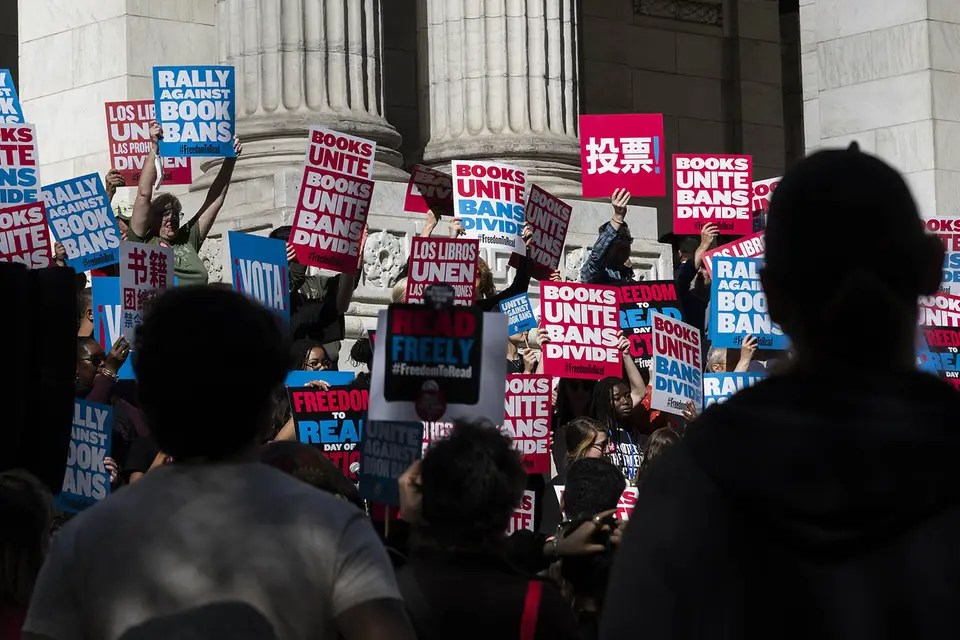
The attack on libraries, in the U.S. and beyond, has been a recurring theme here– precisely because it is so threatening. The estimable Richard Ovenden considers the titles banned, the data deleted, the nation’s librarians sacked without explanation, and explains that Donald Trump’s war on books is a threat to democracy across the world…
I am a librarian. I am fortunate enough to run one of the world’s largest and best known libraries – the Bodleian in Oxford – but my experience of libraries began as a reader. My mother took me as a child to the Deal public library in Kent, and it was there, in its modest book-filled rooms, that I discovered new worlds. My life was transformed by a public library (and its librarians) that allowed me to read freely from its well-stocked shelves. Throughout my career, I have seen at first-hand how libraries underpin the education and self-improvement of all of our citizens, rich and poor, young and old, of all creeds and colours, through providing access to a multitude of ideas and knowledge.
They celebrate the history and identity of our communities; they are stout defenders of facts and truth in an age of misinformation; and they are places where people can learn about their rights and how to protect them. This year we celebrate the 175th anniversary of the Public Libraries Act of 1850, which created our system of free public libraries – a kind of “NHS for the mind”. But what has been happening to American libraries rings a loud alarm bell for our own cherished library system.
Libraries large and small in the US are now on the frontline of the battles over knowledge that have intensified since the second presidency of Donald Trump began. The attack on libraries and librarians there is shocking and happening at a disorienting pace. Thousands of books have been banned from public and school libraries, librarians have received death threats and many have been fired. The heads of both the National Archives and the Library of Congress have been sacked on spurious grounds. Data has been deleted and funding for critical initiatives ceased.
Why is the US, the land of the free, where the realm of ideas and knowledge has been enabled by the first amendment, now turning on institutions that have been among the most trusted in society?
The first dispatches from the war on libraries began to reach me in 2022. I had recently published Burning the Books, which highlighted the role of libraries in society through a long history of attacks on the written word. Librarians began to send me messages and tagged me on social media, sharing news of assaults on public and school libraries in Florida and Texas. As one librarian put it, my book was fast beginning to look as if it would need updating. A pattern was forming: an epidemic of book banning, driven by groups from the far right of the political spectrum, empowered through social media, and funded, it seemed, by larger and darker organisations.
Throughout Joe Biden’s presidency, a coalition of extremist groups, with interests ranging from Christian nationalism to white supremacy, and anti-gay protesters were able to mobilise around common themes such as opposing sex education, LGBTQ+ issues and race equality. They began a concerted campaign to control what young people could read. Two tactics were deployed. The first was to seize control of the boards that oversee small public and school libraries. The boards then censored the books available to library users, especially young people. The second was the mobilisation of supporters using social media, manufacturing outrage through spreading lies, and encouraging challenges to libraries and attacks on librarians.
These tactics have been highly successful. The American Library Association (ALA) collects data on book bans in US libraries. Between 2001 and 2020 an average of 273 unique titles were challenged each year. In 2023, 9,021 individual titles were challenged across hundreds of libraries…
[Richard elaborates on those attacks…]
… Trump’s second presidency has heralded a more ferocious phase in the book-banning wars, moving these acts of local censorship to state and federal level. In April, I received an email letting me know that the Rutherford County’s board of education in Tennessee ordered 145 books to be removed from circulation, citing their “sexually explicit” content; they included Beloved by Toni Morrison and Forever by Judy Blume. In May, a judge ruled that users of Llano County library in Texas have no first amendment right to receive information in the form of books held by public libraries, and that the choice of books a library holds is a form of allowable “government speech” immune from constitutional scrutiny. At a stroke, in Trump’s US, public libraries are the mouthpiece of central government…
… The great civic public libraries, such as those in New York, Brooklyn, San Diego, Boston and Los Angeles, have not sat idly by as the smaller libraries drew the fire. They have digitised banned books to make them available freely online and they have helped develop toolkits to support libraries facing book banning. Despite these efforts, Friedman’s assessment of the future of the free circulation of ideas in the US is sobering: “Between Llano County and Mahmoud v Taylor, we are now seeing a radical upheaval in the legal frameworks for freedom to read,” he explained. It is hard to believe, but in Tennessee, the works of Bill Watterson, the cartoonist author of Calvin and Hobbes, are now considered a danger to young people and are banned in school libraries in many counties…
[Richard unpacks the assault on the Library of Congrees and teh national Archive, and explores the ways on which this particularly heinous form of censorship is being “exported” to other countries…]
… On 10 May 1933, in the heart of Berlin, a mass book-burning was held, where texts considered to be “un-German” – including, of course, Jewish texts, but also books from a library of human sexuality on LGBTQ+ themes – were burned on a pyre on the Unter den Linden boulevard. It is tempting to draw the analogy between this event and the mass burning of books across the US right now.
But if we do we should also remember that new libraries were founded, such as the German Freedom Library in Paris, to counteract Nazi censorship. “You may burn my books and the books of the best minds in Europe,” Helen Keller wrote in 1933, “but the ideas those books contain have passed through millions of channels and will go on.”
We should, in this anniversary year, not only defend the bold and ambitious idea of the Victorian age – that society would benefit from its citizens having access to a free library – but ensure that all people can read freely. To do so, we must empower, support and celebrate the role of libraries and librarians as defenders of an open, pluralist society – the hidden but essential infrastructure of democracy itself…
Eminently worth reading in full: “There is no political power without power over the archive,” from @richove.bsky.social in @theobserveruk.bsky.social.
We might note that, while the primary energy behind this threat is political, it is being supported by the same folks who are hollowing out journalism in the U.S. and capitalizing on the rush to incarcerate immigrants— private equity, which is supporting book banners and local defunding of libraries, then angling to take over the public libraries that they denude.
Your correspondent supports libraries and archives like Richard’s (Oxford’s Bodleian Library), the Harvard Libraries, The New York Public Library, my own local San Francisco Public Library, and the remarkable Internet Archive. You might consider contributing to your local library and to the other libraries and archives of your choice.
* Carl Sagan
###
As we opt for open, we might recall that on this date in 1951 J. D. Salinger’s The Catcher in the Rye was published by Little, Brown and Co. Almost immediately, it was the subject of bans. From 1961 to 1982 it was the most challenged book in the U.S. There was a resurgence of challenges in 2005 and 2009… and it is again the subject of broad removal efforts. In spite of (or more probably, because of) this, it keeps finding its way into adolescent hands, often as assigned reading by high school English teachers.

“If you tried to give rock and roll another name, you might call it ‘Chuck Berry'”*…

Alex Abramovich with a dispatch on the headwaters of rock and roll…
‘There are ten thousand freedoms,’ the late Joshua Clover once said, ‘but rock freedom is definitely set – in the first instance – in a car, when it’s late outside. It can be ecstatic, it can be boring, it can be adjectiveless freedom, but you have reached escape velocity, faster miles an hour, you have no particular place to go, and you have the radio on.’
Chuck Berry’s ‘Maybellene’ recently turned seventy. Recorded on 21 May 1955 in a studio on the South Side of Chicago, it tells the story of a man chasing his girlfriend down the highway. He’s in a Ford V8, she’s driving a Cadillac. She’s cheating, the car’s overheating, he’s trying to catch her before she gets away for good. ‘Maybellene’ isn’t Chuck Berry’s best song but it was his first single. Without it there’d be no Bob Dylan. No rock and roll as we know it. It’s a miracle.
There’s a story about the song, too….
Read on: “Escape Velocity” (archived link), from @lrb.co.uk.
* John Lennon
###
As we roll over, we might send tuneful brithday greetings to Steve Young, a musical pioneer who followed Berry (the first singer-songwriter in the new era of popular music, Roy Orbison suggested)… and took a different path; he was born on this date in 1942. A singer, songwriter, and guitarist, known for his song “Seven Bridges Road” (on Young’s albums Rock Salt & Nails & Seven Bridges Road, but probably best known in the version by The Eagles). He was a pioneer of the country rock, Americana, and alternative country sounds– a vital force behind the outlaw movement.

Oh, and in 1979 this was also “‘The Night Disco Died’ — Or Didn’t.”
“For the largest part ill handwriting in the world is caused by hurry”*…

Happily, there are some with the virtue of patience– and as Todd Oppenheimer (the founder, editor, and publisher of Craftsmanship) explains, with equal measures of creativity and resourcefulness…
One of the things I love most about publishing a magazine on craftsmanship is that it continually leads me to little-known but fascinating subcultures.
Almost without fail, these communities are filled with highly talented sorts, who pursue their endeavors with uncommon passion and commitment. That was certainly the case, in extremis, when I dove recently into the world of calligraphy.
I know—the practice of calligraphy is no secret. First introduced in China, it has been around since 1600 BCE, and over the centuries took shape in one form or another in virtually every culture across the globe. What I didn’t know about—even though I’ve been fussing with fountain pens and my own versions of calligraphy since I was a teenager—are the craft’s complex dimensions behind the scene, and its numerous, much-admired innovators. By some measures, we might even be in the midst of a kind of calligraphy renaissance. Hundreds of different calligraphy societies are operating across the globe today, many growing vigorously. Perhaps most surprising, the craft seems to be attracting a new generation of young enthusiasts, particularly in the U.S…
The fascinating story, beautifully illustrated: “Calligraphy’s Magicians.”
* Lewis Carroll/Charles Dodgson
###
As we practice our hand, we might recall that it was on this date in 1957 that two gentlement whose pen work was hugely consequential (if not beautiful) met for the first time: Beatles songwriting team John Lennon and Paul McCartney met for the first time at the St. Peter’s Church Rose Queen garden fête in Woolton (near Liverpool), England, at which Lennon’s skiffle group The Quarrymen were playing. In the audience was 15-year-old Paul McCartney. At the Woolton Village Hall across the street, where The Quarrymen were scheduled to perform that evening, McCartney borrowed Lennon’s guitar to play Eddie Cochran’s “Twenty Flight Rock” as well as Little Richard’s “Long Tall Sally” on the hall’s piano. Lennon later told biographer Hunter Davies, “I half thought to myself, ‘He’s as good as me.’ If I take him on, what will happen? It went through my head that I’d have to keep him in line if I let him join. But he was good, so he was worth having. He also looked like Elvis. I dug him.”

You must be logged in to post a comment.