Posts Tagged ‘Quarrymen’
“For the largest part ill handwriting in the world is caused by hurry”*…

Happily, there are some with the virtue of patience– and as Todd Oppenheimer (the founder, editor, and publisher of Craftsmanship) explains, with equal measures of creativity and resourcefulness…
One of the things I love most about publishing a magazine on craftsmanship is that it continually leads me to little-known but fascinating subcultures.
Almost without fail, these communities are filled with highly talented sorts, who pursue their endeavors with uncommon passion and commitment. That was certainly the case, in extremis, when I dove recently into the world of calligraphy.
I know—the practice of calligraphy is no secret. First introduced in China, it has been around since 1600 BCE, and over the centuries took shape in one form or another in virtually every culture across the globe. What I didn’t know about—even though I’ve been fussing with fountain pens and my own versions of calligraphy since I was a teenager—are the craft’s complex dimensions behind the scene, and its numerous, much-admired innovators. By some measures, we might even be in the midst of a kind of calligraphy renaissance. Hundreds of different calligraphy societies are operating across the globe today, many growing vigorously. Perhaps most surprising, the craft seems to be attracting a new generation of young enthusiasts, particularly in the U.S…
The fascinating story, beautifully illustrated: “Calligraphy’s Magicians.”
* Lewis Carroll/Charles Dodgson
###
As we practice our hand, we might recall that it was on this date in 1957 that two gentlement whose pen work was hugely consequential (if not beautiful) met for the first time: Beatles songwriting team John Lennon and Paul McCartney met for the first time at the St. Peter’s Church Rose Queen garden fête in Woolton (near Liverpool), England, at which Lennon’s skiffle group The Quarrymen were playing. In the audience was 15-year-old Paul McCartney. At the Woolton Village Hall across the street, where The Quarrymen were scheduled to perform that evening, McCartney borrowed Lennon’s guitar to play Eddie Cochran’s “Twenty Flight Rock” as well as Little Richard’s “Long Tall Sally” on the hall’s piano. Lennon later told biographer Hunter Davies, “I half thought to myself, ‘He’s as good as me.’ If I take him on, what will happen? It went through my head that I’d have to keep him in line if I let him join. But he was good, so he was worth having. He also looked like Elvis. I dug him.”

Take me to your leader…
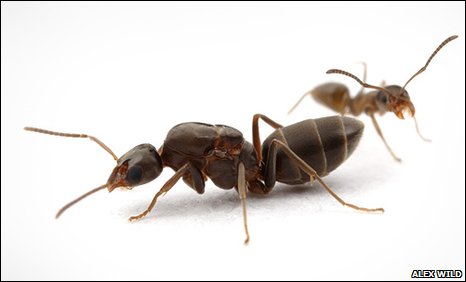
Just as one begins to feel self-satisfied about the dominance of humanity on earth, and the degree of interconnectedness afforded by Facebook, Twitter, and the like, this from the BBC:
A single mega-colony of ants has colonised much of the world, scientists have discovered.
Argentine ants living in vast numbers across Europe, the US and Japan belong to the same inter-related colony, and will refuse to fight one another. The colony may be the largest of its type ever known for any insect species, and could rival humans in the scale of its world domination.
…
While ants are usually highly territorial, those living within each super-colony are tolerant of one another, even if they live tens or hundreds of kilometres apart. Each super-colony, however, was thought to be quite distinct.
But it now appears that billions of Argentine ants around the world all actually belong to one single global mega-colony.
…
Read the entire story here.
As we contemplate connection (and redouble our efforts to emulate E.M. Forster), we might recall that it was on this date in 1957 that young Paul McCartny attended a church picnic at which a newly-formed band, the Quarrymen, were playing between sets, McCartney played a couple of tunes on the guitar for the group and its leader, John Lennon, who invited McCartney to join. McCartney did, but was slow to serious commitment (Paul missed his first gig, as he had a scout outing to attend).
Still, the group gained a following, changed its name to Johnny and the Moondogs, and recruited McCartney’s friend George Harrison. After bassist Stu Sutcliffe joined, they changed the name again, to the Silver Beetles, then finally to the Beatles. Tommy Moore joined the band as drummer and was replaced by Pete Best in 1960. After a tour to Germany in 1961, Sutcliffe left the band to become a painter (a scant year before he died of a brain hemorrhage), and the band returned to Liverpool. In 1962, five years after Lennon and Mccartney found each other, they found Ringo; Best left the band; the Fab Four–McCartney, Lennon, Harrison, and Starr–recorded “Love Me Do”… and the rest is history.
 McCartney and Lennon in the Quarrymen (source: Dull Neon/Random Notes)
You must be logged in to post a comment.