Posts Tagged ‘Ants’
“I discovered that if one looks a little closer at this beautiful world, there are always red ants underneath”*…
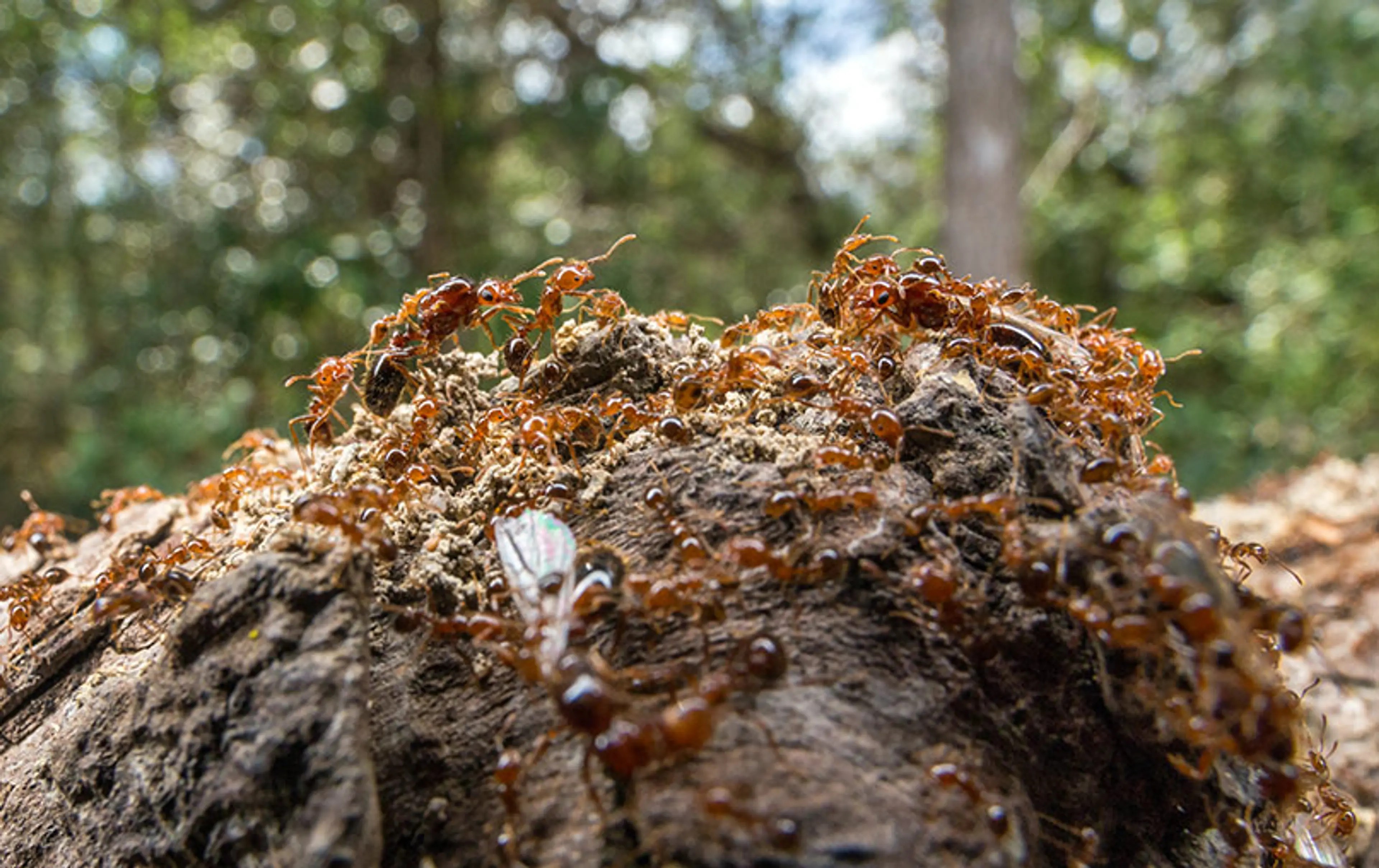
E.O. Wilson once observed that “Ants have the most complicated social organization on earth next to humans.” John Whitfield explores the way in which, over the past four centuries, quadrillions of ants have created a strange and turbulent global society that shadows our own…
It is a familiar story: a small group of animals living in a wooded grassland begin, against all odds, to populate Earth. At first, they occupy a specific ecological place in the landscape, kept in check by other species. Then something changes. The animals find a way to travel to new places. They learn to cope with unpredictability. They adapt to new kinds of food and shelter. They are clever. And they are aggressive.
In the new places, the old limits are missing. As their population grows and their reach expands, the animals lay claim to more territories, reshaping the relationships in each new landscape by eliminating some species and nurturing others. Over time, they create the largest animal societies, in terms of numbers of individuals, that the planet has ever known. And at the borders of those societies, they fight the most destructive within-species conflicts, in terms of individual fatalities, that the planet has ever known.
This might sound like our story: the story of a hominin species, living in tropical Africa a few million years ago, becoming global. Instead, it is the story of a group of ant species, living in Central and South America a few hundred years ago, who spread across the planet by weaving themselves into European networks of exploration, trade, colonisation and war – some even stowed away on the 16th-century Spanish galleons that carried silver across the Pacific from Acapulco to Manila. During the past four centuries, these animals have globalised their societies alongside our own.
It is tempting to look for parallels with human empires. Perhaps it is impossible not to see rhymes between the natural and human worlds, and as a science journalist I’ve contributed more than my share. But just because words rhyme, it doesn’t mean their definitions align. Global ant societies are not simply echoes of human struggles for power. They are something new in the world, existing at a scale we can measure but struggle to grasp: there are roughly 200,000 times more ants on our planet than the 100 billion stars in the Milky Way…
…
The more I learn, the more I am struck by the ants’ strangeness rather than their similarities with human society. There is another way to be a globalised society – one that is utterly unlike our own. I am not even sure we have the language to convey, for example, a colony’s ability to take bits of information from thousands of tiny brains and turn it into a distributed, constantly updated picture of their world. Even ‘smell’ seems a feeble word to describe the ability of ants’ antennae to read chemicals on the air and on each other. How can we imagine a life where sight goes almost unused and scent forms the primary channel of information, where chemical signals show the way to food, or mobilise a response to threats, or distinguish queens from workers and the living from the dead?
As our world turns alien, trying to think like an alien will be a better route to finding the imagination and humility needed to keep up with the changes than looking for ways in which other species are like us. But trying to think like an ant, rather than thinking about how ants are like us, is not to say that I welcome our unicolonial insect underlords. Calamities follow in the wake of globalised ant societies. Most troubling among these is the way that unicolonial species can overwhelmingly alter ecological diversity when they arrive somewhere new. Unicolonial ants can turn a patchwork of colonies created by different ant species into a landscape dominated by a single group. As a result, textured and complex ecological communities become simpler, less diverse and, crucially, less different to each other. This is not just a process; it is an era. The current period in which a relatively small number of super-spreading animals and plants expands across Earth is sometimes called the Homogecene. It’s not a cheering word, presaging an environment that favours the most pestilential animals, plants and microbes. Unicolonial ants contribute to a more homogenous future, but they also speak to life’s ability to escape our grasp, regardless of how we might try to order and exploit the world. And there’s something hopeful about that, for the planet, if not for us.
The scale and spread of ant societies is a reminder that humans should not confuse impact with control. We may be able to change our environment, but we’re almost powerless when it comes to manipulating our world exactly how we want. The global society of ants reminds us that we cannot know how other species will respond to our reshaping of the world, only that they will…
Bracing: “Ant geopolitics,” from @gentraso in @aeonmag.
* David Lynch
###
As we investigate insects, we might spare a thought for Sara Josephine Baker; she died on this date in 1945. A physician, she was a pioneer in public health and child welfare in the United States in her roles as assistant to the Commissioner for Public Health of New York City, and later, head of the city’s Department of Health in “Hell’s Kitchen” for 25 years. Convinced of the value of well-baby care and the prevention of disease, in 1908 she founded the Bureau of Child Hygiene– and decreased the death rate by 1200 from the previous year. Her work made the New York City infant mortality rate the lowest in the USA or Europe at the time. She set up free milk clinics, licensed midwives, and taught the use of silver nitrate to prevent blindness in newborns.
Baker is also remembered as the public health official who (twice) tracked down “Typhoid Mary.”

“Am I as admirable as that ant?”*…
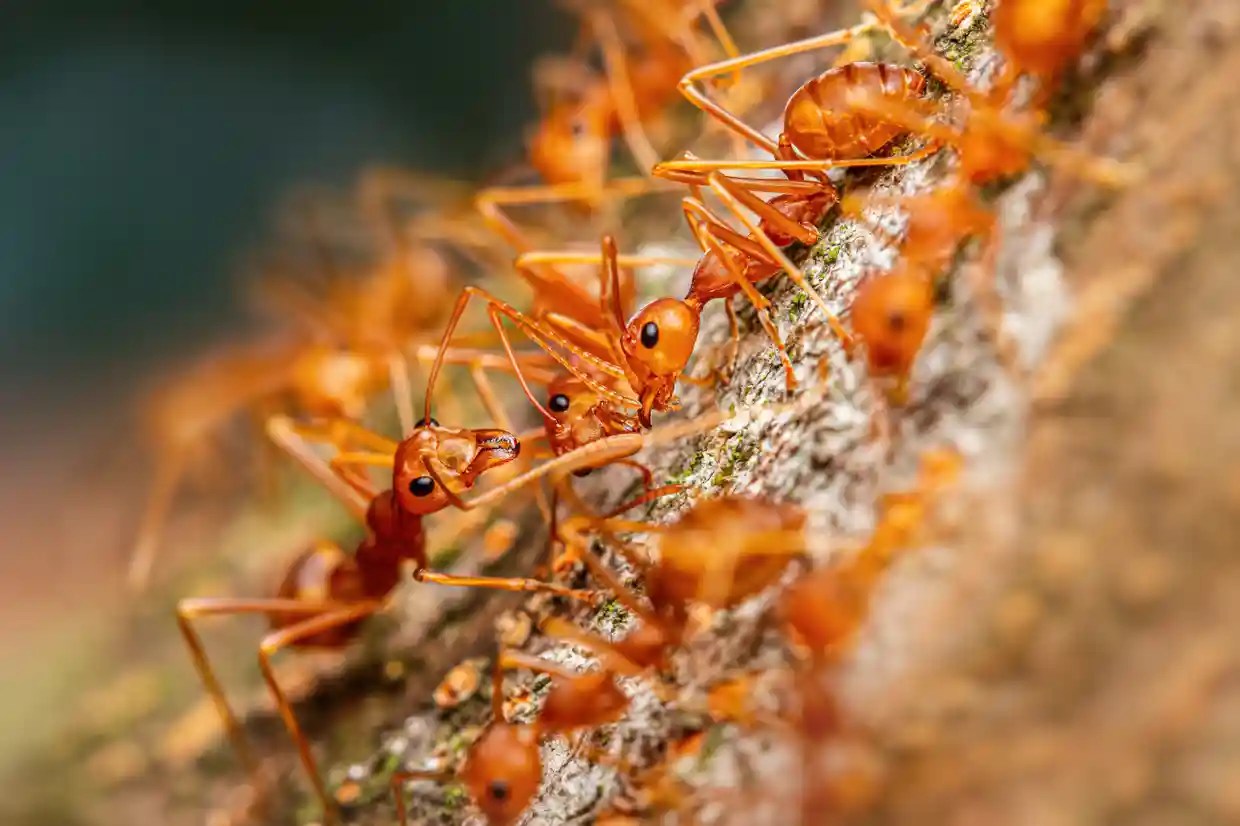
There are lots of ants on earth. And, as Anna Turns explains, they play a big role as ecosystem engineers– as well as providing insights on everything from the climate to aging…
To most of us, they are small, uninteresting and sometimes annoying, but 2022 revealed just how ubiquitous ants are and how indispensable they are to the planet. Scientists revealed in September that there are an estimated 20 quadrillion (or 20 million billion) ants globally – that’s 2.5 million for every person on the planet.
More than 12,000 known species of ant live in all sorts of habitats, from the Arctic to the tropics and they represent one of the most diverse, abundant and specialist groups of animals on the planet. Leafcutter ants are fungus farmers, slave-making ants capture broods to increase their work force, while wood ants herd aphids to the juiciest parts of a plant to harvest their honeydew sap…
Experts agree that ants are ecosystem engineers because they play a crucial role in decomposing organic matter, recycling nutrients, improving soil health, removing pests and dispersing seeds. But, historically, ants haven’t attracted as much attention as crop pollinators, such as bees, which perhaps have more of an obvious economic value. That bias could soon change. Ants have been used as a biological pest control on citrus crops in China for centuries, and research published in August indicates that the pest control potential of some predatory ants could work better than some agricultural chemicals.
The wonders of ant biology throw up plenty of other possibilities for real-world applications. Queen ants that live more than 30 years – yet have the same genetic material as a short-lived worker ant – could teach us something about senescence. Nobody understands how queens store sperm for decades inside their bodies without any degradation, despite colonies living in different climates. Meanwhile, Schultheiss’ [Dr Patrick Schultheiss, of the University of Würzburg] research into ant navigation – how they find food and how they behave when they get lost – could help build mathematical models that instruct a robot searching for missing people.
Looking back at how ants evolved can shed light on a huge array of other plants and animals, too. Butterflies that rely on ants to tend to their caterpillars could disappear if those ants are wiped out, says Corrie Moreau, a professor at Cornell University: “Nature is this intricate woven tapestry and if you pull one thread, you’ll never know which is the critical thread that makes the whole thing fall apart.”…
“Insects and us: a mind-blowing 20 quadrillion ants and what they mean for the planet,” from @AnnaTurns in @guardian.
###
As we get antsy, we might spare a thought for Swedish botanist Carl Linné, better known as Carolus Linnaeus, “the Father of Taxonomy,” died on this date in 1778. Historians suggest that the academically-challenged among us can take heart from his story: at the University of Lund, where he studied medicine, he was “less known for his knowledge of natural history than for his ignorance of everything else.” Still, he made is way from Lund to Uppsala, where he began his famous system of plant and animal classification– still in use today.

“Now I wanna remind everyone of the House of Mouse Rules: No smoking. No villainous schemes. And no guests eating other guests.”*…

In addition to being home to men with questionable decision-making skills, Florida also seems to have some issues with bizarre animal behavior, whether it’s freezing iguanas dropping from trees or alligators battling pythons in the Everglades. When it comes to those animals, however, Floridians can truly put the blame on non-natives. Neither pythons nor green iguanas made the Sunshine State their home until we brought them there as pets.
In fact, there are lots of problematic invasive species that have spread through the pet trade, from predatory fish that can drag themselves between bodies of water to a crayfish that clones itself to reproduce. Those high-profile cases lead to some obvious questions, like whether pets really are more likely to be invasive and, if so, why?
Two Swiss researchers, Jérôme Gippeta and Cleo Bertelsmeier have now attempted to answer these questions. And their conclusion is that yes, our pets are more likely to be problems.
To answer the question of whether pets really are problematic, the researchers generated some basic statistics for different groups of animals (mammals, birds, reptiles, amphibians, and fish). These included estimates of the total number of species, as well as the number of those that are classified as invasive and the number that are part of the pet trade.
If pets were no more or less likely to be invasive, you’d expect to see the invasive ones occupy similar fractions of both the pet trade and the total number of species in that group. But that’s not what we see in any of the groups. Invasive mammal species were present at five times the rate in the pet trade as they are in the wild around the globe. There was a similar result in birds; for amphibians, invasive species were eight times more common in the pet trade and about 10 times more common in fish.
Overall, invasive species were 7.4 times more likely to be kept as pets than you’d expect based on their frequency among vertebrate populations.
But cause and effect can be difficult to disentangle. Do we choose species that are more likely to be invasive as pets? Or have pets ended up with more opportunities to invade new environments because we transport them around the world?…
Spoiler alert: it’s the former… A new study finds the factors making them easier to keep also help them spread: “Unfortunately, we like pets that are likely to be invasive species.”
* Mickey Mouse
###
As we ponder proliferation, we might recall that it was on this date in 1964 that a different kind of “invader,” the Beatles, set a record: they became the first artists to hold all top 5 spots on the Billboard Hot 100 on the same week, on April 4, 1964.
#1. Can’t Buy Me Love
#2. Twist and Shout
#3. She Loves You
#4. I Want to Hold Your Hand
#5. Please Please Me.
More Beatles on the Charts that week: #31 – I Saw Her Standing There, #41 – From Me To You, #46 – Do You Want To Know a Secret, #58 – All My Loving, #65 – You Can’t Do That, #68 – Roll Over Beethoven, #79 – Thank You Girl
At the time, the best-selling piece of Beatles merchandise was the “I Love Ringo” button.

“ANT: model to cite in front of a spendthrift”*…

We tend to think of ants, and other social insects such as bees and termites, as busy little workers, but it turns out some of them may actually be quite lazy.
A study (paywall) conducted by researchers at the University of Arizona observed five colonies of Temnothorax rugatulus—a common ant species found across western Canada and the United States—and tracked their movements for three random days over a three weeks. Before they began their observations, they painted certain ants so they could track their individual activities. The team recorded five-minute videos of the colonies at four-hour intervals, and categorized the type of work they were doing at a given time.
They were surprised to find that almost half of the ants were actually fairly inactive throughout the day. While their counterparts busied themselves with nest-building or foraging, these ants were “effectively ‘specializing’ on inactivity,” according to the paper…
More at “Scientists say many worker ants are actually super lazy.” See also, “News: Ants Don’t Actually Work that Hard.”
[Image above, from here]
* Gustave Flaubert, Dictionary of Accepted Ideas
###
As we learn by example, we might recall that it was on this date in 4004 BCE that the Universe was created… as per calculations by Archbishop James Ussher in the mid-17th century.
When Clarence Darrow prepared his famous examination of William Jennings Bryan in the Scopes trial [see here], he chose to focus primarily on a chronology of Biblical events prepared by a seventeenth-century Irish bishop, James Ussher. American fundamentalists in 1925 found—and generally accepted as accurate—Ussher’s careful calculation of dates, going all the way back to Creation, in the margins of their family Bibles. (In fact, until the 1970s, the Bibles placed in nearly every hotel room by the Gideon Society carried his chronology.) The King James Version of the Bible introduced into evidence by the prosecution in Dayton contained Ussher’s famous chronology, and Bryan more than once would be forced to resort to the bishop’s dates as he tried to respond to Darrow’s questions.
– source

Ussher
“There is no better high than discovery”*…

Be careful what you use as a bookmark. Thousands of dollars, a Christmas card signed by Frank Baum, a Mickey Mantle rookie baseball card, a marriage certificate from 1879, a baby’s tooth, a diamond ring and a handwritten poem by Irish writer Katharine Tynan Hickson are just some of the stranger objects discovered inside books by AbeBooks.com booksellers.
I recently opened a secondhand book and an airline boarding pass from Liberia in west Africa to Fort Worth, Texas, fell to the floor. Was there a story behind this little slip of paper? Was someone fleeing from a country ravaged by two civil wars since 1989? I will never know, but used and rare booksellers discover countless objects – some mundane, some bizarre, some deeply personal – inside books as they sort and catalog books for resale.
Adam Tobin, owner of Unnameable Books in Brooklyn, New York, has created a display inside his bookstore dedicated to objects discovered in books.
“It’s a motley assortment,” he said. “We’ve been doing it for about two years since opening the store. The display quickly took over the back wall and now it’s spreading to other places, and there’s a backlog of stuff that we haven’t put up yet. There are postcards, shopping lists, and concert tickets but my favorites are the cryptic notes. They are often deeply personal and can be very moving.”
Used booksellers often take ownership of books that have been in a family or a household for decades or even generations. “It’s easy to find things in books that are very dated,” explained Adam,” Such as a newspaper advert for elastic bands from the 19th century. My personal favorite is an ad from the 1950s that reads ‘Rinsing Dacron Curtains in Milk Makes Them Crisp, Stiff, Just Like New.’”
The most valuable item discovered by Adam is a letter written by C.S. Lewis – author of the Narnia series – but his monetary finds have been limited to a $1 note now pinned to the display.
Eager to learn more, AbeBooks.com asked its booksellers to reveal their finds. You might be surprised to learn what people will leave inside a book…
Discover this buried treasure at “Things Found in Books.”
[TotH to @MartyKrasney]
* E.O. Wilson
###
As we rifle through the volumes in our libraries, we might might recall that it was on this date in 1887 that there occured an event that would surely have warmed Dr. Wilson’s heart: an enormous “rain of ants” at Nancy in France.; “most of them were wingless” (Nature, 36-349.. as quoted in Charles Fort’s The Book of the Damned).

You must be logged in to post a comment.