Posts Tagged ‘Sara Josephine Baker’
“I discovered that if one looks a little closer at this beautiful world, there are always red ants underneath”*…
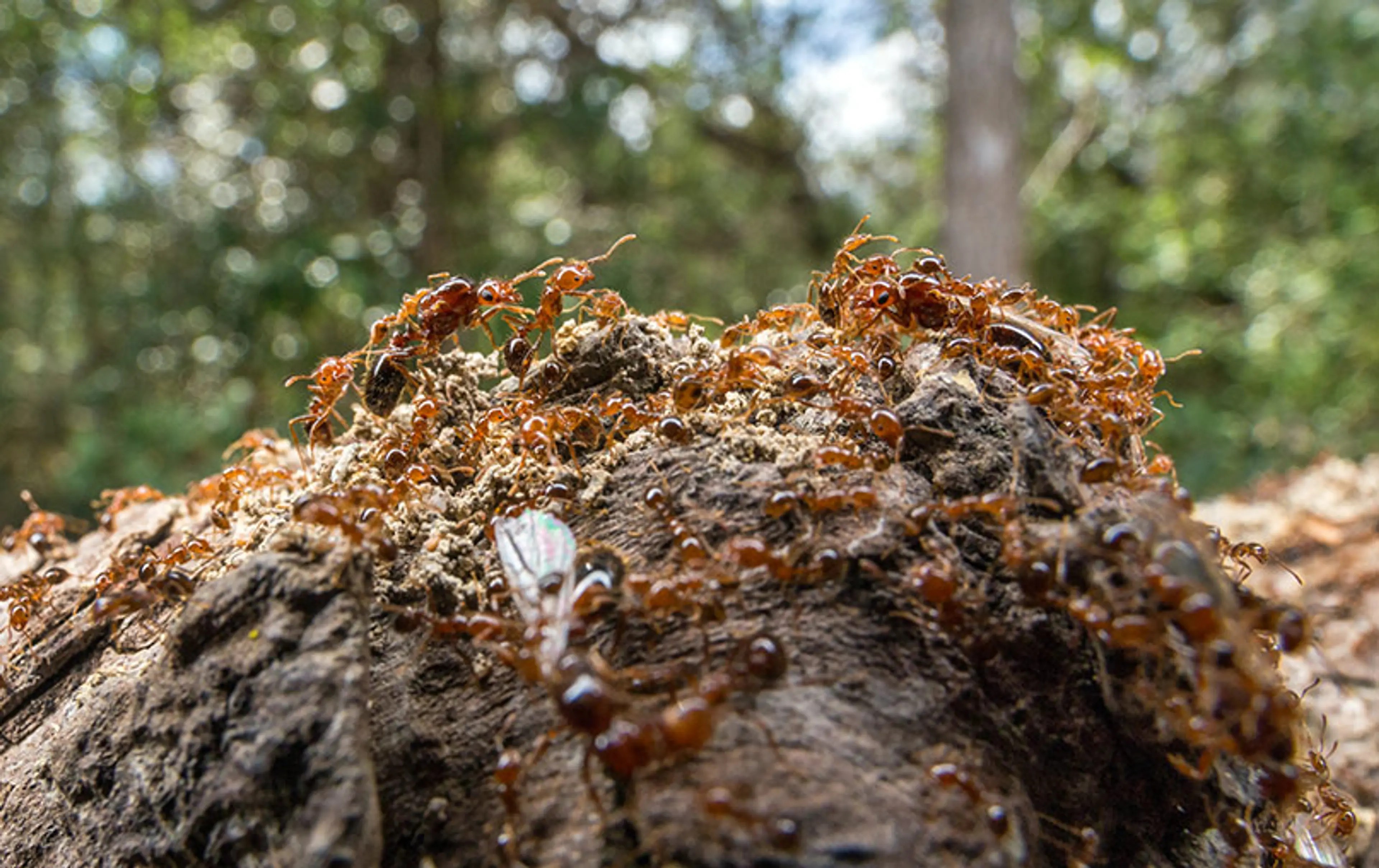
E.O. Wilson once observed that “Ants have the most complicated social organization on earth next to humans.” John Whitfield explores the way in which, over the past four centuries, quadrillions of ants have created a strange and turbulent global society that shadows our own…
It is a familiar story: a small group of animals living in a wooded grassland begin, against all odds, to populate Earth. At first, they occupy a specific ecological place in the landscape, kept in check by other species. Then something changes. The animals find a way to travel to new places. They learn to cope with unpredictability. They adapt to new kinds of food and shelter. They are clever. And they are aggressive.
In the new places, the old limits are missing. As their population grows and their reach expands, the animals lay claim to more territories, reshaping the relationships in each new landscape by eliminating some species and nurturing others. Over time, they create the largest animal societies, in terms of numbers of individuals, that the planet has ever known. And at the borders of those societies, they fight the most destructive within-species conflicts, in terms of individual fatalities, that the planet has ever known.
This might sound like our story: the story of a hominin species, living in tropical Africa a few million years ago, becoming global. Instead, it is the story of a group of ant species, living in Central and South America a few hundred years ago, who spread across the planet by weaving themselves into European networks of exploration, trade, colonisation and war – some even stowed away on the 16th-century Spanish galleons that carried silver across the Pacific from Acapulco to Manila. During the past four centuries, these animals have globalised their societies alongside our own.
It is tempting to look for parallels with human empires. Perhaps it is impossible not to see rhymes between the natural and human worlds, and as a science journalist I’ve contributed more than my share. But just because words rhyme, it doesn’t mean their definitions align. Global ant societies are not simply echoes of human struggles for power. They are something new in the world, existing at a scale we can measure but struggle to grasp: there are roughly 200,000 times more ants on our planet than the 100 billion stars in the Milky Way…
…
The more I learn, the more I am struck by the ants’ strangeness rather than their similarities with human society. There is another way to be a globalised society – one that is utterly unlike our own. I am not even sure we have the language to convey, for example, a colony’s ability to take bits of information from thousands of tiny brains and turn it into a distributed, constantly updated picture of their world. Even ‘smell’ seems a feeble word to describe the ability of ants’ antennae to read chemicals on the air and on each other. How can we imagine a life where sight goes almost unused and scent forms the primary channel of information, where chemical signals show the way to food, or mobilise a response to threats, or distinguish queens from workers and the living from the dead?
As our world turns alien, trying to think like an alien will be a better route to finding the imagination and humility needed to keep up with the changes than looking for ways in which other species are like us. But trying to think like an ant, rather than thinking about how ants are like us, is not to say that I welcome our unicolonial insect underlords. Calamities follow in the wake of globalised ant societies. Most troubling among these is the way that unicolonial species can overwhelmingly alter ecological diversity when they arrive somewhere new. Unicolonial ants can turn a patchwork of colonies created by different ant species into a landscape dominated by a single group. As a result, textured and complex ecological communities become simpler, less diverse and, crucially, less different to each other. This is not just a process; it is an era. The current period in which a relatively small number of super-spreading animals and plants expands across Earth is sometimes called the Homogecene. It’s not a cheering word, presaging an environment that favours the most pestilential animals, plants and microbes. Unicolonial ants contribute to a more homogenous future, but they also speak to life’s ability to escape our grasp, regardless of how we might try to order and exploit the world. And there’s something hopeful about that, for the planet, if not for us.
The scale and spread of ant societies is a reminder that humans should not confuse impact with control. We may be able to change our environment, but we’re almost powerless when it comes to manipulating our world exactly how we want. The global society of ants reminds us that we cannot know how other species will respond to our reshaping of the world, only that they will…
Bracing: “Ant geopolitics,” from @gentraso in @aeonmag.
* David Lynch
###
As we investigate insects, we might spare a thought for Sara Josephine Baker; she died on this date in 1945. A physician, she was a pioneer in public health and child welfare in the United States in her roles as assistant to the Commissioner for Public Health of New York City, and later, head of the city’s Department of Health in “Hell’s Kitchen” for 25 years. Convinced of the value of well-baby care and the prevention of disease, in 1908 she founded the Bureau of Child Hygiene– and decreased the death rate by 1200 from the previous year. Her work made the New York City infant mortality rate the lowest in the USA or Europe at the time. She set up free milk clinics, licensed midwives, and taught the use of silver nitrate to prevent blindness in newborns.
Baker is also remembered as the public health official who (twice) tracked down “Typhoid Mary.”

“People will not look forward to posterity who never look backward to their ancestors”*…

Your family tree might contain a few curious revelations. It might alert you to the existence of long-lost third cousins. It might tell you your 10-times-great-grandfather once bought a chunk of Brooklyn. It might reveal that you have royal blood. But when family trees includes millions of people—maybe even tens of millions of people—then we’re beyond the realm of individual stories.
When genealogies get so big, they’re not just the story of a family anymore; they contain the stories of whole countries and, at the risk of sounding grandiose, even all of humanity…
The story of the largest family tree so far found– 13 million people. (And yes, that includes Kevin Bacon.): “What Can You Do With the World’s Largest Family Tree?“
* Edmund Burke
###
As we ruminate on roots, we might spare a thought for Sara Josephine Baker; she died on this date in 1945. A physician and public health pioneer, she was active especially in the immigrant communities of New York City. In 1917, she noted that babies born in the United States faced a higher mortality rate than soldiers fighting in World War I, and undertook her fight against the damage that widespread urban poverty and ignorance caused to children, especially newborns. She founded the Bureau of Child Hygiene after visiting mothers on the lower east side, was appointed assistant to the Commissioner for Public Health of New York City, then headed the city’s Department of Health in Hell’s Kitchen for 25 years. Among many other initiatives, she set up free milk clinics, licensed midwives, and taught the use of silver nitrate to prevent blindness in newborns.
She is also known for (twice) tracking down Mary Mallon, the infamous index case known as Typhoid Mary.

You must be logged in to post a comment.