Posts Tagged ‘ecosystem’
“Am I as admirable as that ant?”*…
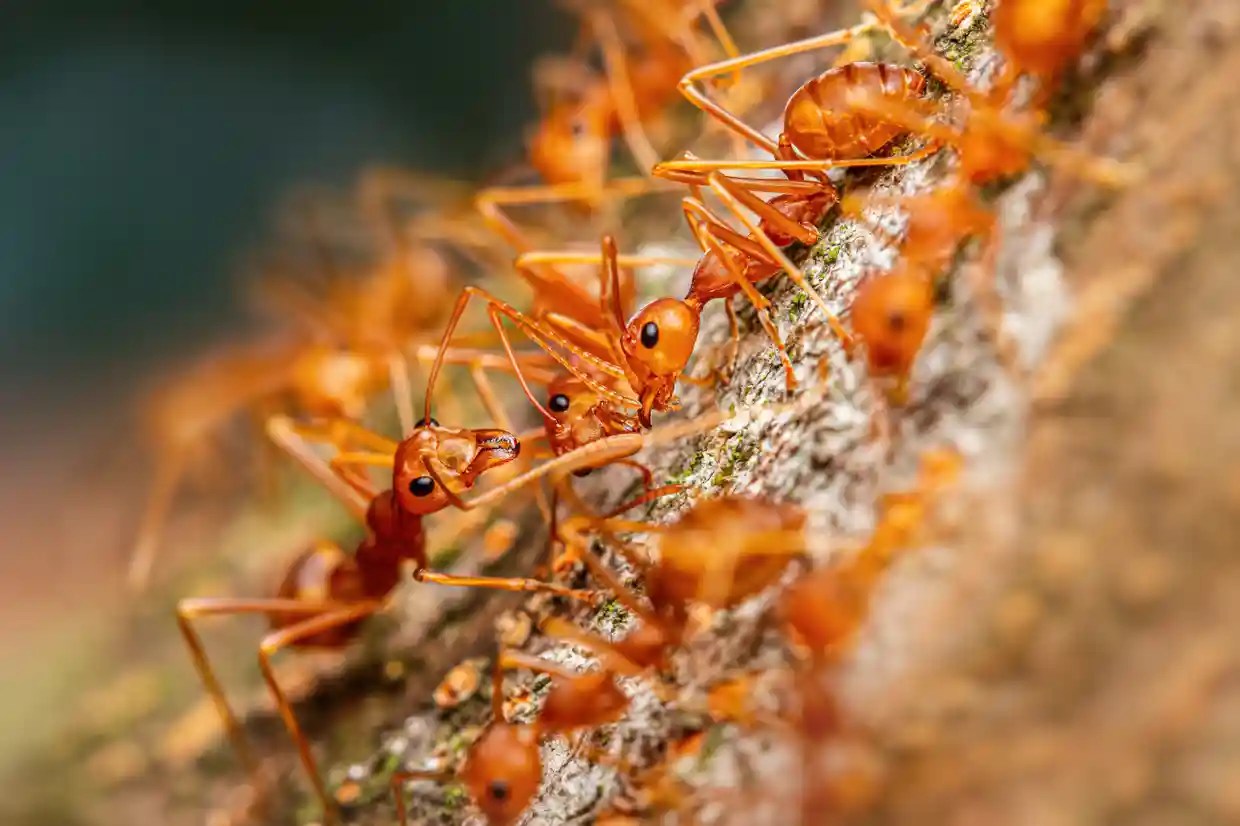
There are lots of ants on earth. And, as Anna Turns explains, they play a big role as ecosystem engineers– as well as providing insights on everything from the climate to aging…
To most of us, they are small, uninteresting and sometimes annoying, but 2022 revealed just how ubiquitous ants are and how indispensable they are to the planet. Scientists revealed in September that there are an estimated 20 quadrillion (or 20 million billion) ants globally – that’s 2.5 million for every person on the planet.
More than 12,000 known species of ant live in all sorts of habitats, from the Arctic to the tropics and they represent one of the most diverse, abundant and specialist groups of animals on the planet. Leafcutter ants are fungus farmers, slave-making ants capture broods to increase their work force, while wood ants herd aphids to the juiciest parts of a plant to harvest their honeydew sap…
Experts agree that ants are ecosystem engineers because they play a crucial role in decomposing organic matter, recycling nutrients, improving soil health, removing pests and dispersing seeds. But, historically, ants haven’t attracted as much attention as crop pollinators, such as bees, which perhaps have more of an obvious economic value. That bias could soon change. Ants have been used as a biological pest control on citrus crops in China for centuries, and research published in August indicates that the pest control potential of some predatory ants could work better than some agricultural chemicals.
The wonders of ant biology throw up plenty of other possibilities for real-world applications. Queen ants that live more than 30 years – yet have the same genetic material as a short-lived worker ant – could teach us something about senescence. Nobody understands how queens store sperm for decades inside their bodies without any degradation, despite colonies living in different climates. Meanwhile, Schultheiss’ [Dr Patrick Schultheiss, of the University of Würzburg] research into ant navigation – how they find food and how they behave when they get lost – could help build mathematical models that instruct a robot searching for missing people.
Looking back at how ants evolved can shed light on a huge array of other plants and animals, too. Butterflies that rely on ants to tend to their caterpillars could disappear if those ants are wiped out, says Corrie Moreau, a professor at Cornell University: “Nature is this intricate woven tapestry and if you pull one thread, you’ll never know which is the critical thread that makes the whole thing fall apart.”…
“Insects and us: a mind-blowing 20 quadrillion ants and what they mean for the planet,” from @AnnaTurns in @guardian.
###
As we get antsy, we might spare a thought for Swedish botanist Carl Linné, better known as Carolus Linnaeus, “the Father of Taxonomy,” died on this date in 1778. Historians suggest that the academically-challenged among us can take heart from his story: at the University of Lund, where he studied medicine, he was “less known for his knowledge of natural history than for his ignorance of everything else.” Still, he made is way from Lund to Uppsala, where he began his famous system of plant and animal classification– still in use today.

“The Florida in my novels is not as seedy as the real Florida. It’s hard to stay ahead of the curve.”*…

Jeff VanderMeer is a master of teasing out the weird in the service of critiquing our relationship with nature; his novels– e.g., Annihilation, Hummingbird Salamander— are entertaining, illuminating cautionary tales. In a recent essay, he turned his attention to his native Florida…
About the size of Greece, Florida is the jewel in the crown of the amazingly biodiverse Atlantic Coastal Plain. The state has 1,300 miles of shoreline, 600 clear-water springs, 1,700 ravines and streams, and over 8,000 lakes. More than 3,000 native trees, shrubs, and flowering plants are native to Florida, many unique to our peninsula and also endangered due to development. Our 100 species of orchid (compared to Hawai’i’s three native orchids) and 150 fern species speak to the moist and subtropical climate across many parts of the state. Florida has more wetlands than any other conterminous state—11 million acres—including seepage wetlands, interior marshes, and interior swamp land. Prior to the 1800s, Florida had over 20 million acres of wetlands.
As Jen Lomberk of Matanzas Riverkeeper describes it, Florida’s aquifer is unique because it is “so inextricably connected both underground and to surface waters. Florida’s limestone geology means that pollutants can readily move through groundwater and from groundwater to surface water (and vice versa).” In a sense, the very water we drink in Florida lays bare the connections between the often-invisible systems that sustain life on Earth and reveals both the strength of these systems and their vulnerability.
[But Floridians aren’t stewarding these unique resources…]
Most of this harm has been inflicted in the service of unlimited and poorly planned growth, sparked by greed and short-term profit. This murder of the natural world has accelerated in the last decade to depths unheard of. The process has been deliberate, often systemic, and conducted from on-high to down-low, with special interests flooding the state with dark money, given to both state and local politicians in support of projects that bear no relationship to best management of natural resources. These projects typically reinforce income inequality and divert attention and money away from traditionally disadvantaged communities.
Consider this: several football fields-worth of forest and other valuable habitat is cleared per day in Florida, with 26 percent of our canopy cut down in the past twenty years. According to one study, an average of 25 percent of greenhouse gas emissions come from deforestation worldwide.
The ecocide happening here is comparable for our size to the destruction of the Amazon, but much less remarked upon. Few of the perpetrators understand how they hurt the quality of life for people living in Florida and hamstring any possibility of climate crisis resiliency. Prodevelopment flacks like to pull out the estimates of the millions who will continue to flock to Florida by 2030 or 2040 to justify rampant development. Even some Florida economists ignore the effects of the climate crisis in their projects for 2049, expecting continued economic growth. but these estimates are just a grim joke, and some of those regurgitating them know that. By 2050, the world likely will be grappling with the fallout from 1.5- to 2-degree temperature rise and it’s unlikely people will be flocking to a state quickly dissolving around all of its edges…
An accelerating race to destroy Florida’s wilderness shows what we value and previews our collective future during the climate crisis: “The Annihilation of Florida: An Overlooked National Tragedy,” from @jeffvandermeer in @curaffairs. Eminently worth reading in full.
* “The Florida in my novels is not as seedy as the real Florida. It’s hard to stay ahead of the curve. Every time I write a scene that I think is the sickest thing I have ever dreamed up, it is surpassed by something that happens in real life.” – VanderMeer’s fellow Floridian Carl Hiaasen
###
As we contemplate consequences, we might recall that it was on this date in 1626 that Peter Minuit, the new director of “New Netherland” for the Dutch West India Company, in what we now know as Manhattan, “purchased” the island from the the Canarsee tribe of Native Americans for a parcel of goods worth 60 guilders: roughly $24 dollars at the time, now roughly $1,000.
In the event, Native Americans in the area were unfamiliar with the European notions and definitions of ownership rights. As they understood it, water, air and land could not be traded. So scholars are convinced that both parties probably went home with totally different interpretations of the sales agreement. In any case, the Carnarsees were happy to take payment in any meaningful amount pertaining to land that was mostly controlled by their rivals, the Weckquaesgeeks.

1626 letter from Pieter Schaghen (a colleague of Minuit) reporting the purchase of Manhattan for 60 guilders [source]
You must be logged in to post a comment.