Posts Tagged ‘Howard Hawks’
“Individuals may form communities, but only institutions can create a nation”*…
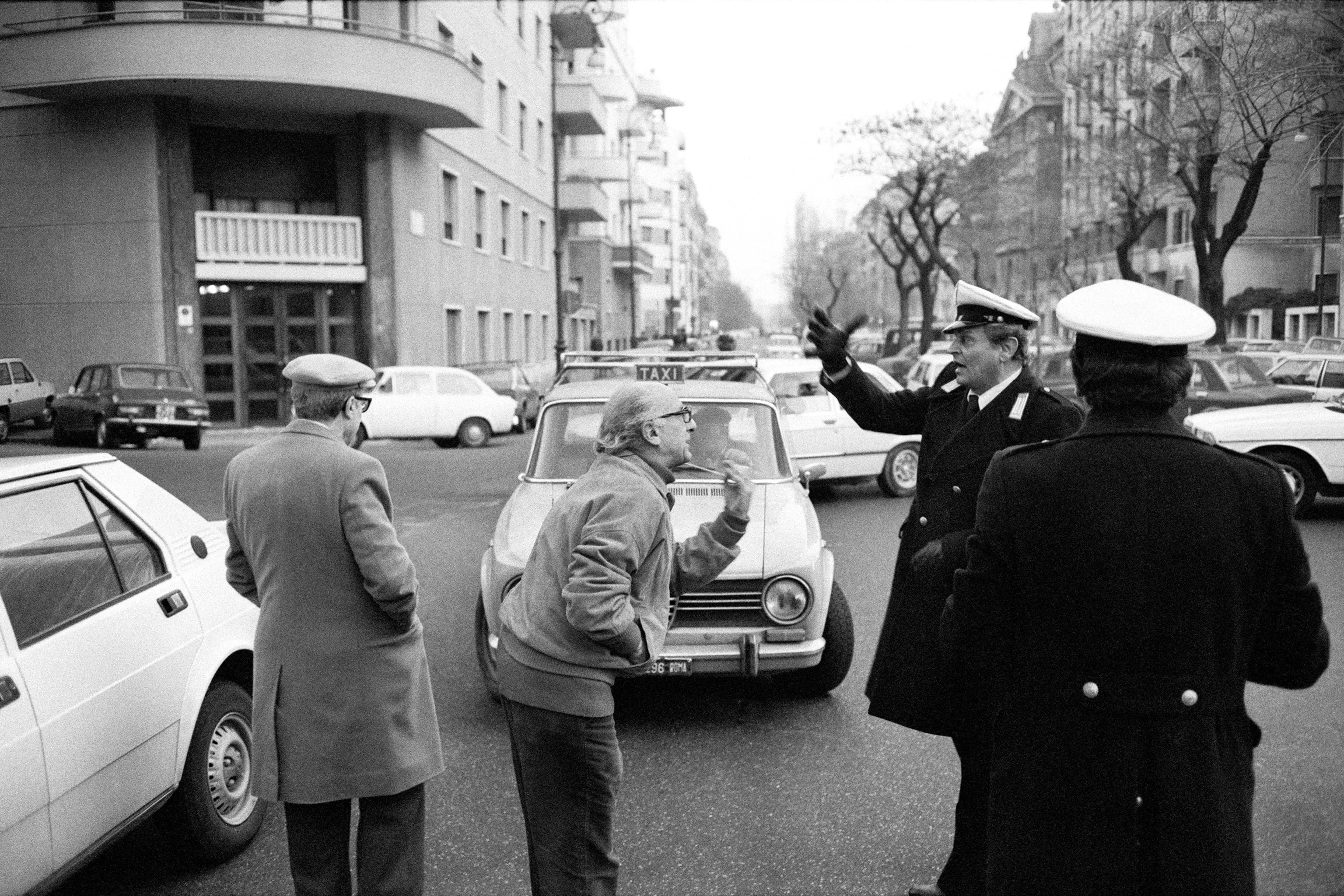
Good institutions are social technologies that scale trust from personal relations to entire nations. Game theorist and social scientist Julien Lie-Panis unpacks the extraordinary phenomenon of human cooperation to explain how– and why– institutions work…
Every human society, from the smallest village to the largest nation, faces the same fundamental challenge: how to get people to act in the interests of the collective rather than their own. Fishermen must limit their catch so fish stocks don’t collapse. People must respect others’ property and safety. Citizens must pay taxes to fund roads, schools and hospitals. Left to pure self-interest, no community could endure; the bonds of collective life would quickly unravel.
The solutions we’ve devised are remarkably similar across cultures and centuries. We create rules. Then we appoint guardians to enforce them. Those who break the rules are punished. But there’s a problem with this approach, one that the Roman poet Juvenal identified nearly 2,000 years ago: Quis custodiet ipsos custodes? Who will guard the guards themselves?
Fisheries appoint monitors to prevent overfishing – but what if the monitors accept bribes to look the other way? Police officers exist to protect everyone’s property and safety – but who ensures that they don’t abuse their power? Governments collect taxes for public services – but how do we stop officials from diverting the funds to their own accounts?
Every institution faces the same fundamental paradox. Institutions foster cooperation by rewarding good behaviour and punishing rule-breakers. Yet they themselves depend on cooperative members to function. We haven’t solved the cooperation problem – we’ve simply moved it back one step. So why do institutions work at all? To understand this puzzle, we need to first ask what makes human cooperation so extraordinary in the natural world…
[Lie-Panis explores human cooperation, and examines the ways in which, while it follows the same evolutionary rules as cooperation among other species, humans have expanded the ambit of their coordination. He explains the ways in which institutions depend on “a present-future trade-off,” on its constituents’ patience as it works through problems. And he illustrates the ways in which constituents’ concerns with material security and social capital can generate that patience. He concludes…]
… Institutions can thus be understood as social technologies. We engineer them constantly, often without realising it. When neighbours organise to maintain a shared garden or playground, they appoint a small committee to manage funds and decisions. The arrangement works because it transforms the hard problem of coordinating dozens of contributors into the easier problem of trusting a few visible people who can be praised for diligence or blamed for misuse.
Like any tool, institutions cannot create what isn’t already there; they can only amplify existing cooperative capacity. Institutions rest on the conditions that make cooperation rational: material security and social capital. Where those conditions hold, reputation can work at scale. One layer of accountability supports the next, until cooperation extends far beyond the limits of familiarity. From the same force that binds vampire bats and coral reef fish, we have built cities, markets, and nations. Institutions are how trust is scaled to millions of strangers.
Eminently worth reading in full: “Guarding the Guardians,” from @jliep.bsky.social in @aeon.co.
Apposite (albeit a bit orthogonal): “Culture Is the Mass-Synchronization of Framings,” from @marco-giancotti.bsky.social.
* Benjamin Disraeli
###
As we get along, we might recall that it was on this date in 1938 that a film poking fun at a plethora of institutions, Howard Hawks’ comedy Bringing Up Baby, premiered at the Golden Gate Theater in San Francisco. Featuring Cary Grant, Katherine Hepburn, and a leopard, the film earned good reviews but suffered at the box office. Indeed, Hepburn’s career fell into a slump– she was one of a group of actors labeled as “box office poison” by the Independent Theatre Owners of America– that she broke with The Philadelphia Story (again with Grant) in 1940.
As for Bringing Up Baby, the film did well when re-released in the 1940s, and grew further in popularity when it began to be shown on television in the 1950s. Today it is recognized as the authentic screwball classic that it is; it sits at 94% on Rotten Tomatoes, and ranks among “Top 100” on lists from the American Film Institute and the National Society of Film Critics.

“Hollywood is a place where a man can get stabbed in the back while climbing a ladder.”*…

While William Faulkner spent most of his life in the Oxford, Mississippi area that he made famous, he did a considerable– and fascinating– stetch in Hollywood. John Meroney reports…
… It all started in 1932, when, riding on the success of his novel Sanctuary, Faulkner got word that Leland Hayward, a prominent Hollywood talent agent, had secured for him a $500-a-week contract (the equivalent of $8,500 today) to write scripts at Metro-Goldwyn-Mayer. Faulkner was a modernist, and film was still a new, exciting form of storytelling. But that wasn’t the reason Faulkner accepted. It was the money.
At the same time Faulkner received the offer from Metro, he got news that his publisher, Cape & Smith, was bankrupt. Faulkner had been planning on $4,000 ($68,000 in today’s money) from the company for Sanctuary but was informed he wouldn’t see any of it. Suddenly, he was broke. Word apparently got around Oxford. When he tried writing a check for three dollars at a sporting goods store, the owner told him, I’d rather have cash. All at once, Hollywood became attractive. Faulkner didn’t even have the money to send a wire to answer yes. Eventually MGM advanced him some cash and paid for his train ticket, and days later he arrived in Culver City.
He was so naive about the industry that he entertained hopes he would be writing for the famous movie star Mickey Mouse. But the folks at Metro informed him, No, Mickey lives at another studio out in the Valley—we want you for a Wallace Beery picture. “Who’s he?” Faulkner asked…
… Faulkner completed four story treatments in four weeks. That kind of productivity earned him a meeting with up-and-coming director Howard Hawks [see almanac entry here]. He liked Faulkner’s writing and purchased a Saturday Evening Post short story by him that he wanted Faulkner to adapt into a script for Hawks to direct. Over a “couple of quarts of whiskey,” as Hawks recalled in an interview, they clicked and found common cause. “[Faulkner] got up the next morning and started to work, and in five or six days, he had a script,” Hawks said. “It was one of the finest scripts I’ve ever read.” Hawks showed it to Metro’s head of production, Irving Thalberg, who concurred. “Go out and make it!” he ordered Hawks. The result was Today We Live, a drama starring Gary Cooper and Joan Crawford, released in 1933. William Faulkner now had a hit movie to his credit. And, more important, the beginning of what would become an ongoing professional connection with Hawks…
…Faulkner sometimes hunted with Hawks, and on one dove hunting trip recounted by the director, Hawks invited along Clark Gable, already a star. Faulkner and Hawks began discussing literature and eventually Gable asked, “Mr. Faulkner, what do you think somebody should read if he wants to read the best modern books? Who would you say are the best living writers?” Faulkner replied, “Thomas Mann, Willa Cather, John Dos Passos, Ernest Hemingway, and myself.” Gable asked, “Oh, do you write, Mr. Faulkner?” Faulkner replied, “Yeah. What do you do, Mr. Gable?”…
And so much (so very much) more: “William Faulkner’s Hollywood Odyssey” from Garden and Gun.
* William Faulkner
###
As we fathom fish out of water, we might recall that it was on this date in 1987 that the United States Postal Service issued a 22-cent postage stamp in Faulkner’s honor. Very early in his career, Faulkner had briefly served as Postmaster at the University of Mississippi, and in his letter of resignation in 1923 wrote:
As long as I live under the capitalistic system, I expect to have my life influenced by the demands of moneyed people. But I will be damned if I propose to be at the beck and call of every itinerant scoundrel who has two cents to invest in a postage stamp. This, sir, is my resignation.

“This is, if not a lifetime process, awfully close to it”*…

Shani Zhang paints weddings (and other events). Along the way, she’s drawn some fascinating conclusions…
Painting weddings for a few years now, I have spent a fair bit of time observing strangers move through a room. Seeing someone new, I always have a feeling of noticing their internal architecture. I did not realize that some people do not feel this way, at least not as intensely.
- By internal architecture, what I mean is, when someone talks to me, what I notice first are the supporting beams propping up their words: the cadence and tone and desire behind them. I hear if they are bored, fascinated, wanting validation or connection. I often feel like I can hear how much they like themselves.
- I hear the speed at which they metabolize information and the nature of their attention. Attention falls on the spectrum of jumping bean to steady stream. Where it falls depends on a person’s nature, and also how much they want to be in that conversation. Someone’s quality of attention is evident from the questions they ask (how much they diverge from what the speaker is saying), if their gaze is wandering elsewhere, if they are fidgeting, restless. The outlier is dissociation, when someone is noticeably vacant, their attention completely absent.
- Sometimes I see their feelings towards me when we talk, but that has the largest room for error in retrospect. Maybe the person I have the hardest time seeing clearly is still myself. I can see people more clearly when I am watching them talk to others.
- I watch the person with the loudest laugh. The most striking thing isn’t the volume—it’s the feverish pitch. As the night goes on, it begins to sound more like desperation. Their joy has a fraying quality; it is exhausting to carry because it comes with a desire to seem happy and make others happy at all times…
Read on for all “21 observations from people watching.”
* “This is, if not a lifetime process, awfully close to it. The writer broadens, becomes deeper, becomes more observant, becomes more tempered, becomes much wiser over a period time passing. It is not something that is injected into him by a needle. It is not something that comes on a wave of flashing, explosive light one night and say, ‘Huzzah! Eureka! I’ve got it!’ and then proceeds to write the great American novel in eleven days. It doesn’t work that way. It’s a long, tedious, tough, frustrating process, but never, ever be put aside by the fact that it’s hard.” – Rod Serling (and here and here)
###
As we look, we might send observant birthday greetings to Howard Hawks; he was born on this date in 1896. A key film director, producer, and screenwriter of the classic Hollywood era. Hawks explored many genres– comedies (screwball and straight), dramas, gangster films, science fiction, film noir, war films and Westerns– in films including Scarface (1932), Bringing Up Baby (1938), Only Angels Have Wings (1939), His Girl Friday (1940), To Have and Have Not (1944), The Big Sleep (1946), Red River (1948), The Thing from Another World (1951), and Rio Bravo (1959). His frequent portrayals of strong, tough-talking female characters came to define the “Hawksian woman“. Relevently to this post, Hawks directed Gentlemen Prefer Blondes (1953), which of course, ends with a double wedding.
A close observer of human behavior, Hawks transmuted what he learned into unique, powerful, and wonderfully-entertaining work. Critic Leonard Maltin called him “the greatest American director who is not a household name.” Roger Ebert called Hawks “one of the greatest American directors of pure movies, and a hero of auteur critics because he found his own laconic values in so many different kinds of genre material.”

You must be logged in to post a comment.