Posts Tagged ‘observation’
“Look deep into nature, and then you will understand everything better”*…

Further, in a loose fashion, to yesterday’s post: The Most Observed Animals and Plants (as reported on iNaturalist), from Randall Munroe and his wonderful xkcd (@xkcd.com)
* (attributed to) Albert Einstein
###
As we keep an eye out, we might recall that it was on this date in 1964 that US disc jockeys were sent boxes of animal crackers wrapped in promotional material touting The Animal’s second single, “The House of the Rising Sun,” which had just entered the UK charts. The gambit worked (though, of course, it didn’t hurt that the song was, as Cashbox described it, “a haunting, beat-ballad updating of the famed folk-blues opus that the group’s lead delivers in telling solo vocal fashion”); the tune reached #1 on U.S. pop charts.

“This is, if not a lifetime process, awfully close to it”*…

Shani Zhang paints weddings (and other events). Along the way, she’s drawn some fascinating conclusions…
Painting weddings for a few years now, I have spent a fair bit of time observing strangers move through a room. Seeing someone new, I always have a feeling of noticing their internal architecture. I did not realize that some people do not feel this way, at least not as intensely.
- By internal architecture, what I mean is, when someone talks to me, what I notice first are the supporting beams propping up their words: the cadence and tone and desire behind them. I hear if they are bored, fascinated, wanting validation or connection. I often feel like I can hear how much they like themselves.
- I hear the speed at which they metabolize information and the nature of their attention. Attention falls on the spectrum of jumping bean to steady stream. Where it falls depends on a person’s nature, and also how much they want to be in that conversation. Someone’s quality of attention is evident from the questions they ask (how much they diverge from what the speaker is saying), if their gaze is wandering elsewhere, if they are fidgeting, restless. The outlier is dissociation, when someone is noticeably vacant, their attention completely absent.
- Sometimes I see their feelings towards me when we talk, but that has the largest room for error in retrospect. Maybe the person I have the hardest time seeing clearly is still myself. I can see people more clearly when I am watching them talk to others.
- I watch the person with the loudest laugh. The most striking thing isn’t the volume—it’s the feverish pitch. As the night goes on, it begins to sound more like desperation. Their joy has a fraying quality; it is exhausting to carry because it comes with a desire to seem happy and make others happy at all times…
Read on for all “21 observations from people watching.”
* “This is, if not a lifetime process, awfully close to it. The writer broadens, becomes deeper, becomes more observant, becomes more tempered, becomes much wiser over a period time passing. It is not something that is injected into him by a needle. It is not something that comes on a wave of flashing, explosive light one night and say, ‘Huzzah! Eureka! I’ve got it!’ and then proceeds to write the great American novel in eleven days. It doesn’t work that way. It’s a long, tedious, tough, frustrating process, but never, ever be put aside by the fact that it’s hard.” – Rod Serling (and here and here)
###
As we look, we might send observant birthday greetings to Howard Hawks; he was born on this date in 1896. A key film director, producer, and screenwriter of the classic Hollywood era. Hawks explored many genres– comedies (screwball and straight), dramas, gangster films, science fiction, film noir, war films and Westerns– in films including Scarface (1932), Bringing Up Baby (1938), Only Angels Have Wings (1939), His Girl Friday (1940), To Have and Have Not (1944), The Big Sleep (1946), Red River (1948), The Thing from Another World (1951), and Rio Bravo (1959). His frequent portrayals of strong, tough-talking female characters came to define the “Hawksian woman“. Relevently to this post, Hawks directed Gentlemen Prefer Blondes (1953), which of course, ends with a double wedding.
A close observer of human behavior, Hawks transmuted what he learned into unique, powerful, and wonderfully-entertaining work. Critic Leonard Maltin called him “the greatest American director who is not a household name.” Roger Ebert called Hawks “one of the greatest American directors of pure movies, and a hero of auteur critics because he found his own laconic values in so many different kinds of genre material.”

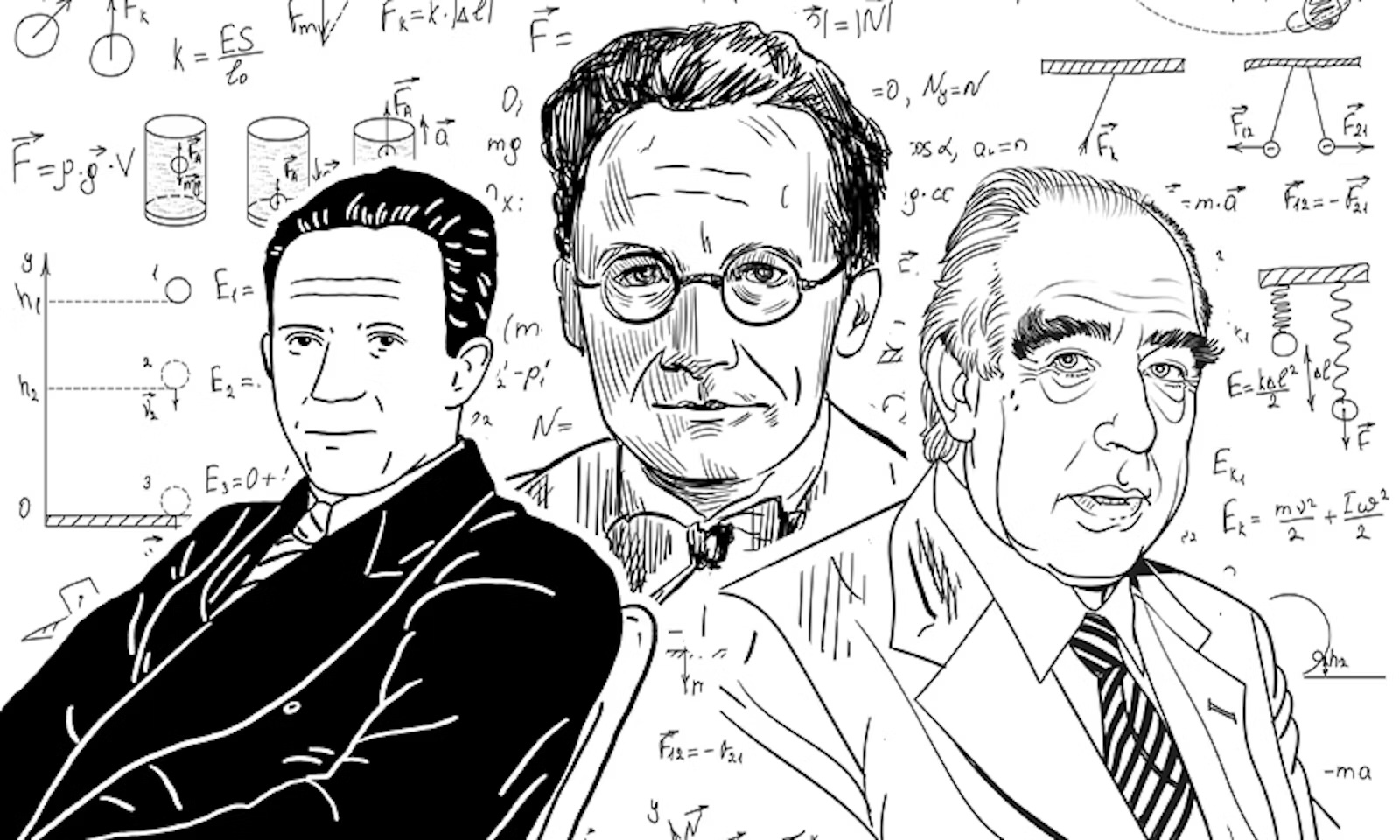
“Those who are not shocked when they first come across quantum theory cannot possibly have understood it”*…
A scheduling note: your correspondent is headed onto the road for a couple of weeks, so (Roughly) Daily will be a lot more roughly than daily until September 20th or so.
100 years ago, a circle of physicists shook the foundation of science. As Philip Ball explains, it’s still trembling…
In 1926, tensions were running high at the Institute for Theoretical Physics in Copenhagen. The institute was established 10 years earlier by the Danish physicist Niels Bohr, who had shaped it into a hothouse for young collaborators to thrash out a new theory of atoms. In 1925, one of Bohr’s protégés, the brilliant and ambitious German physicist Werner Heisenberg, had produced such a theory. But now everyone was arguing with each other about what it implied for the nature of physical reality itself.
To the Copenhagen group, it appeared reality had come undone…
[Ball tells the story of Niels Bohr’s building on Max Planck, of Werner Heisenberg’s wrangling of Bohr’s thought into theory, of Einstein’s objections and Erwin Schrödinger’s competing theory; then he homes in on the ontological issue at stake…]
Quantum mechanics, they said, demanded we throw away the old reality and replace it with something fuzzier, indistinct, and disturbingly subjective. No longer could scientists suppose that they were objectively probing a pre-existing world. Instead, it seemed that the experimenter’s choices determined what was seen—what, in fact, could be considered real at all.
In other words, the world is not simply sitting there, waiting for us to discover all the facts about it. Heisenberg’s uncertainty principle implied that those facts are determined only once we measure them. If we choose to measure an electron’s speed (more strictly, its momentum) precisely, then this becomes a fact about the world—but at the expense of accepting that there are simply no facts about its position. Or vice versa…
…A century later, scientists are still arguing about this issue of what quantum mechanics means for the nature of reality…
[Ball recounts subsequent attempts to reconcile quantum theory to “reality,” including Schrödinger’s wave mechanics…]
… Schrödinger’s wave mechanics didn’t restore the kind of reality he and Einstein wanted. His theory represented all that could be said about a quantum object in the form of a mathematical expression called the wave function, from which one can predict the outcomes of making measurements on the object. The wave function looks much like a regular wave, like sound waves in air or water waves on the sea. But a wave of what?
At first, Schrödinger supposed that the amplitude of the wave—think of it like the height of a water wave—at a given point in space was a measure of the density of the smeared-out quantum particle there. But Born argued that in fact this amplitude (more precisely, the square of the amplitude) is a measure of the probability that we will find the particle there, if we make a measurement of its position.
This so-called Born rule goes to the heart of what makes quantum mechanics so odd. Classical Newtonian mechanics allows us to calculate the trajectory of an object like a baseball or the moon, so that we can say where it will be at some given time. But Schrödinger’s quantum mechanics doesn’t give us anything equivalent to a trajectory for a quantum particle. Rather, it tells us the chance of getting a particular measurement outcome. It seems to point in the opposite direction of other scientific theories: not toward the entity it describes, but toward our observation of it. What if we don’t make a measurement of the particle at all? Does the wave function still tell us the probability of its being at a given point at a given time? No, it says nothing about that—or more properly, it permits us to say nothing about it. It speaks only to the probabilities of measurement outcomes.
Crucially, this means that what we see depends on what and how we measure. There are situations for which quantum mechanics predicts that we will see one outcome if we measure one way, and a different outcome if we measure the same system in a different way. And this is not, as is sometimes implied (this was the cause of Heisenberg’s row with Bohr), because making a measurement disturbs the object in some physical manner, much as we might very slightly disturb the temperature of a solution in a test-tube by sticking a thermometer into it. Rather, it seems to be a fundamental property of nature that the very fact of acquiring information about it induces a change.
If, then, by reality we mean what we can observe of the world (for how can we meaningfully call something real if it can’t be seen, detected, or even inferred in any way?), it is hard to avoid the conclusion that we play an active role in determining what is real—a situation the American physicist John Archibald Wheeler called the “participatory universe.”..
… Heisenberg’s “uncertainty” captured that sense of the ground shifting. It was not the ideal word—Heisenberg himself originally used the German Ungenauigkeit, meaning something closer to “inexactness,” as well as Unbestimmtheit, which might be translated as “undeterminedness.” It was not that one was uncertain about the situation of a quantum object, but that there was nothing to be certain about.
There was an even more disconcerting implication behind the uncertainty principle. The vagueness of quantum phenomena, when an electron in an atom might seem to jump from one energy state to another at a time of its own choosing, seemed to indicate the demise of causality itself. Things happened in the quantum world, but one could not necessarily adduce a reason why. In his 1927 paper on the uncertainty principle, Heisenberg challenged the idea that causes in nature lead to predictable effects. That seemed to undermine the very foundation of science, and it made the world seem like a lawless, somewhat arbitrary place….
… One of Bohr’s most provocative views was that there is a fundamental distinction between the fuzzy, probabilistic quantum world and the classical world of real objects in real places, where measurements of, say, an electron with a macroscopic instrument tell us that it is here and not there.
What Bohr meant is shocking. Reality, he implied, doesn’t consist of objects located in time and space. It consists of “quantum events,” which are obliged to be self-consistent (in the sense that quantum mechanics can describe them accurately) but not classically consistent with one another. One implication of this, as far as we can currently tell, is that two observers can see different and conflicting outcomes from an event—yet both can be right.
But this rigid distinction between the quantum and classical worlds can’t be sustained today. Scientists can now conduct experiments that probe size scales in between those where quantum and classical rules are thought to apply—neither microscopic (the atomic scale) nor macroscopic (the human scale), but mesoscopic (an intermediate size). We can look, for example, at the behavior of nanoparticles that can be seen and manipulated yet are small enough to be governed by quantum rules. Such experiments confirm the view that there is no abrupt boundary of quantum and classical. Quantum effects can still be observed at these intermediate scales if our devices are sensitive enough, but those effects can be harder to discern as the number of particles in the system increases.
To understand such experiments, it’s not necessary to adopt any particular interpretation of quantum mechanics, but merely to apply the standard theory—encompassed within Schrödinger’s wave mechanics, say—more expansively than Bohr and colleagues did, using it to explore what happens to a quantum object as it interacts with its surrounding environment. In this way, physicists are starting to understand how information gets out of a quantum system and into its environment, and how, as it does so, the fuzziness of quantum probabilities morphs into the sharpness of classical measurement. Thanks to such work, it is beginning to seem that our familiar world is just what quantum mechanics looks like when you are 6 feet tall.
But even if we manage to complete that project of uniting the quantum with the classical, we might end up none the wiser about what manner of stuff—what kind of reality—it all arises from. Perhaps one day another deeper theory will tell us. Or maybe the Copenhagen group was right a hundred years ago that we just have to accept a contingent, provisional reality: a world only half-formed until we decide how it will be…
Eminently worth reading in full: “When Reality Came Undone,” from @philipcball in @NautilusMag.
See also: When We Cease to Understand the World, by Benjamin Labatut.
* Niels Bohr
###
As we wrestle with reality, we might spare a thought for Ludwig Boltzmann; he died on this date in 1906. A physicist and philosopher, he is best remembered for the development of statistical mechanics, and the statistical explanation of the second law of thermodynamics (which connected entropy and probability).
Boltzmann helped paved the way for quantum theory both with his development of statistical mechanics (which is a pillar of modern physics) and with his 1877 suggestion that the energy levels of a physical system could be discrete.

“The importance of experimental proof, on the other hand, does not mean that without new experimental data we cannot make advances”*…

Adam Becker explains why demanding that a theory is falsifiable or observable, without any subtlety, will hold science back…
The Viennese physicist Wolfgang Pauli suffered from a guilty conscience. He’d solved one of the knottiest puzzles in nuclear physics, but at a cost. ‘I have done a terrible thing,’ he admitted to a friend in the winter of 1930. ‘I have postulated a particle [the neutrino] that cannot be detected.’
Despite his pantomime of despair, Pauli’s letters reveal that he didn’t really think his new sub-atomic particle would stay unseen. He trusted that experimental equipment would eventually be up to the task of proving him right or wrong, one way or another. Still, he worried he’d strayed too close to transgression. Things that were genuinely unobservable, Pauli believed, were anathema to physics and to science as a whole.
Pauli’s views persist among many scientists today. It’s a basic principle of scientific practice that a new theory shouldn’t invoke the undetectable. Rather, a good explanation should be falsifiable – which means it ought to rely on some hypothetical data that could, in principle, prove the theory wrong. These interlocking standards of falsifiability and observability have proud pedigrees: falsifiability goes back to the mid-20th-century philosopher of science Karl Popper, and observability goes further back than that. Today they’re patrolled by self-appointed guardians, who relish dismissing some of the more fanciful notions in physics, cosmology and quantum mechanics as just so many castles in the sky. The cost of allowing such ideas into science, say the gatekeepers, would be to clear the path for all manner of manifestly unscientific nonsense.
But for a theoretical physicist, designing sky-castles is just part of the job. Spinning new ideas about how the world could be – or in some cases, how the world definitely isn’t – is central to their work. Some structures might be built up with great care over many years and end up with peculiar names such as inflationary multiverse or superstring theory. Others are fabricated and dismissed casually over the course of a single afternoon, found and lost again by a lone adventurer in the troposphere of thought.
That doesn’t mean it’s just freestyle sky-castle architecture out there at the frontier. The goal of scientific theory-building is to understand the nature of the world with increasing accuracy over time. All that creative energy has to hook back onto reality at some point. But turning ingenuity into fact is much more nuanced than simply announcing that all ideas must meet the inflexible standards of falsifiability and observability. These are not measures of the quality of a scientific theory. They might be neat guidelines or heuristics, but as is usually the case with simple answers, they’re also wrong, or at least only half-right.
alsifiability doesn’t work as a blanket restriction in science for the simple reason that there are no genuinely falsifiable scientific theories. I can come up with a theory that makes a prediction that looks falsifiable, but when the data tell me it’s wrong, I can conjure some fresh ideas to plug the hole and save the theory.
The history of science is full of examples of this ex post facto intellectual engineering…
[Becker recount’s The Story of Herschel’s discovery on Uranus, the challenge it posed to Newtonian gravity, and Einstein’s ultimately saving theory; then returns to Pauli and to Bohr’s attempts to use it to refute the principle of conservation of energy; and finally explores the disagreement among, Boltzmann, Maxwell and Clauisus (on the one hand) and Mach (on the other) over atomic theory. He then considers competing theories for similar outcomes (that’s to say, theories that are observationally identical)…]
… the choices we make between observationally identical theories have a big impact upon the practice of science. The American physicist Richard Feynman pointed out that two wildly different theories that have identical observational consequences can still give you different perspectives on problems, and lead you to different answers and different experiments to conduct in order to discover the next theory. So it’s not just the observable content of our scientific theories that matters. We use all of it, the observable and the unobservable, when we do science. Certainly, we are more wary about our belief in the existence of invisible entities, but we don’t deny that the unobservable things exist, or at least that their existence is plausible.
Some of the most interesting scientific work gets done when scientists develop bizarre theories in the face of something new or unexplained. Madcap ideas must find a way of relating to the world – but demanding falsifiability or observability, without any sort of subtlety, will hold science back. It’s impossible to develop successful new theories under such rigid restrictions. As Pauli said when he first came up with the neutrino, despite his own misgivings: ‘Only those who wager can win.’…
We need madcap ideas: “What is good science?,” from @FreelanceAstro in @aeonmag.
Apposite: Charles Sanders Peirce on “abduction”
* Carlo Rivelli, Reality Is Not What It Seems
###
As we ponder proof, we might spare a thought for Donald William Kerst; he died on this date in 1993. A physicist, he helped develop the experimental approach (and apparatus) that let Enrico Fermi confirm the existence of Pauli’s neutrino (among many other discoveries).
Kerst specialized in plasma physics, and worked on advanced particle accelerator concepts (accelerator physics). He developed the Betatron (1940), the first device to accelerate electrons (“beta particles”) to speeds high enough to have sufficient momentum to produce nuclear transformations in atoms. It influenced all subsequent particle accelerators.

“The past, like the future, is indefinite and exists only as a spectrum of possibilities”*…

A recent paper by Robert Lanza and others suggests that physical reality isn’t independent of us, “objective,” but is the product of networks of observers…
Is there physical reality that is independent of us? Does objective reality exist at all? Or is the structure of everything, including time and space, created by the perceptions of those observing it? Such is the groundbreaking assertion of a new paper published in the Journal of Cosmology and Astroparticle Physics.
The paper’s authors include Robert Lanza, a stem cell and regenerative medicine expert, famous for the theory of biocentrism, which argues that consciousness is the driving force for the existence of the universe. He believes that the physical world that we perceive is not something that’s separate from us but rather created by our minds as we observe it. According to his biocentric view, space and time are a byproduct of the “whirl of information” in our head that is weaved together by our mind into a coherent experience.
His new paper, co-authored by Dmitriy Podolskiy and Andrei Barvinsky, theorists in quantum gravity and quantum cosmology, shows how observers influence the structure of our reality.
According to Lanza and his colleagues, observers can dramatically affect “the behavior of observable quantities” both at microscopic and massive spatiotemporal scales. In fact, a “profound shift in our ordinary everyday worldview” is necessary, wrote Lanza in an interview with Big Think. The world is not something that is formed outside of us, simply existing on its own. “Observers ultimately define the structure of physical reality itself,” he stated.
How does this work? Lanza contends that a network of observers is necessary and is “inherent to the structure of reality.” As he explains, observers — you, me, and anyone else — live in a quantum gravitational universe and come up with “a globally agreed-upon cognitive model” of reality by exchanging information about the properties of spacetime. “For, once you measure something,” Lanza writes, “the wave of probability to measure the same value of the already probed physical quantity becomes ‘localized’ or simply ‘collapses.’” That’s how reality comes to be consistently real to us all. Once you keep measuring a quantity over and over, knowing the result of the first measurement, you will see the outcome to be the same.
“Similarly, if you learn from somebody about the outcomes of their measurements of a physical quantity, your measurements and those of other observers influence each other ‒ freezing the reality according to that consensus,” added Lanza, explaining further that “a consensus of different opinions regarding the structure of reality defines its very form, shaping the underlying quantum foam,” explained Lanza.
In quantum terms, an observer influences reality through decoherence, which provides the framework for collapsing waves of probability, “largely localized in the vicinity of the cognitive model which the observer builds in their mind throughout their lifespan,” he added.
Lanza says, “The observer is the first cause, the vital force that collapses not only the present, but the cascade of spatiotemporal events we call the past. Stephen Hawking was right when he said: ‘The past, like the future, is indefinite and exists only as a spectrum of possibilities.’”
Could an artificially intelligent entity without consciousness be dreaming up our world? Lanza believes biology plays an important role, as he explains in his book The Grand Biocentric Design: How Life Creates Reality, which he co-authored with the physicist Matej Pavsic.
While a bot could conceivably be an observer, Lanza thinks a conscious living entity with the capacity for memory is necessary to establish the arrow of time. “‘A brainless’ observer does not experience time and/or decoherence with any degree of freedom,” writes Lanza. This leads to the cause and effect relationships we can notice around us. Lanza thinks that “we can only say for sure that a conscious observer does indeed collapse a quantum wave function.”…
Another key aspect of their work is that it resolves “the exasperating incompatibility between quantum mechanics and general relativity,” which was a sticking point even for Albert Einstein.
The seeming incongruity of these two explanations of our physical world — with quantum mechanics looking at the molecular and subatomic levels and general relativity at the interactions between massive cosmic structures like galaxies and black holes — disappears once the properties of observers are taken into account.
While this all may sound speculative, Lanza says their ideas are being tested using Monte Carlo simulations on powerful MIT computer clusters and will soon be tested experimentally.
Is the physical universe independent from us, or is it created by our minds? “Is human consciousness creating reality?” @RobertLanza
We might wonder, if this is so, how reality emerged at all. Perhaps one possibility is implied in “Consciousness was upon him before he could get out of the way.”
* Stephen Hawking
###
As we conjure with consciousness, we might recall that it was on this date in 1908 (the same year that he was awarded the Nobel Prize in Physics) that Ernest Rutherford announced in London that he had isolated a single atom of matter. The following year, he, Hans Geiger (later of “counter” fame), and Ernest Marsden conducted the “Gold Foil Experiment,” the results of which replaced J. J. Thomson‘s “Plum Pudding Model” of the atom with what became known as the “Rutherford Model“: a very small charged nucleus, containing much of the atom’s mass, orbited by low-mass electrons.

You must be logged in to post a comment.