Posts Tagged ‘art’
“I’m Your Puppet”*…

Your correspondent is hitting the road again. (Roughly) Daily will be on hiatus until July1…
The first English language history of puppets…
Anybody who grew up with Shari Lewis’ Lamb Chop, Fred Rogers’ King Friday XIII, or Jim Henson’s Muppets will surely feel that they have entered a more expansive puppet realm at the outset of Helen Haiman Joseph’s A Book of Marionettes (1920). Late one evening in Cleveland, Ohio as she makes alterations to their costumes, a cast of stringed characters from Anglo-Irish dramatist Lord Dunsany’s otherworldly drama The Golden Doom — the Chief Prophet of the Stars, the Chamberlain, a pair of Spies, and a Priest — treat Joseph as rudely and defiantly as Pinocchio abused Geppetto. Beating her retreat from this imagined Lilliputian assault, the weary marionette seamstress overhears them vainly reciting their august, cosmopolitan ancestry, from the ancient Indian Ramayana, Japanese jōruri dramas, and medieval Passion plays to pugilistic stars like Pulcinella, Punch, Kasperle and Karaghöz, on down to the devotion of modern immortals spanning from Shakespeare, Voltaire, and Goethe to George Bernard Shaw and Maurice Maeterlinck.
The first comprehensive history of marionette artistry in the English language, A Book of Marionettes appeared at a watershed moment in both American and world puppetry, after a century of artistic and technical innovation, and before the cinema’s global supplanting of human attention and storytelling. Drawing on her field study of European puppetry, Helen Haiman Joseph magisterially surveys the millennia-long world history of string and silhouette marionettes. Born seemingly simultaneously with organized religion, the little creatures never leave their creators’ sides, fully capable of expressing the entire range of human emotion and experience in every corner of the globe, in every age. Enlisted as surrogate actors, marionettes perform with their necessarily circumscribed mechanical gestures deeds of immense gravity, all while barely touching the earth. As Joseph moves adeptly through the ever-dynamic world of marionette theaters, one gets the feeling that she is actually narrating a kind of alternate history of the world, one that is altogether more joyously humane than any epic recounted about mere human beings.
Granted the power to subvert any worldly authority, marionettes, as Joseph proves, perennially overthrow all social, political, religious, and even artistic conventions. When Martin Luther’s Calvinist confrères refused to administer the sacrament to actors, they became puppeteers. On more than a few occasions, both puppeteers and puppets found themselves behind bars, so effective was their satire against oppressive ecclesiastics and governments. Since the modern Western state arose at a time when marionette theaters were ubiquitous, the diminutive legion was always at hand to model courage and stoutheartedness for their momentarily cowed audiences. That Shakespeare’s Julius Caesar, Christopher Marlowe’s Massacre of Paris, and Ben Jonson’s Every Man Out of His Humour were inspired by puppet plays, or that Lord Byron drew his model of Don Juan from a Punch & Judy piece titled The Libertine Destroyed, suggests the deep fraternity of modern drama with its little brother…
More history– and illustrations: “Strings Attached: Helen Haiman Joseph’s A Book of Marionettes (1920)” from @publicdomainrev.bsky.social.
Browse the book in full at the invaluable Internet Archive.
* a song written by Dan Penn and Spooner Oldham, best known in the version recorded by James & Bobby Purify (Hear here)
###
As we untangle the strings, we might recall that it ws on this date in 1623 that a large codfish, split open at a Cambridge market, was found to contain a copy of a book of religious treatises by John Frith.

“Gravity. It’s not just a good idea; it’s the law!”*…

… But what is gravity? George Musser unpacks a new argument that explores how the growth of disorder could cause massive objects to move toward one another– one that has left some physicists interested, and some skeptical…
Isaac Newton was never entirely happy with his law of universal gravitation. For decades after publishing it in 1687, he sought to understand how, exactly, two objects were able to pull on each other from afar. He and others came up with several mechanical models, in which gravity was not a pull, but a push. For example, space might be filled with unseen particles that bombard the objects on all sides. The object on the left absorbs the particles coming from the left, the one on the right absorbs those coming from the right, and the net effect is to push them together.
Those theories never quite worked, and Albert Einstein eventually provided a deeper explanation of gravity as a distortion of space and time. But Einstein’s account, called general relativity, created its own puzzles, and he himself recognized that it could not be the final word. So the idea that gravity is a collective effect — not a fundamental force, but the outcome of swarm behavior on a finer scale — still compels physicists.
Earlier this year, a team of theoretical physicists put forward what might be considered a modern version of those 17th-century mechanical models. “There’s some kind of gas or some thermal system out there that we can’t see directly,” said Daniel Carney of Lawrence Berkeley National Laboratory, who led the effort. “But it’s randomly interacting with masses in some way, such that on average you see all the normal gravity things that you know about: The Earth orbits the sun, and so forth.”
This project is one of the many ways that physicists have sought to understand gravity, and perhaps the bendy space-time continuum itself, as emergent from deeper, more microscopic physics. Carney’s line of thinking, known as entropic gravity, pegs that deeper physics as essentially just the physics of heat. It says gravity results from the same random jiggling and mixing up of particles — and the attendant rise of entropy, loosely defined as disorder — that governs steam boilers, car engines and refrigerators.
Attempts at modeling gravity as a consequence of rising entropy have cropped up now and again for several decades. Entropic gravity is very much a minority view. But it’s one that won’t die, and even detractors are loath to dismiss it altogether. The new model has the virtue of being experimentally testable — a rarity when it comes to theories about the mysterious underpinnings of the universal attraction…
[Musser explains the hypothesis, traces is origin, and reviews other scientists’ reactions, and traces possible approaches to testing it…]
… if this long-shot theory does work out, physicists will need to update the artist Gerry Mooney’s famous gravity poster, which reads: “Gravity. It isn’t just a good idea. It’s the law.” Perhaps gravity is not, in fact, a law, just a statistical tendency…
“Is Gravity Just Entropy Rising? Long-Shot Idea Gets Another Look” from @georgemusser.com in @quantamagazine.bsky.social.
###
As we fumble with forces, we might send insightful birthday greetings to a man who encourages us to see in different ways, M. C. Escher; he was born on this date in 1898. A graphic artist inspired by mathematics, he created woodcuts, lithographs, and mezzotints, that— while largely ignored by the art world in his lifetime, have become widely celebrated. He’s been recognized as an heir to Parmigianino, Hogarth, and Piranesi.
His work features mathematical objects and operations including impossible objects, explorations of infinity, reflection, symmetry, perspective, truncated and stellated polyhedra, hyperbolic geometry, and tessellations. And though Escher believed he had no mathematical ability, he interacted with the mathematicians George Pólya, Roger Penrose, and Donald Coxeter, and the crystallographer Friedrich Haag, and conducted his own research into tessellation.
For more on (and more examples of) Escher’s work, see here.


“If it is not useful or necessary, free yourself from imagining that you need to make it”*…

The Shakers, a millennial Christian sect founded in the mid-18th century, are characterized by their simple, communal lives… and their celibacy (as a product of which there are only three known Shakers alive today). That said, they had an outsized impact on design– now on display at Frank Gehry-designed Vitra Design Museum in Weil am Rhein, Germany. Jane Enfield unpacks the Shakers’ legacy…
Vitra Design Museum is presenting The Shakers: A World In Making, an exhibition highlighting the enduring design principles of the 18th-century Shakers who prioritised utilitarianism, craftsmanship and ethics.
Designed by Milan studio Formafantasma, the exhibition spotlights the design legacy of the Shakers, a Protestant sect founded in England around 1747 whose members created unadorned and meticulously built architecture and furniture.
“Today, the relevance of Shaker principles feels more urgent than ever,” Vitra Design Museum curator Mea Hoffmann told Dezeen.
“Their approach to democratic design, combining utilitarian function with exceptional craftsmanship and ethical intent, offers a compelling alternative to the excesses of modern consumer culture.”…
… The historical works were created after the Shakers emigrated to the USA in 1774, where they established 18 communities from Kentucky to Maine and created pieces that set the tone for a utilitarian, wood-heavy trend that endures to this day.
Among Hoffmann’s highlights is an four-metre-long bench from 1855, which was designed as communal but gender-segregated seating for the traditional Shaker meetinghouse.
“Community and shared property were at the heart of Shaker life,” explained the curator.
“There’s something very compelling about the inherent proximity that comes from sitting together on a bench – you can’t help but feel your connection to the people around you.”
Also on display is an “elevator” shoe, created around 1890. The footwear was specially designed with a raised sole for a woman whose legs were of two different lengths to facilitate her mobility.
“The Shakers were dedicated to including all members in daily life and often adapted or created objects to allow everyone to contribute,” noted Hoffmann.
The curator emphasised that the exhibition strives to highlight the Shakers’ knack for embracing external influences despite their particular way of life, highlighting the sect as early adopters of electricity, indoor plumbing and telecommunications.
An object that reflects this is a 1925 radio designed by trailblazer Elder Irving Greenwood, who is said to have persuaded the Canterbury Shakers to install electricity throughout his New Hampshire community in 1909.
“It’s an interesting example of the Shakers’ openness to technological change and innovation,” reflected Hoffmann. “Although they retreated from the world, the radio demonstrates that this apparent division may have been far more permeable.”
“Beyond adopting existing technologies, the Shakers also engineered their own machinery, such as steam engines and specialised cutting devices, to streamline labour-intensive tasks,” continued the curator.
“As they mass-produced their standardised goods, they also developed the tools necessary to improve production.”…
… Considering the sect’s enduring visual language, Hoffmann described the Shakers as holding a “unique position within the design canon”.
“Although their object culture emerged from an organic craft tradition rather than a centralised design ideology, their work has had a lasting influence, particularly on 20th-century Scandinavian designers such as Kaare Klint and Børge Mogensen, and continues to inspire contemporary practitioners today,” said Hoffmann.
“In many ways, Shaker design anticipated modern aesthetics, though it was entirely unintentional,” concluded the curator. “It’s an interesting example of groups of people getting to similar places from very different starting points.”…
More (and more photos) at: “Shaker exhibition at Vitra Design Museum “feels more urgent than ever‘,” from @dezeen.com.
* Shaker maxim
###
As we keep it simple, we might spare a thought for a contemporary of the earliest Shakers, Richard Lovell Edgeworth; he died on this date in 1817. A politician and writer, he is best remembered as an inventor (perhaps most notably– and Shaker-like– a turnip-cutter and a velocipede [an early bicycle]).
That said, Edgeworth was no Shaker. He was a member of the Lunar Society, an informal organization of Birmingham-based industrialists, scientists, and intellectuals that met regularly to discuss and share ideas relating to their (amny and various) fields of interest. Other members included Erasmus Darwin, Josiah Wedgwood, and James Watt.
And perhaps more tellingly, Edgeworth was anything but celibate: he married four times and fathered 22 children.

“The Times They Are A-Changin'”*…

Further to an earlier post in his wonderful newsletter The Honest Broker, Ted Gioia offers a provocative (and for your correspondent’s money, ultimately optimistic) forecast…
Would you believe me if I told you that the biggest news story of our century is happening right now—but is never mentioned in the press?
That sounds crazy, doesn’t it?
But that is often the case when a bold new worldview appears.
The biggest changes often happen long before they even get a name. By the time the scribes notice, the world is already reborn.
- How long did it take before the Renaissance got mentioned in the town square?
- When did newspapers start covering the Enlightenment?
- Or the collapse in mercantilism?
- Or the rise of globalism?
- Or the birth of Christianity or Islam or some other earthshaking creed?
You can take this to the bank: If the New York Times notices the Buddha, the enlightened one has already left town.
For example, the word Renaissance got introduced two hundred years after the start of the Renaissance. The game was already over.
The same is true of most major cultural movements—they are truly the elephants in the room. And the elites at the epicenter of power are absolutely the last to notice.
Tiberius may run the entire Roman Empire, but he will never hear the Good News.
There’s a general rule here—the bigger the shift, the easier it is to miss.
We are living through a situation like that right now. We are experiencing a total shift—like the magnetic poles reversing. But it doesn’t even have a name—not yet.
So let’s give it one.
Let’s call it: The Collapse of the Knowledge System.
We could also define it as the emergence of a new knowledge system.
In this regard, it resembles other massive shifts in Western history—specifically the rebirth of humanistic thinking in the early Renaissance, or the rise of Romanticism in the nineteenth century.
In these volatile situations, the whole entrenched hierarchy of truth and authority gets totally reversed. The old experts and their systems are discredited, and completely new values take their place. The newcomers bring more than just a new attitude—they turn everything on its head.
That’s happening right now…
[Gioia unpacks ten signs of this collapse…]
… Why isn’t this discussed openly—in media, in universities, in public discourse? Everything I’ve mentioned above is public knowledge. So why aren’t the experts discussing it?
Well, that’s obvious.
The experts don’t want to admit this is happening because it puts their status at risk. And the same is true of all the organizations and businesses that own and control the knowledge system.
The last thing they want is to call attention to the breakdown.
So they can only address the situation in isolated, disconnected ways. Admitting that these ten symptoms are part of a larger, systemic problem can’t be acknowledged—not under any circumstances.
And that’s why we can’t assume that any quick fix—from politicians or universities—will reverse this decline. We are beyond that stage.
The more important question is this: When the old knowledge hierarchy collapses, what will replace it?
Yes, something will replace it. And I’ve hinted at that in previous articles here—for example, my “Notes Toward a New Romanticism.”
Even as tech gets degrades, people will still need something solid and reliable that will contribute to human flourishing. In fact, they will need that more than ever.
If they can’t get it from Silicon Valley, they will find it elsewhere.
But where?
Let me point out that despite all the manipulations, hallucinations, abuses, and dysfunctional excesses of the digital life…
…Despite all of these, symphonies sound as majestic as ever. Philosophy is more necessary than ever. Paintings are still glorious. Great architecture does not collapse. Nature warms the heart. As do poems and epics and myths.
Jazz still swings. Heroes still prevail. The soul is stirred. And one lover still reaches for another.
I’m not sure what exactly will replace the cold, dying knowledge system. But I suspect it will recognize the value of these things. And will prevail for that very reason…
… before closing, let me make a few more points
- Science and tech will not disappear. But they will face an intense backlash beyond anything we’ve experienced in the last 200 years.
- The people running the tech world fail to grasp this. They think that the next big stage is the Singularity—when everybody lets the technocracy control everything and make every decision. In fact, the exact opposite is about to unfold.
- I’m not suggesting that you can replace tech with a poem or symphony. But tech now desperately needs what can only be provided by the humanities and human values.
- The new knowledge system will be built on these human values. Technology will be forced to serve it—or it will get locked into a losing battle with the new “softer and gentler” knowledge system…
A huge change is coming: “The Ten Warning Signs,” from @tedgioia.bsky.social.
* Bob Dylan
###
As we wonder about ways of knowing, we might recall that it was on this date in 1983 that the Kinks released their 20th studio album, State of Confusion. (The LP features the single “Come Dancing“, which hit number 6 on the Billboard Hot 100 and was one of the band’s biggest hit singles in the United States, equaling the 1965 peak of “Tired of Waiting for You.” The album itself was a major success, peaking at number 12 on the Billboard albums chart.)

“When we build, let us think that we build forever”*…
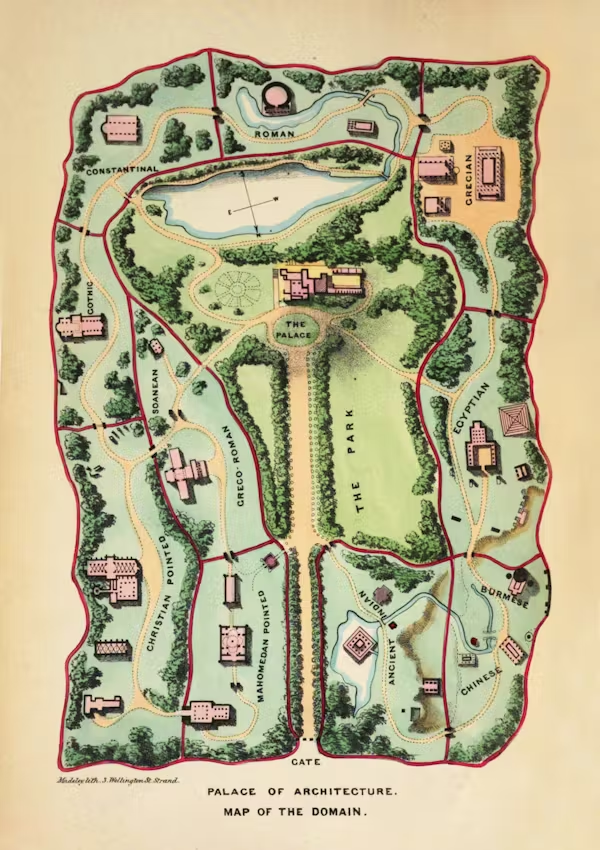
In 1840, British architect George Wightwick published a world history of architecture in the Romantic mode, inviting readers to enter a vast garden where Buddhist iconography rubs shoulders with Greek temples and Egyptian pyramids gaze upon Gothic cathedrals. His intended audience? Idle women. Matthew Mullane revisits this visionary but ultimately unpopular text and explores the legacy of attempts to gatekeep the realms of imagination and fantasy pertaining to the built environment…
The “Prince Architect” welcomes you: “You will see, within this domain, an epitome of the Architectural world. Mine is, as it were, a palace of congress, wherein you will be successively addressed by humble (but, it is hoped, characteristic) representatives of the great families of Design in ancient and Mahomedan India, China, Egypt, Greece, ancient and modern Italy, Turkey, Moorish Spain, and Christian Europe”.
This grandiose introduction is offered by the protagonist of George Wightwick’s Palace of Architecture: A Romance of Art and History (1840). The reader, an imagined visitor referred to in the second person, is quickly handed a map showing the “architectural world” not as a diagram of transmission, a “tree” of influence, or a catalogue of entries, but a picturesque garden. Flanking the central palace is a group of buildings representing the “ancient” corners of the world, including India, China, Burma, and Egypt. At the top-right corner of the map, Greek and Roman structures curl leftward to show a European panoply of styles including Gothic, Soanean, Greco-Roman, and finally, two pointed styles from the Christian and “Mahomedan” perspective. Before entering this garden, you face the palace gate, an unruly collage of world architecture history consisting of, among other things, a Gothic spire, an Islamic dome, and crude prehistoric stone. The gate represents the chasm between the Prince Architect’s overflowing storehouse of experience, and you, the new guest, with none. The well-traveled architect sourced the building’s components from his extensive travels and “crammed [it] with observation, the which it vents in mangled forms.”2 You, the reader, are homebound and observationally deficient and therefore must feel beguiled. However, after a guided journey through the grounds of the palace, “you will return, competent to read the significant details of what, now, only vaguely addresses your understanding.”
Unlike more familiar world histories of the nineteenth century that enticed readers with pages full of illustrations, simplified categorizations, and appeals to scientific rationality, Wightwick’s tour of world architecture was a poetically narrated experience. His florid language and direct reference to the reader were intended to “address the eye and ear of the general public with the eloquence of picturesque illustration and impassioned comment”. He believed that “the error of architectural authors has been that of writing technical treatises for professional readers” and approached the public with a different proposition: “[architecture] requires no critical knowledge of its beauties to admit; neither are its mathematics necessary to a certain enjoyment of the associations that may be connected with a building.”5 In other words, plans, geometry, and other artifacts of specialized knowledge are impediments to actually knowing architecture and its history, and a general audience requires none of that. What they need is a basic level of historical knowledge introduced in an evocative manner so that “the joy of being competent to appreciate” can be unlocked in order to experience “the poetic enchantment of Architecture [that] transfixes the soul of the beholder, and leaves him spell-bound under the combined influence of the phantom past, and the palpable present”. Instead of relying on the empirical evidence of professionals alone, after just one tour through the palace of architecture, you will be in command of architectural knowledge as your “own poet”.
Wightwick’s preference for “speculation and belief” over technical demonstration was directed toward a very specific readership: idle women. The seemingly neutral “you” that drew readers into the palace grounds was in fact aimed at the “fair countrywomen of England”. At a time when female readership of both popular and specialized material was growing, the book is perhaps the first world architectural history written specifically with women in mind…
…
… Critical responses to Wightwick’s entreaty to female readers spanned from bemusement to venomous reproach. The Gentleman’s Magazine recognized that the book was not for the “scientific observer” of architecture but acknowledged that it could nonetheless “afford amusement to the ‘fair’ and fashionable admirers of the art”. W. H. Leeds, writing under the penname Candidus, was not so generous. He published an excoriating review that held the book up as an example of the withering effects of Romanticism on contemporary architectural discourse. He called Wightwick the “wickedest dog in existence” for audaciously dedicating his book not to any reputable institute, but “to a woman, or a no-man” and thinking “that romance has anything to do with art—at any rate, with architecture”. Leeds argued that Wightwick’s avoidance of technical description, scarce reference to plans, and indulgence in imagination threatened to turn architecture into an unserious field of curiosity, charm, and play — all words invariably tinged with the feminine. If Wightwick’s book gained the influence its author wanted, then surely “that which has hitherto been the task of a higher order of intellect is now to become the amusement of women—perhaps the plaything of children”. Careful to not appear ungentlemanly, Leeds clarified that he is not opposed to women enjoying or appreciating architecture in a passive way, but Wightwick’s encouragement of active speculation and creative rearrangement of architecture history was dangerous. “We object to it”, he reasoned, “not because we question the capacity or the sex, but because we see no occasion for increasing the number of designing women”. Where Wightwick saw idle women as eager consumers, Leeds was concerned that an overly enticing history would shock them out of their idleness and convince them that they, too, could make architecture.
Men like Leeds feared that “designing women” would disrupt two key aspects of English architectural culture, its homosociality and its claim to truth. The first was perhaps an annoyance, but the second could be disastrous. Leeds argued that women’s flimsy associations and predilection for exclamations like “how exceedingly pretty!” could trigger the collapse of all architectural knowledge made by men before them.23 Such anxiety represents the panic of a discipline whose propulsive drive to include more and more case studies and accommodate more and more readers also brought unwelcomed actors, like women, dangerously close to the inner circle of architectural expertise. The discrediting of Wightwick’s book shows the quick hardening of professional and epistemological borders to maintain credibility…
…
… Into the twentieth century, architectural history remained stubbornly male dominated and the gendering of architectural fantasy and imagination as feminine stymied any hope that such ideas could gain professional credence. Things quickly changed in the 1960s, when young architects championed phenomenology as a critique of modernism’s universalizing assumptions about user experience. Historian Jorge Otero-Pailos argues that this phenomenological revolution allowed for a generation of so-called postmodern architects to challenge architectural history’s longstanding positivist bent. The buildings of Charles Moore, Robert Venturi, and Denise Scott Brown playfully assemble specific and invented historical references, provoking the viewer in a manner that is not so dissimilar from Wightwick’s mutant palace gate.
While postmodernists experimented with architectural history, the written output of architectural historians such as Charles Jencks ironically remained somewhat conventional and tied to the explanatory textbook. Fantasy and imagination seemingly still carried an indelible stigma. However, a few recent books suggest a return of the repressed, so to speak. Françoise Fromonot’s The House of Doctor Koolhaas (2025) tells the history of a famous house by Rem Koolhaas through the genre conventions of a detective novel. Charlotte Van den Broeck’s Bold Ventures: Thirteen Tales of Architectural Tragedy (2022) blends researched histories of architectural failure and suicide with self-reflective passages that question the authoritativeness of words like “explanation” that are so often used in history texts. Past authors are being rediscovered as well. Lin Huiyin’s mid-twentieth-century poems reflecting on a changing China are at last being translated and reframed as examples of architectural history. These texts are refreshingly strange — just as strange as walking into the Palace of Architecture — and signal that the discipline is finally shedding some of its enduring prejudices about imagination and fantasy…
More of the fascinating story, along with copious illustrations: “Imagining an Idle Countess- George Wightwick’s The Palace of Architecture,” from @publicdomainrev.bsky.social.
Apposite: “Bernard Sleigh’s Anciente Mappe of Fairyland (ca. 1920 edition),” also from @publicdomainrev.bsky.social
* John Ruskin
###
As we dwell on design, we might send connected birthday greetings to an architect of a different kind, Sir Tim Berners-Lee; he was born on this date in 1955. A computer scientist best known as the inventor of the World Wide Web, the browser, the HTML markup language, the URL system, and HTTP, he is a professorial research fellow at the University of Oxford, a professor emeritus at the MIT, and director of the World Wide Web Consortium, which oversees its continued development.

You must be logged in to post a comment.