Posts Tagged ‘art’
“When we build, let us think that we build forever”*…
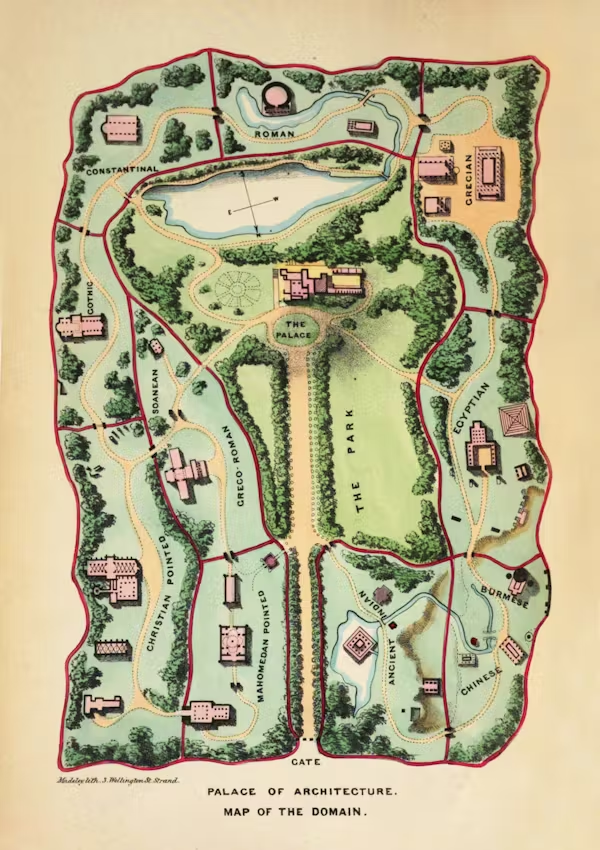
In 1840, British architect George Wightwick published a world history of architecture in the Romantic mode, inviting readers to enter a vast garden where Buddhist iconography rubs shoulders with Greek temples and Egyptian pyramids gaze upon Gothic cathedrals. His intended audience? Idle women. Matthew Mullane revisits this visionary but ultimately unpopular text and explores the legacy of attempts to gatekeep the realms of imagination and fantasy pertaining to the built environment…
The “Prince Architect” welcomes you: “You will see, within this domain, an epitome of the Architectural world. Mine is, as it were, a palace of congress, wherein you will be successively addressed by humble (but, it is hoped, characteristic) representatives of the great families of Design in ancient and Mahomedan India, China, Egypt, Greece, ancient and modern Italy, Turkey, Moorish Spain, and Christian Europe”.
This grandiose introduction is offered by the protagonist of George Wightwick’s Palace of Architecture: A Romance of Art and History (1840). The reader, an imagined visitor referred to in the second person, is quickly handed a map showing the “architectural world” not as a diagram of transmission, a “tree” of influence, or a catalogue of entries, but a picturesque garden. Flanking the central palace is a group of buildings representing the “ancient” corners of the world, including India, China, Burma, and Egypt. At the top-right corner of the map, Greek and Roman structures curl leftward to show a European panoply of styles including Gothic, Soanean, Greco-Roman, and finally, two pointed styles from the Christian and “Mahomedan” perspective. Before entering this garden, you face the palace gate, an unruly collage of world architecture history consisting of, among other things, a Gothic spire, an Islamic dome, and crude prehistoric stone. The gate represents the chasm between the Prince Architect’s overflowing storehouse of experience, and you, the new guest, with none. The well-traveled architect sourced the building’s components from his extensive travels and “crammed [it] with observation, the which it vents in mangled forms.”2 You, the reader, are homebound and observationally deficient and therefore must feel beguiled. However, after a guided journey through the grounds of the palace, “you will return, competent to read the significant details of what, now, only vaguely addresses your understanding.”
Unlike more familiar world histories of the nineteenth century that enticed readers with pages full of illustrations, simplified categorizations, and appeals to scientific rationality, Wightwick’s tour of world architecture was a poetically narrated experience. His florid language and direct reference to the reader were intended to “address the eye and ear of the general public with the eloquence of picturesque illustration and impassioned comment”. He believed that “the error of architectural authors has been that of writing technical treatises for professional readers” and approached the public with a different proposition: “[architecture] requires no critical knowledge of its beauties to admit; neither are its mathematics necessary to a certain enjoyment of the associations that may be connected with a building.”5 In other words, plans, geometry, and other artifacts of specialized knowledge are impediments to actually knowing architecture and its history, and a general audience requires none of that. What they need is a basic level of historical knowledge introduced in an evocative manner so that “the joy of being competent to appreciate” can be unlocked in order to experience “the poetic enchantment of Architecture [that] transfixes the soul of the beholder, and leaves him spell-bound under the combined influence of the phantom past, and the palpable present”. Instead of relying on the empirical evidence of professionals alone, after just one tour through the palace of architecture, you will be in command of architectural knowledge as your “own poet”.
Wightwick’s preference for “speculation and belief” over technical demonstration was directed toward a very specific readership: idle women. The seemingly neutral “you” that drew readers into the palace grounds was in fact aimed at the “fair countrywomen of England”. At a time when female readership of both popular and specialized material was growing, the book is perhaps the first world architectural history written specifically with women in mind…
…
… Critical responses to Wightwick’s entreaty to female readers spanned from bemusement to venomous reproach. The Gentleman’s Magazine recognized that the book was not for the “scientific observer” of architecture but acknowledged that it could nonetheless “afford amusement to the ‘fair’ and fashionable admirers of the art”. W. H. Leeds, writing under the penname Candidus, was not so generous. He published an excoriating review that held the book up as an example of the withering effects of Romanticism on contemporary architectural discourse. He called Wightwick the “wickedest dog in existence” for audaciously dedicating his book not to any reputable institute, but “to a woman, or a no-man” and thinking “that romance has anything to do with art—at any rate, with architecture”. Leeds argued that Wightwick’s avoidance of technical description, scarce reference to plans, and indulgence in imagination threatened to turn architecture into an unserious field of curiosity, charm, and play — all words invariably tinged with the feminine. If Wightwick’s book gained the influence its author wanted, then surely “that which has hitherto been the task of a higher order of intellect is now to become the amusement of women—perhaps the plaything of children”. Careful to not appear ungentlemanly, Leeds clarified that he is not opposed to women enjoying or appreciating architecture in a passive way, but Wightwick’s encouragement of active speculation and creative rearrangement of architecture history was dangerous. “We object to it”, he reasoned, “not because we question the capacity or the sex, but because we see no occasion for increasing the number of designing women”. Where Wightwick saw idle women as eager consumers, Leeds was concerned that an overly enticing history would shock them out of their idleness and convince them that they, too, could make architecture.
Men like Leeds feared that “designing women” would disrupt two key aspects of English architectural culture, its homosociality and its claim to truth. The first was perhaps an annoyance, but the second could be disastrous. Leeds argued that women’s flimsy associations and predilection for exclamations like “how exceedingly pretty!” could trigger the collapse of all architectural knowledge made by men before them.23 Such anxiety represents the panic of a discipline whose propulsive drive to include more and more case studies and accommodate more and more readers also brought unwelcomed actors, like women, dangerously close to the inner circle of architectural expertise. The discrediting of Wightwick’s book shows the quick hardening of professional and epistemological borders to maintain credibility…
…
… Into the twentieth century, architectural history remained stubbornly male dominated and the gendering of architectural fantasy and imagination as feminine stymied any hope that such ideas could gain professional credence. Things quickly changed in the 1960s, when young architects championed phenomenology as a critique of modernism’s universalizing assumptions about user experience. Historian Jorge Otero-Pailos argues that this phenomenological revolution allowed for a generation of so-called postmodern architects to challenge architectural history’s longstanding positivist bent. The buildings of Charles Moore, Robert Venturi, and Denise Scott Brown playfully assemble specific and invented historical references, provoking the viewer in a manner that is not so dissimilar from Wightwick’s mutant palace gate.
While postmodernists experimented with architectural history, the written output of architectural historians such as Charles Jencks ironically remained somewhat conventional and tied to the explanatory textbook. Fantasy and imagination seemingly still carried an indelible stigma. However, a few recent books suggest a return of the repressed, so to speak. Françoise Fromonot’s The House of Doctor Koolhaas (2025) tells the history of a famous house by Rem Koolhaas through the genre conventions of a detective novel. Charlotte Van den Broeck’s Bold Ventures: Thirteen Tales of Architectural Tragedy (2022) blends researched histories of architectural failure and suicide with self-reflective passages that question the authoritativeness of words like “explanation” that are so often used in history texts. Past authors are being rediscovered as well. Lin Huiyin’s mid-twentieth-century poems reflecting on a changing China are at last being translated and reframed as examples of architectural history. These texts are refreshingly strange — just as strange as walking into the Palace of Architecture — and signal that the discipline is finally shedding some of its enduring prejudices about imagination and fantasy…
More of the fascinating story, along with copious illustrations: “Imagining an Idle Countess- George Wightwick’s The Palace of Architecture,” from @publicdomainrev.bsky.social.
Apposite: “Bernard Sleigh’s Anciente Mappe of Fairyland (ca. 1920 edition),” also from @publicdomainrev.bsky.social
* John Ruskin
###
As we dwell on design, we might send connected birthday greetings to an architect of a different kind, Sir Tim Berners-Lee; he was born on this date in 1955. A computer scientist best known as the inventor of the World Wide Web, the browser, the HTML markup language, the URL system, and HTTP, he is a professorial research fellow at the University of Oxford, a professor emeritus at the MIT, and director of the World Wide Web Consortium, which oversees its continued development.

“I have said before that metaphors are dangerous”*…

… still, metaphor animates much of our thought and of the received wisdom that it can become. Quinn Slobodian unpacks the ways in which metaphors of the natural sciences loom large in the neoliberalism conception, then walks us through its myriad permutations, concluding with metaphor’s corrosion at the hands of Silicon Valley’s reactionary accumulation regime…
Polyps confounded political theorists in the 18th century. The creatures that collectively make up coral reefs acted in ways that defied both expectations of divine design and the established hierarchy of the animal kingdom. How could these lowest of organisms create such enormous structures—especially ones that appeared to be the product of one mind? How could microscopic creatures obstruct the ships of the most powerful forces on Earth, rupturing their hulls and forcing them to chart their way around polyp metropoli risen into islands? It’s no wonder that the anarchist anthropologist James C. Scott later drew an analogy between polyps and peasants. “Just as millions of anthozoan polyps create, willy-nilly, a coral reef,” he wrote, “so do thousands upon thousands of individual acts of subordination and evasion create a political or economic barrier reef of their own.”
The historian of science Whitney Barlow Robles quotes Scott in her wonderful book, Curious Species, where she explains how coral unsettled certainties. Fed by sunlight like grass, plants with their tentacles laid down layers of limestone. The power of polyps turned ideas of agency on their head, a molecular sightless mass acting as architect. Robles imagines it would be like “suddenly learning that butterflies, not people, planted all the trees in Central Park.”
It was a similar wonder at the endless events of the natural world that led classical liberals to draw connections between the order of nature and the order created by human exchange in the profane world of political economy. Philip Mirowski reminds us that natural metaphors serve double duty: they are “reassuring and graphically concrete images of order, situating humanity squarely at home in ‘its’ universe” while they also tame the disorder of nature, making “an unintelligible alien world comprehensible.”
Nature offered what Deirdre McCloskey calls the ”metaphors economists live by.” Because so much of our politics relies on an explicit and implicit understanding of economics, this means we live by those metaphors too. The intellectual movement of neoliberalism arrived at its ideas of the good society by thinking with and through nature. As the post-Cold War consensus around neoliberal globalization crumbles and the boundaries of individual freedom narrow, new metaphors might help us understand the successor ideology…
[Slobodian outlines the intellectual history of neoliberalism, from Friedrich Hayek, its intwined connection with he sciences, and the centrality of the “garden” metaphor in economics. He describes the displacement of the graden with the “swarm” and argues that it is now being wrestled into a mechanistic, surveillance-centric vision of control– a factory…]
… In Curious Species, Whitney Robles reminds us that the polyp agglomerations—those coral structures built by tiny, collective labor—were dubbed “colonies” in the language of the European merchant empires and the Romans before them. The metaphor was no accident. Colonial science mapped political fantasies onto biological forms.
Robles insists that the polyps were never docile subjects. Yet, however resilient, the polyps are not immortal. When the waters around them acidify and warm, these vast reef-structures bleach and break apart. The microorganisms that once formed a community detach from the whole and float away—winking, fluttering, nearly invisible. A nothing. A dispersal. Polyp politics does not just teach us about creation. It teaches us about endings, too.
The neoliberal imagination, when it looked to nature, saw spontaneous order, unplanned complexity, and the beautiful unpredictability of emergent systems. But it often underestimated the possibility of collapse—not as failure of planning, but as a systemic consequence of the very freedom it prized.
What happens when the waters change? When the reef dissolves?
In our current moment, we are no longer just asking how order emerges, but how it vanishes. We are watching the garden trodden underfoot, the swarm militarized, the factory reinstalled as a total system of command. And in this long shift—from polyps to protocols, from butterflies to drones—there is a profound political lesson.
Freedom, when real, is fragile. So is spontaneity. So is improvisation. The forces of order may begin in a coral reef or a Central Park meadow, but they can end in a codebase, a drone cloud, or a boardroom with no windows.
The question is no longer whether we can find metaphors from the natural world to describe human society. It is whether we can preserve the kinds of life that those metaphors once made thinkable…
As Robert Frost once said, “unless you are educated in metaphor, you are not safe to be let loose in the world”: “Garden, Swarm, Factory,” from The Ideas Letter and @open-society.bsky.social.
Apposite: “Artificial intelligence” as we’re being encouraged to understand and accept it is a lie that depends on a worldview the richest people on the planet need you to believe in, namely that intelligence is “measurable and hierarchical” “Toolmen.”
And further: “A Reality Check for Tech Oligarchs.”
* Milan Kundera
###
As we analyze our analogies, we might send lyrical birthday greetings to a master of metaphor, Walt Whitman; he was born on this date in 1819. A poet, essayist, and journalist; he also wrote two novels. Whitman is considered one of the most influential poets in American and world literature. He incorporated both transcendentalism and realism in his writings and is often called the father of free verse. His work was controversial in his time, particularly his 1855 poetry collection Leaves of Grass, which was described by some at the time (and again, more recently) as obscene for its overt sensuality.
Whitman grew up in Brooklyn, where over time he moved from printing to teaching to journalism, becoming the editor of the Brooklyn Daily Eagle in 1846. He began experimenting with a new form of poetry, revolutionary at the time, free of a regular rhythm or rhyme scheme, that has come to be known as “free verse.” In 1855, Whitman published, anonymously and at his own expense, the first edition of Leaves of Grass— which was revolutionary too in its content, celebrating the human body and the common man. Whitman spent the rest of his life revising and enlarging Leaves of Grass; the ninth edition appeared in 1892, the year of his death.

Whitman and the Butterfly, from the 1889 edition of Leaves of Grass (source: Library of Congress)
“This is, if not a lifetime process, awfully close to it”*…

Shani Zhang paints weddings (and other events). Along the way, she’s drawn some fascinating conclusions…
Painting weddings for a few years now, I have spent a fair bit of time observing strangers move through a room. Seeing someone new, I always have a feeling of noticing their internal architecture. I did not realize that some people do not feel this way, at least not as intensely.
- By internal architecture, what I mean is, when someone talks to me, what I notice first are the supporting beams propping up their words: the cadence and tone and desire behind them. I hear if they are bored, fascinated, wanting validation or connection. I often feel like I can hear how much they like themselves.
- I hear the speed at which they metabolize information and the nature of their attention. Attention falls on the spectrum of jumping bean to steady stream. Where it falls depends on a person’s nature, and also how much they want to be in that conversation. Someone’s quality of attention is evident from the questions they ask (how much they diverge from what the speaker is saying), if their gaze is wandering elsewhere, if they are fidgeting, restless. The outlier is dissociation, when someone is noticeably vacant, their attention completely absent.
- Sometimes I see their feelings towards me when we talk, but that has the largest room for error in retrospect. Maybe the person I have the hardest time seeing clearly is still myself. I can see people more clearly when I am watching them talk to others.
- I watch the person with the loudest laugh. The most striking thing isn’t the volume—it’s the feverish pitch. As the night goes on, it begins to sound more like desperation. Their joy has a fraying quality; it is exhausting to carry because it comes with a desire to seem happy and make others happy at all times…
Read on for all “21 observations from people watching.”
* “This is, if not a lifetime process, awfully close to it. The writer broadens, becomes deeper, becomes more observant, becomes more tempered, becomes much wiser over a period time passing. It is not something that is injected into him by a needle. It is not something that comes on a wave of flashing, explosive light one night and say, ‘Huzzah! Eureka! I’ve got it!’ and then proceeds to write the great American novel in eleven days. It doesn’t work that way. It’s a long, tedious, tough, frustrating process, but never, ever be put aside by the fact that it’s hard.” – Rod Serling (and here and here)
###
As we look, we might send observant birthday greetings to Howard Hawks; he was born on this date in 1896. A key film director, producer, and screenwriter of the classic Hollywood era. Hawks explored many genres– comedies (screwball and straight), dramas, gangster films, science fiction, film noir, war films and Westerns– in films including Scarface (1932), Bringing Up Baby (1938), Only Angels Have Wings (1939), His Girl Friday (1940), To Have and Have Not (1944), The Big Sleep (1946), Red River (1948), The Thing from Another World (1951), and Rio Bravo (1959). His frequent portrayals of strong, tough-talking female characters came to define the “Hawksian woman“. Relevently to this post, Hawks directed Gentlemen Prefer Blondes (1953), which of course, ends with a double wedding.
A close observer of human behavior, Hawks transmuted what he learned into unique, powerful, and wonderfully-entertaining work. Critic Leonard Maltin called him “the greatest American director who is not a household name.” Roger Ebert called Hawks “one of the greatest American directors of pure movies, and a hero of auteur critics because he found his own laconic values in so many different kinds of genre material.”

“To call for close reading, in fact, is to do more than insist on due attentiveness to the text”*…

Dan Sinykin with a plea for reading– really reading…
In Sigrid Nunez’s 2018 novel The Friend, a famous writer kills himself. Not long before, he complains to the narrator about readers: “People talking about a book as if it were just another thing, like a dish, or a product like an electronic device or a pair of shoes, to be rated for customer satisfaction—that was just the goddamn trouble.” Students submit papers that say, “I hate Joyce, he’s so full of himself.” Online reviewers imply, “if a book didn’t affirm what the reader already felt—what they could identify with, what they could relate to—the author had no business writing the book at all.” The famous author quits teaching, quits writing. The state of the novel, its place in the world, is too depressing.
“But hasn’t it always been this way?” asks the narrator.
“No doubt,” says the famous writer. “But in the past the writer didn’t have to know, the problem wasn’t right there in your face.”
We know it’s been this way—or something like it—for more than a century, because that’s how long it’s been since I. A. Richards conducted his experiment. A young Cambridge professor in the 1920s, Richards printed poems with their authors redacted, sent them home with his students, and asked them to produce commentary. They did, and their commentary, from these otherwise good students, was riddled with errors. Without the context of who wrote the poems or when, the students failed to make out the plain sense. They connected poems to irrelevant memories, offered stock responses, indulged in sentimentality, and allowed preconceptions about what poetry is to skew what they saw on the page. At a time when literature professors either lectured grandly or lingered over the minutiae of history, Richards set out a new path; he wanted to provide support for “those who wish to discover for themselves what they think and feel about poetry.”
Reading, a skill easily taken for granted, is difficult—all the more so when reading literature that wields language as a medium for art. In the wake of Richards’ revelations, scholars in Britain and the United States developed a technique to address our failures. Eventually that technique took the name “close reading,” and it remains the principal methodology of literary studies.
Close reading is untimely. It bristles against today’s universities, which treat students as customers to please and as future workers to train rather than as people in pursuit of human flourishing. Jeff Bezos’ empire—Amazon; Goodreads; Kindle Direct Publishing, which dominates the perfervid world of self-publishing—encourages readers to “talk about a book as if it were just another thing, like a dish, or a product like an electronic device.” Social media compels us to attend to what we’re seeing for as long as it takes to scroll by. Every day, AI produces more of the words we come across, making it hard—maybe impossible—to care about reading them. I’m sure there were college courses this semester where students completed their work with AI and professors graded it with AI, cutting humans from the loop. It’s easy to see why close reading, which demands patience, openness to others, and slow, careful thought, is having a moment among academics.
In January, literary critic John Guillory, emeritus faculty at NYU, well known in the small world of literary studies, published a slim volume, On Close Reading, accompanied by an exhaustive annotated bibliography compiled by Rhodes College professor Scott Newstok that demonstrated that more people are writing about close reading now than ever. Jonathan Kramnick’s Criticism and Truth has garnered disproportionate attention, occasioning roundtables, special sections of journals, and many reviews. Much more, including a volume I co-edited, is forthcoming. After a spell of taking it for granted, academics are rediscovering the quiet excitement of close reading, a relief from the overheated corporate pablum routinely suffocating us.
But close reading is not just for academics, and it deserves a bigger audience. Not because it’s virtuous. Not because it makes us better people. (I know some great close readers who are real assholes.) But because it’s a thrilling way to think with others, to claw back some of the time taken from us daily by tech oligarchs (I have looked at Twitter impulsively several times while writing this pointedly long, difficult sentence), and relearn some of our capacity, atrophied into passivity by algorithms, for aesthetics, a term that arose in modernity to name a storehouse of values in dialectical opposition to those of capitalism: above all, treating texts as ends in themselves rather than as means to productive ends—treating them, that is, as art…
Rediscovering literature in these distracted times: “Close Reading Is For Everyone,” from @dan-sinnamon.bsky.social in the always illuminating @defector.com. Eminently worth reading in full.
* “To call for close reading, in fact, is to do more than insist on due attentiveness to the text. It inescapably suggests an attention to this rather than to something else: to the ‘words on the page’ rather than to the contexts which produced and surround them. It implies a limiting as well as a focusing of concern – a limiting badly needed by literary talk which would ramble comfortably from the texture of Tennyson’s language to the length of his beard. [then, after a breath] But in dispelling such anecdotal irrelevancies, ‘close reading’ also held at bay a good deal else: it encouraged the illusion that any piece of language, ‘literary’ or not, can be adequately studied or even understood in isolation. It was the beginnings of a ‘reification’ of the literary work, the treatment of it as an object in itself, which was to be triumphantly consummated in the American New Criticism.” – Terry Eagleton, Literary Theory: An Introduction [Your correspondent understands Sinykin’s plea as an altogether timely call, not to abandon context, but to the swing the pendulum back.]
###
As we pay close attention, we might send gritty birthday greetings to a man who was a master of prose the repays close reading– Samuel Dashiell Hammett; he was born on this date in 1894. Hammett worked as an agent of the Pinkerton National Detective Agency from 1915-1922, when– disillusioned by the organization’s role in strike-breaking– he left to become a writer, providing copy in an ad agency until his fiction earned enough to support him. Hammett drew for his fiction on his experiences as a “Pinkerton Man,” and created an extraordinary series of characters– Sam Spade (The Maltese Falcon), Nick and Nora Charles (The Thin Man), The Continental Op (Red Harvest and The Dain Curse)– on the way to becoming, as the New York Times called him, “the dean of the… ‘hard-boiled’ school of detective fiction.”
In his book The Simple Art of Murder, Raymond Chandler, considered by many to be Hammett’s successor, observed,
Hammett was the ace performer… He is said to have lacked heart; yet the story he himself thought the most of The Glass Key is the record of a man’s devotion to a friend. He was spare, frugal, hard-boiled, but he did over and over again what only the best writers can ever do at all. He wrote scenes that seemed never to have been written before.

“Dada was a bomb… can you imagine anyone, around half a century after a bomb explodes, wanting to collect the pieces, sticking it together and displaying it?”*…

Marcel Duchamp was hugely influential in the revolutionary developments in the arts in the early 20th century. After helping establish Cubism, he turned to what he called “Readymades,” “found objects” which he selected and presented as art. By far the most famous of these was the piece he entitled “Fountain.” Damon Young and Graham Priest recount the stir that ensued… and unpack the work’s philosophical comment, making a case for why it resonates to this day…
In 1917 a pivotal event occurred for art and philosophy: Marcel Duchamp unveiled his artwork Fountain in Alfred Stieglitz’s New York studio. This was simply a porcelain urinal, signed ‘R. Mutt’.
Fountain was notorious, even for avant-garde artists. It has become one of the most discussed works of art of the 20th century. The Society of Independent Artists rejected it, though every artist who paid the exhibition fee was supposed to have their work shown. For almost a century, it has remained a difficult artwork. The philosopher John Passmore summed up Fountain as: ‘a piece of mischief at the expense of the art world’, though many have taken it very seriously.
No doubt there was some tomfoolery involved – Duchamp did not choose a urinal randomly. Yet there is more to Fountain than nose-thumbing. What makes this artwork so striking is its philosophical contribution.
Commentators often highlight the influence of Fountain on conceptual art, and this most ‘aggressive’ readymade, as Robert Hughes put it, has certainly had an enduring legacy. In 2004, it was voted the most important 20th-century work by hundreds of art experts. From Andy Warhol to Joseph Beuys to Tracey Emin, this urinal inspired artists to reconsider the traditional artwork. Instead of paintings and sculptures, art was suddenly Brillo boxes, an unmade bed, or a light-bulb plugged into a lemon: ordinary objects, some readymade, removed from their original contexts and placed on display in art galleries. The art critic Roberta Smith sums it up this way: ‘[Duchamp] reduced the creative act to a stunningly rudimentary level: to the single, intellectual, largely random decision to name this or that object or activity “art”.’ As we will see, Duchamp’s choice was not random at all, but Smith’s description points to the broader shock that Duchamp’s work prompted: if this can be art, then anything can.
Since then, scholars have discussed Fountain to demonstrate a shift away from aesthetics to thought. As the philosopher Noël Carroll notes, it’s possible to enjoy thinking about Duchamp’s work without actually looking at it, which cannot be said for Henri Matisse’s vivid paintings or Barbara Hepworth’s dignified stone sculptures.
These traditional ideas, as we will see, are all important to Fountain. But they do not go far enough. They treat Fountain as art, but of a mocking sort: a kind of intellectual heckling that nudged artists to taunt and scoff more academically at their own field. Our explanation of the artwork’s power is much more controversial: we believe that Fountain is art only insofar as it is not art. It is what it is not – and this is why it is what it is. In other words, the artwork delivers a true contradiction, what’s called a dialetheia. Fountain did not simply usher in conceptual art – it afforded us an unusual and intriguing concept to consider: a work of art that isn’t really a work of art, an everyday object that is not just an everyday object…
Marcel Duchamp’s ‘Fountain’ is not just a radical kind of art; it’s a philosophical dialetheia: a contradiction that is true: “It is and it isn’t,” from @damonyoung.com.au and Graham Priest @aeon.co. Eminently worth reading in full.
We might note that it’s not altogether clear that the dialetheia which the authors celebrate was what Duchamp had in mind. In any case (in line with the quote at the top) Duchamp, a father of Dada, was not entirely pleased with the influence that his work had:
This Neo-Dada, which they call New Realism, Pop Art, Assemblage etc. [Duchamp is referring to Andy Warhol and Roy Lichtenstein], is an easy way out and lives on what Dada did. When I discovered readymades I thought to discourage aesthetics. In Neo-Dada they have taken my readymades and found aesthetic beauty in them. I threw the bottle-rack [here] and the urinal in their faces as a challenge and now they admire them for their aesthetic beauty…
– Duchamp in a 1962 letter to Hans Richter
And as this is the centenniel of Dada’s “child,” Surrealism, we might peruse “The Small Magazines That Birthed Surrealism.”
###
As we ponder paradox, we might raise a glass in celebration of National Cartoonists Day, observed on this day each year. The date was chosen to recognize the first appearance (in color) of the mischievous cartoon character “The Yellow Kid” in the New York World newspaper (on May 5, 1895).

You must be logged in to post a comment.